Lemass Before Hallstein1962 CE
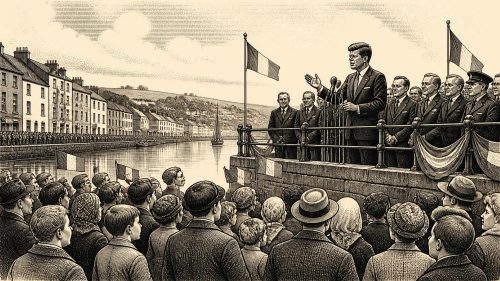
In 1962, Seán Lemass advanced Ireland’s application to join the European Economic Community, arguing that economic modernisation required wider markets despite dependence on Britain. Growth after 1958 tempered, but did not end, emigration, rural decline and weak infrastructure; new housing, sanitation and welfare measures addressed domestic needs. The IRA ended Operation Harvest, while Ireland continued demanding UN service in the Congo. Television expanded national culture through Radharc and The Late Late Show, as the Theatre Royal closed and The Chieftains formed. Catholic influence remained strong, yet Vatican II signalled change. Ireland balanced European ambition, international engagement, tradition and unresolved partition.
Dateline
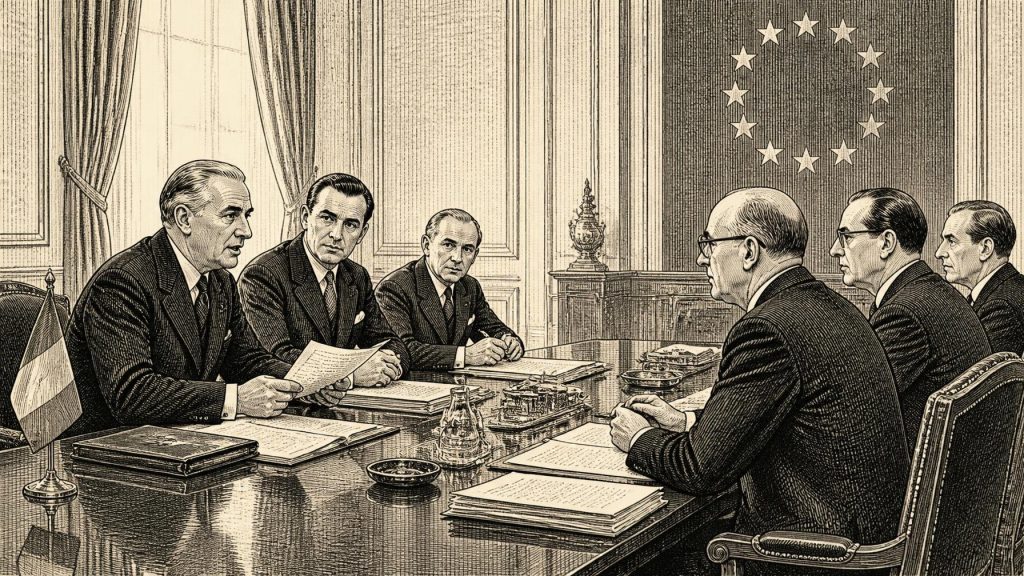
On 18 January, Seán Lemass stood in Brussels before Walter Hallstein, president of the European Economic Community Commission, to set out Ireland’s case for full membership of the Common Market. The State had formally applied in August 1961; the Brussels presentation was therefore not the beginning of the application, but its most public and consequential statement in 1962. Lemass’s delegation included Jack Lynch, Minister for Industry and Commerce, T. K. Whitaker of the Department of Finance, and the Irish ambassador Frank Biggar. Their mission expressed a striking change of direction. A state long identified with economic protection, a small home market and heavy dependence on Britain was asking to take part in continental European integration.
A European Argument
Lemass did not pretend that entry would be easy. Ireland’s economic circumstances gave the six existing EEC members reason to ask difficult questions. Much Irish manufacturing had developed behind tariffs; agriculture remained central to employment and exports; and Britain was overwhelmingly Ireland’s principal trading partner. In Brussels, the Taoiseach argued that the Programme for Economic Expansion, begun in 1958, had already encouraged industrial growth, exports and investment. He accepted that Irish firms would need to adapt to a more competitive environment, while stressing that Ireland’s external trade made access to wider markets essential.
The argument was both economic and political. Lemass stated that Ireland had not joined NATO, but sought to reassure the Community that this did not mean indifference to Western European co-operation. In the following months he visited the capitals of the six founding member states. The EEC Council agreed during 1962 to consider Ireland’s request, although British and Danish applications received priority and substantive Irish negotiations did not begin that year. Ireland’s prospects were also inseparable from Britain’s: admission without its nearest and largest market would have posed especially acute problems.
That dependence was made plain again in October. On 13 October Lemass visited Paris, meeting Prime Minister Georges Pompidou and President Charles de Gaulle. He warned that a British failure to enter the Community would create serious difficulties for Ireland. The visit could not resolve the issue, but it showed that Dublin was now pursuing its European case directly in the highest diplomatic circles. The eventual French veto of Britain’s bid came in January 1963, not in 1962; during this year, the Irish application remained alive, uncertain and central to government policy.
Growth, Migration and Uneven Change
The turn towards Europe grew from domestic pressure as well as ministerial ambition. The 1961 census had recorded the lowest population of the independent state’s lifetime, just over 2.8 million. Between 1956 and 1961, net emigration was estimated at 216,000 people. The outflow had stripped labour from farms, villages and families, while many young people found their futures in Britain or farther overseas. The figures available in 1962 could nevertheless be read alongside signs of recovery: manufacturing jobs had begun to increase and the pace of emigration had eased from the desperate levels of the later 1950s.
Contemporary economic assessments were cautiously hopeful rather than triumphant. Output and exports had grown more quickly after 1958, helped by a policy that welcomed productive foreign investment and sought export markets. Yet the gains rested on a narrow base. Agriculture still employed a large share of the population, investment remained comparatively low, and Ireland’s imports and exports were exceptionally large in relation to national output. Modernisation was visible, but it was neither complete nor evenly distributed between towns, industrial centres and the countryside.
Everyday social indicators reveal the scale of the society being reshaped. In the twenty-six counties, 61,782 births were registered during 1962, a birth rate of 21.88 per thousand people. The year’s legislation also addressed practical conditions at home. The Local Government (Sanitary Services) Act, passed in August, provided a framework for grants towards private water supplies and sewerage facilities, while the Housing (Loans and Grants) Act widened and reorganised state and local-authority support for construction, improvement and repair. Such measures mattered especially in rural districts and smaller settlements where piped water, sanitation and sound housing could not be assumed.
Social welfare changes were similarly concrete. The Social Welfare (Miscellaneous Provisions) Act provided, among other things, for increased non-contributory widows’ pensions from August 1962; increases in unemployment and disability benefits were scheduled to follow in January 1963. These were limited adjustments, not a transformation of the welfare state. Still, they show a government concerned with incomes and domestic conditions while it also promoted a much larger strategy of industrial and commercial change.
The End of Operation Harvest
On 26 February the Irish Republican Army formally called off its Border Campaign, known within the movement as Operation Harvest. It had begun in December 1956 with attacks on targets in Northern Ireland, seeking to end partition by armed action. By 1962 it had failed to secure the popular support or strategic momentum required to achieve that aim. The campaign’s end did not settle the constitutional division of the island, remove political grievance in Northern Ireland, or make the border irrelevant. It did, however, end a specific six-year armed campaign and marked a low point in the IRA’s public capacity.
For the Irish government, the cessation removed an immediate security problem but did not produce a new agreed approach to Northern Ireland. Lemass’s European policy offered a different kind of long-term possibility: greater economic connection with Britain and continental Europe might alter the setting in which partition operated. That was an aspiration rather than an achieved policy in 1962. No official meeting between Lemass and a Northern Ireland prime minister took place that year; the first such meeting would not occur until 1965.
Irish Soldiers in the Congo
Irish concerns reached far beyond the island. The Defence Forces continued their major commitment to the United Nations Operation in the Congo, or ONUC, during a crisis involving the secession of Katanga and the unstable politics of the newly independent Congo. The 36th Infantry Battalion completed its tour in May. The 37th served from May to November, and the 38th Infantry Battalion was mobilised in November and flown out in stages between 7 and 18 November. Its men arrived in a tense Katanga, where UN forces faced restrictions on movement and a still-unresolved secession.
This was not a ceremonial overseas posting. Irish units served in a multinational force attempting to uphold a UN mandate amid armed danger, political rivalry and difficult living conditions. Ireland had entered the Congo mission in 1960, and by 1962 the deployment was a substantial expression of the State’s commitment to collective security. It also gave Irish soldiers and their families direct experience of a post-colonial conflict far removed from the older assumptions of national isolation. The mission remained active after 1962, so this year should be understood as one demanding phase in a continuing commitment rather than its conclusion.
A New Domestic Screen
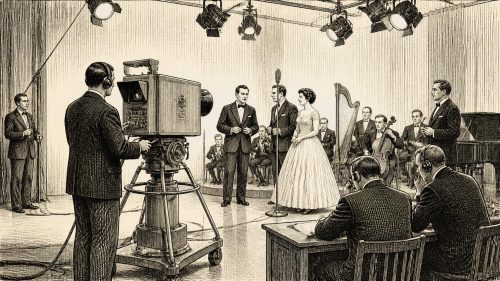
Telefís Éireann had begun broadcasting only on New Year’s Eve 1961. Its first full calendar year quickly demonstrated that television could become more than an imported entertainment service. On 12 January, Radharc first appeared: a documentary series made by a group of Catholic priests, reporting on religious and social life in Ireland and, later, around the world. Its arrival placed religious perspectives within a modern visual medium at a moment when Catholic institutions retained immense authority in Irish society.
On 6 July, at 11.20 p.m., Gay Byrne presented the first Late Late Show. Conceived initially as a late-night summer programme, it was live, conversational and deliberately informal. The first broadcast ran beyond midnight, an innovation in the regular Telefís Éireann schedule. It would be misleading to project the programme’s later controversies backwards onto its opening night, but the format already created a national space in which guests, humour, performance and unscripted discussion could meet an audience in its homes.
The changing entertainment economy was visible elsewhere in Dublin. The Theatre Royal on Hawkins Street closed on 30 June, ending the career of a major venue for variety, theatre and cinema. Demolition was under way by September. Television was not the sole cause of its disappearance: property values, operating costs and wider shifts in leisure all mattered. Yet the coincidence was telling. As one great mass-audience theatre vanished, the new national television service expanded its reach from Donnybrook.
Traditional music was also acquiring a new institutional shape. Paddy Moloney assembled the original line-up of The Chieftains in 1962, bringing together musicians who would become internationally associated with Irish instrumental tradition. Their later global fame lay in the future, and their first album would not appear until 1964. Nevertheless, the group’s formation belongs firmly to this year: it was an early sign that traditional repertoire could be organised for recording and performance without simply being treated as a relic of rural life.
Faith, Memory and Transition
Religion remained deeply embedded in public culture. On 17 March President Éamon de Valera and his wife, Sinéad, were received by Pope John XXIII in Rome at the close of the Saint Patrick jubilee marking fifteen centuries since the saint’s traditional death date. The papal address praised Irish Catholic loyalty, missionary activity and religious vocations. The occasion linked the presidency, national memory and Rome in a manner familiar to the Ireland of the period.
Later, on 11 October, the Second Vatican Council opened. Its first session did not instantly alter parish life in Ireland, but the council began a process whose consequences for liturgy, lay participation and Catholic self-understanding would become increasingly apparent in later years. In 1962, then, Irish society was not simply moving from an old world to a new one. It was living in both: European ambition alongside British economic dependence; international peacekeeping alongside an unresolved border; television’s new intimacy alongside powerful religious institutions; and improving material policy alongside migration and rural decline. Lemass’s appearance before Hallstein captured the year’s governing hope—that Ireland could enter a larger world without losing control of its own future.
Primary Sources
- Statement by Seán Lemass, Brussels, 18 January 1962
- Ireland through the decades
- Lemass, Seán
- OECD Economic Surveys: Ireland 1962
- Census 1961 Volume 1: Population, Area and Valuation of Each DED and Each Larger Unit of Area
- Annual Report of the Registrar-General of Marriages, Births, and Deaths in Ireland, 1962
- Timeline of Events, 1919–69
- Documents on Irish Foreign Policy, Volume XII: 1961–1965
- Irish Republican Army Resistance Campaign
- CAIN: Background Chronology of Key Events, 1800 to 1967
- Seán O’Mahony Papers, National Library of Ireland
- United Nations Operation in the Congo (ONUC)
- Congo Unit Histories
- Unit History: 37 Irish Battalion, Congo
- Unit History: 38 Irish Battalion, ONUC
- Housing (Loans and Grants) Act, 1962
- Local Government (Sanitary Services) Act, 1962
- Social Welfare (Overlapping Benefits) (Amendment) Regulations, 1962
- The Late Late Show Appears on Our Screens, 1962
- Radharc: A Celebration
- Tearing Down the Theatre Royal, 1962
- The 1960s: The Chieftains
- Address of Pope John XXIII to President Éamon de Valera, 17 March 1962
- President of Ireland Interactive Timeline
- Catholicism in Ireland, 1880–2015