Kennedy’s Summer Homecoming1963 CE
1963 marked Ireland’s uneven transition towards economic modernisation, planning and international engagement. France’s rejection of Britain’s EEC bid stalled Dublin’s linked application, while growth, industrial change and reduced yet persistent emigration exposed continuing dependence on Britain. A controversial turnover tax highlighted social costs. In Northern Ireland, Terence O’Neill became prime minister amid unemployment and unresolved nationalist grievances. President Kennedy’s celebrated June visit connected statehood, diaspora and American links, before his assassination prompted national mourning. The Planning Act created development controls; cultural and religious life remained influential. Ireland also pursued disarmament at the United Nations, while constitutional division and inequality endured.
Dateline
In 1963 Ireland stood at an awkward but energetic point of transition. Seán Lemass’s government was committed to economic expansion, industrial development and a more outward-looking diplomacy, while much of daily life still reflected an overwhelmingly rural, Catholic and emigrant-shaped society. The island’s two jurisdictions faced related pressures: each sought new investment and better employment, yet their political systems, constitutional claims and communal divisions remained profoundly different. The year brought no single domestic upheaval, but its firmly dated episodes reveal an Ireland becoming more visible abroad, more planned at home, and newly aware of the limits as well as the possibilities of modernisation.
Europe’s Closed Door
On 14 January, President Charles de Gaulle of France rejected Britain’s application to join the European Economic Community. Ireland’s own application, lodged in July 1961, had been conceived alongside Britain’s because the British market remained central to Irish trade. De Gaulle did not formally veto Ireland; nevertheless, a separate Irish entry while Britain remained outside was judged impracticable. The result was a serious check to one of Lemass’s central international and economic ambitions. Dublin adopted what was, in effect, a waiting policy, while continuing to liberalise trade and to make the State more attractive to industry.
The setback exposed a basic fact about the Republic’s position. Economic policy was no longer framed simply as protection of native producers. Access to larger markets, foreign capital and competitive manufacturing had become essential to the programme begun in the late 1950s. Yet Britain’s slower economy was already affecting Irish exports. An OECD survey issued in 1963 estimated that total Irish output had risen by about 3 to 3½ per cent in 1962, but noted weaker industrial export conditions in Britain, the country’s largest market for both manufactured and agricultural produce.
Modernisation and Its Costs
Growth did not mean that old problems had disappeared. The same OECD assessment recorded continuing net emigration in 1962, chiefly to Britain: about 21,000 people on its measure, down from roughly 27,000 in 1961. The fall was welcome, and net emigration was lower than natural increase, but leaving remained a normal calculation for many young Irish people. Employment was expanding in manufacturing and construction while it contracted in agriculture; work, incomes and opportunity were being redistributed rather than evenly improved. The census low point of the early 1960s remained a recent and powerful memory.
For households, modernisation could also arrive as a bill. The Finance Act received presidential assent on 30 July. Its most controversial innovation was a turnover tax of 2½ per cent, due to begin on 1 November and levied on a wide range of commercial receipts. The measure became a sharp political issue because it was expected to feed through into prices. In an October Dáil debate, ministers defended the revenue as necessary for public services and development, while opponents argued that ordinary consumers and wage earners would bear the burden. Whatever its long-term administrative significance, the tax made the tension between expanding State provision and the cost of living immediate in shops, businesses and family budgets.
A New Premier at Stormont
Northern Ireland underwent a change of leadership in March. Lord Brookeborough resigned after two decades as prime minister, and Terence O’Neill succeeded him on 25 March. O’Neill inherited an administration under pressure to answer chronic unemployment and the decline of established sectors such as shipbuilding, textiles and agriculture. He represented a more technocratic style of Unionism, associated with economic planning, infrastructure and the attraction of new industry, though this did not alter the Unionist Party’s dominance of Stormont or resolve the grievances of the nationalist minority.
The economic problem was plain in figures cited at Westminster during the summer. Northern Ireland’s unemployment in June stood at 36,400, or 7.5 per cent of insured workers, after a winter peak exacerbated by severe weather. Public assistance and industrial incentives could point to new factories and prospective jobs, but losses in older industries continued to offset them. O’Neill’s accession therefore mattered beyond personnel: it linked political authority to a promise that roads, housing, industrial sites and regional development could remake the province. In 1963 that promise was still a programme, not a settlement of Northern Ireland’s underlying political divisions.
Four Days in June
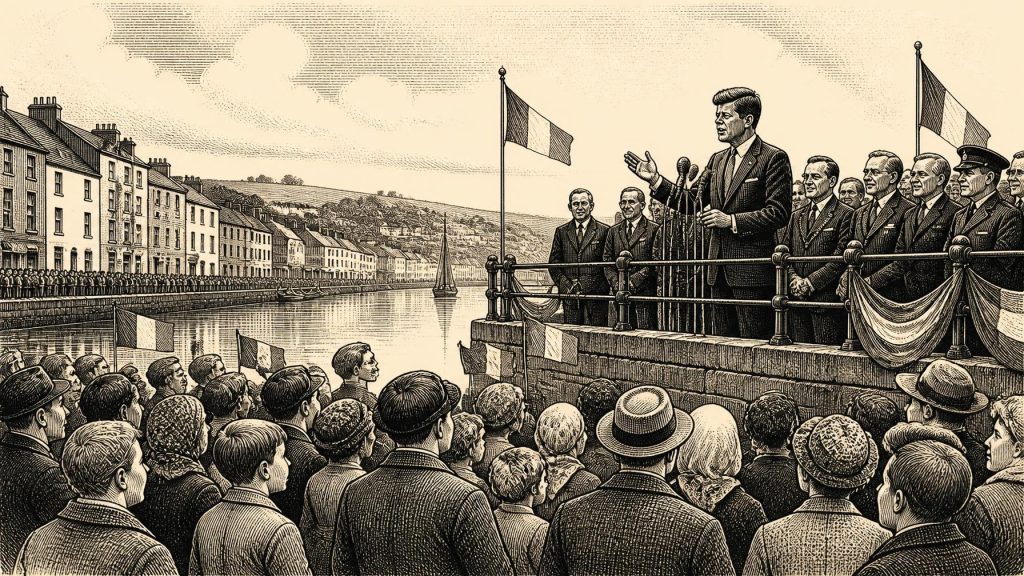
The year’s most memorable event began on 26 June, when President John F. Kennedy arrived for a four-day state visit. He was received at Dublin Airport by President Éamon de Valera and Taoiseach Seán Lemass. The itinerary joined state ceremony to family history and public spectacle: Dublin, Wexford and the Kennedy ancestral district around New Ross, Cork, Galway and Limerick all featured. The National Library of Ireland preserves the official programme, an unusually detailed record of how carefully the Irish State organised receptions, civic honours, meals, academic ceremonies and journeys across the country.
Kennedy’s appeal rested on more than protocol. His eight great-grandparents had left Ireland, and his visit gave a vivid public form to the relationship between Irish emigration and the wider diaspora. At Dublin Airport he spoke of the island’s historic loss of sons and daughters; in Galway he invoked family connections across the Atlantic. Such language met an audience for whom migration was not an abstraction. Relatives in America, remittances, letters and the possibility of departure were woven into the experience of countless households. Kennedy’s Irishness was American, prosperous and presidential, but it was intelligible because it drew on the same long story of separation.
On 28 June Kennedy became the first foreign statesman to address a joint sitting of the Oireachtas at Leinster House. His speech praised the Republic’s post-independence economic and industrial change while treating nationhood as a beginning rather than an achieved endpoint. That formulation suited the Lemass government’s self-image: Ireland was presenting itself not as an isolated remnant of the past, but as a democratic state willing to trade, develop and participate internationally. Kennedy also visited Arbour Hill, where he laid a wreath at the graves of leaders executed after the 1916 Rising, binding American recognition to the State’s own commemorative landscape.
The visit was not merely symbolic, although symbolism was its strength. It offered officials and citizens a rare moment when Irish history, American power and popular celebration converged without apparent strain. Kennedy left from Shannon on 29 June. In October Lemass made an official visit to the United States, a reminder that the June ceremonies formed part of a wider effort to cultivate political, commercial and diaspora links.
Planning the Physical State
A less dramatic but enduring event came on 7 August, when the Local Government (Planning and Development) Act, 1963 became law. It required planning authorities to prepare development plans and gave a statutory framework for development control. These plans were to address such matters as the allocation of land for residential, commercial, industrial and agricultural purposes; road safety and parking; the renewal of obsolete areas; and the preservation and extension of amenities. The legislation did not instantly transform towns or countryside, but it established an important machinery through which expansion could be directed rather than simply endured.
Its significance lay in the scale of change already under way. Housing construction, industrial estates, new roads and the outward growth of towns made land use a public question. Planning implied that local authorities would have to look ahead: to where people might live, work, travel and find open space. It also brought a new layer of rules into the relationship between householders, builders, farmers, businesses and councils. In a State often associated with informal local influence, the Act marked a notable commitment to professional administration and mapped objectives.
Culture, Faith and Public Life
Irish cultural life in 1963 registered both institutional continuity and sharper observation. The National Gallery of Ireland Act, passed that year, consolidated the Gallery’s governing legislation with earlier Acts. More revealing of social mood was John McGahern’s first novel, The Barracks, published in 1963. Set around a rural Garda station and centred on Elizabeth Reegan, it brought illness, marriage, domestic responsibility and constrained village life into serious contemporary fiction. The book did not describe all of Ireland, but its quiet intensity challenged any complacent picture of a uniformly contented countryside.
Religion remained deeply embedded in public and private life. Pope John XXIII died on 3 June, while the Second Vatican Council, which he had convened, continued under his successor Paul VI. Irish Catholicism was not a single political force, nor was Ireland culturally static, but clerical institutions, schools, devotional practice and Catholic assumptions still shaped the social environment in which reformers, writers and families operated. At the same time, television and radio were widening the shared public sphere: footage from the June bank-holiday weekend shows city families travelling by car and bus towards Dublin’s seafront and parks, a modest but telling image of leisure, mobility and a new national medium.
Loss and International Responsibility
Ireland’s close association with Kennedy gave the final weeks of 1963 a special poignancy. On 22 November, news of his assassination in Dallas reached the Irish Embassy in Washington. De Valera sent condolences that evening, and the government approved his travel to the funeral as Ireland’s representative. The warmth of June was suddenly transformed into official mourning, but also into a durable public memory of the visit.
Meanwhile, Irish diplomacy continued to assert a role at the United Nations. Frank Aiken addressed the General Assembly in October, in keeping with Ireland’s sustained concern with nuclear danger and disarmament. The year therefore closed with two contrasting images of the Republic abroad: a small state pursuing an independent moral voice in international affairs, and a society emotionally linked to the United States through history, migration and the extraordinary reception it had given Kennedy.
1963 did not settle Ireland’s future. Europe had receded, economic improvement remained uneven, and Northern Ireland’s modernising language sat beside unresolved inequality and constitutional division. But the year made visible the directions in which change was moving: outward towards the Atlantic and Europe, inward towards planned development, and across the island towards a new political generation whose promises would soon face far harder tests.
Primary Sources
- Timeline of events, 1919–69
- Ireland and the EU: A History
- European Union Enlargement
- OECD Economic Surveys: Ireland 1963
- The Irish Economy in 1962 and 1963
- Census 1966 Volume 1 – Population
- Finance Act, 1963
- Turnover Tax – Motion of No Confidence, Dáil Éireann, 30 October 1963
- Local Government (Planning and Development) Act, 1963 – Bill History
- Local Government (Planning and Development) Act, 1963
- National Gallery of Ireland Act, 1963, Section 2
- President John F. Kennedy in Leinster House
- American Presidential Visits To Ireland
- Visit to Ireland of the President of the United States of America John Fitzgerald Kennedy, 26th to 29th June, 1963
- Ireland – Travels of the President
- Address Before the Irish Parliament in Dublin
- Remarks Upon Arrival at Dublin Airport
- Remarks at Eyre Square in Galway
- Commemorating JFK: Ireland’s Role in a Moment of Global Mourning
- 1963 – Visits by Foreign Leaders
- Parliament and Northern Ireland, 1921–2021
- O’Neill, Terence Marne
- Northern Ireland, House of Commons debate, 1 August 1963
- McGahern, John
- John McGahern’s Debut Novel The Barracks 60 Years On
- Sunny Old Dublin 1963
- General Assembly, 18th Session: General Debate, Frank Aiken (Ireland), 3 October 1963