
Davin’s American Invasion1888 CE
In 1888 Ireland faced coercion, agrarian conflict and scrutiny of constitutional nationalism. The Special Commission investigated allegations against Charles Stewart Parnell and Irish MPs, while the Plan of Campaign provoked prosecutions, evictions and papal condemnation. Local government reform failed, leaving Ireland without elected county councils. Meanwhile, Horace Plunkett promoted co-operation, Christian Brothers College opened in Cork, and W. B. Yeats published Fairy and Folk Tales of the Irish Peasantry. Maurice Davin led Gaelic Athletic Association athletes to America, promoting hurling among emigrants despite financial difficulties. These developments demonstrated continuing struggles over political representation, land, religion, culture and Irish institutional independence.
Dateline
In 1888 Ireland’s most consequential struggles were conducted through committees, courts, chapels, newspapers, prison rules and sporting fields rather than through a single dramatic national event. The year was dominated by the continuing collision of agrarian protest with coercive government, and by a judicial inquiry that placed the reputation of Charles Stewart Parnell and the Irish Parliamentary Party under exceptional pressure. Yet it also produced quieter signs of cultural and institutional confidence: a young W. B. Yeats brought Irish folk narrative to a wide reading public; a new Catholic college opened in Cork; Horace Plunkett began publicly considering co-operation; and a remarkable party of Gaelic athletes crossed the Atlantic.
These were not separate worlds. Land agitation, Catholic authority, constitutional nationalism, education, literature and sport all concerned the ownership and expression of Irish public life. In a country governed from Westminster and Dublin Castle, the question was repeatedly whether Irish people could organise their affairs on their own terms.
The Special Commission Begins
The gravest political development of the year was the establishment of the Special Commission, conventionally called the Parnell Commission. Its immediate background lay in The Times campaign of 1887, Parnellism and Crime, which had accused Parnell and fellow nationalists of encouraging agrarian violence and associating with murder. The most sensational item was a facsimile letter purportedly written by Parnell after the Phoenix Park murders of 1882. Parnell denied it at once; it was in fact a forgery, though that decisive exposure still lay in the future at the close of 1888.
After Parnell pressed for an investigation, Parliament enacted the Special Commission Act in August 1888. The resulting tribunal was much broader than an examination of handwriting. It was empowered to investigate allegations against Parnell, named Irish MPs and others concerning conspiracy, agrarian agitation, intimidation and connections with political violence. Thus a newspaper’s charges became a long public examination of the constitutional nationalist movement itself.
The commissioners first met to settle procedure on 17 September. Regular hearings began in London on 22 October, with Sir James Hannen presiding. Counsel for The Times opened an extensive case, while Parnell and the other respondents assembled formidable legal representation, notably led by Charles Russell. For Irish supporters, the location and scope mattered as much as the accusations: their elected representatives were being required to defend their political movement before a British judicial body, with events from years of agrarian conflict reassembled as evidence.
It is important not to read the verdict of later months back into 1888. Richard Pigott, the financially troubled former nationalist newspaper proprietor who had supplied the disputed letters, had not yet given the evidence that would unravel his story in February 1889. During 1888 the Commission was a dangerous uncertainty. It absorbed political energy, supplied hostile newspapers with material and left Parnell’s authority exposed to a test which he believed he could not decline.
Land, Coercion and Rome
The inquiry unfolded while the Plan of Campaign remained at the centre of rural politics. Begun in 1886, the Plan was not a national suspension of all rents. It was an organised method used on selected estates: tenants collectively offered what they considered a fair rent, and if that offer was rejected, paid money into a common fund to assist families threatened with eviction. It emerged from depressed agricultural prices, arrears and the limits of earlier land legislation. For supporters it was disciplined self-defence; for landlords and the government it was an unlawful machinery of pressure, reinforced in practice by boycotting.
Arthur James Balfour, Chief Secretary for Ireland, governed within the coercive framework created by the Criminal Law and Procedure (Ireland) Act of 1887. The Irish National League had already been proclaimed an illegal association, while prosecutions and imprisonment continued to bear heavily upon organisers, priests and MPs connected to the Plan. William O’Brien, one of its most effective advocates, was imprisoned in Tullamore during 1888. His refusal to accept prison clothing became a political symbol when a suit was smuggled to him and he later appeared in it at Westminster: a theatrical episode, certainly, but one that dramatised nationalist claims that political prisoners were being treated as ordinary criminals.
The contest was visible on the ground as well. The Vandeleur estate at Kilrush, County Clare, became associated with evictions during the summer of 1888, demonstrating the human stakes behind arguments over rent, property and law. An eviction was not an abstract statistic: it could mean a household’s removal, a roof dismantled or guarded, neighbours mobilised in sympathy, and police and military authority made suddenly present in a small community. Such confrontations sharpened resentment but also exposed tenants to severe risk.
On 20 April a Roman rescript condemned both the Plan of Campaign and boycotting. A further papal intervention followed in June. This placed Irish Catholic leaders in an acutely difficult position. Archbishop William Joseph Walsh of Dublin and Archbishop Thomas Croke of Cashel had sympathised with tenants’ distress and supported nationalist leaders while counselling against violence. They now had to balance obedience to Rome with the fear that abandoning rural communities would weaken the Church’s moral authority. The episode shows why Irish Catholicism cannot be treated simply as an arm of nationalism or an ally of government: clergy and bishops were themselves divided over method, discipline and pastoral responsibility.
The rescript, a better harvest and sustained enforcement all reduced the Plan’s momentum, but none settled the land question. Tenants still sought security and ownership; landlords still defended contractual rights and income; and nationalists differed over how closely the campaign for Home Rule should be tied to an escalating agrarian struggle. Parnell, although reluctant publicly to repudiate activists, had reservations about the Plan’s political costs. In 1888 those strains existed beneath the outward unity required by the Special Commission.
Representation Deferred
Irish demands also reached Westminster in the more prosaic form of local government. On 25 April the House of Commons debated an Irish Local Government Bill. Its opponents argued that major constitutional change in Ireland was inopportune, and the proposal did not proceed. This was a revealing failure. The Local Government Act passed for England and Wales later in 1888 did not create elected county councils in Ireland. Irish ratepayers remained comparatively excluded from the representative county administration that reformers wanted.
That distinction mattered far beyond administrative tidiness. Local bodies controlled or influenced matters close to daily life: roads, sanitation, poor relief, public health and local expenditure. A demand for elected local government could therefore be both practical and constitutional, a claim that communities should have a voice in the services they funded. Ireland would not receive its elected county councils until 1898; in 1888 the issue was a reminder of how incomplete political reform remained.
Co-operation, Schooling and Print
Not every response to Ireland’s difficulties took the form of confrontation. Horace Plunkett, then a young landlord and cattle breeder, published articles in 1888 advocating co-operative stores and forms of mutual assistance. His mature co-operative movement belonged to the following decade, and it would be misleading to project its later success backwards. Nevertheless, these articles are firmly of 1888 and indicate an emerging argument that rural weakness might be answered not only by protest or state action, but also by collective economic organisation among producers and consumers.
Education likewise remained a field in which denominational initiative and social aspiration met. Christian Brothers College, Cork, formally opened on 20 August. The Christian Brothers took charge of premises at St Patrick’s Place after clerical students moved to the new seminary at Farranferris. Under its first president, Brother James Dominic Burke, the college aimed to prepare boys for university and offered a curriculum extending beyond narrow elementary instruction. Its opening reflected the growing importance of Catholic educational institutions in urban Irish life, especially for families seeking advancement within a society still marked by unequal access to influence and employment.
In literature, 1888 brought W. B. Yeats’s Fairy and Folk Tales of the Irish Peasantry. Edited for Walter Scott’s Camelot Series, the volume gathered tales, poems, translations, notes and extracts from a range of earlier collectors and writers, including Douglas Hyde, William Carleton and Lady Wilde. It was not a verbatim record of an untouched oral tradition; it was a selective Victorian anthology, shaped by Yeats’s own taste and arguments. Yet its appearance was significant. Folk narrative from Irish-speaking and English-speaking communities was being presented as serious cultural material, not merely as superstition to be discarded in the name of improvement.
The book’s Ireland was filled with fairies, saints, ghosts, pookas, storytellers and dangerous landscapes. Such figures did not erase the contemporary realities of rent, migration or political repression. Rather, the collection helped make inherited local lore available to an expanding English-reading public, and pointed towards the literary revival that would become more visible in the 1890s.
Across the Atlantic
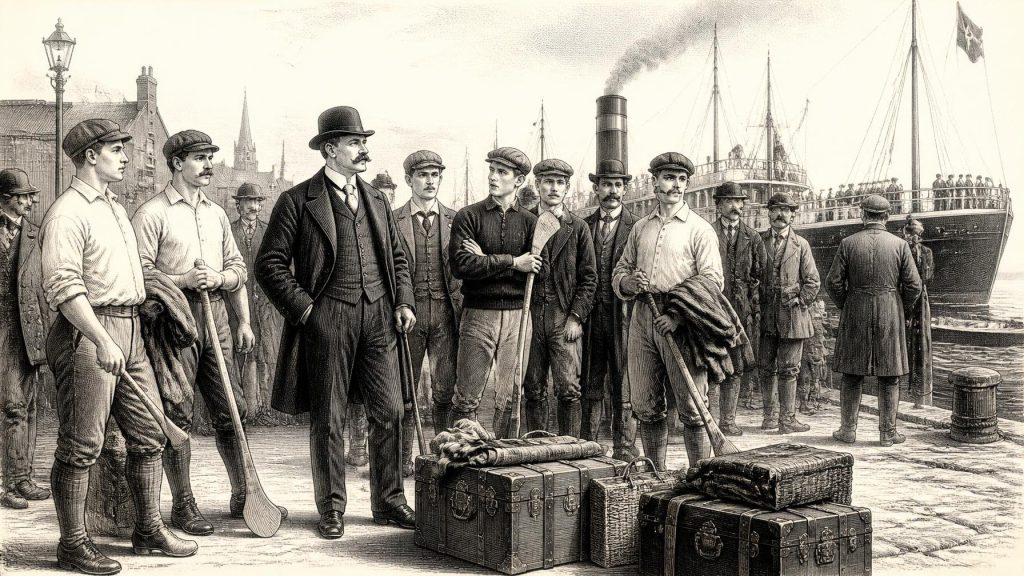
The year’s most striking cultural journey began in September, when the Gaelic Athletic Association sent about fifty hurlers, athletes and officials to the United States. Led by Maurice Davin, the Association’s first president and one of Ireland’s foremost athletes, the party travelled to stage exhibitions and competitions, raise money and cultivate support among Irish emigrants. This became known as the American Invasion.
Matches and athletic events in places including New York, Boston and Philadelphia displayed hurling to audiences far from Ireland and asserted that Gaelic games could travel with the diaspora. The venture faced poor attendances, adverse weather and disputes within American athletics; it did not secure the hoped-for funds. Some members remained in America permanently. Even so, the tour forged a practical connection between Irish sport and emigrant communities, while revealing how closely cultural nationalism depended upon transatlantic networks.
By year’s end, then, Ireland had not been transformed, but its principal arguments had acquired new forms. The Commission had put parliamentary nationalism on trial without resolving the charges. The papal condemnation had complicated, rather than ended, the land struggle. Local self-government had again been withheld. At the same time, schools, folklore in print, co-operative ideas and Gaelic athletics showed people building institutions and audiences beyond the immediate reach of the Castle. Davin’s travellers carried that aspiration across the ocean: a small and imperfect expedition, but an unmistakable declaration that Irish culture could organise, perform and endure in public.
Primary Sources
- Special Commission Act 1888
- Parnell, Charles Stewart
- Pigott, Richard
- Balfour, Arthur James
- Walsh, William Joseph
- O'Brien, William
- Davin, Maurice
- 1888 Diary of Sir Horace Curzon Plunkett (1854–1932)
- Second Reading, 25 April 1888
- Observations, 3 July 1888
- The Parnell Commission
- The Parnell Commission
- The Gaelic Athletic Association's Invasion of America, 1888: Travel Narratives, Microhistory and the Irish American ‘Other’
- A Treasure Trove of GAA and Irish History
- American Invasion
- The Prose of W. B. Yeats
- Fairy and Folk Tales of the Irish Peasantry / edited and selected by W. B. Yeats
- Fairy and Folk Tales of the Irish Peasantry
- About Our School
- Burke, James Dominic
- Supply—Report, 10 December 1888
- John Dillon and the Plan of Campaign, 1886–90
- Chapter 11: William O’Brien and the “Plan of Campaign”
- The Vandeleur Evictions and the Plan of Campaign in Kilrush
- Rescrit du Pape aux évêques d'Irlande (1888)