Membership is completely free, giving members unlimited access to all available resources, services, features, and benefits without any restrictions or fees.
Welcome back. Sign in to continue enjoying unlimited access to all available resources, services, features, and member benefits at no cost.
The census of 2 April was the most comprehensive contemporary snapshot of the whole island. More than 4,000 enumerators had distributed large blue forms to households beforehand. Heads of household recorded names, ages, relationships, occupations, religion, literacy, birthplace and ability to speak Irish. The 1911 form also asked married women how long they had been married, how many children had been born alive, and how many were still living: an unusually direct official acknowledgement of family loss and women’s domestic experience. Such records were produced within British administration, but they preserve lives which were often otherwise absent from formal archives.
The split had formally occurred in December 1890, when the majority of Irish MPs left Parnell and followed Justin McCarthy. In 1891 that majority acquired a more durable organisational form in the Irish National Federation. It retained the parliamentary language of Home Rule but rejected Parnell’s leadership as an impediment to restoring the Liberal alliance on which a second Home Rule bill seemed to depend. Parnell’s adherents, led in parliament by John Redmond and others, insisted that Ireland must not allow an English Liberal leader to decide who could lead an Irish party. The disagreement was therefore not merely personal, although personal morality was continually invoked; it concerned political independence, electoral calculation and the terms on which Irish self-government might be pursued.
February brought the report of the Special Commission appointed after The Times had published allegations linking Parnell and other Irish nationalist MPs to crime, including forged letters supposedly written by Parnell. Richard Pigott’s exposure as the forger had already destroyed the newspaper’s most dramatic accusation. The commission’s findings did not present Parnell as the author of the forged material, and parliamentary debate in February treated that conclusion as a major vindication. It restored much of the political standing that the attacks had threatened to take away.
The dominant political drama of the year was the Special Commission established to examine allegations published by The Times under the heading “Parnellism and Crime”. The accusations had sought to connect Parnell and other Irish parliamentary nationalists with agrarian violence and, most notoriously, with approval of the Phoenix Park murders of 1882. A letter purportedly written by Parnell appeared to excuse the killing of Lord Frederick Cavendish, chief secretary for Ireland, and Thomas Henry Burke, the permanent under-secretary. Parnell had denounced it from the beginning as a forgery.
The gravest political development of the year was the establishment of the Special Commission, conventionally called the Parnell Commission. Its immediate background lay in The Times campaign of 1887, Parnellism and Crime, which had accused Parnell and fellow nationalists of encouraging agrarian violence and associating with murder. The most sensational item was a facsimile letter purportedly written by Parnell after the Phoenix Park murders of 1882. Parnell denied it at once; it was in fact a forgery, though that decisive exposure still lay in the future at the close of 1888.
Arthur James Balfour became chief secretary for Ireland on 7 March 1887. His appointment came after the failure of Gladstone’s first Home Rule Bill in 1886 and at a time when the Irish Parliamentary Party, led by Parnell, remained a formidable force at Westminster. Balfour’s answer to Irish unrest combined two apparently opposed approaches: exceptional powers against organised agrarian resistance, and limited concessions intended to ease defects in the land system.
Gladstone formed his third ministry in February 1886, with the Liberal John Morley appointed Chief Secretary for Ireland and the sympathetic Lord Aberdeen sent to Dublin as lord lieutenant. Aberdeen received conspicuous nationalist goodwill on arriving in Dublin on 20 February. His brief viceregal term included public gestures towards relief work and reconciliation, but real authority lay with ministers in London. The arrival nevertheless mattered: it suggested that Dublin Castle might, for once, administer Ireland under a government willing to remake the constitutional relationship rather than merely police it.
The most tangible Irish measure enacted in 1885 was the Purchase of Land (Ireland) Act, better known as the first Ashbourne Act. It received royal assent on 14 August. The statute enlarged the means by which occupying tenants could buy their holdings: where the Land Commission judged the security sufficient and a guarantee deposit was provided, it could advance the whole purchase price rather than the three-quarters available under the 1881 legislation. Parliament authorised advances of up to £5 million.
The founding meeting took place at Hayes’s Commercial Hotel, Thurles, County Tipperary, on Saturday 1 November. The surviving record is not wholly uniform about how many men were in the room: later institutional accounts commonly name seven, while contemporary newspaper reporting suggests a somewhat wider attendance. The essentials, however, are firm. Maurice Davin, the celebrated athlete and farmer from Carrick-on-Suir, was elected president. Michael Cusack, the Clare-born schoolmaster and journalist, became one of three honorary secretaries, alongside John Wyse Power and John McKay. Charles Stewart Parnell, Michael Davitt and Archbishop Thomas William Croke were invited to act as patrons.
The most consequential Irish measure passed in 1883 was the Labourers (Ireland) Act, which received royal assent on 25 August. Its title—“An Act to better the condition of Labourers in Ireland”—was unusually direct. Earlier land legislation had chiefly concerned the relationship between landlord and tenant farmer. Agricultural labourers, dependent on wages and commonly housed in cottages tied to employment, had much less leverage. They were not automatically beneficiaries of the fair-rent machinery established by the Land Act of 1881.
The immediate question in the spring was whether coercion or concession would govern British policy. William Edward Forster, chief secretary for Ireland, believed that further exceptional powers were necessary. Parnell, held in Kilmainham Gaol since October 1881, and his allies sought release and practical relief for indebted tenants. Through Captain William O’Shea, an intermediary with access to both sides, messages passed between Parnell and ministers. Parnell’s letter of 28 April set out his willingness to use his influence against violence and to support the working of the land legislation if the government addressed the arrears problem.
The year began under the pressure of the Land War, the broad campaign through which tenant farmers and their allies challenged high rents, insecure occupation and landlord power. Its methods ranged from public meetings and legal defence to collective social pressure against those who took farms from which others had been evicted. Such action could protect tenants and make evictions costly, but it also generated intimidation and sometimes violence. The Liberal government of William Ewart Gladstone resolved to combine a new land measure with exceptional powers of repression.
The immediate background was the severe agricultural crisis of 1879, particularly damaging in the west. Poor weather, a badly reduced potato crop and weak agricultural prices had left many small occupiers unable to meet rents and ordinary household needs. Parliament’s Relief of Distress (Ireland) Act, passed on 15 March 1880, regularised emergency measures and made funds available for relief-related loans and works. Its provisions also protected recipients of outdoor relief from losing the parliamentary or other franchise solely because they had accepted it. Such measures acknowledged exceptional conditions, but they did not settle the underlying question: whether tenants should bear the consequences of a bad season while landlords retained a claim to fixed rents.
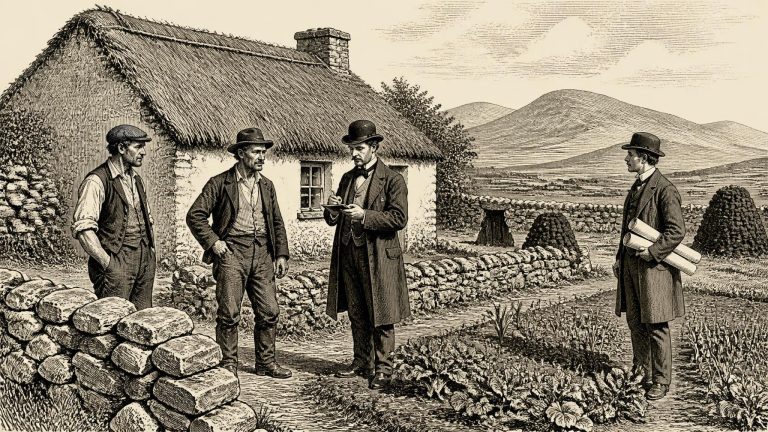
The immediate setting was an agricultural depression rather than a return of the Great Famine on its earlier scale. Rural Ireland had changed greatly since the 1840s: population had fallen, the cottier system had contracted and emigration had become an enduring outlet. Yet these changes had not abolished precarity. Across much of the west, farms were small, holdings were commonly rented rather than owned, and families balanced potatoes, small livestock, seasonal earnings and credit from local shops. A weak potato harvest could therefore threaten both food and the ability to meet rent.
Ireland in 1878 was not yet in the Land War, and the Irish National Land League had not yet been founded. Yet the year made several of the forces that would soon drive national politics much more visible: the insecurity of tenant farming, the strain of falling agricultural returns, the increasingly assertive politics associated with Charles Stewart Parnell, and demands for social provision shaped by Irish circumstances rather than by Westminster convenience. Two Acts of Parliament passed in August touched ordinary routines directly: one reorganised the terms on which post-primary schooling could be rewarded, while another altered Sunday drinking across most of the island. A third measure recast the machinery of public health. The year also brought a murder in Donegal that became an enduring symbol of landlord–tenant antagonism.
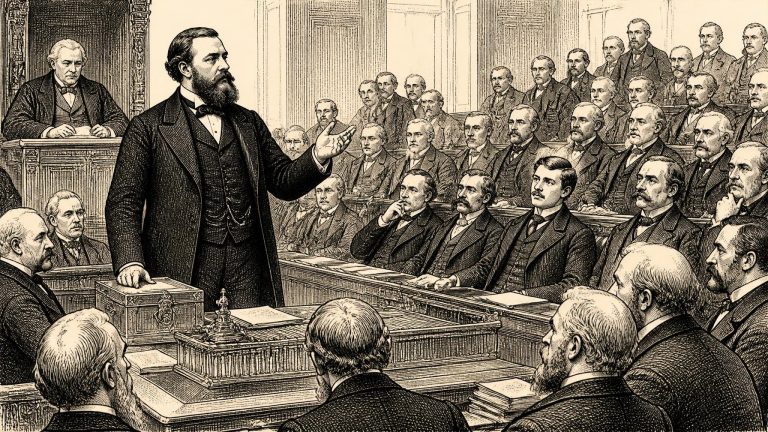
The most consequential firmly dated political episode came at the end of July. Charles Stewart Parnell, MP for Meath, and a small group of Irish members used the rules of the House of Commons to delay the South Africa Bill, legislation intended to facilitate a British imperial settlement following the annexation of the Transvaal. From 31 July into 1 August, Parnell and six colleagues prolonged proceedings through speeches, motions and repeated procedural interventions. The sitting lasted about forty-five hours. Their immediate target was not an Irish bill, but the method was intended to expose a deeper grievance: Westminster could find time for imperial business while Irish measures were repeatedly postponed or frustrated.
In 1876 Ireland remained part of the United Kingdom, yet the year made especially plain how incomplete that constitutional settlement felt to many Irish people. The most conspicuous political event came on 30 June, when Isaac Butt, Home Rule MP for Limerick and leader of the loose Home Rule parliamentary alliance, asked the House of Commons to appoint a select committee. It was to investigate the nature, extent and grounds of the demand for an Irish parliament empowered to manage domestic affairs. Butt did not seek an immediate break with Britain. His model was federal: Ireland would regain authority over internal concerns while the imperial parliament retained control of the Crown, defence, foreign relations and the wider empire.
The first political drama centred on John Mitchel, the Young Ireland journalist and former transportation prisoner. Mitchel had lived for years in the United States, but a Tipperary by-election gave his supporters an opportunity to return him to parliament on a programme embracing home rule, tenant rights, free education and the release of Fenian prisoners. On 16 February he was declared elected unopposed, before he had reached Ireland; he arrived at Queenstown the following day. The symbolism was deliberate. Mitchel had been convicted after the failed rebellion of 1848 and had escaped from Van Diemen’s Land in 1853. His supporters knew that his legal position would be contested, but treated the election as a protest against the constitutional order rather than as a practical route to a Westminster seat.