Lough Mask’s New Word1880 CE
In 1880, agricultural failure, falling prices and rent arrears intensified Irish rural distress, prompting relief measures, emigration and debate over tenants’ responsibilities. The general election and Charles Stewart Parnell’s American fundraising strengthened nationalist organisation; his victory over William Shaw established parliamentary leadership. The Lords’ rejection of the limited Compensation for Disturbance Bill deepened distrust of Westminster. Parnell promoted ostracism of those taking evicted farms, exemplified by Captain Boycott’s isolation at Lough Mask, which created the word boycott. Agrarian violence and prosecutions revealed mounting conflict. Meanwhile, the Royal University of Ireland expanded degree access, including for women, linking crisis with change.
Dateline
In 1880, Ireland’s argument over land acquired a new political scale and a new word. The word was boycott, coined in practice around Lough Mask in County Mayo before it travelled through newspapers into international usage. Its sudden fame can obscure the harder reality from which it arose: a country still dealing with the aftermath of the failed 1879 harvest, a rural economy exposed to falling prices and rent demands, and a constitutional movement learning to connect Westminster elections, local organisation and Irish-American money. This was not yet a settled national uprising, nor did every district experience events alike. It was, however, a decisive year in which distress and tenancy made Charles Stewart Parnell’s leadership appear indispensable to many nationalists.
Distress, Relief and Departure
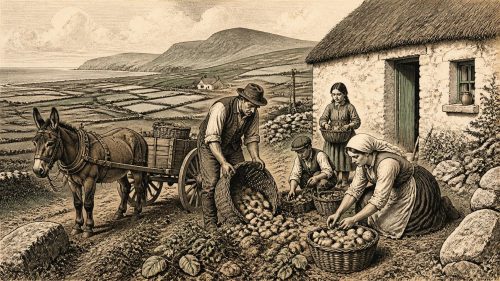
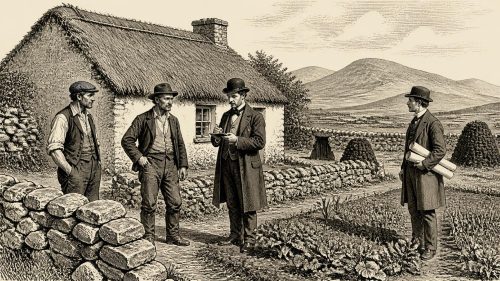
The immediate background was the severe agricultural crisis of 1879, particularly damaging in the west. Poor weather, a badly reduced potato crop and weak agricultural prices had left many small occupiers unable to meet rents and ordinary household needs. Parliament’s Relief of Distress (Ireland) Act, passed on 15 March 1880, regularised emergency measures and made funds available for relief-related loans and works. Its provisions also protected recipients of outdoor relief from losing the parliamentary or other franchise solely because they had accepted it. Such measures acknowledged exceptional conditions, but they did not settle the underlying question: whether tenants should bear the consequences of a bad season while landlords retained a claim to fixed rents.
Relief did not remove the pressure to leave. The Registrar-General recorded 95,517 emigrants departing Irish ports during 1880: 49,937 men and 45,580 women. Munster supplied the largest provincial number, 30,654, followed by Ulster, Leinster and Connaught. These figures describe a nationwide movement, not simply a Connacht emergency; yet contemporary discussion repeatedly treated emigration as a supposed answer to congestion and hardship in the west. For households, departure could mean a remittance and a route out of poverty, but it also meant the loss of young adults and the thinning of local communities. In the first four months alone, parliamentary speakers reported 34,046 departures, nearly three times the equivalent figure in 1879.
Official vital statistics give another, necessarily incomplete, view of ordinary life. Ireland registered 20,363 marriages, 128,086 births and 102,906 deaths in 1880. The Registrar-General stressed that improved burial returns made some of the apparent rise in deaths a matter of better registration, rather than a straightforward increase in mortality. Even so, the report recorded marked regional inequalities. Marriage was relatively uncommon in the poorer western counties: Mayo had the lowest county marriage rate, while Connaught also had the lowest provincial rate. Literacy, measured imperfectly through signatures in marriage registers, varied regionally too. These records show that political arguments over land were rooted in family formation, health, work and the fragile arithmetic of small farms.
An Electoral Turning Point
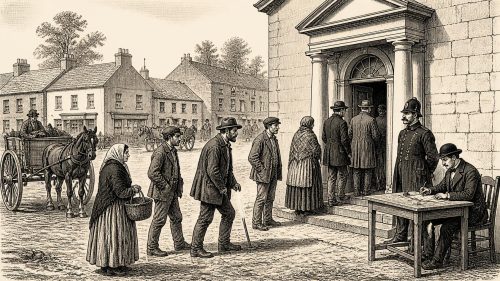
The United Kingdom general election, held in Ireland between 31 March and 27 April, transformed the political setting. Irish nationalist candidates emerged as the largest grouping among Ireland’s 103 Westminster seats, though they were neither yet a perfectly disciplined party nor unanimous on tactics. Parnell’s prestige was strengthened by the election and by a strenuous North American tour undertaken during the opening months of the year. He spoke across the United States, addressed Congress on 2 February, and collected support for relief and Land League purposes. The National Library preserves an illuminated address presented to him by the Land League on his return in March: a reminder that public ceremony, print and transatlantic fundraising were integral to political organisation.
On 17 May, at a pre-session meeting in Dublin’s City Hall, Parnell defeated William Shaw by twenty-three votes to eighteen and became chairman of the Irish parliamentary party. The result did not instantly create the later, tightly managed Irish Parliamentary Party, but it marked a clear change of leadership. Parnell’s strength lay in joining parliamentary obstruction and electoral politics to the Land League’s rural network. Michael Davitt, the League’s most important organiser and ideological force, continued to link the movement to radical Irish-American circles. John Dillon, elected for Tipperary while in North America, represented another rising generation. The alliance contained real differences—between constitutional parliamentarians, Fenians, tenant-right reformers and advocates of more sweeping land change—but it was increasingly able to act on a common crisis.
The Limits of Westminster Relief
William Ewart Gladstone’s incoming Liberal administration attempted a limited response through the Compensation for Disturbance (Ireland) Bill. Introduced in June, it proposed assistance for certain tenants in scheduled distressed districts who were evicted for non-payment of rent. The scheme was deliberately narrow: its application was tied to defined areas of exceptional distress rather than to a general remodelling of landlord and tenant relations. It nevertheless raised a profound issue. If crop failure made payment impossible, nationalists asked, should eviction carry compensation? Landlord opponents regarded the proposal as an unacceptable interference with property and contract.
The bill passed the Commons but was rejected in the House of Lords in the summer. Parnell turned that defeat into an argument for Irish self-government, maintaining in an August Commons debate that Irish opinion could not secure effective legislation within the Union. Other Irish members had criticised the bill as inadequate, which is important: its rejection was not a simple story of a satisfactory measure denied to Ireland. Still, the episode persuaded many that relief administered from London could be too narrow, too late and too vulnerable to an upper chamber in which Irish tenants had no meaningful influence. It also sharpened the contrast between parliamentary remedy and extra-parliamentary pressure.
Ennis to Lough Mask
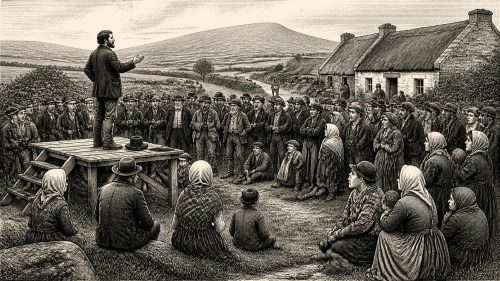
That pressure became unmistakable in the autumn. At Ennis on 19 September, Parnell advised tenants not to use violence against a person who took an evicted farm. Instead, he urged social isolation: no dealings, labour, trade or ordinary neighbourliness. The instruction built on older communal practices but gave them a national political vocabulary. It was coercive in its own way, and its effectiveness depended on broad local participation—farm workers, shopkeepers, servants, clergy and neighbouring tenants could all matter. It was also designed as an alternative to overt assault, allowing the movement to impose a cost on eviction and on taking a displaced family’s holding.
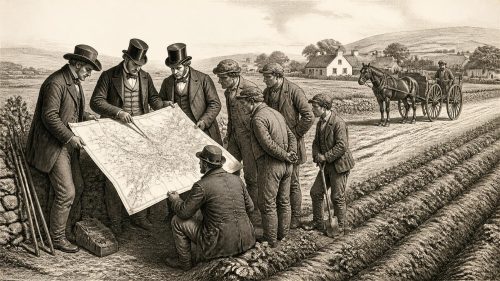
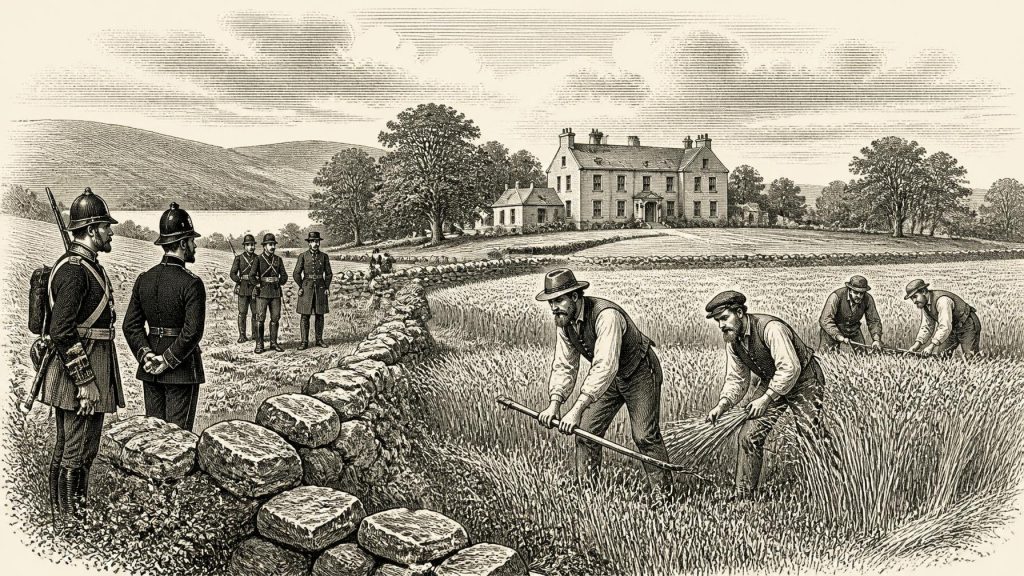
The case that made the tactic famous unfolded around Captain Charles Cunningham Boycott, land agent for Lord Erne at Lough Mask, near Ballinrobe. On 22 September, a process-server and Royal Irish Constabulary escort attempting to serve notices on defaulting tenants near the Neale were driven back by a crowd in which local women played a conspicuous part. In the following days Boycott’s labour force was warned off and he found it difficult to hire hands, buy provisions or conduct normal business. His household still included several servants, and the episode should not be reduced to a simple image of one isolated man; nonetheless, the withdrawal of local co-operation was sufficiently comprehensive to immobilise the estate’s agent at harvest time.
Boycott publicised his position in a letter to The Times in October. A heavily protected expedition, largely composed of Ulster Protestant and Orange volunteers, subsequently travelled to Mayo to bring in Lord Erne’s crops. Soldiers and police guarded the operation at public expense far exceeding the value of the harvest. The demonstration made Lough Mask a spectacle for British, Irish and overseas readers. It also exposed the several tensions operating at once: class conflict between landlord and tenant, the state’s determination to protect property and free labour, and an emerging sectarian edge visible in the mobilisation of the rescuers. By 1 December, Boycott and his wife had left Ireland for Britain. The surname had become an internationally recognised verb before the year was out.
Agitation and Its Darker Edges
Boycotting was not the whole Land War. The year also saw intimidation, confrontations at evictions and serious agrarian violence. On 25 September Lord Mountmorres, a Galway landowner, was shot dead near Clonbur. Such acts were politically consequential even where they were not directed by the Land League. They allowed opponents to portray the entire movement as criminal, while League leaders had to distinguish collective pressure from violence that they publicly condemned. The distinction was neither merely rhetorical nor always secure on the ground: fear, secrecy and local grievances could make the boundary difficult to maintain.
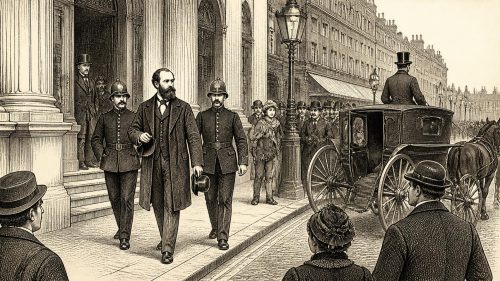
The government’s response was beginning to harden. In November it decided to prosecute fourteen Land League leaders, including Parnell, Patrick Egan, Joseph Biggar and Thomas Brennan, on allegations of conspiracy connected with rent, eviction and the taking of farms. The December trial ended with a divided jury rather than convictions. Far from weakening Parnell, the proceedings increased his standing among supporters who believed the administration was criminalising a campaign born of hardship. More sweeping coercive legislation belonged to 1881; in 1880 the crucial development was the visible approach of confrontation between an organised popular movement and the state.
Learning and Public Institutions
Not every important development lay in the fields or the courts. On 27 April the Royal University of Ireland received its charter and began operations during the year as an examining and degree-awarding body. Unlike its predecessors, it could examine candidates from a range of colleges rather than teaching them itself. This offered a significant, though limited, route to recognised degrees for students associated with institutions outside Trinity College and the old Queen’s University framework. Its charter also opened examinations, prizes, scholarships and degrees to women on the same academic basis as men, an important principle whose practical effects would emerge only gradually.
Thus 1880 joined two different kinds of Irish change. One was immediate and urgent: relief works, rent arrears, emigration, eviction notices and the practical power of a village to withhold its labour. The other was institutional and longer-term: a reconfigured parliamentary leadership and a new university structure. Lough Mask supplied the year’s unforgettable symbol, but the wider significance of 1880 was that land distress became inseparable from national politics. Parnell’s ascendancy rested not on one dramatic encounter, but on his ability to make Ireland’s local crisis a question that Westminster, the diaspora and the world could no longer ignore.
Primary Sources
- Seventeenth Annual Report of the Registrar-General of Marriages, Births, and Deaths in Ireland, 1880
- Famine to 1916: Life in 1916 Ireland — Stories from Statistics: Agriculture
- Relief of Distress (Ireland) Act, 1880
- Relief of Distress (Ireland) Act 1880
- Relief of Distress (Ireland) Amendment Act 1880
- Relief of Distress (Ireland) Bill, House of Lords, 1 March 1880
- Relief of Distress (Ireland): The Supply of Seed Potatoes, House of Commons, 4 March 1880
- Compensation for Disturbance (Ireland) Bill, House of Commons, 25 June 1880
- Compensation for Disturbance (Ireland) Bill, House of Commons, 8 July 1880
- Commons Chamber, House of Commons, 24 August 1880
- Distress (Ireland)—Assisted Emigration—Observations, House of Lords, 9 August 1880
- Parnell, Charles Stewart
- Davitt, Michael
- Dillon, John
- Egan, Patrick
- Area Files of Irish National Land League for Counties Antrim, Carlow, Clare, Cork, Fermanagh, Galway, Longford, Mayo, Meath, Sligo, and Tipperary
- Illuminated Address Presented to Charles Stewart Parnell by the Land League on His Return from the United States
- Illuminated Address to Charles Stewart Parnell from the Tenant Farmers of Ireland, 1880
- Captain Boycott: Man and Myth
- Chapter 4: The 1880 Election — Parnell’s Election and My Defeat in County Cork
- Appendix: Irish Land War Legislation
- Dillon, John
- Diaries of John and Arthur Oram
- History — National University of Ireland
- History of the NUI
- Births and Deaths Registration Act (Ireland) 1880
- Registered Papers of the Chief Secretary’s Office: Browse Records
- America’s Errand of Mercy to Ireland 1880