
Crumlin Road and Newgate1883 CE
In 1883, Ireland remained divided by unresolved land ownership, coercive government and demands for Home Rule, while the aftermath of the Phoenix Park murders shaped prosecutions and political debate. The Labourers (Ireland) Act established a cautious framework for sanitary authorities to build rural cottages, foreshadowing later reforms. Nationalist organisation persisted through Parnell, the National League and transatlantic support. Catholic institutions expanded with Belfast’s Mater Hospital and a Jesuit University College in Dublin. Completed O’Connell monument figures, international rugby, emigration, a Tyrone tramway proposal and George Moore’s first novel reflected wider civic, economic and cultural change amid continuing uncertainty, national tensions.
Dateline
In 1883 Ireland stood between an exhausted phase of confrontation and the slower work of institutional change. The fiercest years of the Land War had passed, but its central problem—who should control the land, and on what terms—was unresolved. The state still governed Ireland from Westminster and Dublin Castle; Charles Stewart Parnell’s movement was refining a constitutional demand for self-government; and the aftermath of the Phoenix Park murders kept coercion, secret societies and police power sharply in public view. Yet the year also produced less dramatic foundations: a statute directed at rural labourers’ housing, new Catholic institutions in Belfast and Dublin, and a widening network of civic, cultural and sporting life.
A Law for Labourers
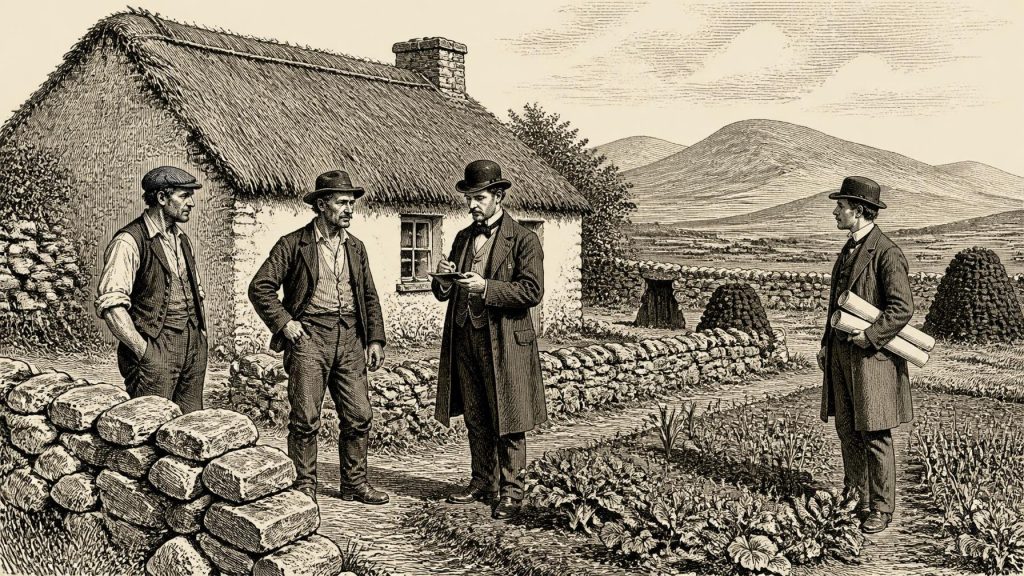
The most consequential Irish measure passed in 1883 was the Labourers (Ireland) Act, which received royal assent on 25 August. Its title—“An Act to better the condition of Labourers in Ireland”—was unusually direct. Earlier land legislation had chiefly concerned the relationship between landlord and tenant farmer. Agricultural labourers, dependent on wages and commonly housed in cottages tied to employment, had much less leverage. They were not automatically beneficiaries of the fair-rent machinery established by the Land Act of 1881.
The new Act addressed housing rather than wages, landownership or employment security. It empowered rural sanitary authorities—normally boards of guardians acting under the public-health system—to prepare improvement schemes where labourers’ dwellings were insufficient or unfit for habitation. The statutory language identified familiar defects: dilapidation, poor light, inadequate ventilation and absent sanitary conveniences. Authorities could acquire land, in some circumstances compulsorily through a provisional order confirmed by Parliament; borrow from the Board of Works; build or arrange for the building of cottages; and attach a plot of ground of up to half an acre to each dwelling.
This was a significant recognition that shelter, water, drainage and proximity to work were political questions. Parliamentary discussion earlier in the year had described labourers crowded in poor dwellings, sometimes at a considerable distance from their employment. The remedy, however, remained cautious and bureaucratic. A complaint or representation had to move an authority to act; schemes required resources, procedures and oversight by the Local Government Board for Ireland; and lettings under the Act were restricted to agricultural labourers. The legislation did not transform rural living conditions in 1883. Its importance lies in providing a framework from which later Labourers Acts and thousands of labourers’ cottages would grow.
The contrast with the better-organised tenant-farming interest was instructive. The Irish National League, created from the suppressed Land League in October 1882, continued to treat peasant proprietorship as its principal objective. Rent disputes still mattered, even as the most intense Land War phase receded. In April 1883, a convention in Philadelphia transformed the American Land League into the National League of America, demonstrating the continuing importance of transatlantic organisation and fundraising. Parnell’s parliamentary nationalism was therefore supported by an extensive network of branches, newspapers, meetings and emigrant communities rather than by Westminster representation alone.
Trials, Informers and Retribution
Political life in 1883 was also shadowed by the prosecutions arising from the murders of Lord Frederick Cavendish, the chief secretary, and Thomas Henry Burke, the permanent under-secretary, in Dublin’s Phoenix Park on 6 May 1882. The killings had wrecked hopes that the Kilmainham agreement might usher in a more conciliatory relationship between the British government and constitutional nationalists. In the spring of 1883, special trials brought the Irish National Invincibles before the courts. James Carey, himself a leading conspirator, gave evidence for the Crown.
The executions were firmly dated public events: Joe Brady was hanged in Kilmainham Gaol on 14 May; Michael Fagan on 28 May; Thomas Caffrey on 2 June; and Timothy Kelly on 9 June. Their convictions, together with that of Daniel Curley, rested substantially on Carey’s testimony and other approver evidence. The proceedings brought the secret violence of 1882 into daylight, but they also made Carey a detested figure among many nationalists. His name became synonymous with betrayal, while the trials reinforced the belief among Irish critics of Dublin Castle that exceptional policing and judicial arrangements could not be separated from politics.
Carey left Britain with his family under the name Power in July. On 29 July, aboard the Melrose after sailing from Cape Town towards Natal, he was shot dead by Patrick O’Donnell, a Donegal-born Fenian sympathiser. O’Donnell was returned to Britain, convicted at the Old Bailey and hanged at Newgate on 17 December. The killing took place far from Ireland, but its reception and meaning were Irish: it revealed how political violence, exile, maritime travel and diaspora networks connected Dublin, Britain, South Africa and America. It also left Parnell’s constitutional movement in a difficult position. It sought disciplined mass politics and Home Rule, while opponents repeatedly used Fenian conspiracy and dynamite activity to question nationalist respectability.
No Home Rule Bill was before Parliament in 1883. Nevertheless, the direction of travel was increasingly clear. Parnell and the Irish Parliamentary Party pressed Irish grievances at Westminster, while the Liberal government was considering electoral reform. Debate over a wider franchise raised an obvious Irish question: whether the household and small-farmer electorate would be enlarged on the same basis as in Britain. The reform was not enacted until 1884, but the argument in 1883 anticipated a major change in the political weight of rural Ireland.
Institutions on Crumlin Road and St Stephen’s Green
On 1 November the Mater Infirmorum Hospital admitted its first patients at Bedeque House on the Crumlin Road in Belfast. Founded by Dr Patrick Dorrian, Roman Catholic bishop of Down and Connor, and entrusted to the Sisters of Mercy, it began as a voluntary Catholic hospital in a rapidly industrialising city. Its opening mattered beyond medicine. Belfast’s religious communities were developing their own charitable and educational institutions within a city shaped by factory employment, migration, poverty and sectarian division. The Mater offered a durable example of Catholic voluntary organisation meeting urban needs.
Dublin saw a related development in Catholic higher education. During October 1883, the trustees of the Catholic University leased the St Stephen’s Green buildings to the Society of Jesus; in November the Jesuits opened University College there. This was not yet the later National University institution normally meant by University College Dublin. It was a Jesuit-managed college working within the Royal University system, where students sat examinations set by a body that did not itself teach. The arrangement reflected the long-running Catholic demand for university education that was intellectually serious, socially respected and compatible with religious authority.
Public symbols and pastimes supplied quieter evidence of an Ireland becoming more institutionally self-conscious. In May, the four winged bronze figures omitted from the 1882 unveiling were installed at the base of John Henry Foley’s Daniel O’Connell monument in Sackville Street. The completed monument joined the capital’s most prominent thoroughfare to the memory of Catholic emancipation and popular constitutional agitation. In sport, Ireland took part in the inaugural Home Nations rugby championship. Its February fixtures, including a home match at Ormeau Road in Belfast, involved an all-island representative side years before sport acquired the later political meanings attached to partition.
Movement, Markets and Cultural Horizons
Economic and demographic change did not pause because the Land War’s first great crisis had eased. Emigration remained a defining fact of household calculation. The recorded total for 1883 was 108,724 people leaving Ireland, a reminder that departure for Britain, North America and Australasia remained a normal, though wrenching, answer to constrained prospects. Emigration linked rural townlands to remittances, letters, political subscriptions and family separation. Women formed a particularly important part of the post-1880 migrant stream, complicating any picture of migration as a solely male search for work.
Transport projects pointed towards another response: better access to markets. The Castlederg and Victoria Bridge Tramway received its parliamentary authorisation in July 1883, proposing to connect the County Tyrone market town with the Great Northern Railway at Victoria Bridge. It did not become an operating railway during this calendar year, but the legislation recorded local aspirations to bind a peripheral agricultural district more closely to the main-line network. Such schemes were expressions of commercial hope as well as engineering ambition.
Irish culture, meanwhile, was not confined to overtly nationalist forms. George Moore, born in County Mayo, published his first novel, A Modern Lover, in 1883. Set largely in London’s art world, it showed an Irish writer looking towards French realism and metropolitan literary fashion. Its appearance offers a useful counterpoint to the year’s politics: Irish life was being remade through local government, religious institutions, migration, sport and cultural exchange, not by one national story alone. By year’s end, Ireland had not settled its land question or constitutional status. But in cottages proposed by law, wards opened to patients, classrooms reclaimed by Jesuits and organisations reaching across the Atlantic, the foundations of later change were visibly being laid.
Primary Sources
- Labourers (Ireland) Act 1883
- Agricultural Labourers (Ireland)—Resolution, House of Lords, 13 April 1883
- Land Law (Ireland) Act, 1881—Provisions as to Labourers' Cottages, House of Commons, 25 June 1883
- Rural Ireland, 1850–1950: Timeline of Events
- The Rehousing of Rural Labourers in Ireland under the Labourers (Ireland) Acts, 1883–1919
- Introduction, Royal Historical Society Camden Fifth Series
- The Machinery of the Irish Parliamentary Party, 1880–85
- Home Rule
- Carey, James
- O'Donnell, Patrick
- Brady, Joe
- Burke, Thomas Henry
- Cavendish, Lord Frederick Charles
- Mallon, John
- Term Browse: St Stephen’s Green
- University College, Dublin
- Health Services No. 387 (Mater Infirmorum Hospital founding recital)
- Guinness Men’s Six Nations: Championship History
- Ireland Captains
- History of Monuments in the O’Connell Street Area
- Report of the O’Connell Monument Committee
- Moore, George Augustus
- A Modern Lover
- Emigration and Immigration
- Historical Documents: Despatch from the United States Consul at Dublin, 1883
- Journals of the House of Commons, Volume 138, February–August 1883
- Statute Law Revision Act 2012, Schedule of Local Acts