Bilton’s Constitutional Gamble1870 CE
In 1870, Irish politics increasingly moved from Fenian insurrection towards constitutional campaigning, though prisoner amnesty remained contentious. Isaac Butt founded the Home Government Association at Bilton’s Hotel, uniting disparate interests behind a federal-style Irish legislature within the Crown and empire. Gladstone’s Landlord and Tenant (Ireland) Act recognised Ulster custom, improvements and eviction compensation, but neither secured fair rents nor ownership. Church of Ireland disestablishment, legislated in 1869, awaited implementation in 1871, while its Representative Church Body was established. Emigration, infant mortality, literacy and livestock farming highlighted pressures. The year transformed methods and principles without settling Ireland’s land or religious questions.
Dateline
In 1870 Ireland’s central arguments were increasingly being carried through meeting rooms, newspapers, petitions and Westminster divisions rather than through a fresh insurrection. That did not mean that the legacy of Fenianism had vanished. Imprisoned Fenians remained a powerful public grievance, and the failure of the rising of 1867 had sharpened a practical question: could Irish discontent be turned into a broad constitutional movement? During the year, two answers took institutional form. Isaac Butt helped found the Home Government Association in Dublin, while William Ewart Gladstone’s Liberal ministry carried the Landlord and Tenant (Ireland) Act through parliament. One proposed a different way to govern Ireland; the other altered, though very incompletely, the rules under which much of rural Ireland lived.
Butt’s new alliance
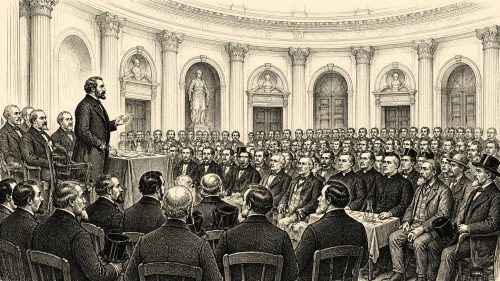
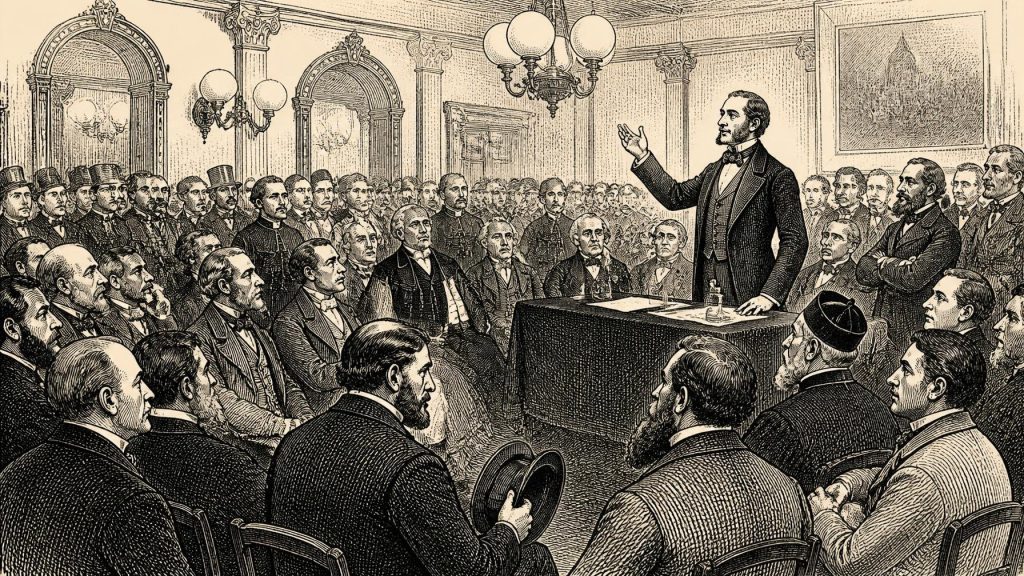
On 19 May, a meeting at Bilton’s Hotel in Dublin established the Home Government Association. Its leading figure was Isaac Butt, a Donegal-born barrister, former Conservative MP and Protestant who had become prominent through his defence of Fenian prisoners and his presidency of the Amnesty Association. The setting and personnel mattered. This was not a clandestine republican organisation, nor simply a revival of Daniel O’Connell’s Repeal movement. Butt sought a constitutional, federal remedy: an Irish legislature to manage domestic affairs while Ireland remained connected to the Crown and empire.
The association’s origins lay in overlapping discontents. Catholic clergy and nationalist activists had long complained that government from Westminster did not meet Irish needs. Some Protestant Conservatives, meanwhile, had been alienated by Gladstone’s reform programme, especially the impending end of the Church of Ireland’s privileged constitutional position. Tenant-right advocates had their own grievance in insecure occupation of the land. Butt’s achievement in 1870 was to place people from these different political and religious backgrounds in the same organisation, however precarious that alliance would prove.
Home government was deliberately capacious language. For Butt it could mean a federal rearrangement of the United Kingdom rather than an independent Irish state. That moderation was meant to offer an alternative both to violent separatism and to passive dependence on British parties. Yet it also contained an ambiguity that would be politically useful. Those who joined or supported the association could imagine very different degrees of Irish autonomy. The larger Home Rule movement of later decades had its organisational beginning here, but it should not be read back as if its aims, methods or leadership had already been settled in 1870.
The unresolved demand for a Fenian amnesty gave the new politics emotional force. In February, Butt publicly appealed to Gladstone on behalf of the prisoners, presenting amnesty as a test of the government’s whole Irish policy rather than a narrow question of clemency. Significant releases did not come until late in the year, and then fell well short of what campaigners wanted. The episode helped Butt argue that even a reforming Westminster ministry responded too slowly and too conditionally to Irish opinion. Constitutional nationalism in 1870 therefore grew not from the disappearance of Fenian feeling, but partly from an effort to draw it into legal and electoral channels.
The land question enters statute
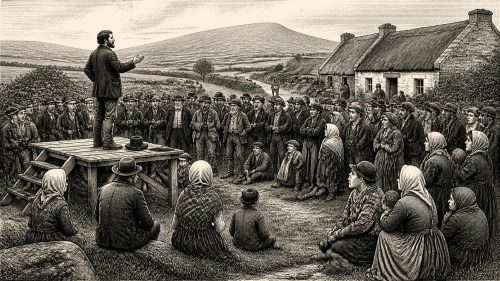
The year’s most consequential firmly dated measure came on 1 August, when the Landlord and Tenant (Ireland) Act received royal assent. Often called the first Irish Land Act, it was Gladstone’s attempt to address a relationship that shaped the lives of most rural households. Farming families commonly occupied land rented from landlords or middlemen; they could invest labour and capital in houses, drainage, fencing or reclamation without possessing the security of an owner. The fear of eviction, or of losing the value created by improvement, lay behind persistent tenant-right agitation.
The Act did not make tenants owners, nor did it establish the later “three Fs” of fair rent, fixity of tenure and free sale. It nevertheless broke with the simple assumption that a landlord’s legal title exhausted the rights in a holding. In Ulster, where a customary tenant right had developed in many districts, the law recognised the custom when it could be shown to exist. Elsewhere, it provided compensation for qualifying improvements made by tenants and, in many cases, compensation for disturbance when a tenant was evicted. Important exceptions and qualifications remained, especially where rent was unpaid or a tenant had breached obligations. The measure also included limited state-assisted purchase provisions, associated with John Bright, allowing loans to tenants where a landlord was willing to sell.
This was a major change in principle, but an incomplete settlement in practice. A tenant still lacked a general statutory right to a permanent holding at a fair judicial rent. Compensation after an eviction was not the same thing as security before it. Landlords retained considerable authority, and the working of the Act would be questioned almost immediately. Still, 1870 marked the moment when parliament accepted that Irish land occupation required distinct legislation and that tenants could possess an interest deserving legal protection. That concession would frame later conflicts over rent, eviction and ownership.
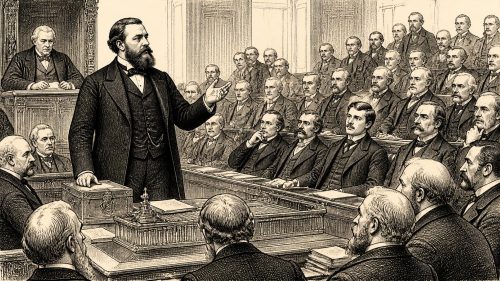
The debates surrounding the bill showed why the issue reached beyond economics. Supporters presented reform as a means of removing a source of chronic resentment and encouraging improvement. Opponents regarded compulsory compensation as an interference with property and warned that it would damage relations between landlord and tenant. Both arguments recognised the same reality: land was the foundation not only of livelihood but of local power, social standing and political loyalty. The Act made no sudden transformation of the countryside, but it acknowledged publicly that the older settlement could not continue untouched.
Church transition, not yet completion
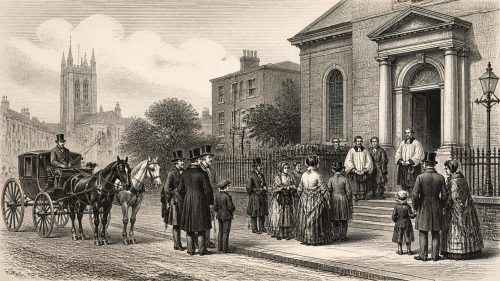
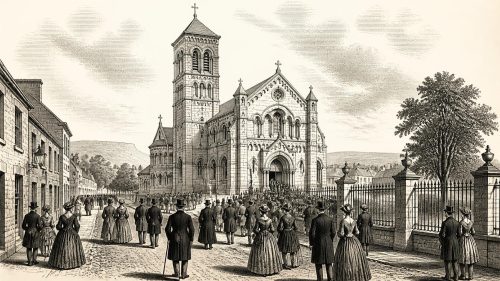
Religious change also remained unfinished business in 1870. The Irish Church Act had been passed in July 1869, but its key provision was scheduled to take effect on 1 January 1871. Thus, throughout this calendar year, the Church of Ireland stood in a transitional position: its disestablishment had been legislated for, but had not yet formally taken effect. This distinction is important. It is inaccurate to say that the Church was disestablished during 1870; rather, churchmen, government commissioners and congregations were preparing for the new order.
The Act had transferred much church property and its complex financial questions into the hands of the Church Temporalities Commissioners. In 1870 the Church of Ireland also acquired a durable institutional means of self-government when its Representative Church Body was incorporated by royal charter. For a denomination losing establishment, endowments and its former official relationship with the state, this was not a minor administrative adjustment. It was part of the practical work of becoming a voluntary, self-financing church. The change unsettled many Protestants, while for many Catholics it represented overdue recognition that a church attended by a minority should not enjoy state establishment.
These religious arrangements helped make Butt’s coalition possible but also exposed its tensions. Conservative Protestants could resent disestablishment while resisting any political scheme that seemed to endanger the Union. Catholic nationalists could welcome equality of denominations but demand much more extensive political change. The Home Government Association did not dissolve those differences. It gave them, for a time, a shared constitutional vocabulary.
Departure, work and household life
Official returns reveal another Ireland in 1870: one still being remade by migration. The Registrar-General recorded 74,855 emigrants leaving Irish ports during the year. Ulster supplied the largest stated provincial total, 23,030, followed by Leinster and Munster; Connacht’s recorded number was lower, though thousands of emigrants did not state a province. Most were young: 76 per cent were between fifteen and thirty-five. Emigration was therefore not an occasional escape from hardship but a normal and continuing feature of family calculation, labour supply and community life. Remittances and letters bound those leaving for Britain, North America and elsewhere to households they had left behind.
The same report suggests the demographic pressures within those households. Of people whose deaths were registered in 1870, more than a quarter were children under five. Marriage registers also recorded the uneven reach of literacy: 41.85 per cent of those marrying signed with a mark rather than writing their names, with the proportion higher among women than men. Such figures cannot tell every family’s story, and registration itself had limits, but they offer a sober corrective to political history centred only on lawyers and MPs. Health, infant survival, schooling, seasonal work and departure overseas remained immediate concerns.
Agricultural statistics show a countryside increasingly oriented towards livestock as well as crops. In 1870, official June returns listed about 3.081 million cattle, 4.065 million sheep and 1.221 million pigs. The acreage under wheat had fallen markedly from the levels of the 1850s, while oats and potatoes remained important crops. These totals describe the island as a whole, not the fortunes of any one farm. They nonetheless underline why tenant security mattered: a household’s improvements, grazing rights, buildings and stock could represent years of work, yet be vulnerable to a notice to quit.
Weather was observed carefully at the Ordnance Survey Office in Phoenix Park, Dublin. Its record noted rain or snow on 109 days in the first eleven months, a highest recorded air temperature of 86.9°F on 11 August and a low of 11°F on 30 December. This is a local record, not a climate history of all Ireland, but it is a reminder that the year’s politics unfolded amid the ordinary exposure of rural labourers, town dwellers and farmers to season, fuel costs and harvest conditions.
A beginning rather than a settlement
By the close of 1870, Ireland had not received either a domestic parliament or a final land settlement. The Church of Ireland had not yet reached its statutory day of disestablishment. Fenian prisoners had not received the full amnesty demanded by campaigners. Yet the year altered the terms on which each question would be fought. Butt’s association gave constitutional home government an organised public platform. The Land Act conceded that tenants’ claims could qualify landlords’ powers. Church transition demonstrated that even an entrenched constitutional arrangement could be dismantled by parliament.
Those developments did not create harmony. They made expectations larger. In that sense, 1870 was less the resolution of Ireland’s grievances than a decisive change in political method and legal principle: a year in which Dublin meeting rooms, Westminster statutes and the continuing departures from Irish ports all pointed towards a country whose old arrangements were being contested, adapted and slowly remade.
Primary Sources
- Landlord and Tenant (Ireland) Act 1870
- Irish Church Act 1869
- Butt, Isaac | Dictionary of Irish Biography
- Nolan, John (‘Amnesty Nolan’) | Dictionary of Irish Biography
- Isaac Butt and the founding of the Home Rule movement
- Explainer: What was Home Rule? | Century Ireland
- The Fenians, Parnell and the Land War
- Home Rule Movement
- Irish Land Bill, House of Lords debate, 8 July 1870
- Irish Land Bill, House of Lords debate, 26 July 1870
- Irish Land Bill, House of Commons debate, 21 July 1870
- Irish Land Bill, House of Commons third reading, 10 August 1870
- Seventh Annual Report of the Registrar-General of Marriages, Births, and Deaths in Ireland, 1870
- Farming Since the Famine 1847–1996
- Agriculture Statistical Yearbook of Ireland 2017: Crops and Livestock
- General Details: Farming Since the Famine
- Disestablishment
- Church of Ireland – Parish Handbook
- The Irish Conservatives and Home Rule, 1869–73
- Federalism | Irish Political Thought and the Union
- The Material for Victory: The Memoirs of Andrew J. Kettle, Chapter 2
- The Landlord and Tenant (Ireland) Act 1870 and the Irish Jury System
- Irish Agriculture after the Land War
- State-aided Land Purchase under the Disestablishment Act of 1869