Londonderry’s Secret Ballot1872 CE
In 1872, the Ballot Act introduced secret voting for Irish parliamentary and municipal elections, first tested at Londonderry City, where Conservative Charles Lewis won a four-cornered by-election. Franchise restrictions and local religious, social and political influence nevertheless persisted. Isaac Butt’s Home Rule movement expanded through contested elections, linking constitutional reform with tenant grievances. Repeal of the Party Processions Act enabled nationalist demonstrations: Derry’s passed peacefully, but Belfast’s Hannahstown procession preceded severe sectarian rioting, deaths and displacement. Religious education, Church affairs, agricultural change, urban institutions and literary publication reflected pressures. Lord Mayo’s assassination in India highlighted Ireland’s connections to imperial government.
Dateline
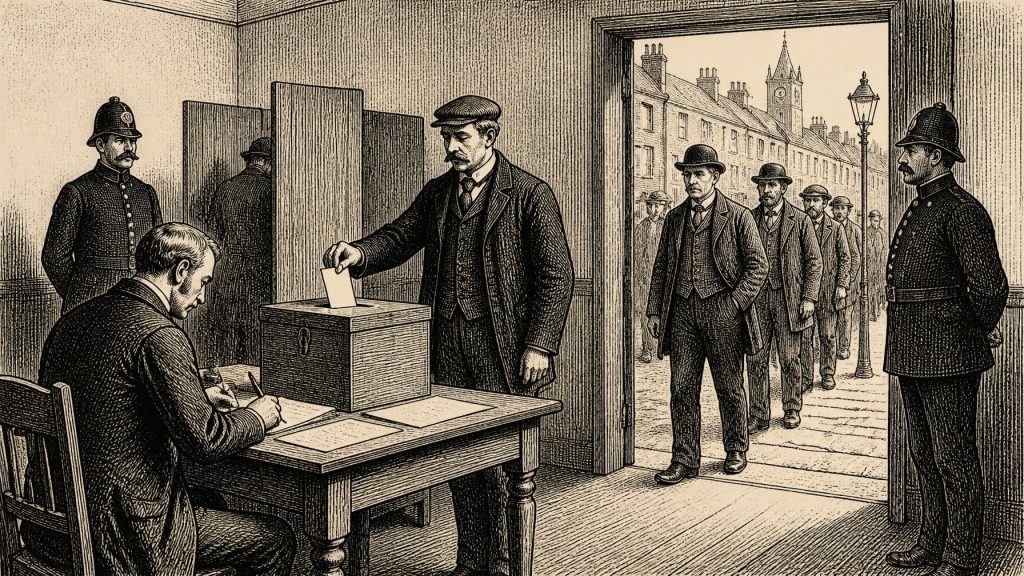
In 1872, Ireland’s most consequential political novelty was not a new parliament or a dramatic constitutional settlement, but a change in the act of voting. The Ballot Act, passed at Westminster in July, replaced the public declaration of a vote with a secret ballot for parliamentary and municipal elections. Its first Irish parliamentary test came in Londonderry City in November. The change did not extend the franchise: voting remained confined to men meeting property qualifications, and local influence still mattered greatly. Yet it altered a public ritual in which landlords, employers, priests, party organisers and neighbours had previously been able to watch an elector declare himself at the poll.
The year also exposed the limits of legal reform in a society divided by religion, politics and place. Parliament repealed the Party Processions Act, removing a much-disputed restriction on sectarian and political demonstrations. In August, nationalist supporters of Home Rule and amnesty paraded in towns across Ulster. Some events were peaceful; Belfast’s Hannahstown demonstration was followed by destructive communal rioting. Thus 1872 brought both a more private vote and a newly contested public politics.
A Vote Concealed
The Ballot Act received royal assent on 18 July. Its central principle was simple but far-reaching: an elector marked a ballot paper in private rather than announcing his choice aloud. In Ireland, where elections had often been occasions for deference, intimidation, treating and large public processions, secrecy promised a measure of independence for the voter. It did not make elections fully modern. The electorate was narrow, women could not vote, and candidates and local patrons retained enormous influence. Nor did the Act settle every concern about corruption. But it ended open voting as the normal form of parliamentary choice.
Londonderry City’s by-election of 23 November became the first Irish parliamentary election conducted under the new system. It followed the resignation of the Liberal MP Richard Dowse on his appointment as a baron of the Court of Exchequer. Charles Lewis, a Conservative solicitor, won with 696 votes. Christopher Palles, the Liberal candidate, polled 522; Joseph Biggar, standing for Home Rule, received 89; and a second Conservative candidate, Bartholomew McCorkell, received two. Lewis’s majority over Palles was 174.
The result cannot be explained by ballot secrecy alone. Londonderry’s politics were entangled with denominational allegiance, the legacy of the disestablishment of the Church of Ireland, and arguments over education. Palles, though a Catholic, had alienated sections of Catholic opinion through earlier prosecutions of clergy, while Protestant unease about denominational education weakened Liberal cohesion. Biggar’s candidacy showed that the Home Government Association could enter a northern contest, but his modest vote also showed the obstacles facing constitutional nationalism in the city. The secret ballot changed the mechanics of polling, not the social geography of power.
Butt’s Expanding Cause
Isaac Butt remained the most important advocate of Irish self-government within the United Kingdom. A Donegal-born barrister and former Conservative, he had been MP for Limerick since September 1871 and led the Home Government Association founded two years earlier. Butt’s programme was not separatism. He sought an Irish legislature for domestic affairs while maintaining the connection with Britain and the empire. His appeal rested on a broad and uneasy coalition: constitutional nationalists, former Fenians attracted by amnesty, Catholic clergy and lay supporters, tenant-right advocates, and a minority of Protestant conservatives dissatisfied with centralised rule from Westminster.
The movement’s momentum was visible in the by-elections around this period, though it was not uniform. In County Kerry, Rowland Blennerhassett, a Protestant Home Ruler, defeated the Catholic Liberal James Dease in February with the support of the Home Government Association and many priests, despite opposition from Bishop David Moriarty. In County Galway, Captain John Nolan initially secured a striking Home Rule victory, but an election petition resulted in Judge William Keogh awarding the seat to the Conservative Captain William Le Poer Trench. These contests revealed both the breadth of the cause and the fragility of electoral outcomes under a restrictive and legally contested system.
Land remained inseparable from politics. Gladstone’s Land Act of 1870 had recognised, in limited form, tenants’ interests in their holdings and provided compensation in certain circumstances, but it had not removed insecurity or transformed the unequal relationship between landlord and tenant. Butt had long argued that land tenure was central to Irish social survival. In 1872, the Home Rule cause therefore drew force not only from constitutional principle but from rural grievance and from the belief that Irish conditions required Irish political remedies.
Processions and Their Perils
On 27 June, Parliament repealed the Party Processions Act of 1850. That Act had attempted to curb parades involving provocative banners, symbols, music or weapons, but its enforcement had repeatedly been denounced as partial. In the parliamentary debate on repeal, speakers acknowledged the danger of local hostility while arguing that ordinary law should preserve peace without a special Irish prohibition. The repeal enlarged the formal space for public demonstration; it did not create agreement about who could safely use that space.
August demonstrated the problem. Nationalist meetings and parades in support of Home Rule and Fenian prisoners were planned for 15 August, the Catholic feast of the Assumption, in Belfast, Derry and numerous towns. In Derry, a nationalist procession of about 5,000 people marched through the centre, around the walls and across to the Waterside without violence. That peaceful passage mattered: it showed that official protection and local restraint could make a shared urban landscape negotiable, even where memories and identities were sharply opposed.
Belfast was different. A Home Rule procession setting out towards Hannahstown encountered a hostile gathering at Carlisle Circus and was attacked near Divis Street. The march nevertheless reached Hannahstown, where roughly 30,000 people assembled. Later that day conflict resumed as returning marchers, shipyard workers, police and crowds from different districts converged. Barricades appeared between the Falls and Shankill roads; fighting spread through the city and continued for almost a week. Torrential rain on 21 August helped end the disorder. At least four people died, 247 houses were destroyed, and more than 800 families were forced from their homes.
The Belfast violence should not be reduced to an inevitable clash of fixed communities. It was connected to fears about parading, political sovereignty, religious identity, work and territorial control within a rapidly industrialising town. Yet its immediate consequence was stark. Large nationalist displays in central Belfast became far harder to stage, while parades remained an arena in which claims to belonging and authority were made physically visible.
Church, School and Public Life
Religion continued to shape political argument after the Church of Ireland’s disestablishment. The formal settlement was already in operation, but Parliament still passed an Irish Church amendment measure in 1872 dealing with the Church Temporalities Commissioners. More immediately contentious was education. Catholic leaders pressed for a system that would recognise denominational needs and improve access to higher education. A Dublin meeting associated with Cardinal Paul Cullen in January made Catholic educational equality a public demand. The issue was not merely theological: it concerned who would train teachers, professionals and clergy, and whether public authority could be trusted to educate Catholic children without diluting religious control.
In Belfast, the opening of the Ulster Hospital for Women and Sick Children in Chichester Street offered a quieter sign of urban institutional growth. Its original purpose addressed two groups whose medical needs could be overlooked in general provision: women and sick children. The hospital was small by later standards, but its foundation belongs to the expanding network of voluntary hospitals, charities and civic institutions through which nineteenth-century towns attempted to answer the pressures of population, poverty and disease.
Fields, Books and an Imperial Funeral
Most Irish people still lived with the rhythms of farming, seasonal work and migration. Agricultural returns for 1872 recorded about 451,000 hectares of oats, 301,000 hectares of potatoes, 88,000 hectares of barley and 66,000 hectares of wheat. Oats remained the largest of these principal tillage crops, while the potato, though still essential to many households, occupied far less ground than before the Great Famine. These figures do not describe every farm or every household, but they underline a countryside more diversified than the pre-Famine potato economy and still deeply exposed to questions of rent, markets and employment.
Irish cultural production also registered a strong interest in the island’s past and present. Samuel Ferguson published Congal: A Poem, in Five Books, drawing on early Irish historical and legendary material. Sheridan Le Fanu’s In a Glass Darkly, published in 1872, gathered tales of psychological and supernatural disturbance, including Carmilla. Charles Lever’s final novel, Lord Kilgobbin, reached book form that year after serial publication, presenting an Ireland recognisably shaped by contemporary political and social strain. Such works did not speak for all Ireland, but they show writers using the past, the Gothic and the social novel to interpret a changing society.
Finally, events far beyond the island connected Ireland to the imperial world. Richard Southwell Bourke, sixth earl of Mayo, a former chief secretary for Ireland and viceroy of India, was assassinated at Port Blair in the Andaman Islands on 8 February. His remains were returned to Ireland and buried at Johnstown, County Kildare, on 26 April. The episode was a reminder that Irish-born and Ireland-based elites held important places within British imperial administration, even as constitutional nationalists argued that Ireland itself was inadequately governed from London.
By the end of 1872, no single issue had resolved Ireland’s political future. The secret ballot offered a guarded new protection to qualified electors; Home Rule had become a serious constitutional language; public processions revealed both claims to equal civic rights and the danger of violent exclusion. Beneath these contests lay enduring questions of land, education, faith, urban growth and emigration. The year’s importance lies in that combination: modest legal changes, dramatic local conflict, and a growing sense that Irish public life could no longer be managed by old habits alone.
Primary Sources
- Ballot Act 1872
- Party Processions (Ireland) Act Repeal Bill—(No. 87)
- Riot to Rights: Nationalist Parades in Northern Ireland
- Butt, Isaac
- Home Rule and the General Election of 1874 in Ireland
- 1872 Londonderry City By-election
- List of United Kingdom By-elections (1868–1885)
- Irish Statute Book: 1872 (35 & 36 Vict.)
- Ireland—The Party Processions Act—Question
- Resolution, 22 March 1872
- Question, 23 February 1872
- The Irish Dimension of the British Kulturkampf: Vaticanism and Civil Allegiance 1870–1875
- Ulster Hospital History
- Haypark, 32 Whitehall Parade
- Agriculture: Crops and Livestock
- A Review of Irish Agricultural Prices
- In a Glass Darkly
- Congal: A Poem, in Five Books
- Lord Kilgobbin: A Tale of Ireland in Our Own Time
- Bourke, Richard Southwell
- Papers of Richard Southwell Bourke, 6th Earl of Mayo
- Reform of the Irish Census of Population
- Pamphlets and News Cuttings on the Condition of Ireland
- The Introduction of the Secret Ballot, 1872