
Wellington Bridge and Wildgoose Fire1816 CE
In 1816, postwar recession and exceptionally cold, wet weather brought Ireland a serious subsistence crisis, with deficient potatoes and grain, costly food, wet fuel and conditions favouring fever. Westminster acknowledged distress and disorder but rejected major inquiry or reform. Maritime wrecks killed hundreds near Waterford and Kinsale. Dublin opened Richmond and Wellington, later Ha’penny, bridges, began Dunleary harbour, and founded an institution for deaf children. Belfast gained Ireland’s first successful savings bank and St George’s Church. Yet progress coexisted with exclusion, poverty and violence: Catholic disabilities persisted, while the burning of Wildgoose Lodge killed eight, exposing agrarian conflict and insecurity.
Dateline
In 1816 Ireland experienced a year in which new bridges, schools, banks and harbour works stood beside acute hunger, worsening illness and rural violence. It was a difficult moment in the first peace after the Napoleonic wars. Wartime demand had supported parts of Irish agriculture and trade, but peace brought falling prices, uncertain employment and a sharp exposure of long-standing poverty. Then an exceptionally adverse season damaged the food supply on which many households depended. Later memory would place 1816 within the wider northern-hemisphere ‘Year Without a Summer’, a climatic crisis now connected principally with the great eruption of Tambora in Indonesia in April 1815.
That global explanation should not obscure Ireland’s own social circumstances. The island was governed from London under the Union, while the Dublin Castle administration, local magistrates, landlords, clergy and grand juries remained vital in everyday government. A large and growing population relied on small holdings, seasonal work and a diet in which potatoes were especially important. The poor had few formal protections against a failed harvest or unemployment. In that setting, bad weather became not merely an agricultural inconvenience but a crisis of access to food, fuel and work.
A Failed Season
The weather of 1816 was remembered for cold, wet and unsettled conditions. Modern climatology identifies volcanic aerosols from Tambora as a major cause of the broader climatic disturbance, while also recognising that regional weather patterns shaped how it was felt locally. For Irish people, the decisive fact was practical: fields yielded poorly, and crops that did grow could be difficult to ripen, gather, store or sell. The potato crop was deficient in both quantity and quality. Contemporary parliamentary discussion the following spring stressed that potatoes, the people’s most important food, could not be preserved properly. Oats and other grains were also affected.
It is important not to project the later Great Famine backwards onto 1816. This was not a potato-blight catastrophe of the kind that began in 1845, nor can a precise national death toll responsibly be assigned to this calendar year alone. Yet it was a genuine subsistence crisis. Food scarcity and high prices bore most heavily on labourers, cottiers and the landless poor, whose cash income was already precarious after the war. Rain also created a domestic problem beyond food: turf cut for household fuel could be hard to dry. For families dependent upon it, wet fuel meant difficulty cooking and keeping warm just as diet and health deteriorated.
Fever began to spread amid this distress. The major typhus epidemic conventionally dated from 1816 to 1819 belongs to a longer emergency, with mortality rising particularly severely in 1817. It would therefore be misleading to attach the whole human cost of that epidemic to 1816. But the conditions in which it took hold were already present: malnutrition, crowding, movement in search of work or relief, and households with little reserve. Hunger and disease reinforced one another. The crisis revealed how fragile survival could be in a country capable of producing market crops while many people lacked the means to buy food.
Parliamentary Alarm, Limited Remedy
Political debate registered the strain without producing an immediate transformation in policy. On 1 April, Sir John Newport gave notice in the House of Commons that he would seek a detailed account of Ireland’s condition. His proposal responded to the intended maintenance of 25,000 troops for domestic tranquillity and asked ministers both to explain the disturbed state of the country and to show how its underlying evils might be remedied. On 26 April, Newport argued that Ireland’s condition deserved a searching parliamentary inquiry. Ministers resisted, maintaining that existing measures for agriculture and order were adequate; Newport’s effort failed.
The debate is revealing. It showed that Irish poverty, agrarian disturbance, absenteeism, education and Catholic exclusion could be discussed at Westminster, but also that these were interpreted through the priorities of imperial security and property. One speaker pointed to thousands of schools, including hedge schools, as evidence of popular desire for learning. That observation did not mean that education was universally available, secure or state-supported. Rather, it suggests a society in which informal teaching and local initiative coexisted with considerable institutional weakness.
Catholics, although the great majority of the population, remained barred from parliament and from important offices. Daniel O’Connell, still several years before the foundation of the Catholic Association, had emerged from the disputes over Catholic relief and the proposed crown veto on episcopal appointments as a conspicuous defender of Catholic ecclesiastical independence. In 1816 the movement for emancipation had not disappeared, but it lacked the durable mass organisation O’Connell would build after 1823. The year’s immediate pressures were bread, work and public order, not a single dramatic constitutional breakthrough.
Sea Losses and City Crossings
The year opened with a maritime disaster that connected Ireland directly to the recent continental war. On 30 January, the transport Sea Horse, carrying soldiers of the 59th Regiment and women and children, was wrecked in a gale in Tramore Bay, County Waterford. The associated transports Boadicea and Lord Melville were also lost or driven ashore near the Old Head of Kinsale over 30 and 31 January. Several hundred people died. Contemporary accounts differ in their tabulation of troops, sailors and family members, but the scale of loss was unmistakeable. Men who had survived campaigns in the Napoleonic Wars, and relatives travelling with them, were killed within sight of the Irish coast.
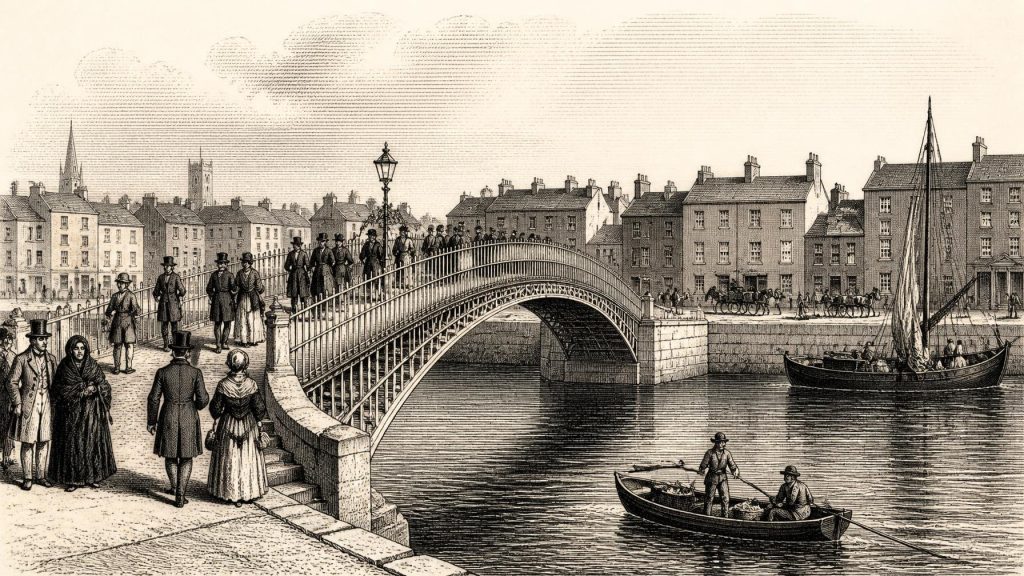
Dublin nonetheless acquired two conspicuous new crossings of the Liffey. Richmond Bridge, designed by James Savage on the site of the former Ormond Bridge, opened on St Patrick’s Day, 17 March. In May, Wellington Bridge opened downstream as a light cast-iron pedestrian bridge between Liffey Street and the Temple Bar side. It soon became known by the toll charged to users: the Ha’penny Bridge. Neither structure was merely decorative. Bridges channelled pedestrians, carts, commerce and sociability through a growing capital divided by its river. The contrast was striking: even in a year of scarcity, urban investment continued, and a small fee regulated access to the newest pedestrian route.
Another 1816 measure looked seaward. The Dublin Harbour Act authorised the creation of a harbour east of Dún Laoghaire, then commonly called Dunleary, and work commenced under commissioners appointed through the legislation. The project arose from the hazards of Dublin Bay and the need for a safer harbour of refuge. Its full consequences belonged to later decades: the developing port would be renamed Kingstown after George IV’s visit in 1821 and become closely tied to the railway age. In 1816, however, the undertaking signalled confidence in maritime infrastructure despite the season’s disasters.
Belfast’s Institutions
Belfast offered another view of change. In January the Belfast Savings Bank opened, the first successful savings bank in Ireland. Modelled on Scottish examples, it was intended to enable modest deposits by working people and to encourage habits of thrift. Its early customers included mechanics and female domestic servants. Such an institution could not solve mass deprivation; indeed, the need to cultivate small savings says much about insecurity. But its arrival in an expanding commercial town indicated the institutional ambitions of industrialising Ulster and the strength of connections across the North Channel.
On 16 June, St George’s Church opened on High Street. Designed by John Bowden in a confident neoclassical manner, it replaced a much older place of worship on a site associated with Belfast’s medieval Chapel of the Ford. Its Scrabo sandstone and imposing classical frontage expressed the resources and aspirations of the Church of Ireland in a rapidly growing town. The building also reflected social hierarchy: church accommodation was closely linked to subscriptions and pew arrangements. Belfast was expanding, but access to its principal institutions remained structured by denomination, money and status.
Education and Violence
In Dublin, 18 May saw the foundation of the National Institution for the Education of Deaf and Dumb Children of the Poor in Ireland. The institution’s historical title uses language now rejected, but the foundation itself marks an important development in the recognition that deaf children deserved organised education rather than neglect or confinement. Its early work was associated with Charles Orpen, a physician and reformer who had drawn public attention to deaf children encountered through Dublin’s House of Industry. The initiative was charitable and limited in reach, yet it opened a durable strand in the history of deaf education in Ireland.
By autumn, the vulnerability of rural life found a terrible expression in County Louth. On the night of 29–30 October, eight people, including an infant, died when Wildgoose Lodge was set on fire. The victims were members and servants of the Lynch household. The attack was carried out by men linked to a local agrarian secret society and followed an earlier raid and prosecutions in which Edward Lynch had supplied information to the authorities. The murders were an atrocity, not a simple illustration of ‘peasant unrest’. They arose from a local world of land, labour, loyalty, secrecy, retaliation and fear.
The judicial aftermath belongs chiefly to 1817 and later, when prosecutions, executions and controversy followed. What can securely be said of 1816 is that the burning exposed the danger of treating rural disorder solely as a policing question. At a time of failed crops and anxiety over subsistence, secret-society conflict could make ordinary farm households targets as well as witnesses. The government’s concern with troops and tranquillity therefore had a grim local counterpart in Louth.
An Unequal Year
For Ireland, 1816 was neither a blank interval between wars nor simply a prelude to later famine. It was a year with firmly dated acts of building, worship, education, finance and violence, all set against climatic adversity and postwar economic contraction. A cast-iron bridge invited Dubliners across the Liffey for a halfpenny; a new harbour began on the coast; Belfast gained both a savings bank and a substantial church. Elsewhere, ships foundered, food stores failed, fever gathered strength and a family perished at Wildgoose Lodge. These were not separate stories. Together they show an Ireland in which modern institutions were taking shape, but security remained profoundly unequal.
Primary Sources
- Chronology of Irish History
- Famine in Ireland, 1300–1900
- Scarcity of Provisions in Ireland, 5 March 1817
- State of Ireland, 1 April 1816
- State of Ireland, 26 April 1816
- Narrative of the Loss of the Sea-Horse Transport, Captain Gibbs, in the Bay of Tramore
- The Regiment’s Greatest Tragedy – The Wrecking of the Sea Horse, Lord Melville & Boadicea
- Ha’penny Bridge Coin
- Ha’Penny Bridge (Droichead Ha’penny)
- Dictionary of Irish Architects: James Savage
- Dublin’s Bridges Dated and Explained
- Content of the Registered Papers, 1818–1833
- An Act to Amend the Acts Relating to the Harbour of Kingstown
- Savings Banks as an Institutional Import: The Case of Nineteenth-Century Ireland
- Belfast Savings Bank
- History: St George’s Parish Church, Belfast
- A History of St George’s Church Belfast: Two Centuries of Faith, Worship and Music
- First Report of the National Institution for the Education of Deaf and Dumb Children of the Poor in Ireland
- The Murders at Wildgoose Lodge: Agrarian Crime and Punishment in Pre-Famine Ireland
- Wildgoose Lodge
- Disentangling the Causes of the 1816 European Year Without a Summer
- Tambora 1815 as a Test Case for High Impact Volcanic Eruptions: Earth System Effects
- Mount Tambora and the Year Without a Summer
- O’Connell, Daniel