

Ulster’s Black Oath1639 CE
In 1639, Thomas Wentworth’s Dublin administration treated Ulster’s Scottish settlers as a security threat amid the Covenanters’ revolt. Commissioners imposed a compulsory loyalty oath, later called the Black Oath, requiring Scots to reject unauthorised covenants; 1,500 troops enforced compliance. Although no uprising occurred, departures, religious division and distrust deepened. Ireland also figured in Charles I’s abortive war plans against Scotland, including Randal MacDonnell’s ambitions, but no expedition sailed. Wentworth’s land policies faced resistance in Connacht, while Catholic grievances remained unresolved. Despite political strain, Dublin produced scholarly works by James Ussher and James Ware, revealing a brittle yet culturally active kingdom.
Dateline
In 1639 Ireland did not become a battlefield in the war between Charles I and the Scottish Covenanters. Yet the crisis across the North Channel decisively entered Irish life, especially in Ulster. The year’s most consequential measure was the compulsory oath imposed on Scottish settlers: a test of royal obedience that required them to disavow the Scottish National Covenant. Later remembered as the Black Oath, it exposed how closely plantation, religion, migration and state power had become intertwined. It also showed that the apparently orderly kingdom governed from Dublin Castle rested on uneasy foundations.
A Scottish Crisis in Ulster
Thomas Wentworth, Charles I’s lord deputy in Ireland, regarded the Scottish revolt of 1638–39 as more than a foreign disturbance. The Scottish presence in Ulster was substantial, commercially connected to western Scotland and religiously diverse. Many settlers had Presbyterian sympathies; many also maintained kinship, trading and pastoral links across the narrow sea. A Covenanting victory in Scotland therefore raised an alarming prospect for the Dublin administration: a politically mobilised Protestant population within Ireland which rejected the episcopal order favoured by the crown.
The issue was sharpened by the character of Wentworth’s government. Since arriving in 1633, he had pursued a programme of firmer royal administration, enhanced revenue and religious conformity. He worked closely with John Bramhall, bishop of Derry, to strengthen the Church of Ireland’s episcopal hierarchy and revenues. Presbyterian ministers in east Ulster had already faced pressure to conform, leave their ministries or depart. The National Covenant, sworn in Scotland in 1638 in defence of its reformed kirk, gave this local religious discontent a wider political language.
There was no general Ulster rising in 1639. That absence is important. The government’s fear of rebellion did not describe a rebellion actually under way. Nevertheless, reports of Covenanting contacts, the movement of people and papers between Scotland and Ulster, and anxiety about strategically important ports made officials treat dissent as a security danger. For Wentworth, religious nonconformity, Scottish solidarity and possible disloyalty to Charles I increasingly appeared inseparable.
The Oath and the Garrison
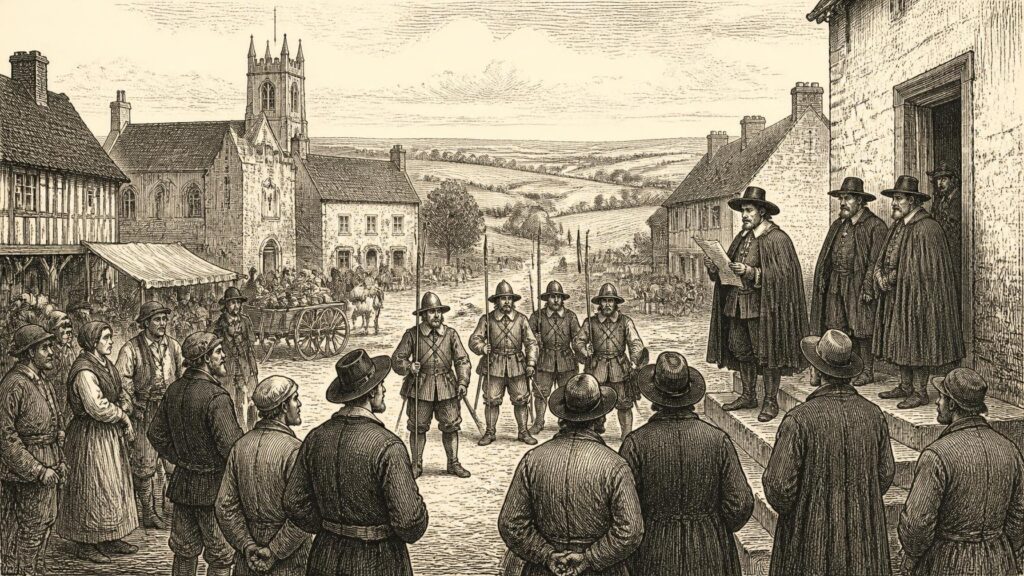
In the spring, commissioners were sent through Ulster to administer an oath to adult Scots. The surviving evidence securely places this initiative in April 1639, while some accounts date the wider enforcement phase to May. It is safer, therefore, not to assign a single day to its operation. Those required to swear promised obedience and allegiance to the king, renounced hostile action against him, and abjured covenants, oaths or bonds of mutual defence made without royal authority. The target was unmistakable: the Scottish National Covenant and any Irish extension of its political and religious commitments.
The order was backed by force. Wentworth quartered 1,500 soldiers in the province to assist the commissioners and underline the consequences of refusal. This was not merely a doctrinal declaration from Dublin; it inserted soldiers, officials and compulsory public profession into communities whose lives depended on seasonal labour, tenancy, markets and sea-borne exchange. The phrase “Black Oath” is the later, enduring name for the measure, but it conveys the hostility it generated among those who believed that the crown was demanding a repudiation of conscience as well as obedience.
Evidence does not support a simple picture in which every Scottish settler resisted. Some complied, some sought to avoid notice, and the record is uneven from district to district. Yet committed Covenanters did leave for Scotland rather than submit, and Scottish representations later in 1639 complained of oaths imposed on people in Ireland contrary to the Covenant. Departures could leave households, leases and holdings unsettled. Their aggregate scale cannot be measured with confidence, but the policy plainly disrupted a population which the crown had once viewed as a dependable buttress of plantation and Protestant security.
The oath therefore had a paradoxical effect. It sought to isolate Ulster from the Scottish revolution, but it confirmed for many settlers that their religious fate was bound to events in Scotland. It also widened the gulf between Presbyterian Scots and the Anglican establishment. The immediate result was coercive quiet rather than armed resistance. The longer result was a more suspicious, politicised and fractured northern province on the eve of the wider wars.
War Plans Across the Sea
Ireland mattered to the First Bishops’ War because Charles I needed men, money, shipping and secure western approaches for a confrontation with the Covenanters. Randal MacDonnell, second earl of Antrim, occupied a particularly revealing position in these calculations. A Catholic magnate of north-east Ulster with extensive Gaelic and Highland connections, Antrim wished to strike at the Campbell interest in western Scotland. His ambitions overlapped with the king’s wish to pressure the Covenanters, but they also carried their own dynastic and regional purposes.
Wentworth did not simply become Antrim’s willing partner. He distrusted Antrim’s designs and was concerned to preserve control over military policy in Ireland. The proposed intervention from Ireland remained entangled in rival plans, logistics and wider royal uncertainty. It did not produce an Irish landing in Scotland during 1639. The First Bishops’ War ended in June with the Pacification of Berwick, an agreement that halted the immediate campaign without resolving the fundamental dispute over church government and royal power.
That settlement prevented Ireland from becoming an active western front in 1639, but it did not remove its strategic importance. The failure of Charles’s expedition weakened the king’s position and increased the value of Wentworth’s administrative and military experience. Charles summoned him to England in July; by September Wentworth was there, moving towards the role of the king’s principal adviser. Christopher Wandesford, a trusted associate, was among those carrying the burdens of government during Wentworth’s absences. Ireland’s most forceful governor was thus drawn away precisely as the kingdom’s connections with the British crisis became more dangerous.
Land, Authority and Uneasy Order
The northern emergency unfolded against a wider background of insecurity over land and law. Wentworth’s government had pursued crown claims and plantation projects with particular force in Connacht. By 1639 that programme was moving slowly. Catholic landholders had resisted it through legal and political means, while the scale and reputation of the enterprise discouraged prospective English settlers. During the year Charles agreed to exempt the lands of the earl of Clanricarde from the Connacht plantation scheme, a notable indication that local power and court influence could constrain even Wentworth’s ambitious designs.
For Catholics of Old English and Gaelic Irish background, the royal government’s need for support against Scotland carried an obvious but uncertain implication. Their land titles, religious position and access to office had long been matters of grievance. The crown’s military difficulties suggested that Irish resources and loyalty now had greater value. But no comprehensive Catholic settlement was granted in 1639, and it would be misleading to present later promises, parliamentary subsidies or army raising as events already achieved within this calendar year. The political bargaining that followed belonged chiefly to 1640.
Nor should later catastrophe be projected backwards without qualification. The rebellion of October 1641 had not begun, and the Confederate movement did not exist. Ireland in 1639 remained formally peaceful, with courts functioning, estates managed and towns trading. But peace was being sustained through a highly assertive administration whose policies created distinct resentments among Catholics, Presbyterian Scots and sections of the Protestant political elite. The Black Oath was one visible expression of that brittle order.
Books from Dublin
Amid political strain, 1639 was also a notable year for Irish scholarship and printing. In August James Ussher, archbishop of Armagh, published Britannicarum ecclesiarum antiquitates in Dublin. This vast Latin study of the early churches of Britain and Ireland assembled historical, patristic and medieval material in pursuit of a documented account of Christian origins. Ussher’s work was shaped by confessional argument, especially over antiquity, succession and the authority of churches, but it also displayed the manuscript-based habits of the growing antiquarian world.
Sir James Ware, a Dublin-based official and antiquary associated with Wentworth’s administration, also published De scriptoribus Hiberniae in 1639. Often described as Ireland’s first biographical dictionary, it catalogued writers connected with Ireland across many centuries. Ware’s undertaking preserved and ordered knowledge of an Irish learned past at a time when political authority was increasingly centralised and contested. Both books were Latin works for educated readers, yet their appearance in Dublin demonstrates that the capital was not solely a garrison and administrative centre: it was also a site of ambitious historical scholarship.
Thus 1639 joined coercion and learning in a striking fashion. Commissioners demanded declarations of loyalty in Ulster while scholars in Dublin sought authoritative accounts of church and intellectual inheritance. Neither enterprise was politically neutral. In a kingdom divided by confession, ancestry and settlement, the meaning of the past and the terms of obedience had become urgent questions. The Black Oath did not cause the wars that would engulf Ireland after 1641, but it revealed the pressures already gathering beneath the surface of Stuart rule.
Primary Sources
- Wentworth, Sir Thomas
- Wandesforde, Christopher
- Butler, James
- MacDonnell, Randall
- Ussher, James
- Ware, Sir James
- Strafford, the Ulster-Scots and the Covenanters
- Scottish Protestant Clergy and the Origins of Dissent in Ireland
- The Scots in Ulster
- Seventeenth-century Ireland: The War of Religions
- Strafford in Ireland 1633–1641: A Study in Absolutism
- Ireland Under the Stuarts and During the Interregnum, 1603–1642
- Scotland and Ireland, 1632–1640
- The Supplication of the General Assembly Convened at Edinburgh, 12 August 1639
- Act Regarding the Ratification of the Articles of the Treaty
- Inhabitants of Antrim Parish
- Ideology and Early Modern Ireland
- Britannicarum ecclesiarum antiquitates
- De Scriptoribus Hiberniae
- Britannicarum Ecclesiarum Antiquitates: 1639 Dublin Edition
- The Political World of Thomas Wentworth, Earl of Strafford, 1621–1641
- Scottish Covenanters in Ulster and the Black Oath