Parliamentary Remonstrance1640 CE
In 1640, Ireland remained formally peaceful, but Charles I’s war against Scotland exposed mounting political divisions. Parliament granted four subsidies and discussed an enlarged army, then challenged the government’s methods of taxation and collection. Christopher Wandesford, succeeding Strafford as lord deputy, lacked his authority and repeatedly prorogued parliament. The Commons’ November remonstrance denounced Strafford’s arbitrary administration, monopolies, financial exactions and land policies, linking Irish grievances to his Westminster impeachment. Wandesford’s removal of parliamentary journal entries worsened distrust. His death in December, followed by Bishop John Atherton’s execution, weakened government further. Theatre and Gaelic scholarship continued amid crisis, foreshadowing 1641’s upheaval.
Dateline
A Kingdom Drawn into Wider War
In 1640, Ireland was not yet at war within itself. The uprising usually called the Irish Rebellion would not begin until October 1641, and the Catholic Confederation belonged to the following year. Yet this was a year in which the political arrangements that had held the kingdom together began to fail visibly. Ireland’s government was drawn into Charles I’s attempt to subdue the Scottish Covenanters in the Second Bishops’ War; its parliament became an arena for arguments about taxation, law and arbitrary rule; and confidence in the administration of Thomas Wentworth, earl of Strafford, drained away. By December, the lord deputy was dead, a prominent bishop had been executed, and the authority of Dublin Castle looked markedly less secure than it had in spring.
Ireland was one of the three Stuart kingdoms ruled by Charles I, but it had its own parliament, legal system and religious landscape. Its population included Gaelic Irish, Old English Catholic families long established in Ireland, Protestant settlers from England and Scotland, and a governing establishment closely tied to the English crown. These communities did not form two simple, fixed blocs. They differed by region, landholding, language, church allegiance and political interest. Nonetheless, disputes over plantations, land titles, religious conformity and the power of government gave the kingdom deep reserves of mistrust.
Strafford had governed Ireland since 1633 with an energetic, centralising programme often described as ‘Thorough’. He strengthened royal revenue, pursued defective land titles, promoted selected manufactures and tried to restore ecclesiastical property and discipline. These measures made the Dublin administration more effective, but they also created enemies among Catholics and Protestants, great landowners and merchants alike. By 1640 the strains of that system mattered more because Charles’s war with Scotland made Ireland a source of money and soldiers for a crisis beyond its shores.
March: Supply for the Scottish War
The Irish parliament assembled in Dublin on 16 March. Christopher Wandesford, Strafford’s close ally and deputy, opened the session; Sir Maurice Eustace was chosen Speaker of the House of Commons. Strafford arrived two days later. The immediate business was royal supply. Charles wanted an enlarged Irish army for use against the Scots, and the government sought money for the undertaking.
The Commons initially responded with striking speed. By 26 March it had agreed four subsidies, commonly valued at £45,000 each on paper. The vote has sometimes been treated as evidence of a compliant parliament. It was more accurately a bargain made under pressure and uncertainty. Members could support the king’s need for defence while expecting that their grievances would later receive attention. The meaning of a subsidy also depended on assessment and collection: an agreed grant did not automatically put cash into the treasury, and the burden fell unevenly upon local communities and property holders.
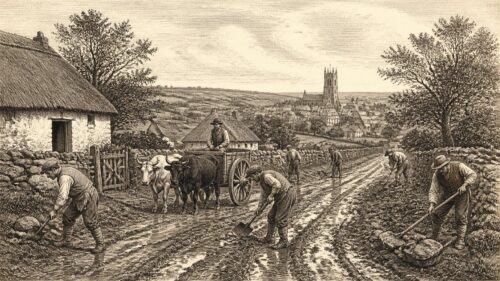
For ordinary people, high politics translated into familiar demands. Taxes had to be assessed and gathered through counties and local elites; military expansion required recruits, officers, clothing, weapons, transport, food and quarters. Ireland’s established army had already been enlarged after the Scottish crisis began, and the proposed force was to be much larger. The prospect alarmed critics who saw an armed instrument of a government they considered overbearing, while the Crown regarded it as essential to royal security.
Strafford left Ireland at the end of the first session to advise Charles in England. On 1 April Wandesford became lord deputy in his name. This transfer of responsibility was consequential. Wandesford was experienced, but he lacked Strafford’s forceful authority and inherited a parliament increasingly conscious that events in England and Scotland might change the balance of power in Ireland.
Revenue, Rights and Grievances
The second session began on 1 June. The issue was no longer whether four subsidies had been promised but how the remaining payments would be levied. On 13 June the Commons asserted a claim to shape the method of collection, pressing for a revised assessment that would reduce what the government expected to receive and slow payment. This was a constitutional argument as well as a fiscal one. Members were insisting that taxation involved the consent and continuing role of parliament, not merely an initial vote followed by executive direction.
The disagreement exposed the wider legacy of Strafford’s rule. His government had employed prerogative courts, monopolies and tightly managed administration to raise revenue and advance policy. It had also interfered heavily in economic life. Ireland’s overseas trade rested chiefly on cattle and pastoral produce, hides, butter, tallow, fish, timber and iron, with linen yarn and rugs among traded goods. These were not abstract figures to producers and merchants. Customs duties, licences and monopolies could reshape the price received for livestock, the movement of timber, the sale of tobacco or the marketing of yarn. Strafford’s regulations intended to assist a linen enterprise at Chapelizod had provoked particular resentment before being withdrawn.
Wandesford prorogued parliament rather than allow the dispute to gather force. But postponement did not restore confidence. Across the Stuart kingdoms, the Scottish resistance and the collapse of Charles’s English Short Parliament showed that royal policy could be challenged. Irish politicians watched closely. Catholic and Protestant critics, Old English and New English members, did not agree on every aim; nevertheless, hostility to arbitrary government could join people whose religious and social interests otherwise diverged.
Autumn: A Remonstrance Against Strafford
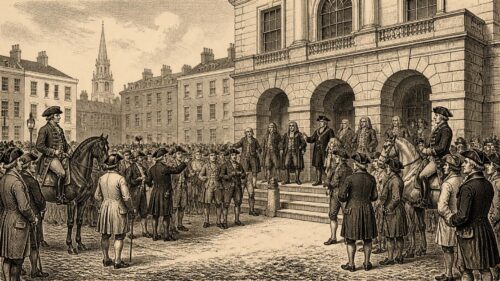
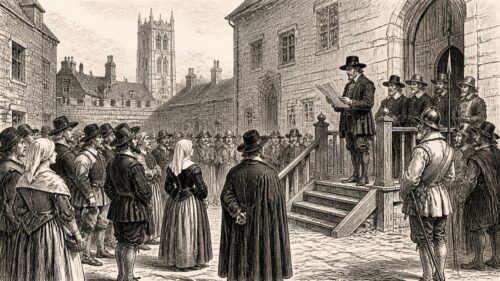
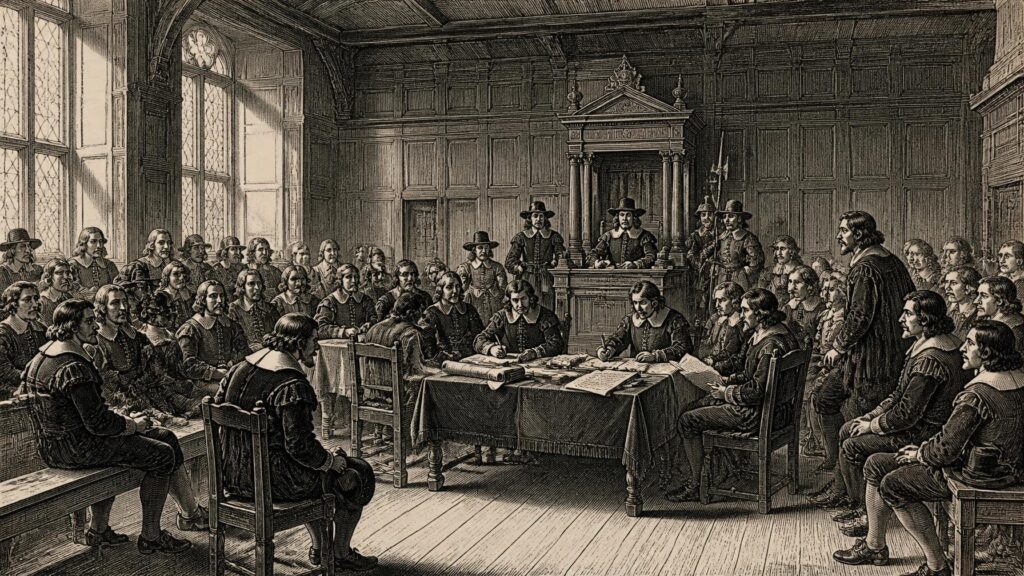
Parliament returned on 1 October, amid the more dangerous atmosphere created by the English Long Parliament, which had met in November and moved quickly against the king’s ministers. In Ireland, opposition members developed a comprehensive statement of complaints. The Humble and Just Remonstrance, presented to Wandesford on 9 November, condemned the alleged arbitrary character of Strafford’s government. It addressed abuses in administration and justice, financial exactions, monopolies and the handling of land and property. Crucially, it also accused Strafford of encouraging the use of an Irish army against the king’s subjects in England.
The remonstrance did not represent a modern national programme, nor should it be mistaken for a declaration of independence. Its language appealed to the kingdom’s laws, liberties and loyalty to the crown. That was precisely its force: critics argued that opposition to a minister’s methods could be presented as defence of the king’s proper government. A committee carried Irish grievances towards Westminster, linking Dublin’s parliamentary quarrel directly to Strafford’s impeachment in England.
Wandesford responded by proroguing parliament on 12 November. Later that month, acting on Strafford’s advice, he ordered entries concerning the Commons’ position on the subsidies to be removed from its journal. The act was politically disastrous. Far from erasing a difficulty, it suggested that the administration was willing to tamper with the record of parliamentary proceedings. It reinforced the belief that ordinary constitutional safeguards could not be trusted to survive executive necessity.
A Government Loses Its Centre
The pressure of the autumn overwhelmed Wandesford. He fell ill after the parliamentary crisis and died in Dublin on 3 December. His death deprived the Irish administration of the man most closely associated with Strafford’s government in the kingdom. It also came just as Strafford’s enemies in Westminster were gathering evidence for the proceedings that would eventually lead to his execution in May 1641. Ireland’s government did not collapse in December 1640, but its leadership had become uncertain at the very moment that political tempers were rising.
Two days after Wandesford’s death, on 5 December, John Atherton, Church of Ireland bishop of Waterford and Lismore, was hanged at Dublin after conviction in the Court of King’s Bench for sodomy. His proctor, John Childe, was also prosecuted, though his execution occurred later. Atherton’s case was a public scandal, amplified in print the following year. It had wider political resonance because Atherton had supported Strafford’s ecclesiastical programme, including efforts to recover church property. The conviction must not be reduced to a simple factional conspiracy: surviving evidence records grave accusations, a trial and a guilty verdict. But contemporaries inevitably read the downfall of such a prominent Straffordian churchman through the charged politics of the moment.
Culture in an Uneasy Dublin
Dublin’s cultural life nevertheless showed that the kingdom was not defined solely by parliament and war preparations. Henry Burnell’s Landgartha, a tragicomedy associated with the new theatre in Werburgh Street, belongs to this moment. Its printed text of 1641 states that it was first acted on St Patrick’s Day ‘1639’, a date that falls in 1640 under the calendar year then beginning on 25 March; catalogues therefore treat a 1640 performance as probable but not wholly certain. It is an important landmark: Burnell was Irish-born, and the play demonstrates the ambitions of a professional Dublin theatre only shortly before the political crises of the 1640s shut down such large-scale theatrical activity.
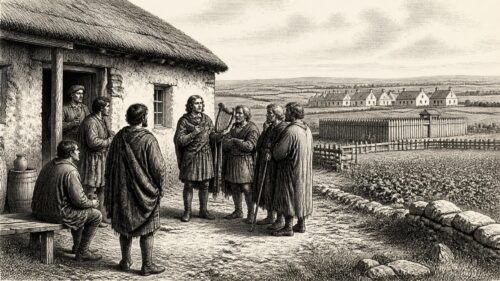
Gaelic scholarship also continued, though its dating must be handled with care. Dubhaltach Mac Fhirbhisigh’s surviving copy of Chronicon Scotorum is generally assigned to the period 1640–50 rather than securely to this single year. Its significance is nonetheless closely connected to 1640: a learned antiquary was preserving medieval Irish annalistic material at a time when the manuscript cultures and landed networks that sustained such work were approaching immense disruption.
The Unsettled Year’s Legacy
Nothing in 1640 made the rebellion of 1641 inevitable in a narrow sense. Decisions still lay ahead, and many people sought redress through petition, parliament and royal authority rather than violence. But the year made a peaceful settlement harder. The Crown had asked Ireland for money and an army to fight Scotland; the Irish Commons had rediscovered its capacity to contest the executive; Strafford’s opponents had connected Irish grievances to a British crisis; and the Dublin government had lost Wandesford just as its credibility weakened.
For contemporaries, 1640 was a year of taxes, hearings, troop levies, markets, sermons, theatre and manuscript work as well as elite confrontation. Its importance lies in the way these ordinary structures of government and society became politically charged. By the close of the year, Ireland remained formally at peace. Yet the institutions meant to contain disagreement—crown, council, parliament and established church—had all been drawn into a conflict that was already wider than any one kingdom.

Primary Sources
- Wentworth, Sir Thomas
- Wandesforde, Christopher
- Atherton, John
- The lord deputy’s deputy: Christopher Wandesford’s role in Sir Thomas Wentworth’s Irish administration of Charles I’s reign
- Wentworth's ‘eye of the Court’: Sir George Radcliffe's management of the Irish parliaments of Charles I's reign
- Parliamentary History, Vol. 43, pt. 3, pp. 276–290
- The Instruments of ‘Thorough’
- Wentworth’s Economic Policy
- The Impeachment of Wentworth
- The Irish Elections of 1640–1641
- Against the Lieutenant of Ireland
- A Speech Made by Captaine Audley Mervin to the Upper House of Parliament in Ireland, March 4. 1640
- Financial Accounts of Thomas Wentworth, Earl of Strafford, and Sir George Radcliffe, 1639–40
- The Life and Death of John Atherton Lord Bishop of Waterford and Lysmore
- Some Memorials of the Life and Penitent Death of Dr. John Atherton
- Landgartha
- Early Modern Drama
- Chronicon Scotorum
- Ireland Corporate of Itself
- A Failed Revolution? The Irish Confederate War in Its European Context
- The English Pale: A ‘Failed Entity’?
- Tonnage and Poundage Act 1640