

Lisnagarvey’s Covenant Warning1638 CE
In 1638, Wentworth’s administration strengthened revenue, episcopal authority and executive power through monopolies, revenue farms, land investigations and prerogative courts. His suspension and imprisonment of Lord Chancellor Adam Loftus demonstrated the vulnerability of even senior opponents, while proposed Connacht plantations heightened landowners’ fears. Scottish resistance to Charles I’s religious policies brought anxiety to Ulster, where Scottish settlers maintained links with Covenanting communities. Troops moved north as a precaution. Bishop Henry Leslie’s Lisnagarvey sermon and Antrim communion records revealed pressure for conformity. Meanwhile, church revenues expanded and Dublin’s theatre flourished. Ireland remained peaceful, but coercive government and religious division presaged crisis.
Dateline
Ireland in 1638 was not yet at war, but events across the North Channel made the kingdom’s outward calm increasingly precarious. Thomas Wentworth, Lord Deputy of Ireland and the dominant servant of Charles I in Dublin, had spent five years strengthening royal revenue, the established Church and executive authority. His administration could point to fuller coffers, a more disciplined army and a more assertive episcopate. Yet the same measures accumulated resentments among Old English landowners, Catholic communities, Protestant critics of religious change and Scottish settlers in Ulster. During this year, the crisis which began in Scotland entered Irish calculations with new urgency.
Revenue as Government
In January a proclamation enforced Wentworth’s tobacco monopoly. Tobacco was no longer a rare novelty: it had become a widely consumed imported commodity, and therefore an attractive object of state control. The monopoly did not simply regulate what could be sold. It channelled a familiar article of everyday consumption through a licensing and customs system from which the deputy expected both crown revenue and private advantage. Tobacco merchants, retailers and consumers encountered the state not as an abstraction but in prices, permits, seizures and the restricted legal supply of a desired good.
The measure belonged to a wider programme. Wentworth had obtained the tobacco patent in 1637 and, in 1638, also acquired the farm of taxes on imported wine. Such revenue farms placed collection in private hands in return for promised payments to the crown; they could be profitable, but they also bound government policy closely to the interests of those administering it. Wentworth’s regime pursued customs, monopolies and fiscal privileges with unusual energy. Ireland’s improving revenue was intended to make the crown less dependent upon parliamentary grants, while also furnishing the means for royal policy across the Stuart kingdoms.
That programme had consequences beyond Dublin’s quays and counting-houses. Imported tobacco and wine linked Irish ports to English, Atlantic and continental commerce, but the benefits and burdens were unevenly distributed. Traders faced official regulation; consumers paid what the regulated market would bear; and political opponents saw in such devices evidence that a powerful deputy could convert public authority into patronage and personal profit. The tobacco proclamation was consequently a small but revealing part of a larger contest over who possessed power in Ireland, and for whose benefit it was used.
The Deputy and the Chancellor
The sharpest demonstration of Wentworth’s authority came in his treatment of Adam Loftus, Viscount Loftus of Ely, the lord chancellor. Loftus had long been a leading figure in Irish government, but a dispute arising from a family property case opened a destructive breach between the two men. In May 1638 Wentworth had Loftus suspended from office and imprisoned after proceedings before the court of castle chamber. Loftus’s removal did not amount to a final dismissal from the chancellorship, which came only in December 1639, but the events of 1638 were momentous: the kingdom’s senior judicial officer had been overborne by the deputy and council.
Contemporaries could see that the episode was about more than one inheritance dispute. It exposed the reach of prerogative government, in which the deputy’s influence over courts and council could make resistance hazardous even for a peer and office-holder. Wentworth’s supporters could present rigorous action as the correction of misconduct; his critics saw a warning that legal process itself could be bent to political will. The affair supplied later enemies of the deputy with powerful material, while undermining confidence among men who had previously worked within his administration.
There was no Irish parliament sitting in 1638 in which this dispute could be publicly tested. That absence mattered. Wentworth had used the parliament of 1634–35 to obtain legislation and subsidies, but thereafter he governed without regular parliamentary scrutiny. Dublin Castle, the privy council, prerogative courts and commissions were the main instruments through which decisions were made. For many inhabitants, government was experienced through local officials, sheriffs, bishops, customs men and land commissions rather than through representation. The Loftus case showed just how formidable the centre could be when those instruments were directed against an individual opponent.
Land, Plantations and Uneasy Prospects
Land remained at the heart of political anxiety. Wentworth’s government had pursued plantations and investigations into defective titles, particularly in Connacht, where the crown sought to establish rights that could enable a new redistribution of property. By 1638 the Connacht project was moving slowly. Catholic landowners resisted through petitions, legal argument and collective caution; the scale of surveying, title-making and resettlement was formidable; and prospective English settlers were not readily drawn to a scheme associated with coercion. In June, Wentworth himself acknowledged the heavy labour involved in the plantations.
Slow progress did not make the policy harmless. The prospect that old titles might be reopened could alter bargaining, credit and local authority long before a plantation was completed. Landowners in Connacht and elsewhere had reason to observe events in Dublin closely, especially when the Loftus affair seemed to show how little protection high status might provide. Wentworth also enlarged his own Irish landed interests, including acquisitions in Wicklow during 1638. His private estate-building was therefore inseparable, in the eyes of critics, from the wider expansion of crown power over land and tenure.
For rural communities, however, 1638 was not reducible to official plans. Most people lived by mixed husbandry, seasonal labour, small markets and household production. Their religious loyalties, dependence on landlords and exposure to dues varied widely by region. The surviving record is strongest for the state, churches and landed classes, and it is important not to mistake their concerns for the whole texture of daily life. Even so, fiscal regulation, disputed land and increasingly insistent ecclesiastical discipline could all reach far beyond the circles that generated written petitions and official correspondence.
Scotland Comes Nearer
The decisive external development was the Scottish National Covenant. Signed in Edinburgh in February 1638, it united opposition to Charles I’s religious programme and to the imposition of episcopal authority in the Church of Scotland. The covenanting movement was Scottish in origin, but its implications for Ireland were immediate. Ulster contained large communities of Scottish settlers, bound to western Scotland by migration, trade, kinship, ministry and shared Presbyterian sympathies. What happened in Scotland could not be kept on the other side of the sea.
Wentworth recognised the danger. During the summer, as the prospect of a peaceful settlement between king and Covenanters diminished, Charles sought to learn what assistance Ireland might provide in a coming confrontation. Wentworth regarded the Scottish population of Ulster as a potential source of support for their co-religionists. His concern was political and military as well as theological: ports, shipping, information and armed men could connect Antrim and Down with the Clyde and the Scottish coast with alarming speed.
In November, part of the Irish army was moved towards Ulster. This was a precaution rather than the opening of a war in Ireland. The Bishops’ Wars would begin in 1639, and the notorious oath compelling Ulster Scots to renounce the Covenant—the ‘Black Oath’—was imposed only in 1639. Those later events should not be read back as if they had already happened. But in late 1638 the logic behind them was taking shape: Dublin Castle was preparing to make religious conformity a test of political reliability.
Lisnagarvey and Antrim Parish
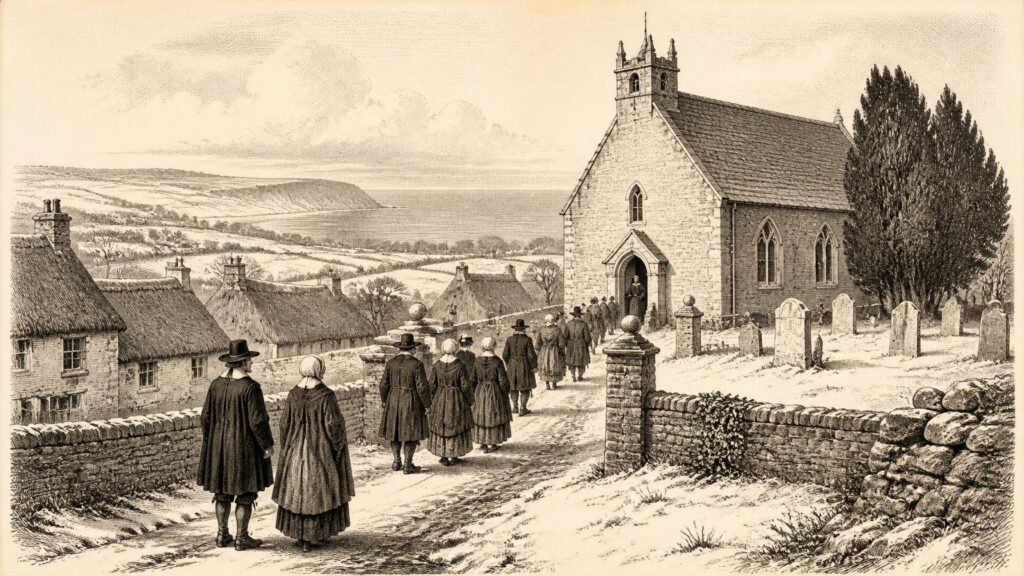
The conflict was already visible in church life. On 26 September, Henry Leslie, Church of Ireland bishop of Down and Connor, preached a visitation sermon at Lisnagarvey, now Lisburn. He attacked the Scottish Covenant and complained of widespread nonconformity and disobedience among both clergy and laity. Leslie was not a detached observer. With Wentworth’s backing, he had driven Presbyterian ministers from office in his dioceses and worked to restore episcopal income and authority. His sermon placed the crisis in Scotland directly before an Ulster audience.
A remarkable parish record from Antrim gives the issue a domestic scale. Communion-taking, including kneeling at reception, had become an important public marker of conformity to the established Church. In the Easter 1638 list, only members of thirty-two households out of 238 were recorded as receiving communion. A Christmas list recorded 153 households, a striking increase. The document itself presents this as evidence that more Scots were conforming, but its marginal notes—such as ‘gone’, ‘desires time’ and ‘promises conforming’—also preserve hesitation and pressure.
These figures cannot tell us every individual’s belief. Absence from communion might reflect theology, fear, local conflict, practical circumstance or resistance to a ceremony regarded by Presbyterians as unscriptural. Nor were all people named in the lists necessarily Scottish. Yet the records demonstrate that religious policy was being measured household by household. In Antrim parish, conformity was not merely proclaimed from pulpit or council chamber; it was counted at the communion table.
A Church Rebuilt, A Church Contested
Wentworth’s ecclesiastical programme continued elsewhere. John Bramhall, bishop of Derry and the deputy’s principal church adviser, pursued the recovery of revenues and lands for the Church of Ireland. In 1638 he claimed that annual church revenues in the ecclesiastical province of Armagh had risen by more than £14,000. The figure was a partisan administrative claim, not a complete account of religious life, but it conveys the scale of the ambition. Bramhall also regarded the restoration of a separate diocese of Cloyne in 1638, after a long lapse, as a significant success.
Such reconstruction strengthened bishops and benefices, but it could also intensify hostility. Protestant laypeople who disliked Laudian ceremonial and Presbyterian sympathisers in Ulster found the Church more demanding; Catholic proprietors and tenants could see clerical recovery as another threat to property or customary arrangements. Catholic worship remained deeply rooted across much of the island despite the legal supremacy of the established Church. The kingdom’s confessional landscape was therefore neither uniform nor static: official institutions gained resources, while the social consent needed to sustain them became more fragile.
Stage, Ceremony and Courtly Dublin
Dublin also displayed a more cultivated face of Wentworth’s rule. James Shirley’s The Royal Master, written for John Ogilby’s new theatre in Werburgh Street and performed in Dublin in late 1637, appeared in print in 1638. Its title page advertised performances at the new Dublin theatre and before the lord deputy at Dublin Castle. In February 1638 Ogilby received a royal warrant appointing him master of the revels in Ireland, giving him control over public theatrical performance.
This was an important, if socially narrow, cultural development. The Werburgh Street theatre brought professional actors and musicians to a city whose governing and legal elites increasingly sought metropolitan entertainments. Wentworth and his entourage attended, while lawyers, soldiers and office-holders formed much of the audience. The theatre depended upon elite patronage and struggled to compete with popular diversions, but it testified to Dublin’s place within the cultural circuits of the Stuart kingdoms. The printed play, dedicated to George FitzGerald, sixteenth earl of Kildare, also joined courtly authority, Old English aristocratic prestige and commercial print.
By the end of 1638, then, Ireland was tied more tightly than ever to the troubles of Charles I’s multiple kingdoms. Wentworth’s government appeared strong: revenue was regulated, opponents could be imprisoned, bishops were better endowed, troops were available and courtly culture flourished in the capital. Its strength was also its weakness. A system that depended so heavily on coercion, personal authority and religious uniformity had limited room for dissent. Scotland’s Covenant exposed that fact, and Ulster gave it an Irish frontier. The year closed not with rebellion, but with the warning signs of a crisis that official power could postpone, not resolve.
Primary Sources
- Wentworth, Sir Thomas
- Loftus, Adam
- Bramhall, John
- Leslie, Henry
- Ogilby, John
- Shirley, James
- Livingston, John
- Blake, Richard
- King, Sir Robert
- Margetson, James
- The Royal Master
- CELM: James Shirley
- Statute Law Revision Act 2015
- Inhabitants of Antrim Parish
- Scotland and Ireland, 1632–1640
- Studies in Irish History, 1603–1649
- Ireland Under the Stuarts, Volume I
- Strafford in Ireland 1633–1641
- Sources: National Library of Ireland Catalogue
- Early Stuart Irish Warrants, 1623–1639
- The Covenanters in Ulster