

Castlecomer’s Crown Title1637 CE
In 1637 Thomas Wentworth’s administration strengthened royal control in Ireland through ceremony, land investigations, economic regulation and institutional reform. His provincial progress projected authority, while the Commission for Defective Titles unsettled proprietors and enabled Christopher Wandesford’s crown-backed acquisition of Castlecomer, displacing the Brennan community. Proclamations regulated cloth, currency, land titles and licensed trade, supporting revenue and English commercial standards. Dublin gained building projects and a chartered Goldsmiths’ Company; Trinity received Laudian statutes. Church discipline pressured Presbyterians, despite William Bedell’s Irish-language work. Meanwhile, Mícheál Ó Cléirigh and Franciscan patrons sustained Gaelic Catholic scholarship through Leuven. Apparent order masked grievances and insecurity.
Dateline
In 1637 Ireland lay under the unusually forceful rule of Thomas Wentworth, lord deputy for Charles I. His administration presented itself as orderly, prosperous and reforming: customs income was rising, piracy had diminished, Dublin was being reshaped as a more imposing seat of government, and the Church of Ireland was being more closely disciplined. Yet this apparent calm rested on intrusive government, prerogative courts and a searching examination of land titles. The year’s best-dated developments show how power reached from a royal procession and Dublin’s corporations to the fields of Kilkenny, the legal paperwork of Connacht and the manuscript culture of Irish Franciscans.
A Government on Display
Wentworth’s authority was both practical and theatrical. In August he made a progress through Leinster and Munster, receiving formal civic welcomes in a succession of towns. Such occasions allowed municipal elites to demonstrate loyalty and gave the lord deputy a visible presence far beyond Dublin Castle. They should not, however, be mistaken for a popular verdict on his rule. The receptions were carefully managed. Many landowners, both catholic and protestant, had reason to fear the administration’s use of commissions, inquisitions and prerogative jurisdictions to reopen questions apparently settled by long possession.
The progress occurred after an important victory for the government in the west. The Galway jurors who had resisted the crown’s claims had submitted late in 1636 and formally acknowledged the king’s title in February 1637. That outcome encouraged Wentworth to press forward with wider schemes of plantation and with the Commission for Defective Titles. Its stated purpose was to regularise ownership: occupiers could receive a more secure grant after proving or surrendering their claims. In practice, the process could bring higher rents, altered tenure and feudal obligations, while also exposing estates to fresh crown claims. Land values suffered as uncertainty spread.
Castlecomer and Dispossession
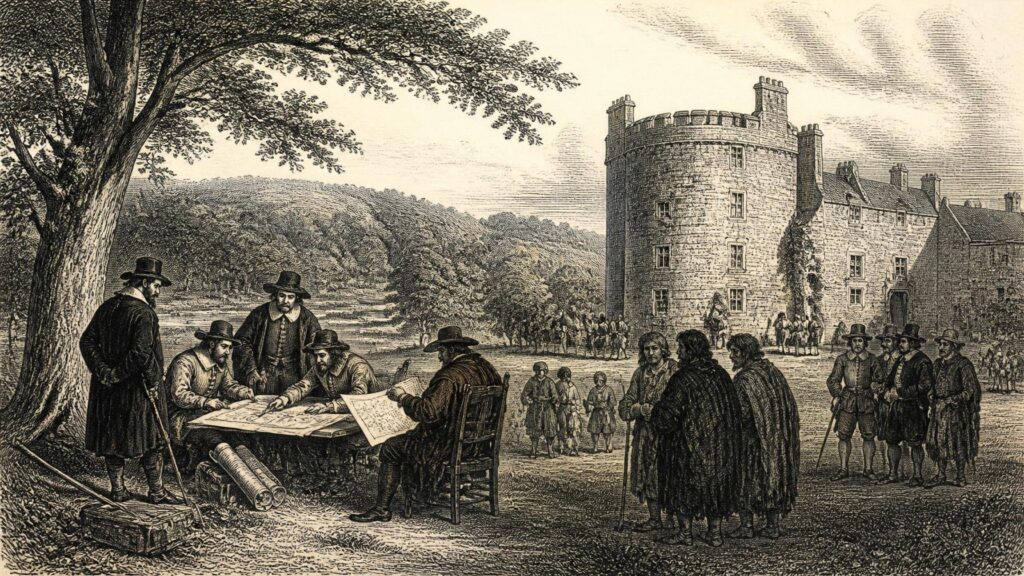
The clearest local example came in the territory of Idough, around Castlecomer in County Kilkenny. On 25 July Christopher Wandesford, Wentworth’s close associate and master of the rolls, acquired Castlecomer and Idough. The acquisition was not a simple commercial purchase. A 1635 inquisition had found the territory to belong to the crown, treating the hereditary occupiers, the Ó Braonáin or Brennan sept, as having no valid legal title. Wandesford’s later estate was thus founded on a legal finding backed by the coercive capacities of the Caroline state.
The transaction reveals the human meaning of abstract language such as ‘defective title’. The Brennans were not strangers on unused ground: they were the established local community. Wandesford rebuilt the castle, developed the estate and planned settlement and production, but the original holders had been displaced. His 1640 will, made only three years later, directed compensation for those who had held land in 1635, suggesting at least a later unease about the settlement’s justice. That payment was never realised amid the upheavals that followed. In 1637, however, Castlecomer stood as a striking demonstration that crown title could be translated into a private estate for a leading servant of government.
Rules for Land, Cloth and Coin
Official measures issued during the year show that authority was being applied to ordinary economic life as well as to great estates. A proclamation of 31 March concerned the making and sale of cloth and woollen commodities. On 6 April another ordered the abandonment of the title or name of Irish money or ‘harps’ in accounts, receipts and payments, requiring sterling and English money instead. Such a direction mattered wherever rents, wages, debts and market transactions were recorded. It did not instantly transform every exchange in a mixed and locally varied economy, but it expressed the administration’s wish to standardise commercial calculation under English monetary terms.
Further orders connected landholding to the government’s wider programme. On 13 July an order addressed tenures under the Commission for Defective Titles; on 31 October another concerned proof of title by landholders in Roscommon, Sligo, Mayo and Galway. The titles of these measures alone convey the geographical scale of the investigation, especially in Connacht. Plantation there was still incomplete in 1637. Resistance by catholic proprietors and the difficulty of attracting settlers meant that paper claims, surveys and negotiations advanced more readily than a wholesale transfer of occupied land. Nevertheless, the prospect of such a transfer shaped behaviour long before any final settlement.
Ireland’s principal exports remained deeply tied to pastoral and coastal production: cattle and their by-products, hides, butter and tallow, alongside fish, timber, iron, linen yarn and rugs. The government saw customs as a source of royal revenue, not merely a record of commerce. The more effective collection of customs and a safer sea passage helped enrich the exchequer, while regulation could also constrain Irish producers in favour of English interests. A late-December proclamation licensing retail sales of wine and aqua vitae reminds us that imported drink, inns, taverns and urban consumption also belonged to this regulated economy.
Dublin’s Corporate Capital
Dublin benefited from the concentration of officials, soldiers, petitioners, noble households and tradesmen around Wentworth’s court. The government renovated Dublin Castle and Christ Church Cathedral and began a building for the Irish mint, making the capital more visibly royal. On 22 December 1637 Charles I’s charter incorporated the Wardens and Commonalty of Goldsmiths of the City of Dublin. The charter is significant not simply as a privilege for a craft: it formally joined standards of workmanship, precious-metal testing and corporate government in the city. The body created by that charter remains recognised in Irish hallmarking law.
For working goldsmiths and their customers, an assay system offered a means of establishing the fineness of gold and silver and of identifying legitimate manufacture. For the authorities, it made valuable goods more legible and trade more governable. This was a small institution beside the great disputes over plantation, but it captures a wider feature of the year: Ireland was being drawn into a denser framework of charters, licensed trades, regulated measures and documentary oversight. The reach of government was uneven, but its ambitions were unmistakably expansive.
Trinity and Laudian Order
On 25 May letters patent from Charles I replaced Trinity College Dublin’s existing statutes with a more comprehensive code prepared by William Laud, archbishop of Canterbury and chancellor of the university. The ‘Laudian statutes’ placed the college within the religious and administrative priorities associated with Laud and Wentworth: stronger institutional discipline, conformity and a more clearly defined hierarchy. The change belonged to a broader remodelling of the Church of Ireland in which Bishop John Bramhall of Derry was a formidable administrative force.
This did not mean that Irish-language religious work had disappeared. William Bedell, formerly provost of Trinity and by 1637 bishop of Kilmore and Ardagh, had promoted Irish-language worship and catechetical material in his diocese. His career illustrates a tension within the established church: reforming zeal could coexist with neglect of the Irish language at higher institutional levels. Meanwhile, Ulster’s Presbyterian ministers faced pressure to conform. John Ridge, Robert Blair and James Cunningham had left Ireland for Scotland in 1637 after ecclesiastical discipline made continued ministry in their dioceses impossible. Thus a year of institutional consolidation also deepened confessional unease.
Ó Cléirigh’s Continuing Work
Against this atmosphere of state discipline, Gaelic Catholic scholarship continued through networks that joined Ireland to the Irish Franciscan college at Leuven. The Annals of the Four Masters had been completed in 1636, but Mícheál Ó Cléirigh’s work did not end with that achievement. In 1637 he was preparing to return to Leuven, having continued to consult, copy and organise Irish historical material. He had begun a transcription of Geoffrey Keating’s recently completed Foras feasa ar Éirinn, though an assistant completed it, and he was back at St Anthony’s College before the end of the year.
Ecclesiastical approbations attached to associated Franciscan manuscripts show the care taken to secure learned and clerical endorsement. Thomas Fleming, the Franciscan catholic archbishop of Dublin, was an important patron of Ó Cléirigh and other scholars. His support points to the resilience of a Catholic intellectual world that worked partly in Ireland and partly through continental institutions. In a decade when the government sought to make land, worship and public institutions more compliant with English models, Irish scholars were preserving and reshaping a historical inheritance in Irish and Latin for readers beyond the reach of Dublin Castle.
There was no single dramatic rupture in Ireland during 1637. Instead, the year recorded the accumulation of pressures: a lord deputy displaying authority in the provinces; legal machinery testing possession; a Kilkenny community losing land to a crown-backed estate; commercial rules reaching into cloth and currency; corporate and university institutions receiving new foundations; and Catholic scholars carrying manuscripts towards Leuven. The apparent order of Wentworth’s Ireland was real enough in its paperwork, ceremonies and revenues. So too was the resentment generated by the methods through which that order was made.
Primary Sources
- Wentworth, Sir Thomas
- Wandesforde, Christopher
- Ó Cléirigh, Mícheál (O'Clery, Michael)
- Fleming, Thomas
- Bedell, William
- Bramhall, John
- Ridge, John
- Eustace, Sir Maurice
- Division – Preliminary
- Irish Script on Screen – MS A 16
- Irish Script on Screen – KBR (Royal Library of Belgium)
- The Plantation of Connacht
- Wentworth's Economic Policy
- The lord deputy’s deputy: Christopher Wandesford’s role in Sir Thomas Wentworth’s Irish administration of Charles I’s reign
- Letter From Wentworth To The Mayor And Sheriffs 28 April 1637
- Statute Law Revision Act 2015
- Hallmarking Act, 1981
- Holdings: The Company of Goldsmiths of Dublin 1637-1979 Charter Dinner Thursday, 1st November 1979
- The Castle Comer Colliery Token
- Add MS 30383
- Exploring the Irish Annals
- Financial Accounts of Thomas Wentworth, earl of Strafford, and Sir George Radcliffe, 1639-40