

Portumna’s Refusal1635 CE
In 1635, Thomas Wentworth’s Dublin administration intensified efforts to reshape Ireland through parliamentary legislation, religious conformity, economic regulation and investigations of land title. Parliament passed measures on correction houses, alehouses, husbandry, clergy and Protestant schools, but failed to secure promised protections for established estates. Crown pressure reached Ulster when London plantation companies lost their charter, and peaked in Connacht, where Galway jurors at Portumna rejected the king’s claimed title and were fined and imprisoned. Wentworth also crushed Lord Mountnorris politically. Meanwhile, Hugh Ward’s death at Louvain marked a loss to Irish scholarship. The year revealed widening distrust of coercive government.
Dateline
In 1635 Ireland was governed with unusual energy from Dublin Castle. King Charles I’s lord deputy, Thomas Wentworth, sought not merely obedience but a more profitable, disciplined and visibly English-style kingdom: one in which parliament supplied revenue, churches obeyed tighter rules, land titles could be examined for defects and local society was brought under closer official supervision. The year did not bring a general war. Its importance lay instead in the coercive use of law, courts and administrative inquiry. In Connacht especially, a county jury’s refusal to endorse the crown’s claim to land exposed the limits of this programme.
Parliament’s Final Session
The Irish parliament’s third and final session met from 26 January to 18 April. Wentworth had called the parliament in 1634 chiefly to obtain money for the crown, and it had granted substantial subsidies. Many Catholic and Old English landowners had supported that arrangement in the hope that the crown would confirm the promised ‘Graces’: concessions intended to regularise insecure land titles, ease particular legal disabilities and acknowledge established interests. By 1635, however, it was clear that the most valuable protections would not be embodied in statute. The long-sought assurance that sixty years’ peaceful possession would secure title against the crown was not granted.
The final session nevertheless passed a large body of legislation. That achievement suited Wentworth’s style of rule. Parliamentary statute gave authority and permanence to measures prepared under the crown’s supervision, while the deputy retained close control over what could become law. The dissolution in April ended the immediate parliamentary bargain. It also left landholders with a sharper understanding that subsidies paid to the king had not purchased dependable security for their estates. This was not yet a united political opposition, but it deepened distrust among groups whose co-operation Wentworth needed.
Regulating Work and Everyday Order
Several enactments approved on 18 April illuminate the practical ambitions of government. An act for houses of correction required each county to provide a place, with land and working equipment, for the confinement and compulsory employment of ‘rogues’, vagabonds, sturdy beggars and others classed as idle or disorderly. It was a programme rather than proof that such institutions immediately appeared across Ireland. Yet the statute shows officials treating poverty, mobility and perceived idleness as matters for county administration, coercion and labour discipline, rather than simply private charity or parish relief.
An act licensing ale-sellers similarly extended magistrates’ reach into ordinary commercial life. Its preamble complained of excessive alehouses, including houses in woods, bogs and dispersed places, which authorities portrayed as unsafe resorts for malefactors, gamblers and unattached people. Inns and alehouses were essential places of refreshment, lodging, news and sociability, particularly on poor roads; the measure did not abolish them. It sought instead to limit their number, identify their keepers and place them in locations answerable to local authority. Regulation was thus tied to concerns about travel, policing and social hierarchy.
The session also enacted the strikingly named law against ploughing by the tail and pulling wool from living sheep. Such practices were condemned as cruel and destructive: harnessing animals by the tail could maim them, while tearing wool directly from sheep damaged valuable stock. The law belongs to a wider official concern with husbandry, woods and agricultural improvement. Ireland’s export economy rested heavily on cattle, hides, butter, tallow, wool, fish, timber and iron, although grain mattered in particular districts. Protecting animals and regulating labour were therefore not marginal curiosities; they were connected to a government anxious to secure productive resources and taxable trade.
Church, Schools and Conformity
Ecclesiastical policy remained another field of reconstruction. Wentworth’s ally John Bramhall, bishop of Derry, pressed recovery of church revenues, clerical residence and stronger episcopal discipline. A crown grant in April 1635 restored appropriations to the Church of Ireland, giving fresh momentum to efforts to reclaim resources held outside ecclesiastical control. Parliament also passed an act encouraging resident clergy and Protestant schools. Its aspiration should not be mistaken for a description of provision already achieved: many parishes were poor, church structures were uneven, and the established church was far from commanding the religious allegiance of most inhabitants.
The previous year’s convocation had accepted the Thirty-Nine Articles alongside the older Irish Articles. In early 1635 Wentworth retreated from a wholesale imposition of the English canons after sustained clerical resistance. The outcome was still consequential. New Irish canons supplied standards for enforcing a more uniform church order, while Scottish ministers in east Ulster who held advanced presbyterian or congregational views faced removal or flight. Yet compliance varied greatly. High-church ceremony could be introduced in Dublin’s Christ Church Cathedral; worship in many country churches was likely much less transformed. Government ambition ran ahead of its practical reach.
Ulster and the London Companies
In Ulster, a decision made in England bore directly upon the Plantation of Londonderry. After proceedings in Star Chamber, the City of London and the Irish Society were found guilty on 28 February of failures in their plantation obligations. They were fined the enormous nominal sum of £70,000 and their charter was declared forfeited. The ruling struck at the London companies whose capital, settlers and estates had helped shape the county and city since the early seventeenth century.
The judgment did not mean that Londonderry’s population or landscape changed overnight. It did, however, demonstrate that even privileged corporate planters held their property subject to royal scrutiny. The crown’s case criticised the companies’ management and their alleged failure to fulfil building and settlement duties. For Wentworth, the affair offered both a potential gain in revenue and an assertion that plantation interests must answer to central government. It also unsettled an already complex province, where English and Scottish settlers, native Irish communities, landlords and churches occupied unequal but interdependent worlds.
Connacht’s Contested Title
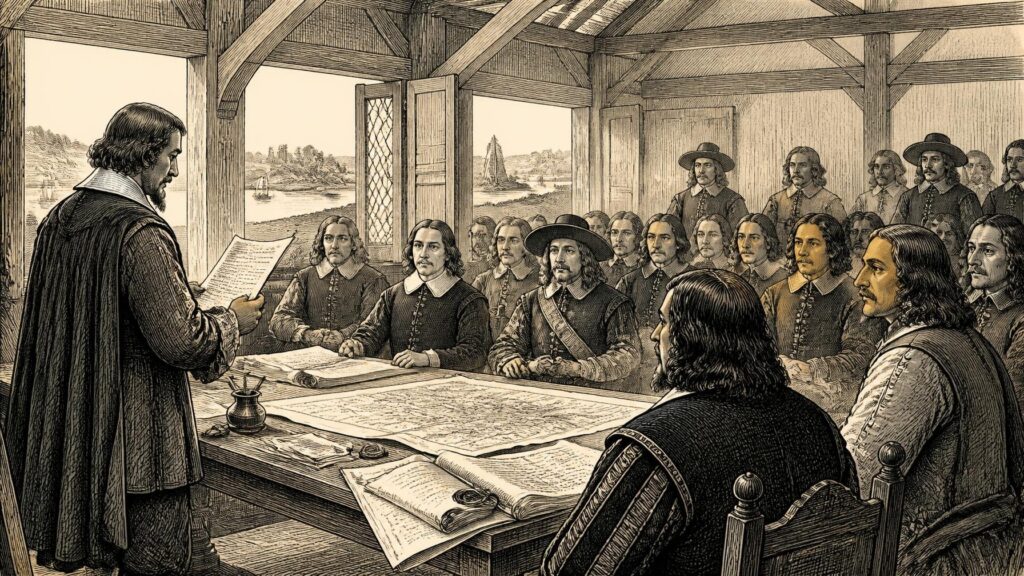
The most significant Irish development of 1635 was Wentworth’s summer progress through Connacht. A commission investigated the crown’s claimed title to the province, drawing upon medieval grants, forfeitures and legal arguments whose relevance landholders strongly disputed. If the king’s title were accepted, the government could require proprietors to take new grants on terms favourable to the crown and could prepare the ground for a plantation settlement. This was not merely an antiquarian exercise. It placed the ownership, inheritance and future occupation of extensive estates under threat.
Juries in Roscommon, Sligo and Mayo found for the crown. County Galway proved different. On 13 August, at Portumna, the Galway jury refused to find the king’s title. Its decision was encouraged by the standing of Richard Burke, fourth earl of Clanricard, a Catholic magnate whose estates and connections made Galway unusually difficult terrain for the deputy. The jurors did not deny royal government altogether; they disputed the legal chain by which the crown claimed proprietorship of their county. Their refusal was therefore a direct challenge to the method by which Wentworth hoped to convert historical claims into present control.
The administration answered with intimidation rather than concession. The jurors were imprisoned and heavily fined for what officials treated as a perversion of justice, while Galway landowners sent agents to London to protest. The immediate episode must be kept distinct from what followed: Connacht was not planted wholesale in 1635, and a full settlement was never completed before the upheavals of 1641. But the inquiry made the danger unmistakable. A defective title could become a means of compulsion; a jury that resisted could be punished; and local landholding societies could not assume that loyalty or long possession would protect them.
Pressure at the Centre
Wentworth’s forceful methods also disturbed members of the Protestant and administrative elite. During 1635 he quarrelled with Lord Mountnorris, vice-treasurer and a participant in the profitable customs farm, over office, money and influence. In December Wentworth used military jurisdiction against him: on 12 December Mountnorris was court-martialled, sentenced to death for alleged insubordination and immediately pardoned, but then removed from office. The episode displayed the deputy’s willingness to turn a political struggle into a disciplinary example.
Events in Galway took a more personal turn when Richard Burke, earl of Clanricard, died in England on 12 November. Contemporaries connected his death with the strain of the Connacht dispute, though no simple medical conclusion can be drawn. His death deprived Galway’s opponents of a powerful patron at a crucial moment. Complaints against Wentworth nevertheless reached court through agents and sympathetic nobles. The political crisis was developing, even if the deputy still retained Charles I’s support.
Learning Across the Sea
Irish Catholic intellectual life continued despite the restrictions and uncertainties at home. On 8 November Aodh Buidhe Mac an Bhaird, known in Latin as Hugh Ward, died at Louvain. The Donegal-born Franciscan had helped organise the Irish scholarly enterprise centred on St Anthony’s College, collecting manuscripts and planning editions of Irish saints’ lives. His death came before much of the material he had assembled could be published. Nevertheless, those collections and the work of fellow Franciscans, including Micheál Ó Cléirigh, would nourish the recovery and preservation of Irish historical tradition.
Thus 1635 joined local coercion to international connections. In Dublin, Portumna and Londonderry, royal authority was being translated into statutes, courts, surveys and discipline. In Louvain, Irish scholars worked to preserve a learned inheritance beyond the immediate reach of the state. The year’s defining tension was not open rebellion, but the growing collision between a crown determined to make Ireland more governable and communities determined to retain land, belief, custom and memory.
Primary Sources
- Wentworth, Sir Thomas
- Burke, Richard
- Bramhall, John
- Mac an Bhaird, Aodh Buidhe (Ward, Hugh; Vardaeus, Hugo)
- Wentworth’s ‘eye of the Court’: Sir George Radcliffe’s management of the Irish parliaments of Charles I’s reign
- Strafford in Ireland 1633–1641: The Plantation of Connacht
- Strafford in Ireland 1633–1641: Wentworth’s Economic Policy
- Crown Servants: Series One: Papers of Thomas Wentworth
- State Papers Ireland 1509–1782: government papers on Irish affairs
- Statute Law Revision (Ireland) Act 1878
- Statute Law Revision Act 2007, Schedule 2
- A History of the Irish Poor Law
- Final Report of Her Majesty’s Commissioners Appointed to Inquire into the Operation and Administration of the Laws Relating to the Sale of Intoxicating Liquors
- The Commonwealth of Ireland
- The Church of Ireland: power and distance in the early-seventeenth-century Atlantic
- Internal Exile: Ussher and Laudianism: 1633–40
- National Library of Ireland Catalogue: Church of Ireland and William Laud Manuscripts
- Londonderry 400: Plantation of the Walled City
- Great Parchment Book Awarded UNESCO Memory of the World Status
- Ireland Under the Stuarts, Volume I
- A Brief Historical Narrative of the Honourable the Irish Society
- Online Access to Irish-language Manuscripts in the Royal Library of Belgium
- The Graces (1625–1641)