

The Graces Withheld1634 CE
In 1634, Thomas Wentworth convened Charles I’s first Irish parliament, tightly managing elections, procedure and debate from Dublin Castle. Parliament unanimously granted six subsidies, expecting enactment of the Graces, concessions sought by Catholic and Old English elites, especially secure land titles. Wentworth subsequently refused the crucial land-security measure, confirming that revenue did not purchase limits on royal power. He also constrained parliamentary action over Sir Vincent Gookin’s inflammatory letter. Church convocation adopted the English Thirty-Nine Articles under pressure, advancing conformity despite resistance. Meanwhile, Geoffrey Keating completed Irish-language history; customs, trade and emigration to Spanish Flanders linked Ireland to Stuart Europe.
Dateline
In 1634, Irish public life was drawn towards Dublin Castle. Thomas Wentworth, Lord Deputy since the previous summer, called the first Irish parliament of Charles I’s reign and used it to secure money, redefine the terms on which political grievances could be heard, and press religious conformity within the established Church. The year did not bring open war or a general rising. Its importance lay instead in a tightly managed parliamentary bargain that initially appeared to promise accommodation, but ended by exposing how limited that accommodation would be.
A Parliament Carefully Made
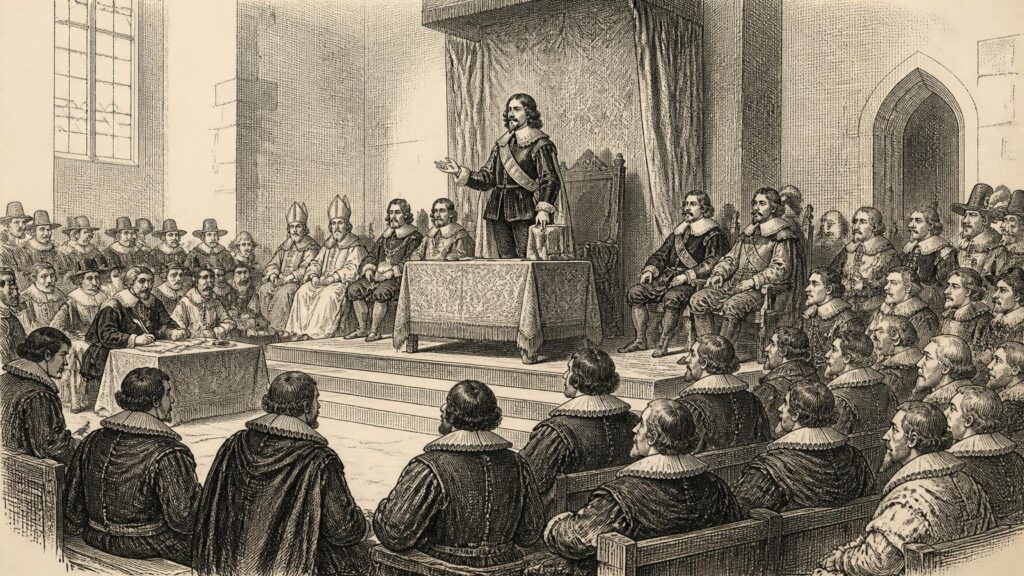
The Irish parliament formally opened at Dublin Castle on 14 July. Wentworth addressed the two Houses on 15 July, setting the order of business with striking clarity: supply for the king came first; only after that might legislation, proposals and grievances be considered. Charles I remained in England, so Wentworth presented royal authority in person, with ceremonial as well as administrative weight.
This was not a representative assembly in a modern sense, nor was it evenly representative of Ireland’s religious and social communities. Elections had been closely managed. Boroughs created or maintained under earlier plantation policies helped give Protestants a narrow working advantage in the Commons, although Catholic and Old English landowners remained a substantial force. The Commons had 256 members, with Leinster especially prominent: it returned 106 members, compared with 56 from Munster, 28 from Connacht and 66 from Ulster. Those figures reveal both the enduring political weight of the Pale and the uneven incorporation of the island into the structures of crown government.
Parliament’s powers were further limited by Poynings’ Law. Bills had to be prepared through the Irish administration, approved by the king and English privy council, and then returned for consideration in Ireland. Members could approve or reject proposed measures, but they could not freely originate legislation. Wentworth treated this procedure not merely as a constitutional restraint but as an instrument of close executive management. Christopher Wandesford, his trusted associate and master of the rolls, sat on key committees and helped keep the administration informed of parliamentary business.
Six Subsidies, One Expectation
The immediate prize was revenue. On 19 July the Commons unanimously voted six subsidies; the Lords completed their approval before the first session was prorogued on 2 August. The unanimity was politically significant. Both Catholic and Protestant members had reason to demonstrate loyalty to Charles, while Wentworth had fostered the expectation that payment would be followed by redress.
That expectation centred on the Graces. First promised by Charles in 1628 in return for a substantial financial contribution, the Graces were a package of legal, political and religious concessions sought chiefly by Catholic and Old English elites. They did not amount to religious equality or self-government. Yet they mattered intensely because they offered greater security in landholding, a less threatening interpretation of certain penal laws, and a route by which loyal Catholics might participate more securely in public life.
The most consequential demand concerned land title. Many proprietors feared that old defects in conveyances, or revived claims of royal title, could make inherited estates vulnerable. A proposed protection for those who had possessed land for sixty years was therefore not a technicality. It was bound up with family property, credit, marriage settlements, tenants’ livelihoods and local authority. For landholders in Connacht and elsewhere, uncertainty over title could mean that the Crown might one day turn a legal investigation into forfeiture, increased rents or plantation.
Wentworth’s language in July encouraged hopes that the Graces would be enacted. He needed the subsidies, and Catholic support helped secure them. But his wider programme depended on preserving the Crown’s freedom to pursue land claims and prospective plantations. In the interval between the summer sitting and the second session, it became clear that the key land-security Grace would not be granted. This was the central reversal of 1634: money had been voted in expectation of concessions which the government now treated as discretionary, partial or unsuitable for statute.
November’s Harder Session
The second session opened on 4 November. The change in mood was soon evident. On 11 November members pressed Wentworth for an answer on the Graces. On 27 November he made his position plain, refusing the concession that would have given Old English proprietors the strongest statutory protection for long-held estates. The refusal did not mean that every proposed reform vanished; some measures and legal business proceeded. But it removed the element most likely to restrain future crown interventions in landholding.
The episode demonstrated a basic imbalance. Parliament could make a collective grant and articulate a collective grievance, but it could not compel the deputy to accept the political understanding on which its cooperation rested. Wentworth had gained the revenue needed to strengthen government without conceding the limits on royal power that many members wanted. The lesson was not lost on those who had treated the parliament as a possible arena for negotiated settlement.
A separate dispute during the session illustrated both the brittle language of settler society and Wentworth’s insistence on controlling parliamentary jurisdiction. Sir Vincent Gookin, an English-born Cork landowner, had written a ferocious attack on people across Ireland: native Irish, Old English, newer settlers, Catholics and Protestants alike. The letter had been composed after Wentworth’s arrival in 1633, rather than being a new work of 1634, but it circulated in Munster and was read in the Commons during the November session. It provoked outrage and talk of parliamentary proceedings against its author.
Wentworth intervened. Gookin fled to England after a pursuivant was sent to arrest him, while the deputy maintained that the matter belonged under his own authority rather than an independently acting parliament. The controversy was exceptional in tone, but revealing in substance. It showed how easily distinctions between ‘native’, ‘Old English’ and ‘new English’ could be sharpened into mutual hostility; it also showed that Wentworth would not permit the Houses to enlarge their authority through a popular cause. The second session ended on 15 December, leaving larger questions of legislation and supply to the following year.
Conformity and the Church
Parliament was accompanied by a convocation of the Church of Ireland. Here Wentworth, acting in concert with Archbishop William Laud of Canterbury and supported in Dublin by John Bramhall, sought a more uniform and recognisably English ecclesiastical settlement. The Church of Ireland already had its own Articles of Religion, issued in 1615, and contained bishops and clergy whose views ranged across a broad Protestant spectrum. Many clergy had Puritan sympathies and did not welcome the imposition of English formulations and disciplinary norms.
During the autumn of 1634, under heavy pressure from Wentworth, convocation accepted the English Thirty-Nine Articles. The Irish Articles were not formally repealed, an important qualification which made the outcome a compromise rather than a total institutional replacement. Nor did Wentworth succeed at once in imposing the English canons wholesale. Continued resistance carried into 1635. Nevertheless, the decision of 1634 gave the established Church a new basis for greater doctrinal and administrative uniformity.
This mattered beyond clerical debate. The Church of Ireland was legally established but a minority church in much of the country. Attempts to make its worship, discipline and theology more exacting could strengthen episcopal government, but they could also widen the distance between the official church and the Catholic majority. Archbishop James Ussher’s resistance to abrupt change showed that opposition was not simply Catholic versus Protestant: it also concerned the character and inherited identity of Irish Protestantism itself.
History in Manuscript
Alongside the state’s efforts to prescribe political and ecclesiastical order, an important work of Irish historical writing reached its final form about this year. Geoffrey Keating, the Catholic priest and scholar from Tipperary, completed Foras Feasa ar Éirinn, usually rendered as A Basis of Knowledge about Ireland or The History of Ireland, around 1634. The dating is approximate, not a securely recorded day or month, but the work belongs firmly to the intellectual world of the year.
Keating wrote in elegant Early Modern Irish, not in the annalistic form alone but as an extended narrative from the creation of the world to the arrival of the Anglo-Normans. Drawing upon Irish manuscripts as well as Latin and English printed authorities, he defended Ireland against writers whom he regarded as hostile or ignorant. His account sought to accommodate both Gaelic Irish and Old English Catholics within a shared category of Éireannaigh, while excluding Protestant newcomers and those born outside Ireland.
Foras Feasa was not printed in 1634. Its early life was manuscript life: copying, lending, reading aloud and circulation among clerics, learned families and patrons. That fact is important. While Dublin’s political elite debated statutes, subsidies and official religion, Irish remained a language of sophisticated historical scholarship. Keating’s work preserved older texts and traditions, but it also recast them for a seventeenth-century Catholic readership seeking an account of Ireland’s dignity, antiquity and continuity.
Revenue, Coasts and Connections
The parliamentary subsidies were part of a wider attempt to make Ireland financially useful to the Stuart monarchy. Wentworth’s administration benefited from improved customs receipts, aided by reduced piracy in the narrow seas and along Irish trading routes. The practical effects were felt in ports, fisheries, shipping and the movement of goods, even if the gains accrued most directly to the Crown’s revenue system. Gookin’s own Cork interests in wool and fisheries are a reminder that coastal enterprise connected local labour and provisioning to larger commercial networks.
Ireland was also connected to continental conflict and service. During 1632–34, about 6,000 Irish people emigrated to Spanish Flanders, many for military employment. This cumulative figure should not be read as a total for 1634 alone, but by this year the movement was substantial. It reduced the number of potential recruits and political malcontents at home, while fitting Wentworth’s preference for workable relations with Spain.
By December, then, 1634 had produced no single dramatic rupture. It had instead established a pattern. Wentworth could obtain cooperation through ceremony, pressure and carefully managed hope; he could obtain revenue; and he could press a more uniform Church. But the refusal of the Graces showed the cost. For many Catholic and Old English proprietors, the parliament had confirmed that loyal service to the Crown did not guarantee secure land or an equal voice in the kingdom’s government.
Primary Sources
- Wentworth, Sir Thomas
- The Lord Deputy’s Deputy: Christopher Wandesford’s Role in Sir Thomas Wentworth’s Irish Administration of Charles I’s Reign
- The Membership of the 1634 Parliament (I)
- The Instruments of ‘Thorough’
- The Government of Wentworth, 1632–40
- Internal Exile: Ussher and Laudianism, 1633–40
- The Caroline Church: James Ussher and the Irish Dimension
- Speech of the Lord Wentworth, Lord Deputie of Ireland, to the Parliament There. July 15, 1634
- Earl of Strafford’s Speech to the Irish Parliament
- Add MS 30383
- The Statutes at Large, Passed in the Parliaments Held in Ireland
- State Papers Ireland, 1509–1782
- Ireland Under the Stuarts and During the Interregnum, Vol. I
- Geoffrey Keating
- Keating, Geoffrey (Céitinn, Seathrún)
- Foras Feasa ar Éirinn (Book I–II)
- ‘A Basis for Knowledge about Ireland’: Geoffrey Keating’s Foras Feasa ar Éirinn (c.1634)
- A Review of Some Placename Material from Foras Feasa ar Éirinn
- Foras Feasa ar Éirinn: Establishing a Literary Canon
- Geoffrey Keating’s Foras Feasa ar Éirinn
- Wentworth’s ‘Eye of the Court’: Sir George Radcliffe’s Management of the Irish Parliaments of Charles I’s Reign
- Crown Servants: Series One: Papers of Thomas Wentworth