

Falkland’s January Proclamations1624 CE
In 1624, Lord Deputy Falkland’s government used proclamations to extend royal control over Irish religion, commerce, arms, dress and settlement, although enforcement proved uneven. A January order expelling Catholic clergy was soon suspended, revealing resilient networks sustained by patrons and continental links. Regulations on logwood, cattle markets, customs, weights and measures sought more governable trade and communities. Ulster policy balanced Protestant plantation ambitions with dependence on Irish tenants, while reforms targeted deficiencies in the Londonderry scheme. Elite succession and peerage reinforced crown connections. Ussher and Messingham mobilised Irish Christian history for Protestant and Catholic claims, amid continuing Gaelic cultural debate.
Dateline
In 1624 Ireland was not at war, yet it was governed as a kingdom in which order remained fragile and contested. James I was still king; Henry Cary, Viscount Falkland, remained lord deputy in Dublin. The most securely dated Irish developments of the year are not battles or parliamentary sessions but a remarkable run of official proclamations. They sought to regulate priests, tenants, cattle dealing, imported dyes, weights and measures, weapons, dress and plantation settlement. Taken together, they show an administration attempting to make royal authority visible in parish, market, household and landscape.
A January Offensive
On 21 January the Dublin government issued a proclamation ordering Jesuits, seminary priests and other Catholic ecclesiastics to leave Ireland within forty days. It was a familiar instrument of Jacobean policy: the crown regarded clergy trained in continental colleges, and especially those exercising authority independent of the established Church of Ireland, as both religious opponents and potential political agents. The order was therefore directed at a clerical network rather than merely at private belief.
Its timing mattered. In the wider kingdoms, the collapse of negotiations for the Spanish Match and the prospect of war with Spain sharpened Protestant anxieties about Catholic loyalty. Ireland’s proximity to the Atlantic and its large Catholic population made those anxieties especially acute. Yet the proclamation should not be mistaken for evidence that Catholic practice disappeared. Enforcement was quickly suspended after about a month. That reversal exposes the limits of government reach as clearly as the original command demonstrates its ambitions.
Catholic structures had survived through mobility, kinship, private patronage and continental links. David Kearney, Catholic archbishop of Cashel since 1603, had earlier described a ministry conducted with great caution, often moving by night. His death in Rome on 14 August 1624 closed a life shaped by precisely such pressures. Kearney’s career also indicates why an expulsion order could not simply settle the matter: Irish dioceses depended on bishops, priests and religious personnel connected with Rome, France, Flanders and Spain, while congregations and lay patrons sustained them at home.
The January order had another immediate Ulster dimension. A separate proclamation issued the same day instructed planters not to expel Irish inhabitants, nor to admit or permit departures, pending further direction. Its language is revealing. Plantation rules had often envisaged a more thoroughly British and Protestant settlement on particular lands, but landlords and tenants lived within economic realities that did not obey simple official categories. Irish labour, rents, grazing arrangements and local knowledge remained indispensable. Government policy therefore had to pause movement even while the larger plantation project aimed to reorder possession and allegiance.
Rule Through Regulation
The sequence of proclamations continued into the spring. On 13 January officials had prohibited the import and use of logwood, a dyewood whose trade was bound up with customs, monopoly and the quality of cloth production. In a kingdom exporting hides, wool, yarn and timber products through ports such as Dublin, Waterford, Cork, Limerick and Galway, such rules connected Irish consumers and traders to larger English and Atlantic commercial policies.
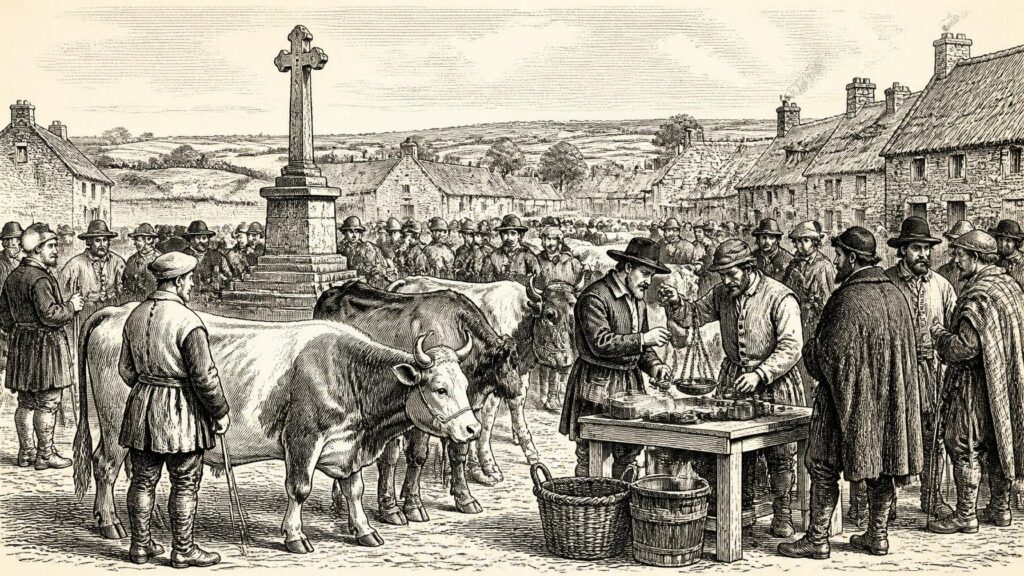
On 26 February came an order restricting the sale of cattle to fairs or markets. This did not create Ireland’s cattle economy; livestock had long been central to wealth, rent and exchange. Rather, it attempted to channel commerce through identifiable places where transactions could be observed, disputes more readily settled and dues more reliably collected. For ordinary buyers, drovers, butchers and smallholders, it implied that the market town was becoming ever more important to the state’s vision of a governable countryside.
The following days brought orders concerning Custom House officers and, on 1 March, the standardisation of certain weights and measures. Such measures were mundane but consequential. A common measure could affect the price of grain, ale, cloth, salt, imported goods and rent paid in kind. It also gave magistrates and municipal officers a practical role in royal government. The evidence does not allow us to assume instant uniformity across Ireland; it does show what officials believed needed correction.
On 1 April the government addressed warlike munitions and prohibited the wearing of forms of Irish dress, including mantles, trousers and skeins. The order joined security to culture. A skein, or dagger, could plainly be treated as a weapon; a mantle was also an everyday garment. By legislating against both, officials treated material appearance as a marker of political trustworthiness and sought conformity as well as disarmament. Whether the rule was consistently obeyed is another question. Repeated attempts to regulate such matters generally indicate that custom could not be altered by proclamation alone.
Repairing the Londonderry Plantation
Ulster was the year’s other central concern. The plantation of County Londonderry, administered through the City of London and its companies, had been intended to create fortified settlements, profitable estates and a dependable Protestant population. By the early 1620s its progress had drawn criticism. Sir Thomas Phillips’s searching investigations highlighted deficiencies in building, settlement and management, while local insecurity made the project’s shortcomings difficult to ignore.
In 1624 the crown appointed Phillips overseer of the Londonderry plantation and instructed the London corporation to carry out reforms associated with his recommendations. On 24 September James I approved a revised programme for the plantation. This was a firmly dated act of correction rather than a new plantation. Its importance lies in its admission that the existing undertaking required supervision from above.
The reform programme belonged to a landscape already transformed, but not remade from scratch. Walled Derry and Coleraine, company estates, new leases and incoming English and Scottish families altered patterns of ownership and settlement. At the same time, Irish people had not vanished from the county. Many remained as tenants or workers, particularly where landlords found their rent and labour useful. The January order against expulsions and the autumn reforms should therefore be read together: the state wanted a secure plantation, but could neither ignore the existing population nor rely on corporate promoters to meet every obligation.
This tension had lasting consequences. Plantation was a project of landholding, defence, religion and demographic change, but it was also an experiment in revenue. London companies expected returns; the crown expected settlement, buildings, loyal inhabitants and military resilience. Those purposes overlapped without always agreeing. In 1624, Irish policy was being shaped not only in Dublin Castle but in the friction between metropolitan investors, crown inspectors, local landlords and the people who cultivated the land.
Munster and the Political Elite
Elsewhere, change could arrive through succession rather than ordinance. Donough O’Brien, fourth earl of Thomond, died at Clonmel on 5 September 1624. Known as the ‘Great Earl’, he was a Gaelic aristocrat who had become a prominent Protestant royal servant, president of Munster and governor of Clare. His career embodied the political settlements made after the Tudor conquest: an old dynastic house preserved rank and considerable estate, but within a monarchy that expected service, Protestant loyalty and participation in its institutions.
His son Henry succeeded as fifth earl. The transition did not erase the O’Brien inheritance or the importance of kinship in Thomond and Clare. It did, however, underline the increasingly formal relationship between great Irish landholders and crown authority. Titles, patents, county offices, leases and inheritance were the machinery through which power was now asserted and negotiated. The creation in May of Sir William Brereton as Baron Brereton of Leighlin similarly shows the continuing distribution of status and interest through the Irish peerage, even where a new title did not itself transform local life.
Competing Histories of Irish Christianity
The sharpest intellectual activity of 1624 concerned history as much as doctrine. James Ussher, bishop of Meath and a leading scholar of the Church of Ireland, preached before the king at Wanstead on 20 June. Later that year he published An Answer to a Challenge Made by a Jesuite in Ireland, directed against the Jesuit William Malone. Ussher used patristic learning and claims about the ancient church to argue that the reformed church, not Rome, possessed genuine continuity with early Christianity.
This was not detached antiquarianism. In Ireland, assertions about the early church bore directly on authority in the present: who could claim the inheritance of Patrick, Columbanus and the island’s saints; which church was truly catholic; and whether obedience to Rome compromised loyalty to the crown. Ussher’s scholarship was part of a Protestant programme that joined learned publication to confessional government.
Across the Channel, Thomas Messingham, rector of the Irish College in Paris, published his Latin Florilegium Insulae Sanctorum. The collection assembled lives and materials relating to Irish saints, including material on St Patrick’s Purgatory. Its appearance was equally political in the broad early modern sense. It presented Ireland as an island of saints within the Catholic world, supplied a learned Catholic readership with Irish devotional history, and reflected the role of continental Irish colleges in educating clergy for an Irish mission.
The contrast between Ussher and Messingham should not obscure a shared fact: Irish history, manuscripts and saints mattered intensely to both. The same year also lies at the edge of the Iomarbhágh na bhFileadh, the Contention of the Bards. The surviving poems cannot be assigned securely one by one to 1624, and scholarly editors caution that the dispute had ended before Donough O’Brien’s death that September. Still, its recent course belongs to the cultural setting of the year. Gaelic poets debated the precedence of north and south, ancestry, kingship and learned authority at a time when their patrons’ political world had been profoundly altered.
An Uneven Settlement
Thus 1624 was not a quiet interval between dramatic crises. Its documentary trail records the practical work of a state seeking to discipline religion, trade, dress, arms and settlement, while repeatedly encountering the limits of command. Catholic clerical life endured despite the January threat; Irish tenants remained essential within a plantation intended to privilege newcomers; and rival Catholic and Protestant scholars made the ancient past serve competing futures. The year’s significance lies in that unevenness: Ireland was being regulated more closely, but not yet made compliant.
Primary Sources
- State Papers Ireland 1509-1782: government papers on Irish affairs
- Statute Law Revision Act 2015
- Cary, Henry
- By the Lord Deputie and Councell
- Early Stuart Irish Warrants 1623–1639: The Falkland and Wentworth Administrations
- Phillips, Sir Thomas
- Plantation of British Undertakers within the Countie of Londonderry, March 1624
- The Irish and the Plantation
- Plantations in Ulster, 1600–41
- Order from Lord Chichester, Lord Deputy and the other Commissioners to Sir T. Phillips, Sir F. Cooke and Capt. Dorington for return of the present state of the Londonderry plantation
- O'Brien, Donough
- Kearney, David
- Ussher, James
- An ansvver to a challenge made by a Iesuite in Ireland
- A briefe declaration of the universalitie of the Church of Christ, and the unitie of the catholike faith professed therein
- Discourse of the religion anciently professed by the Irish and Scottish
- Messingham, Thomas
- Florilegium insulae sanctorum seu vitae et acta sanctorum hiberniae
- Florilegium Insulae Sanctorum, seu vitae et acta sanctorum Hiberniae
- Briefe relation of Ireland, and the diversity of Irish in the same
- Iomarbhaidh na bhfileadh: The Contention of the Bards
- Introduction: The Role of the Bardic Poet in Gaelic Ireland