

Hamilton’s Cashel and Ranelagh1623 CE
In 1623, Lord Deputy Viscount Falkland sought to reduce Irish administration’s costs while reinforcing royal control over revenue, land and religion. Correspondence recorded poverty and efforts to improve customs income. June orders promoted Protestant conformity through oaths, regulated school staff and action against recusants, though obedience remained uneven. Malcolm Hamilton’s consecration as Church of Ireland archbishop of Cashel demonstrated reliance on Protestant networks shaped by Ulster settlement; James Ussher’s republished scholarship supported confessional claims. In October, commissioners investigated timber waste in crown-claimed Ranelagh, linking woodland, survey, law and income. These measures reveal tensions beneath apparent peace, not a settled kingdom.
Dateline
In 1623 Ireland was not convulsed by a single campaign, parliament or rebellion. Its importance lies instead in a series of well-dated decisions which reveal how the Stuart state attempted to govern a kingdom that was formally pacified but socially, confessionally and territorially unsettled. From Dublin Castle, Henry Cary, Viscount Falkland, sought to make administration cheaper, royal authority more visible and crown interests in land more secure. Yet the surviving evidence also shows the limits of that ambition: official orders travelled more readily than obedience, and the government’s view of Ireland was often filtered through revenue, religious conformity and disputed property.
The year must be handled with care. Older chronological lists place a proclamation expelling Catholic priests on 21 January 1623. England and Ireland then commonly began the legal year on 25 March, however, and modern scholarship identifies that proclamation as 21 January 1624 in present-day reckoning. It therefore belongs to 1624, not to this calendar-year account. The firmly dated developments of 1623 were different: royal directions concerning the Church in June, Malcolm Hamilton’s consecration as Church of Ireland archbishop of Cashel later that month, and an October inquiry into the wasting of crown woods in Ranelagh, County Wicklow.
Falkland’s Difficult Administration
Falkland had been sworn in as lord deputy in Dublin in September 1622, arriving as an investigating commission was completing its examination of Irish government. That inquiry had exposed administrative weakness and encouraged demands in London for retrenchment. In 1623 the deputy had to run an Irish administration whose military establishment, offices and pensions depended on money from England, while the crown expected Ireland to become less expensive. The problem was political as much as financial. Savings made from a distance could reduce the resources available to maintain order, reward service and sustain the institutions through which the crown exercised authority.
Falkland’s own correspondence makes clear that he regarded social distress as a matter of government concern. A letter written from Dublin Castle to Sir Thomas Edmondes on 25 May is catalogued as dealing with “the state of Ireland” and “poverty of the people”. The surviving catalogue description does not permit a full reconstruction of his argument, and it would be unsafe to turn it into a national survey of hunger or hardship. Nonetheless, the letter is valuable evidence that poverty was explicitly reported upwards at the centre of government during this year. It cautions against treating the relative absence of warfare as evidence of general prosperity.
Revenue was another persistent preoccupation. Correspondence in July concerning customs, wine imposts and commerce, together with proposals to farm the customs, shows officials and interested parties testing ways to extract a steadier income from trade. Such records should not be mistaken for proof that a particular bargain transformed the economy. They do, however, illuminate the fiscal world of ports, imported drink, customs officers, merchants and court patrons. For Dublin Castle, overseas trade mattered not only because goods arrived in Irish towns, but because every taxable cargo might relieve pressure on the royal treasury.
Directions for Religious Conformity
On 20 June, orders concerning the condition of the Church in Ireland set out an unmistakably Protestant programme of reform and discipline. They required officials connected with civic and ecclesiastical life to take the Oath of Supremacy, affirming the monarch’s authority in the Church; they directed that teachers and ushers should be acceptable to the established Church; and they envisaged proceedings against recusants, those who refused conformity. The instructions also associated relapse after outward conformity with ecclesiastical censure. Their language demonstrates that the state understood schools, municipal office and parish religion as connected fields of authority.
These directions were prescriptive, not a reliable measure of what happened in every parish or town. Catholic worship and clerical networks continued despite the established Church’s legal position, while many local communities had long experience of adapting public behaviour to official demands. The order’s importance lies in its attempt to tighten the link between holding office, educating children and accepting royal ecclesiastical supremacy. It also indicates why religion could not be separated from politics. A civic officer’s oath, a schoolmaster’s employment or a family’s attendance at worship could carry consequences beyond private belief.
The wider international setting made this especially delicate. In 1623 negotiations for a Spanish marriage for Prince Charles still shaped Stuart policy, even as English Protestant opinion distrusted concessions to Catholics. Ireland was directly implicated because its large Catholic population was repeatedly invoked in arguments over toleration and security. But diplomacy did not produce a general Irish settlement in 1623. The cautious conclusion is that events abroad formed the background against which Irish officials, clergy and Catholic elites judged the possible direction of royal policy.
A New Archbishop at Cashel
Church government acquired a visible new figure on 29 June, when Malcolm Hamilton was consecrated Church of Ireland archbishop of Cashel at Drogheda by Christopher Hampton, archbishop of Armagh. Hamilton had been appointed to Cashel in May after the death in the previous year of the long-serving Miler Magrath. The ceremony mattered because Cashel was one of the established Church’s principal Irish sees, with a province extending across much of Munster. It joined an office of high ecclesiastical standing to a clergyman whose career had been formed largely in Ulster.
Hamilton’s path illustrates the connections created by the Ulster Plantation. A Scottish-born cleric, he had settled in Ulster, held offices in Down and Clogher, acquired land in Fermanagh and built Monea Castle before his translation south. His advancement in 1623 did not mean that Munster became an extension of Ulster, nor that the established Church suddenly possessed deep local roots throughout the province. Rather, it shows the crown drawing upon a mobile Protestant clerical and landed network when filling major offices. The personnel of church government were themselves part of the changing map of settlement and patronage.
Learning, controversy and religion also intersected in the career of James Ussher, then bishop of Meath. Ussher’s historical argument that early Irish and British Christianity accorded with the reformed Church was republished in 1623. This was more than antiquarian scholarship. In an age when both Catholic and Protestant writers claimed continuity with the ancient Church, the recovery and interpretation of manuscripts, saints’ traditions and patristic texts served immediate confessional purposes. Ussher left Ireland for England late in the summer of 1623, but his work remained part of the intellectual armoury available to the Irish establishment.
Ranelagh’s Royal Woods
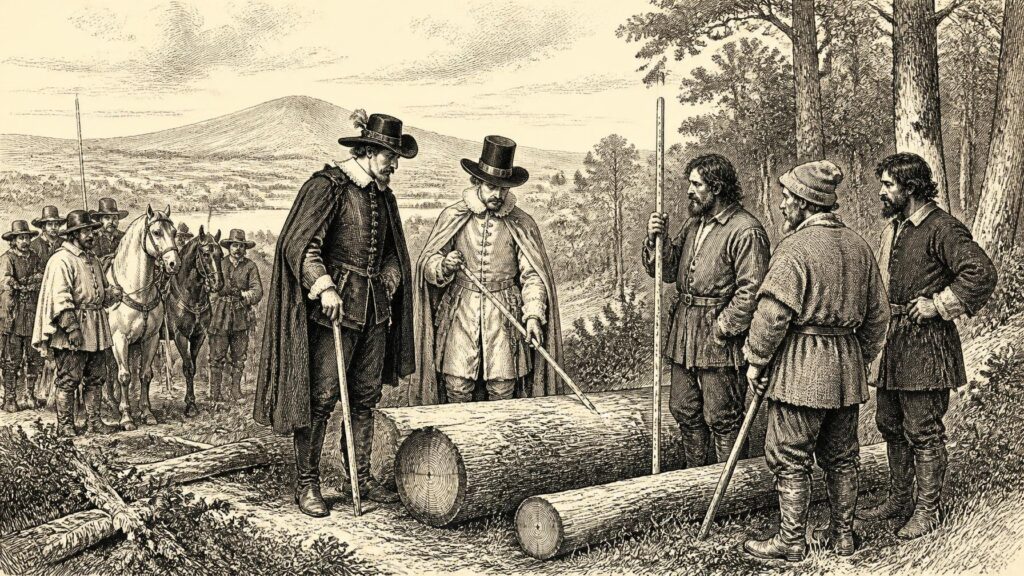
The year’s most concrete environmental and territorial intervention came on 22 October. Falkland issued a warrant for a commission to investigate “waste and spoil” of woods and timber in the territory of Ranelagh, County Wicklow. The warrant stated that the lands had been found by official inquest to belong to the king, and that damage to their timber was said to have caused loss to the crown. It directed commissioners to investigate by local view and by the sworn testimony of “good and lawful men” of the county, identifying who had caused waste, when it had occurred and what it was worth.
The document is revealing precisely because it is limited. It does not establish the scale of tree-felling, name the culprits or prove that woodland destruction was exceptional across Ireland. What it does show is that timber had a fiscal value important enough to prompt formal inquiry, and that the crown sought to turn an assertion of title into practical control over resources. Woods supplied fuel, building material, fencing and other necessities; they also represented an asset whose use could be contested by neighbouring communities, tenants, proprietors and officials.
The choice of commissioners is equally significant. Among them were Sir William Parsons, master of the Court of Wards and surveyor general, together with legal officers and administrators. Their involvement joined surveying, law and revenue. Wicklow had long been a frontier of difficult governance close to Dublin, and the O’Byrne country was particularly attractive to officials who hoped to strengthen crown title and plantation schemes. In 1623, therefore, an inquiry about woodland cannot be reduced to conservation in a modern sense. It was part of the larger early Stuart effort to define ownership, discipline landscapes and make land yield dependable authority and income.
Quiet, But Not Settled
For most inhabitants, the sources do not provide a day-by-day record of work, household routines or local exchange. They preserve the state’s concerns more readily than the voices of labourers, tenants, craftspeople and women. Yet those concerns point towards everyday pressures. Poverty was discussed at Dublin Castle; customs were contested and assessed in the ports; schoolmasters were subjected to confessional scrutiny; and access to woods could become a matter for royal commissioners. These were not remote abstractions for people whose livelihoods rested on land, livestock, local credit, timber, schooling and the religious institutions of their communities.
Thus 1623 should be remembered not as an empty interval before later crises, but as a year in which institutions exposed the tensions beneath apparent tranquillity. The state tried to economise without surrendering authority, to impose conformity without possessing universal obedience, and to claim resources without ending local contest. Hamilton’s consecration at Drogheda and Falkland’s Ranelagh warrant were modest events beside the upheavals that would later engulf Ireland. Together, however, they show a kingdom being governed through churches, oaths, surveys, commissions and revenue papers—tools powerful enough to reshape lives, but not powerful enough to settle the country on their own.
Primary Sources
- Cary, Henry
- Hamilton, Malcolm
- Ussher, James
- Parsons, Sir William
- Barnewall, Patrick
- Barnewall, Sir Richard
- Magennis, Arthur
- Letter of Viscount Falkland, Lord Lieutenant of Ireland, to Sir T. Edmondes, on the state of Ireland, poverty of the people, etc. Dublin Castle, May 25, 1623
- Early Stuart Irish Warrants, 1623–1639: Lord Deputy Falkland’s warrant for a commission to enquire about wastes in the woods in the territory of Ranelagh, County Wicklow, 22 October 1623
- Early Stuart Irish Warrants, 1623–1639: Contents
- Versions: Sources from 1623
- Versions: Customs and Excise Sources
- A Discovery of the True Causes Why Ireland Was Never Entirely Subdued
- The Newsletters
- State Papers Ireland 1509–1782: Government Papers on Irish Affairs
- Calendar of the State Papers Relating to Ireland, of the Reign of James I, 1603–1625
- Calendar of the Carew Manuscripts, Preserved in the Archiepiscopal Library at Lambeth: 1603–1624
- By the Lord Deputie and Councell
- Texts Beginning with the Letter C
- Ireland Under the Stuarts and During the Interregnum
- Ireland Under the Stuarts and During the Interregnum
- Calendar of the State Papers Relating to Ireland