

Brabazon’s Athlone Works1547 CE
In 1547, Edward VI’s accession left Sir Anthony St Leger governing Ireland through system of negotiated loyalties. Dynastic conflict in Laois and Offaly sparked the Midland Rebellion, drawing in Ó Mórdha and Ó Conchobhair Fáilghe forces and exposing limits of conciliation. Reinforcements under Sir Edward Bellingham supported campaigns, while criticism of St Leger intensified. William Brabazon repaired Athlone Castle, strengthening a Shannon crossing. Dublin’s St Patrick’s Cathedral was suppressed and its assets redistributed, though religious reform remained uneven. A storm and cattle raiding illustrated vulnerability. By year’s end, warfare, financial scrutiny and division pushed Tudor government towards garrisons and force.
Dateline
In 1547 Ireland felt the consequences of a royal death, but not in any simple or uniform way. Henry VIII died on 28 January and his nine-year-old son succeeded as Edward VI, king of England and Ireland. The change of monarch mattered in Dublin, in the Pale and in the calculations of Irish and Anglo-Irish lords. Yet it did not instantly remake government across the island. Sir Anthony St Leger remained lord deputy, the Crown’s recent policy of negotiating submissions with powerful Gaelic rulers still formally stood, and local rivalries continued to determine whether districts were peaceful, raided or militarised. The year is best understood as a moment when a fragile political settlement began visibly to break apart.
A Child King and a Contested Deputy
Edward VI inherited the title of king of Ireland created for his father in 1541, together with an administration that claimed island-wide authority but possessed only limited means to enforce it. Its dependable zone lay in Dublin and the Pale, supported by ports, walled towns, royal courts and a small standing military establishment. Beyond it, authority depended heavily on bargains with regional dynasties: the O’Neills in Ulster, the O’Briens in Thomond, the Fitzgeralds and Butlers in the south, and numerous Gaelic lordships nearer Dublin. St Leger had made his reputation by pursuing accommodation, offering recognition, offices, titles and legal protections in return for obedience to the Crown.
On 7 April Edward VI confirmed St Leger as lord deputy. The confirmation was important, but it could not conceal tensions within the Dublin government. St Leger moved to strengthen his own following by replacing opponents in office, while rivals questioned his handling of money, patronage and Gaelic politics. The new English regime also expected closer supervision of Irish revenue and government. Directions issued early in the reign urged vigilance against coign and livery, the customary exaction of food, lodging and other support for a lord’s soldiers and followers. To officials it appeared an intolerable burden and an obstacle to orderly rule; to many frontier communities, however, military service and the obligations sustaining it remained part of political life and local security.
Laois and Offaly Unravel
The greatest immediate danger lay in the midlands. Here the territories later known as Laois and Offaly sat between the Pale and Connacht, intersected by routes towards the Shannon and exposed to the ambitions of neighbouring magnates. The Crown’s agreements with Brian Ó Conchobhair Fáilghe of Offaly and branches of the Ó Mórdha family of Laois had never extinguished competition over succession, land and military power. They had instead overlaid those disputes with royal expectations that were difficult to fulfil.
Early in 1547 Ruaidhrí Caoch Ó Mórdha, lord of Laois, was killed in a dynastic struggle. His brother Giolla Pádraig, aided by Brian Ó Conchobhair Fáilghe’s allies, secured the lordship. This was not merely a family tragedy. It changed the balance of power in a region already unsettled by Crown intervention, old feuds and the presence of garrisons. Modern research places the opening of the Midland Rebellion in southern Leinster in April 1547. It subsequently drew in Brian Ó Conchobhair Fáilghe and Giolla Pádraig Ó Mórdha, turning a regional crisis into a direct challenge to the Dublin administration.
St Leger’s first response was criticised as hesitant. London sent Sir Edward Bellingham, an experienced soldier, with substantial reinforcements during the late spring and summer: 1,500 foot soldiers and 500 horse were assigned to the Irish service. St Leger and Sir William Brabazon, vice-treasurer and a powerful member of the council, campaigned against the Ó Conchobhair Fáilghe and Ó Mórdha forces. Warfare in this setting did not consist only of set-piece battles. It involved cattle seizures, attacks on settlements, the destruction of supplies, intimidation of potential allies, and the problem of whether a defeated lord could safely submit. The immediate human cost fell particularly on tenants, herders, servants and small landholders whose homes, livestock and grain stores could be exposed to both raiding and counter-raid.
Athlone and the Shannon Crossing
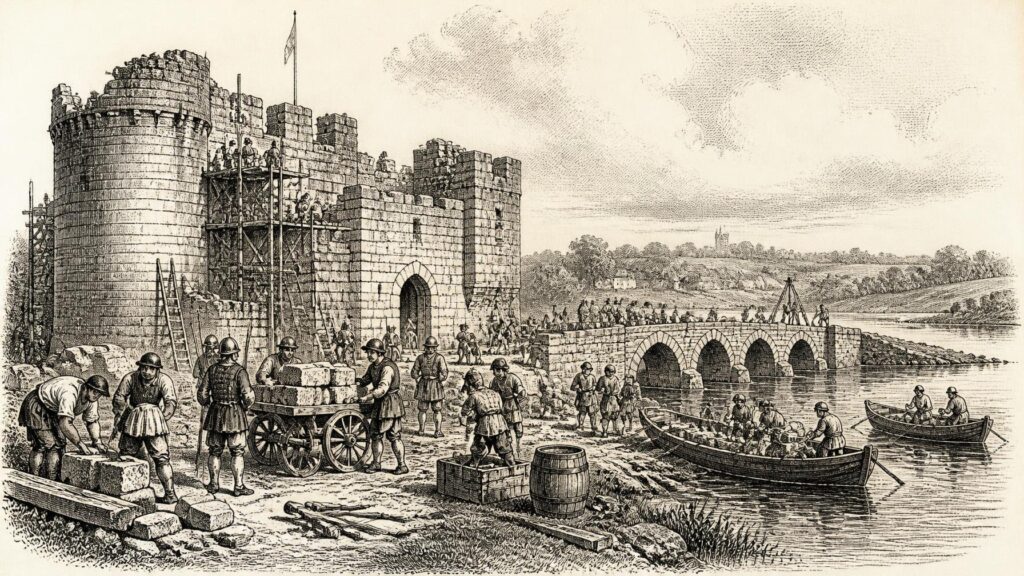
The clearest material development securely associated with 1547 was the repair of Athlone Castle. The Annals of the Four Masters record that William Brabazon repaired the castle with “the English and Irish of Meath”, despite Donnchadh Ó Ceallaigh and the Irish of Connacht. The language reflects the annalists’ political categories rather than a simple modern division of peoples: men from Meath could serve the Crown while retaining local identities and interests. What matters is that labour and armed protection were assembled for a royal work at one of Ireland’s crucial river passages.
Athlone stood on the Shannon, where the route from Meath and the Pale met the approaches to Connacht. The castle had been recovered for the Crown only a decade earlier after long periods of contested control. Repairing it in 1547 therefore had a practical purpose beyond maintenance. A secure garrison base could regulate movement across the river, shelter troops and stores, and make Crown authority more visible on the Connacht frontier. The works also demonstrated the limits of that authority. They were undertaken in a hostile political landscape, not in a pacified province, and the annal’s emphasis on opposition makes clear that construction itself was an assertion of power.
It is tempting to treat Athlone as the beginning of a completed system of conquest, but that would read later developments backwards into 1547. The fort-building programme that transformed the midlands developed more fully after this year. In 1547, the repaired castle was a strategic response to insecurity: a strengthened crossing, not yet a solution to the conflicts of Laois, Offaly and Connacht.
Church Property and Uncertain Reform
Religious affairs also changed, though more unevenly than later accounts sometimes suggest. In January 1547 St Patrick’s Cathedral in Dublin was suppressed as a cathedral foundation and reduced to parish status. Its dean and senior clergy were pensioned; its valuables and ornaments were transferred to Christ Church; and its property became available for Crown-directed uses. This was a profound institutional blow to one of Dublin’s great ecclesiastical communities, affecting clergy, choristers, dependants and the religious routines supported by the cathedral’s endowments.
The suppression arose as much from politics, patronage and control of wealth as from a sudden popular embrace of Protestant belief. George Browne, archbishop of Dublin, had fallen out with St Leger and resented the removal of St Patrick’s as a source of influence. During 1547 he proposed refounding the recently dissolved establishment as a university college, with lectures in Latin, Greek, civil law and divinity, and with preaching as part of its purpose. The plan did not become the university he envisaged, but it is revealing. It shows how confiscated ecclesiastical resources could be imagined as assets for learning, preaching and royal authority.
Edward VI’s accession did signal a more Protestant direction in royal policy. Still, it would be misleading to claim that 1547 brought an immediate, uniform religious revolution to Ireland. The English Book of Common Prayer had not yet been introduced, and the more systematic enforcement associated with Edwardian religious policy in Ireland belongs chiefly to later years. In 1547, the visible realities were the redistribution of church property, contested clerical authority and uncertainty about what further change might entail.
Wind, Cattle and Local Survival
The annals preserve a striking environmental notice for the year: a great wind on the night before the feast of St Brigid, 1 February, which reportedly brought down churches, monasteries and castles, including the two western wings of the church at Clonmacnoise. Such reports should not be treated as modern meteorological measurements, and annalistic chronology requires care. Nevertheless, the entry records that a severe storm was remembered as an event of exceptional destructiveness. Damage to roofs, walls, barns, mills and boats could disrupt worship, travel, storage and the winter economy long after the gale itself had passed.
Other annalistic notices underline the centrality of cattle to power and subsistence. A raid in which 500 cows were taken from the Ó Donnalláin by Melaghlin God Ó Madden was noteworthy precisely because cattle represented food, wealth, breeding stock, rents and political leverage. In an Ireland where many lordships depended on pastoral resources and mobile armed followings, the movement of herds could be as consequential locally as the movement of soldiers.
A Year of Escalation
By late 1547, the dispute in the midlands had become inseparable from arguments over St Leger’s competence. Brian Ó Conchobhair Fáilghe’s renewed rebellion in October prompted London to instruct the deputy not simply to accept an expected submission. Bellingham was recalled to report on conditions, an auditor was appointed to examine Irish finances, and Brabazon produced a hostile assessment of St Leger’s administration. These were not technical matters alone. They concerned the costs of war, the uses of office, the credibility of negotiated settlement and whether the Crown should rely more heavily on force.
Care is needed with some familiar narratives of this year. The Annals of the Four Masters group under 1547 several developments that modern documentary evidence dates to 1548, including Bellingham’s succession to St Leger and the building of a fort in Laois. Bellingham did not become lord deputy until May 1548. Nor should his later garrison policy be presented as already complete in 1547. What can responsibly be said is that 1547 exposed the failure of a precarious midland settlement, brought soldiers and fortification into sharper prominence, and undermined the deputy most associated with conciliation. Athlone’s repaired castle stood at the year’s centre: a tangible sign that Tudor rule in Ireland was becoming more defensive, more expensive and more dependent on armed positions.
Primary Sources
- Part 5 of Annals of the Four Masters
- Athlone Castle
- St Leger, Sir Anthony
- Brabazon, Sir William
- O'Connor Faly (Ó Conchobhair Failghe), Brian
- O'More (Ó Mórdha), Rory (Ruaidhrí Caoch)
- O'More (Ó Mórdha), Rory (Ruaidhrí Óg)
- Bellingham, Sir Edward
- Staples (Staple, Stapull, Stakboll), Edward
- Browne, George
- MacGillapatrick, Brian
- O'Carroll (Ó Cearbhaill), Sir Tadhg Caoch
- Butler, Edmund
- Sir Anthony St Leger and the Outbreak of the Midland Rebellion, 1547–8
- A Window on Mid-Tudor Ireland: the ‘Matters’ Against Lord Deputy St. Leger, 1547–8
- Ireland and the Mid-Tudor Crisis, 1547–1556
- Calendar of State Papers: Ireland, Tudor Period, 1547–1553
- Calendar of State Papers: Ireland, Tudor Period, 1509–1547
- State Papers Ireland 1509–1782: Government Papers on Irish Affairs
- Fiant: 38 Hen VIII (1546–1547), Item 506
- A ‘New Departure’ in Mid-Tudor Ireland?
- Francis Cosby (1510–80), Stradbally, Queen’s County and the Tudor Conquest of Leinster
- The Chief Governors: The Rise and Fall of Reform Government in Tudor Ireland 1536–1588
- Irish Texts at CELT