

Fort Protector Rises1548 CE
In 1548 Sir Edward Bellingham replaced Anthony St Leger as lord deputy, shifting Tudor policy from accommodation towards military occupation. Fort Protector, established in Leix on the future site of Portlaoise, provided a permanent garrison base against the O’Mores and O’Connors. Cahir Roe O’Connor was executed, while Brian O’Connor Faly and Giolla Pádraig O’More submitted, were taken to England, and the latter died there. Cess and the reopened Dublin mint supported government. Bellingham intervened in Wicklow, detained Desmond, while Ulster remained divided by conflict. Edwardian religious reforms advanced unevenly. Tudor power remained limited but relied on garrisons, coercion and confiscation.
Dateline
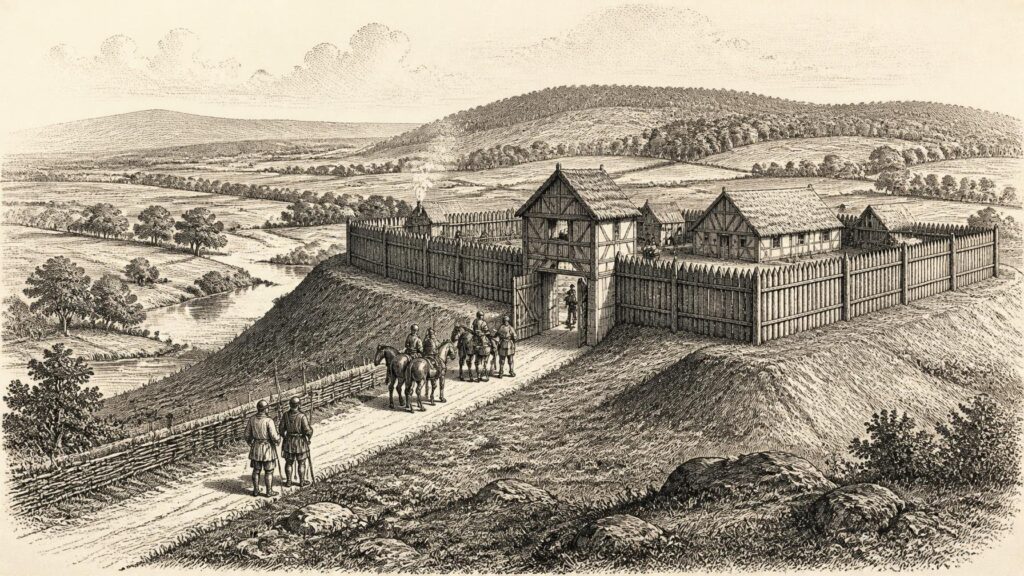
In 1548 the Tudor government’s struggle to extend its authority beyond the Pale acquired a new physical landmark in the midlands: Fort Protector, the garrison established at what became Portlaoise. The fort was not yet a plantation town, nor had the later counties of Queen’s and King’s been created. But its construction marked a decisive change in method. Rather than relying chiefly on negotiated submissions from powerful Irish lords, the Dublin administration increasingly sought to hold contested country with permanent soldiers, fortifications and supply lines.
This was an especially consequential year because the government changed hands. Sir Anthony St Leger, whose earlier policy had rested heavily on accommodation with Gaelic and Gaelicised magnates, was displaced by Sir Edward Bellingham, a professional English soldier closely associated with a more forceful approach. The resulting campaigns affected Leix, Offaly, Wicklow, Munster and Ulster, while also placing heavier demands on the communities expected to feed, finance or endure the Crown’s expanding military presence.
A New Deputy and a Harder Frontier
Firmly dated: on 22 April Sir Edward Bellingham was appointed lord deputy of Ireland; he assumed office in May. St Leger’s removal reflected political shifts around the government of the young Edward VI, but in Ireland it also represented a practical disagreement about rule. St Leger had believed that agreement with leading lords could stabilise the country. Bellingham inherited a war already under way against the O’Connors of Uí Failghe and the O’Mores of Leix, and treated their territories as a military frontier requiring occupation.
The geography mattered. Uí Failghe, broadly corresponding to much of modern Offaly, and Leix, in modern Laois, lay immediately west of the Pale and astride routes between Dublin, the Shannon and Munster. Their lords could raid English settlements and communications, but they also controlled fertile land, woodland and passages through the midlands. Earlier Crown incursions had already damaged the political settlement there. By 1548, recurrent fighting, the seizure of cattle and crops, and the destruction of settlements had made control of the region a question not only of prestige but of provisioning and security.
Bellingham’s answer was Fort Protector in Leix. Built in 1548 after the Crown’s operations against the O’Mores and their allies, it stood on the site around which Portlaoise later developed. A fort was more than a defensive enclosure. It lodged a paid garrison, offered a base for mounted patrols and raids, guarded communications, and announced that royal soldiers were intended to remain. The Crown’s language presented such works as protection; to families displaced by campaigning or exposed to soldiers’ demands, they could equally signify a lasting intrusion into local lordship and landholding.
Fort Protector therefore belongs to 1548 with confidence, but its later significance should not be projected backwards too simply. The formal plantation of Leix and Offaly came afterwards, and the shiring of the area as Queen’s and King’s Counties was still nearly a decade away. In this year, the immediate reality was a fortified military foothold, created amid a conflict whose outcome remained uncertain.
Submission, Capture and Loss
The pressure on the midland confederates intensified during the year. The Annals of the Four Masters record that Cahir Roe O’Connor was put to death in Dublin in 1548. Other government narratives place his defeat and capture during Bellingham’s campaigning in County Kildare, with Nicholas Bagenal among the Crown commanders. The exact sequence and dating of every engagement are not equally clear, but the execution itself demonstrates the altered terms of conflict: prominent resistance could now end not in a negotiated pardon, but in judicial killing at the seat of government.
By November, Brian O’Connor Faly, lord of Uí Failghe, and Giolla Pádraig O’More of Leix had submitted after severe losses. Their submission did not restore their former position. Both were taken to England and confined. The annals record Giolla Pádraig’s sudden death there before the year’s end. Brian survived, but imprisonment removed him from the politics of his lordship at a moment when the Crown was preparing to reshape the midlands around garrisons, confiscation and, later, colonisation.
These outcomes should not be read as proof that either people had simply ceased to matter. Gaelic lordships were networks of kin, clients, military followers, churchmen and tenants, not merely the possessions of one chief. Nor did the elimination or detention of a leader end resistance: Brian’s brother Cathaoir remained in revolt into 1549. Yet 1548 severely weakened the capacity of the O’Connor Faly and O’More leadership to bargain on the terms that had often prevailed under St Leger.
Garrisons, Cess and Ordinary Burdens
Bellingham’s programme depended on money and food. Soldiers needed wages, horses required forage, and strongpoints needed grain, fuel, transport and repair. The deputy used cess, the traditional obligation by which communities supplied the lord deputy and his forces, more directly as a fiscal resource for the enlarged military establishment. This made policy in Dublin immediately tangible in the Pale and its borderlands. Farmers, town officers, freeholders and landlords were drawn into supplying an army whose principal purpose was to extend the government’s reach beyond them.
Surviving official correspondence from 1548 includes petitions and reports from local interests, including the freeholders of County Waterford. Such material is a reminder that Irish politics did not consist only of battles between great names. It also involved rent, debt, legal claims, shipping, local office and the effort to secure redress from the deputy and council. Royal authority was strongest in Dublin and the established towns, but even there the administration was constrained by limited revenue, uneven information and dependence on local cooperation.
Firmly dated: an indenture of 10 February authorised the reopening of the Dublin mint. Coinage was a modest but meaningful sign of governmental infrastructure in the capital. It did not imply a unified cash economy across the island: payments and wealth remained varied, including coin, livestock, grain, rents, service and credit. Nevertheless, the mint linked Dublin more closely to Edward VI’s fiscal and monetary policy at precisely the moment when warfare was making Irish government more expensive.
Wicklow and Munster: Local Power Tested
The new deputy’s arrival did not suspend older rivalries. In July, Butler forces and their allies moved against Seán O’Byrne’s lordship of Críoch Raghnaill in the Wicklow mountains. The attackers forced Seán and Aodh O’Byrne, with their cattle, into higher ground. Seán sought Bellingham’s protection, and the deputy intervened against the Butler advance. By September the O’Byrnes had recovered sufficient room for manoeuvre that Aodh began fresh attacks on the Pale; in October Seán made peace at Dublin.
This episode shows why the language of “English” and “Irish” can obscure more than it reveals. The Butlers were major Old English magnates; the O’Byrnes were Gaelic lords; both pursued regional advantage through armed retainers, claims to land and shifting dealings with Dublin. Bellingham’s intervention was not disinterested arbitration. It asserted the deputy’s right to regulate conflict in the eastern marches and to decide which local power should be checked or protected.
Munster likewise became more unsettled after St Leger’s departure. James fitz John FitzGerald, fourteenth earl of Desmond, faced growing opposition and an upsurge of violence which Bellingham blamed upon him. In August Desmond summoned leading Munster lords and obtained oaths of personal loyalty. That was an intelligible act of lordship in a dangerous political environment, but Bellingham treated such a gathering as a potential threat to royal authority. In December he arrived unexpectedly at one of Desmond’s castles with armed guards and compelled the earl to accompany him to Dublin, where he appears to have been detained briefly. The action starkly demonstrated that even an earl who held royal office could be treated as a suspect rather than a partner.
Ulster’s Fracturing Lordships
Events recorded in Ulster underline that Crown pressure was only one element in a wider political landscape. The annals state that John, son of Conn Bacach O’Neill, led an army against the Clandeboye O’Neills in 1548 and killed Brian Faghartach O’Neill. John is better known to history as Shane O’Neill, and this early appearance reveals dynastic competition already sharpening within the O’Neill world. The government’s developing position at Newry, associated with Nicholas Bagenal, added another force on Ulster’s southern edge, but it could not dictate the outcome of every local feud.
The same annalistic record notes the burning of Magh Corrain, including houses and churches, by Tadhg Caoch O’Carroll and Art Mac Coghlan in their conflict with Delvin. Such notices are necessarily brief, but their inclusion of churches alongside houses conveys the scale of damage that lordly warfare could inflict. Raiding was not a marginal disturbance to an otherwise settled rural society: it threatened food stores, livestock, shelter, worship and the fragile security on which cultivation depended.
Religion and the Limits of Reform
Religious change formed a quieter but important background to 1548. In March Edward VI’s government issued the Order of Communion, introducing communion in both kinds and English devotional material into the Latin mass in England and Ireland. The order pointed towards the more comprehensive Prayer Book settlement of 1549, but it would be misleading to portray 1548 as a moment of uniform religious transformation across Ireland. The Crown had no parliament sitting in Dublin to enact a new Irish liturgy that year, clergy varied greatly in learning and allegiance, and Irish and English linguistic realities complicated every attempt at standardisation.
For most people, therefore, the year’s most immediate religious experience was likely to remain the familiar calendar of parish worship, saints’ days, baptisms, marriages, funerals and local devotions, even as the institutional ground beneath it shifted. The dissolution of religious houses in the preceding decade had altered patronage, property and charity; the new Edwardian reforms added uncertainty rather than instant uniformity.
By the close of 1548, Fort Protector, the deaths and imprisonments of midland leaders, the coercion of Desmond and the manoeuvring of Wicklow and Ulster lords all pointed in the same direction. Tudor government had not conquered Ireland. Its resources were still limited and its authority remained uneven. But it had begun to make military occupation, not merely alliance, central to its ambitions — with consequences that would reshape the midlands and intensify conflict for generations.
Primary Sources
- Bellingham, Sir Edward
- O'Connor Faly (Ó Conchobhair Failghe), Brian
- Fitzgerald, James fitz John
- O'Byrne, Seán
- Brabazon, Sir William
- St Leger, Sir Anthony
- Bagenal (Bagnal(l)), Sir Nicholas
- O'Neill, Shane (Seaán)
- O'Carroll (Ó Cearbhaill), Sir Tadhg Caoch
- Fitzgerald, Joan
- O'Neill, Niall Mór
- Wise (Wyse), Andrew
- Annals of the Four Masters, Part 5
- Annales Breves Hiberniae
- Calendar of State Papers: Ireland, Tudor Period, 1547–1553
- A Volume of Petitions Addressed to Lord Deputy Bellingham, 1548–9
- Fort Protector Outdoor Performance and Event Space: Conservation Plan
- PORTLAOISE: Scoil Chroist Rí, Presentation Convent, Church Avenue
- Laois: An Introduction to the Architectural Heritage
- Edward VI and Religion
- The Order of the Communion, 1548: A Facsimile of the British Museum Copy C. 25, F. 15
- Singing the Pope’s Dregs? The Liber Precum Publicarum of 1560 and Its Use