Banishment Act1697 CE
In 1697, post-war Ireland faced food scarcity, political consolidation and social disruption. Grain exports were restricted amid fears of shortages, while parliament reinforced Protestant ascendancy through property, security and religious legislation. It confirmed limited treaty protections for qualifying Jacobites but secured wartime forfeitures. The Banishment Act ordered Catholic bishops and regular clergy to leave, while restrictions targeted Protestant-Catholic marriages. Peace with France ended the Nine Years’ War, yet fears of Jacobitism persisted. Lightning destroyed Athlone Castle’s powder magazine, causing major damage. Scottish migration strengthened Ulster Presbyterian communities, while commercial tensions over Irish woollens and modest rebuilding reflected an uneven recovery.
Dateline
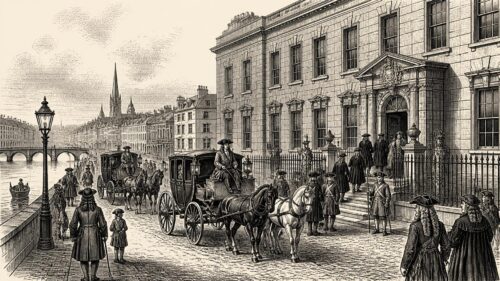
In 1697 Ireland was no longer a battlefield, but it was not yet at peace in any generous or settled sense. Six years had passed since the Treaty of Limerick ended the Williamite war in Ireland, and the country was governed for William III by a Protestant political establishment determined to secure its lands, church and authority. That determination was expressed most starkly in the legislation of the year: an act banishing Catholic bishops and regular clergy, measures reinforcing forfeitures and attainders, and a law aimed at mixed Protestant–Catholic marriages. Yet 1697 also brought an international peace with France, a serious scarcity of grain, continued migration into Ulster, and a destructive explosion at Athlone. The year’s story is therefore not simply one of repression. It is of a society attempting to rebuild after war while deciding who could safely belong within the new order.
A Hungry Summer
The year opened with official concern about food. On 12 January, the Irish administration prohibited grain exports from Ulster ports; on 29 March the restriction was extended to Leinster. A further proclamation of 18 June prohibited the exportation of corn more generally. Such orders are important evidence of pressure on supplies, but they should not be inflated into proof of an island-wide famine comparable with later Irish catastrophes. They do show that officials feared scarcity and high prices, particularly after large quantities of corn and meal had moved through northern Ireland towards famine-stricken Scotland during the preceding winter.
For ordinary households, grain scarcity was a direct matter of survival. Most people lived close to subsistence, depending on local harvests, wages, small plots, credit and informal neighbourhood support. A rise in the price of meal or bread could force labourers, cottiers and town poor to reduce consumption long before it appeared as a crisis in official papers. The government’s intervention acknowledged that food was not merely a commodity: it was a source of public order. Preventing exports kept grain within the kingdom, though it also disrupted merchants, shippers and producers seeking prices elsewhere.
The restrictions belong to the wider climatic and commercial setting of the late 1690s. Scotland’s ‘ill years’ had produced acute hunger and helped drive people across the North Channel. Ireland itself had recovered remarkably quickly in some respects from the devastation of the Williamite war. Grain production and exports had become important to that recovery, especially in parts of Leinster, Munster and the east coast. In 1697, however, the very capacity to export became politically sensitive when local provision seemed insecure.
Parliament and the Post-War Settlement
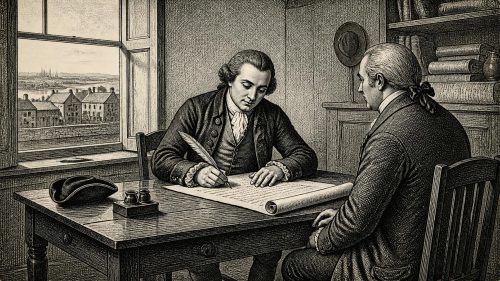
The Irish parliament met in Dublin from 27 July until 3 December. It was a parliament operating under Poynings’ Law, by which proposed Irish legislation required prior approval in England, but it was not politically passive. Its members sought to consolidate a Protestant ascendancy created by conquest, confiscation and the defeat of the Jacobite cause. The session produced statutes on revenue, property, criminal justice and security as well as religion.
On 25 September, parliament passed an act confirming articles made at the surrender of Limerick. This was significant because the civil articles agreed in October 1691 had promised specified protections to the Jacobite inhabitants of Limerick and other qualifying persons. In August 1697, commissioners were instructed to begin hearing claims to the benefit of the Articles of Limerick and Galway, and procedures were published later that month. The process made legal status depend on documentary claims, official interpretation and time limits. It offered a channel through which some individuals could seek recognition of treaty rights, but it was not a restoration of the pre-war Catholic landed order.
Indeed, a second statute passed in November hindered the reversal of many convictions, outlawries and attainders arising from the war. It preserved exceptions for people entitled to the benefit of the Limerick or Galway articles, provided their cases were established within the stated period. The pairing of these measures captures a central contradiction of 1697. Government acknowledged negotiated obligations to a defined group of former opponents while making the larger settlement of confiscated property increasingly secure.
Other enactments show the practical work of government. Parliament continued duties on tobacco, beer, ale and imported goods, regulated quit-rent receipts and raised a poll tax for royal supply. A supplementary act addressed ‘tories and rapparees’, the official terms used for armed robbers and outlaws. Its language should not be read as a neutral description of every person so labelled: post-war authorities often joined criminality, political disaffection and Irish Catholic identity in the same category. Nevertheless, the legislation demonstrates anxiety about insecurity on roads and in rural districts, and about the difficulty of replanting and commercial recovery where robbery was feared.
The Banishment Act
The defining measure of the session was the Act for banishing Catholic ecclesiastics exercising jurisdiction and the regular clergy. Passed on 25 September, it required Catholic archbishops, bishops, vicars-general, deans, Jesuits, monks, friars and other regular clergy to leave Ireland by 1 May 1698. They were directed to report at Dublin, Cork, Kinsale, Youghal, Waterford, Wexford, Galway or Carrickfergus, where civic officers and port officials were to assist their transportation beyond the king’s dominions.
The statute was not a general expulsion of all Catholic priests. Parish clergy who did not exercise episcopal or equivalent jurisdiction were not named for immediate removal. That distinction mattered greatly. Catholic worship and pastoral life did not vanish in 1697, nor did the law itself instantly empty Ireland of bishops and members of religious orders. Its deadline lay in the following year, and enforcement depended upon magistrates, port officers, local informers and communities prepared either to cooperate or to conceal clergy.
But the purpose was severe. A returning banished cleric could be treated as guilty of high treason; newcomers after 29 December 1697 faced imprisonment and transportation; householders who harboured prohibited clergy faced escalating penalties. The act also authorised justices to suppress monasteries, friaries, nunneries and other Catholic religious societies, and penalised burials in disused monastic precincts not employed for Church of Ireland worship. It sought to break the hierarchy, religious orders and institutional memory of the Catholic Church, while making local assistance to them dangerous.
Its preamble presented Catholic clergy as authors of rebellion and foreign influence. That was the outlook of a ruling community haunted by the conflict of 1689–91 and by the continuing European war against Louis XIV. It should not be mistaken for an objective account of Catholic religious life. The law imposed collective political suspicion upon a large Catholic population whose experiences varied sharply by locality, class and personal history. It also sat uneasily beside the Limerick settlement: treaty protections and fresh exclusions were now being defined side by side by the same state.
The session also passed an act to prevent Protestant intermarriage with Catholics. By attaching property and legal consequences to such marriages, it treated family formation as a question of political security. Religion was thus embedded not only in public office and landholding but in inheritance, households and the intimate choices of individuals.
Peace Abroad, Unease at Home
On 20 September, England and France signed the Treaty of Ryswick, part of the wider settlement ending the Nine Years’ War. Ireland had been one of that war’s most important theatres earlier in the decade: Jacobite Ireland had depended on French military and diplomatic support, while Williamite victory had bound Irish questions to the European contest. The Dublin government proclaimed peace with France on 3 November and ordered a thanksgiving for 12 December.
Peace reduced the immediate prospect of a French-backed landing or renewed Jacobite war. It did not dissolve Protestant fears of one. In fact, the end of the continental emergency made it easier for the Irish parliament to press measures against Catholic ecclesiastical leadership, despite William III’s broader diplomatic need to deal with Catholic allies in Europe. Ireland’s internal settlement remained shaped by an international conflict that had formally ended.
Commercial tensions also sharpened in 1697. English clothiers petitioned against the growing Irish woollen manufacture, alleging that Irish goods competed with English producers. Westminster promised legislation restricting Irish woollen exports to foreign markets, although the decisive English Woollen Act did not pass until 1699. It would be misleading to treat the later prohibition as already law in 1697. What belonged to this year was the warning: Irish producers, merchants and landlords could see that recovery in woollens might provoke intervention from England.
Athlone’s Catastrophe
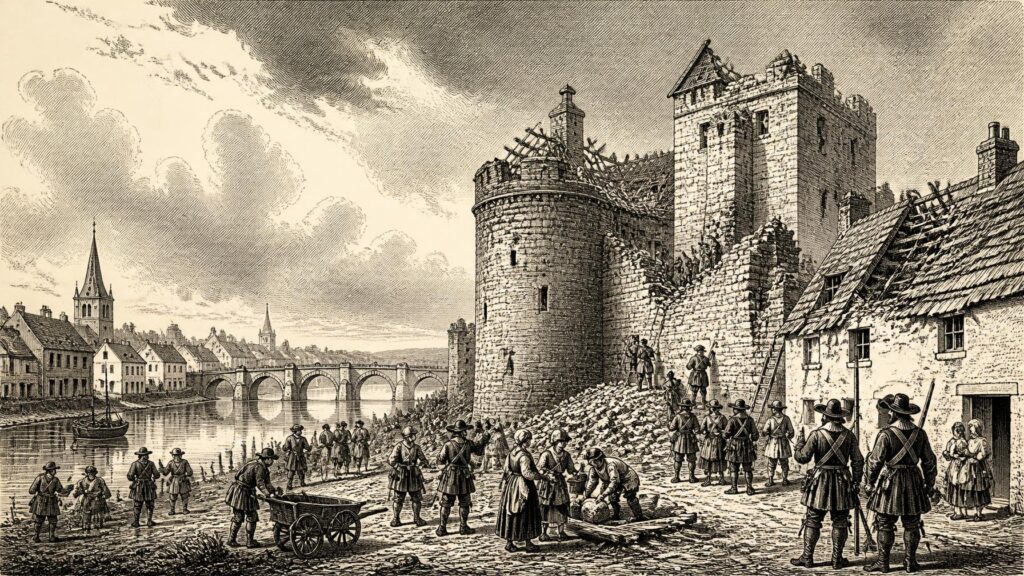
Before dawn on 27 October, a violent thunderstorm struck Athlone Castle. Lightning ignited the castle magazine, where gunpowder and military stores were kept. The resulting explosion badly damaged the town, still marked by its strategic role in the 1691 siege. Later accounts differ in their estimates of casualties and damage, so no precise total should be asserted with confidence. What is clear is that the blast was an urban disaster of exceptional force, shattering buildings and exposing the vulnerability of a garrison town whose fortress had become a storehouse of war.
The government’s response is firmly dated. On 30 November a proclamation announced aid for Athlone after the severe storm damage. That assistance indicates that the consequences remained pressing more than a month later. Athlone’s misfortune was a reminder that peace did not mean the disappearance of military infrastructure or of sudden danger. Powder, fortification and garrison life remained woven into the fabric of post-war towns.
Migration and New Landscapes
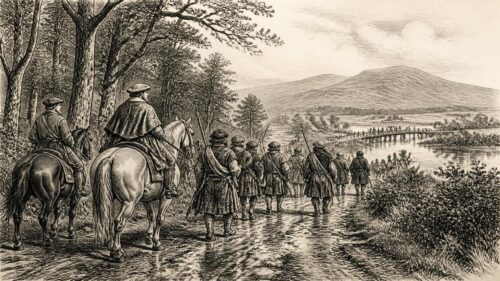
Meanwhile, Ulster continued to receive migrants from Scotland. The famine conditions of the Scottish 1690s encouraged movement, and Presbyterian networks of kinship, tenancy, trade and ministry made the crossing practicable. The scale of migration across the decade is debated, and it would be unsafe to assign a precise number to 1697 alone. Still, the year belongs clearly within the influx that strengthened Presbyterian communities in Antrim, Down and other parts of Ulster.
These newcomers were Protestants, but not generally members of the established Church of Ireland. Their arrival therefore altered local economies and confessional balances without simply enlarging the Anglican ruling church. In towns, market villages and rural settlements, Scotland and Ulster were connected by small ships, seasonal trade, family ties and religious affiliations. The north-east’s later commercial and demographic distinctiveness had many causes; the movements of the 1690s were among them.
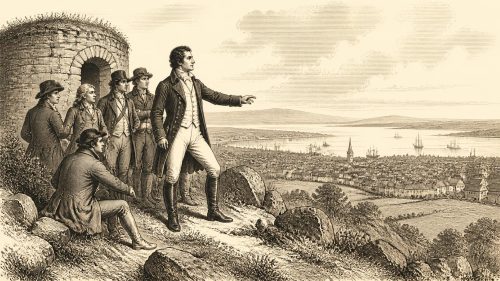
A more modest sign of rebuilding can be found at Celbridge in County Kildare, where the later Celbridge Abbey incorporates fabric associated with a house of 1697 linked to Bartholomew Van Homrigh, Dublin’s lord mayor that year. The evidence for the surviving building is complicated by substantial eighteenth-century alteration, so it should not be presented as an untouched 1697 house. Even so, the association points to an emerging world of merchants, officials and substantial country residences along the Liffey, quite different from the hardship visible in grain proclamations and Athlone’s ruins.
Thus 1697 closed with thanksgiving for European peace but no comparable reconciliation in Ireland. Food anxiety had prompted intervention in trade; parliament had entrenched a confessional state; treaty claims remained unsettled in practice; and a natural storm had devastated a key town. The political and religious settlement fashioned that year would endure, but so too would the Catholic Church, local resistance to enforcement, Presbyterian growth in Ulster, and the economic ambitions that made Ireland’s relationship with England increasingly contentious.

Primary Sources
- Pre-Union Irish Statutes: 1697
- The Ninth Year of William III: An Act for Banishing All Papists Exercising Ecclesiastical Jurisdiction
- Statute Law Revision Act 2015
- Religion: Irish Parliament Background to Statutes
- Constitutional Differences
- History of the Commercial and Financial Relations between England and Ireland from the Period of the Restoration
- The Penal Laws: Origins, Purpose, Enforcement and Impact
- Ratification of Treaty of Limerick 1691/1692
- An Act for the Confirmation of Articles, Made at the Surrender of the City of Limerick
- The Civil Articles of Lymerick
- Treaty of Peace of Ryswick between Louis XIV and William III, 20 September 1697
- Economic Aspects of the Negotiations at Ryswick
- Climate, Weather and Society in Ireland in the Long Eighteenth Century: The Experience of the Later Phases of the Little Ice Age
- A Discourse Concerning Ireland and the Different Interests Thereof
- Irish Historic Towns Atlas: Athlone
- Explosive Combination
- Disastrous Explosion, Christian Brothers Athlone, The Schools’ Collection
- The Great Scottish Migration to Ulster in the 1690s
- The Presbyterians of Ulster, 1680–1730
- Scottish Presbyterian Networks in Ulster and the Irish House of Commons, 1692–1714
- Migration and Cultural Identity in Ulster and Southwest Scotland, 1690–1715
- The Abbey, Clane Road, Celbridge Abbey, County Kildare
- Welcome to North-East Kildare: Celbridge Abbey c.1697