

St Leger’s Kingly Title1541 CE
In 1541, Dublin parliament declared Henry VIII king, rejecting papal claims and linking Irish kingship to England’s crown. Sir Anthony St Leger pursued surrender and regrant, granting titles to Edmund Butler and Barnaby Fitzpatrick, securing pardons and agreements and seeking allegiance from Gaelic and Anglo-Irish rulers. Crown authority nevertheless remained concentrated around the Pale. An autumn Ulster campaign brought Conn Bacach O’Neill’s submission, while Manus O’Donnell sought recognition. Dissolution of religious houses transferred property, affecting communities and economies. Proclamations and safe conducts reveal governance. The act created a legal kingdom, but control still depended on negotiation, force and local power.
Dateline
In 1541, a change made in Dublin altered the constitutional language of Irish government for centuries: Henry VIII ceased, in Irish law, to be styled merely lord of Ireland and became king of Ireland. The change was momentous, but it should not be mistaken for an instant conquest of the island. Tudor government was strongest in and around the Pale, while Gaelic and Gaelicised lordships exercised effective power over much of the country. The year’s real significance lies in the effort to turn a legal title into a practical political relationship—one based on allegiance to the crown, negotiated submission, English-style grants of land and rank, and, where negotiation failed, armed pressure.
A Parliament in Dublin
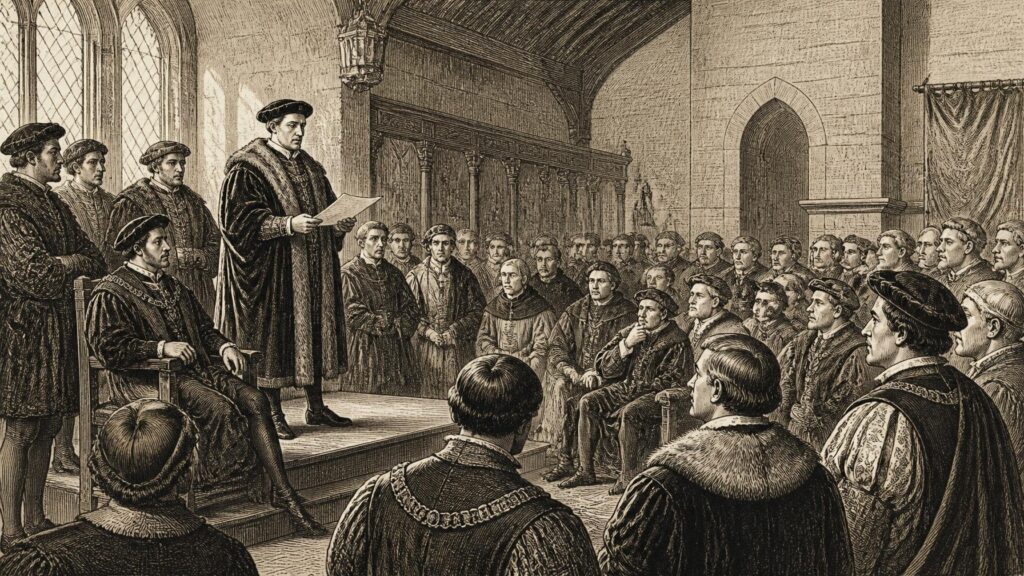
The firmly dated centrepiece of the year was the parliament summoned at Dublin on 13 June. On 18 June it passed the measure conventionally called the Crown of Ireland Act. The statute declared that Henry VIII and his heirs were to have the name, style, title and dignity of kings of Ireland, the kingship being joined to the imperial crown of England. The law’s conventional printed citation is 33 Henry VIII, chapter 1, and it is often labelled an act of 1542 because of the regnal-year dating of the parliamentary session. Contemporary government correspondence, however, records its passage in June 1541; it belongs squarely to this year.
The old title had mattered. English kings had used “lord of Ireland” since the Anglo-Norman settlement, a designation associated with medieval papal authority and with an authority that was, in reality, partial and uneven. Henry’s breach with Rome gave the issue fresh urgency. The new act portrayed the absence of a kingly title as one cause of imperfect obedience, an argument that was both constitutional and political. It rejected any implication that Ireland was held from the pope and asserted a direct, hereditary Tudor claim.
Sir Anthony St Leger, lord deputy since 1540, was the principal architect of the immediate policy. He did not propose a simple military occupation. His approach sought to persuade or pressure local rulers into accepting the king’s authority while preserving their usefulness as regional leaders. The parliament therefore mattered not only as a gathering of the Dublin political community but as a stage on which the crown could invite wider Irish participation. Gaelic lords and chiefs, as well as the established Anglo-Irish nobility, were drawn into the orbit of this programme, even though their attendance and compliance varied greatly.
A Title, Not Yet a State
The new kingship was an assertion of ambition rather than a description of uniform control. In 1541, Ireland remained a patchwork of jurisdictions, languages, legal customs and military powers. Dublin Castle’s officials administered the Pale through courts, sheriffs, towns, revenue officers and garrisons. Beyond it, great lordships such as those of the O’Neills, O’Donnells, MacCarthy families, Butlers, Burkes and Geraldines commanded tenants, fighting men and local alliances. Authority was personal and negotiated. A royal statute could proclaim an all-island kingdom; making that kingdom governable required the cooperation, or subordination, of men who had their own claims to land and lordship.
This explains the importance of “surrender and regrant”, the policy most closely associated with St Leger’s administration. A lord was encouraged to surrender a claimed territory to Henry and receive it back by royal grant, normally with an English title and rules of succession more recognisable to the crown. In principle, this substituted tenure from the king for autonomous or kin-based claims. In practice, it offered local elites recognition, security and prestige, while allowing the government to claim jurisdiction. It was not a painless cultural conversion, nor did it immediately displace Gaelic modes of inheritance and political authority. It was a bargain whose consequences would unfold unevenly over decades.
Two grants dated 11 June, just before parliament assembled, show the policy taking a concrete form. Edmund Butler was created Baron Dunboyne, while Brían Óg Mac Giolla Phádraig—known in English records as Barnaby Fitzpatrick—became Baron Upper Ossory. The latter title was particularly revealing: a ruler rooted in the Gaelic lordship of Upper Ossory was recognised in the peerage of Ireland under a new, crown-sanctioned name. Such patents were not merely decorative. They tied status, landholding and expected service to the Tudor monarchy.
Other submissions and contacts in 1541 demonstrate both the reach and the limits of conciliation. A surviving indenture records an agreement with the Mac Gennises on 24 May. In Leinster, Céadach Ruadh O’More attended the June parliament; he and his family received a pardon on 27 June and a grant of English liberty on the following day. These are firmly dated acts of accommodation. They do not mean that Laois, Iveagh or other lordships had ceased to be politically contested; rather, they show the crown using documentary privilege, pardon and legal inclusion as tools alongside force.
Ulster: Campaign and Submission
The most substantial military business clearly linked to 1541 lay in Ulster. During the autumn, St Leger led a campaign directed at Conn Bacach O’Neill, the dominant figure in Tír Eoghain. Government chronology places the operation between September and 28 December, ending with O’Neill’s submission at Dundalk. A proclamation of 9 October called for a hosting against O’Neill, providing an unusually precise marker within that campaign.
Its outcome should be described carefully. O’Neill did submit to royal authority at Dundalk, but he was not thereby reduced to an ordinary provincial subject. His power rested on extensive regional connections and armed followings, and St Leger’s government lacked the means to occupy all Ulster permanently. The submission was instead an important step towards the much fuller settlement negotiated in the following year, when Conn travelled to the English court and received the earldom of Tyrone. That later journey and patent must not be projected backwards into 1541. What the evidence securely supports for this year is campaign, negotiation and submission.
Manus O’Donnell of Tír Chonaill was also testing the new political language. In 1541 he sought an earldom—of Tír Chonaill or Sligo—and met St Leger in O’Reilly country in notably lavish dress. The encounter reveals a world in which clothing, gift, ceremony and titles were instruments of diplomacy. An Irish lord could seek recognition from Henry without abandoning local power; the crown, equally, could use honour to encourage a hierarchy of allegiance. The crown’s claim to rule Ireland was being enacted through meetings, escorts, letters, pardons and promises as much as through legislation.
Church Property and Local Livelihoods
Religious change formed the other major setting of 1541. The Irish parliament had already accepted royal supremacy over the church, and the suppression of religious houses was under way. Yet the process was limited, locally uneven and often driven by the transfer of property rather than by a rapid remaking of popular belief. Surviving extents and leases make the change visible at ground level: church sites, fisheries, mills, gardens, tithes and agricultural land were being assessed as revenue-producing assets.
A record of 10 April 1541 leases to David Sheghan, a Cork merchant, the site of the Franciscan friary by Cork together with a fishery, weir and lands, for twenty-one years at an annual rent of 42 shillings and four pence sterling. This was not simply a bureaucratic rearrangement. Friaries and monasteries had been places of worship, burial, hospitality, employment, learning and local charity. Their reallocation affected tenants, servants, craft workers, clergy and people who had relied upon their services. At the same time, the lease shows an urban merchant entering the altered economy of former ecclesiastical property.
Documents from early 1541 also record the surveying and disposal of monastic interests in the Ormond sphere, including Kells Priory. Such paperwork should not be read as proof that religious observance vanished from the surrounding countryside. Parish churches, devotional practices, clerical networks and older loyalties endured. It does show, however, that the crown’s religious policy was changing the ownership and management of resources that had long supported religious communities.
People Beyond the Political Record
Most inhabitants encountered the great changes of 1541 indirectly: through rents, military exactions, travel restrictions, market connections, local disputes and the demands of landlords or chiefs. One striking official notice preserves a fleeting glimpse of mobility beyond the established political classes. A fiant of 1541 granted John Naune and his company, described in the record by the contemporary term “Egyptians”, forty days’ safe conduct after they had been driven from Scotland by bad weather. The language reflects Tudor assumptions, not a reliable self-description; historians connect the entry with the early record of Romani people in Ireland. It nevertheless attests to travellers reaching Ireland through the interconnected Irish Sea world.
On 19 June, immediately after the kingly-title legislation, a proclamation pardoned prisoners other than those held for treason, murder, rape or debt. Its survival offers a small but useful reminder that royal government presented itself not only through grand constitutional claims but through pardons and the administration of confinement. The contrast is telling. At Dublin, officials proclaimed a kingdom; across the country, the effectiveness of that claim still depended on local bargains, armed followings, property and personal authority.
Thus 1541 was a hinge year rather than a finished transformation. The Dublin parliament created the legal kingdom of Ireland and placed Henry VIII’s kingship at the centre of Tudor policy. St Leger’s diplomacy, peerage grants and Ulster campaign began to give that title wider political content. But the island remained plural in power and practice. The new crown had announced its reach; the difficult struggle to make it real was only beginning.
Primary Sources
- Crown of Ireland Act 1542 (33 Hen. 8 c. 1), original text
- Crown of Ireland Act 1542: introductory text and statutory metadata
- Calendar of State Papers, Ireland, 1509–1573
- St Leger, Sir Anthony — Dictionary of Irish Biography
- O'Donnell, Manus — Dictionary of Irish Biography
- O'More, Rory (Ruaidhrí Caoch) — Dictionary of Irish Biography
- MacMurrough Kavanagh, Domhnall — Dictionary of Irish Biography
- O'Toole (Ó Tuathail), Toirdhealbhach — Dictionary of Irish Biography
- Burke, Ulick (de Burgh, Uilleag) — Dictionary of Irish Biography
- Fitzgerald, James fitz John — Dictionary of Irish Biography
- Indenture of agreement between the King and the Mac Gennises, 24 May 1541 — National Library of Ireland catalogue
- Chartae Henrici VIII for Barnaby Fitzpatrick, Baron Upper Ossory, June 1541 — National Library of Ireland catalogue
- Making Ireland English — preview edition
- Gaelic lordship and Tudor conquest: Tír Eoghain, 1541–1603
- A ‘new departure’ in mid-Tudor Ireland?
- Creating facts on the ground: the destruction of Clandeboye
- Ireland corporate of itself
- Thomas Holand – Richard II’s King of Ireland?
- The Reformation in Ireland: interpretations old and new
- Extents of Irish monastic possessions, 1540–1541 — Irish History Online
- Irish Monastic and Episcopal Deeds from the Ormond Collection
- Fiants of Henry VIII relating to County Cork
- The Irish Fiants of the Tudor Sovereigns — National Library of Ireland catalogue
- Gypsies in Ireland—A Hiberno-Romany community
- Statute Law Revision Act 2015: schedule of historical proclamations
- Annals of the Four Masters, AD 1501–1588 — CELT, University College Cork
- State Papers Foreign 1509–1782: research guide — The National Archives