

Grey’s Galway Progress1538 CE
In 1538, Lord Leonard Grey extended Tudor influence through an armed western progress, securing submissions, attacking Claregalway Castle and visiting Galway, where civic hospitality reflected loyalty. Yet authority remained contingent: regional rulers used crown alliances for dynastic rivalries, while warfare continued in Connacht, Tyrone, Fermanagh and Wicklow. Grey’s support helped Ulick Burke dominate Clanricarde, and Thomond politics shifted around O’Brien competition. Religious reform advanced unevenly through Browne’s contested visitation and monastic suppressions, while Newry was remodelled rather than dissolved. Piers Butler regained Ormond’s earldom, and urban education and patronage persisted. Ireland remained politically fragmented, governed through force, negotiation and bargains.
Dateline
In 1538 Ireland was neither a kingdom ruled evenly from Dublin nor a country moving in one political direction. Henry VIII remained lord of Ireland; the title of king would not be adopted until 1541. His deputy, Lord Leonard Grey, could exercise effective authority within and near the Pale only with soldiers, artillery, bargains and the co-operation of local powers. Beyond it lay a crowded political landscape of Gaelic lordships, old English towns, magnate estates and ecclesiastical jurisdictions. The year is best understood through movement: Grey’s armed progress westward, the shifting allegiances it produced, and the very different conflicts continuing outside its path.
Grey’s Western Journey
Grey’s government followed the collapse of the Kildare ascendancy. The rebellion of Thomas FitzGerald, ‘Silken Thomas’, had been crushed, but its consequences were still unsettled. The young Gerald FitzGerald, heir to Kildare, remained at large; former Geraldine allies and enemies alike had to decide whether submission to the crown offered safety or merely exposed them to rival claims. Grey’s method was neither simple conquest nor passive diplomacy. He travelled with a military force, used cannon against resistant strongholds, accepted pledges and submissions, and attempted to convert temporary obedience into a framework of royal peace.
Early in the year he attacked the MacMahons in Farney and again intervened in the midlands. Brian Ó Conchobhair Fáilghe, whose struggle for Uí Fhailghe had made Offaly a danger zone between the Pale and the western lordships, submitted to Grey in March. The agreement did not settle the wider contest between Grey and the Butler interest, nor did it abolish the local rivalry that had made the area unstable. It nevertheless shows a central feature of 1538: a submission was a political act with immediate value, not a guarantee of permanent obedience.
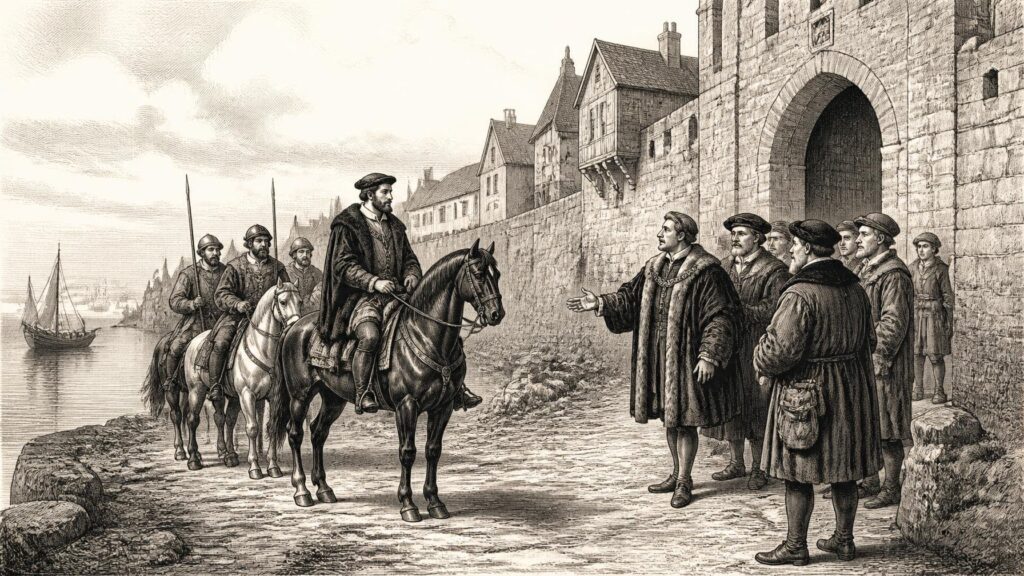
Grey’s most striking expedition came in summer. Passing through territories where the crown’s writ had previously been fragile, he entered Thomond and Connacht, accepting the submissions of a succession of regional rulers. The progress was designed to be seen as much as fought: a deputy, a royal army and artillery moving through lordships accustomed to negotiating with Dublin at a distance. It brought Grey into the tense world of the O’Briens, the Burkes, the O’Flahertys and the merchant town of Galway. The journey impressed contemporaries, but it also sharpened accusations from Grey’s critics that he was making understandings with old Geraldine-connected interests rather than remaking Ireland on stricter English lines.
On 10 July Grey took Claregalway Castle from Richard Óg Burke and handed it to Ulick na gCeann Burke, who was emerging as the dominant claimant in Clanricarde. The following day, 11 July, he entered Galway. The visit is commonly identified as the first by a king’s deputy. Galway’s civic rulers entertained him for a week, a calculated display of loyalty by a fortified Atlantic town whose trade and security depended on workable relations with both Dublin government and powerful neighbours. O’Flaherty, O’Madden and Thomas Mac Yoris made their submissions there. The ceremonial welcome mattered, but the guns at Claregalway made equally plain the force behind the ceremony.
Submission, Rivalry and Local War
Grey’s westward progress did not produce a uniform peace. In Thomond, Conchobhar Ó Briain strengthened his regional position in July through a marriage alliance with the O’Carrolls of Éile. Yet, by the end of that month, he and James fitz John FitzGerald, fourteenth earl of Desmond, submitted to Grey. Conchobhar then joined the deputy and Desmond in action against his own brother and rival, Murchadh Ó Briain, during August. Such shifts should not be read simply as a choice between ‘Irish’ resistance and ‘English’ loyalty. Dynastic survival, control of castles, inheritance and protection against neighbouring lords were all at stake. A relationship with the crown could be a weapon in an internal family contest.
In Clanricarde, Ulick na gCeann Burke displaced his uncle Richard Bacach Burke as lord. The succession dispute followed the death without heirs of an earlier lord in 1536 and exposed the limits of any simple hereditary model. Ulick’s seizure of power was assisted by Grey, whose intervention gave the deputy a useful ally near Galway while allowing Ulick to turn royal backing into local authority. Richard Bacach died during 1538. The episode was an early indication of the political bargains later formalised under ‘surrender and regrant’, though that later programme should not be projected too neatly backwards onto this year.
Elsewhere, events made clear how partial Grey’s influence was. Manus Ó Domhnaill led a major hosting into Lower Connacht, captured Sligo Castle despite its garrison and ordnance, and devastated Moylurg. His son Niall Garbh was killed by gunshot near O’Gara’s castle on 11 December. In Tyrone, Niall, son of Conn Ó Néill, was killed in a night attack after Omagh Castle had been betrayed from within. The annals also record an Ó Néill expedition into Fermanagh with English ordnance and a party described as Saxons, showing that Gaelic rulers could employ crown military resources while pursuing their own regional objectives. Politics in 1538 therefore ran through alliances rather than along a clean frontier.
Violence reached the Wicklow edge of the Pale as well. The Annals of Ulster report a major defeat inflicted by the O’Tooles on ‘the Saxons’, but do not provide a date, location or a reliable scale for the encounter. It is safer to treat the notice as evidence of continuing frontier conflict than as proof of a decisive battle. In Fermanagh, the same annals note a severe hailstorm at the beginning of harvest which destroyed crops wherever it struck. For households dependent on grain, livestock and the proceeds of raids or rents, such a local calamity could be as consequential as a distant submission ceremony.
Reformation in Uneven Practice
Religious change was a central issue in the areas accessible to the government, but it advanced unevenly. George Browne, archbishop of Dublin, had begun a visitation in the winter of 1537–8 to enforce the Henrician settlement in his diocese and province. He encountered clerical resistance and little enthusiasm from fellow administrators. In May Grey released James Humphrey, a canon of St Patrick’s Cathedral whom Browne had imprisoned for refusing to read Browne’s reformist bidding prayers, known as the ‘form of the beads’. The incident revealed that the deputy and the archbishop did not share a single, coherent reforming policy.
The dissolution of religious houses continued to redistribute property, authority and devotional life. Timolin Priory in County Kildare was in lay hands from 14 January; at Ferns the abbot and canons left on 31 March; and Navan Abbey surrendered on 19 July. The Priory of All Hallows in Dublin was also among the houses affected in this period. These were not merely administrative alterations. Religious communities lost their corporate security, tenants faced new landlords, and buildings, ornaments and revenues became prizes for lay and clerical patrons. At Newry, the Cistercian abbey was reduced to a secular collegiate church rather than immediately erased, illustrating that institutional change could take more than one form.
In December, the Franciscan friary at Cashel was leased to Edmund Butler, archbishop of Cashel. The transfer joined ecclesiastical reform to the interests of one of the country’s greatest political families. Yet the reach of reform should not be overstated. Annála Connacht records the burning of revered images at Trim and Dublin and describes a broad assault on religious orders, but its compiler explicitly wondered whether that entry belonged to the preceding year. It is powerful evidence of Catholic alarm and memory, not secure grounds for attaching every act it describes to 1538 itself.
Town, School and Magnate
On 22 February Piers Ruadh Butler recovered recognition as earl of Ormond, alongside his earldom of Ossory. The settlement followed the death of Thomas Boleyn and ended a long dispute shaped by the rise and fall of the Boleyn family at Henry VIII’s court. It restored the formal dignity of the Butler lordship at a moment when Grey’s policies were already provoking Butler suspicion. In Kilkenny, Piers and his wife Margaret FitzGerald were associated with the foundation, in 1538 or 1539, of the grammar school near St Canice’s. The exact foundation year is not secure enough to make it a firmly dated event of 1538, but the project belongs to this immediate moment of renewed Butler power.
That school points to a quieter but important dimension of the year. Latin learning, clerical education and urban patronage continued even as monasteries were being suppressed. Galway’s reception of Grey likewise demonstrates that towns were not passive settings for aristocratic politics: their corporations used hospitality, walls, trade connections and legal privileges to protect local interests. Ireland in 1538 was not moving smoothly towards a centralised Tudor state. Rather, royal power travelled along roads and rivers, entered castles and town gates, and relied on bargains which could be renegotiated as soon as an army marched away.
Primary Sources
- The Annals of Ulster: Year U1538
- Annals of the Four Masters: Annal M1538
- Annála Connacht: Annal 1538
- Grey (Gray), Lord Leonard
- Browne, George
- Butler, Piers (‘Piers Ruadh’)
- Burke, Ulick (de Burgh, Uilleag) (‘Uilleag na gCeann’)
- O'Brien (Ó Briain), Conchobhar
- O'Brien (Ó Briain), Murchadh
- O'Connor Faly (Ó Conchobhair Failghe), Brian
- O'Toole (Ó Tuathail), Toirdhealbhach
- O'Carroll (Ó Cearbhaill), Maolruanaidh
- Barnewall, John
- The Viceroy and His Critics: Leonard Grey's Journey Through the West of Ireland, June-July 1538
- Calendar of State Papers, Ireland, 1509–1573
- State Papers: Part III, Correspondence Between the Governments of England and Ireland
- The History of the County of Mayo to the Close of the Sixteenth Century
- Claregalway Franciscan Friary
- Before Bagenal's Castle: Evidence of the Medieval Cistercian Abbey at Newry, County Down
- Margaret Fitzgerald, Wife of Piers Butler 8th Earl of Ormond and 1st Earl of Ossory
- The Ten Civic Families of Kilkenny
- Fiant: 30 Hen VIII (1538–1539), Item 67
- Holdings: Indenture by Which Piers, Earl of Ormonde Grants a Garden in Dublin to Sir Nicholas Myaghe, June 5, 1538
- Add MS 34079