

Dundrum’s Captive Hostages1517 CE
In 1517 Gerald FitzGerald, ninth earl of Kildare and lord deputy, demonstrated both the reach and limitations of Tudor authority in Ireland. After convening a Dublin parliament, he campaigned in Ulster, destroying Dundrum Castle, seizing Félim Magennis’s family and hostages, and burning Dungannon. Yet O’Donnell also raided Tír Eoghain and destroyed Dungannon amid O’Neill succession rivalries, showing regional politics remained autonomous. Elsewhere, inaugurations, killings, cattle raids and castle warfare reshaped local lordships. A severe frost disrupted travel, while a boat from Tory Island vanished at sea. The year reveals a connected but politically fragmented island, rather than unified crown rule.
Dateline
In 1517, Ireland’s political map was not a single field of rule radiating from Dublin. It was a mosaic of lordships, dynastic territories, towns, church lands and magnate estates, joined by marriage, fosterage, tribute, trade, hostage-taking and armed expeditions. Henry VIII was lord of Ireland, but the day-to-day exercise of royal authority rested largely with Gerald FitzGerald, ninth earl of Kildare, the lord deputy. Kildare’s power was formidable, yet it depended on personal alliances with both the English-descended elite of the Pale and Gaelic rulers beyond it. The year’s evidence shows both the reach and the limits of that power with unusual clarity.
A Dublin Parliament
Later historical accounts place a parliament summoned by Kildare at Dublin in March 1517. Its detailed business is far less visible than its political meaning. A parliament meeting in Dublin represented the governmental world of the lordship: officials, bishops, peers, knights and burgesses whose authority was strongest in and around the Pale. Under Poynings’ Law, Irish legislation required prior approval in England, so a parliamentary session also demonstrated Kildare’s ability to work within Tudor constitutional forms while governing through his own extensive affinity.
Kildare had inherited both the earldom and the deputyship after his father’s death in 1513. He was still only about thirty in 1517, but he had already established himself as the leading political figure in Ireland. His household and estates combined the character of a great Anglo-Irish lordship with those of a Gaelic provincial power. He employed English-speaking officials and maintained links with the court of Henry VIII, but also retained Irish poets, physicians, judges, kerne and galloglass captains. Authority was not expressed merely in proclamations: it was made visible through hospitality, armed followings, the receipt of tribute and the capacity to compel hostages.
The Northern Expedition
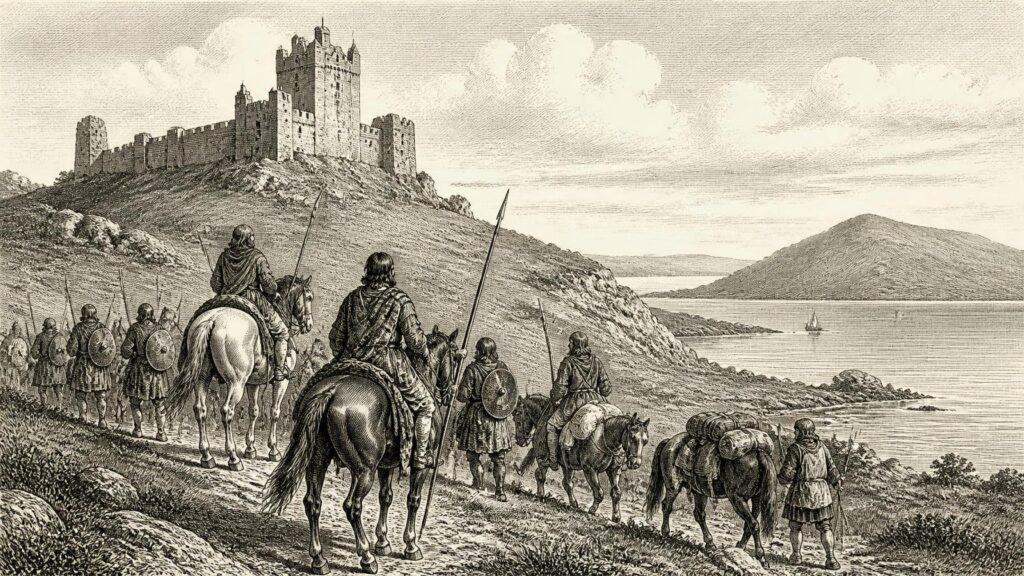
After the Dublin parliament, Kildare led an expedition north into Ulster. The Annals of Ulster, a source especially valuable for the politics of the northern lordships, calls him the justiciary of Ireland and records a strikingly coercive campaign. His force broke down Dundrum Castle in Lecale, devastated lands belonging to Félim Magennis in Uí Echach, and carried off Félim’s wife, his son and hostages from the country. The annal is plain about what such an expedition meant. It was not a tidy transfer of administrative control. It was a demonstration of military superiority, aimed at extracting pledges for future conduct by seizing people whose safety bound a lord and his followers to an agreement.
Dundrum was a strategic castle above the approaches to Dundrum Bay, in territory held by the Magennises. Its capture mattered because castles were not simply residences. They were defensible centres from which a lord could protect dependants, control routes and project influence into neighbouring districts. Yet the episode should not be mistaken for the permanent conquest of Lecale. Kildare’s force could break the castle and take hostages; that did not remove the Magennises from the region or turn the territory into securely administered crown land. The later history of the castle makes the point: it remained contested and required further campaigns in subsequent decades.
On the return journey, Kildare went to Dungannon, the principal power-centre of the O’Neills of Tír Eoghain. There, according to the same annal, he broke down the castle, burned the country and returned safely home. This was a notable success, but the vocabulary of destruction is important. Demolition and burning could punish an opponent, disrupt supplies and proclaim dominance; they did not necessarily secure lasting obedience. The Tudor government in Dublin lacked the permanent military and financial resources required to hold every strongpoint that a deputy could reach on campaign.
Dungannon Burned Twice
The year’s annalistic record makes any claim that Ulster had been ‘quieted’ particularly misleading. The Annals of Ulster also place another destructive expedition in Tír Eoghain during 1517, led by Aodh Dubh O’Donnell of Tír Chonaill. At the urging of a rival O’Neill claimant, Conn son of Niall son of Art, O’Donnell first made raids that brought back substantial cattle spoil. He then entered Tír Eoghain with the nobles of Cenél Conaill, burned territory as far as Coill Íochtarach, waited five nights for Aodh, son of Niall, son of Conn O’Neill, and on withdrawing reached Dungannon. O’Neill abandoned the settlement; it was burned completely, and O’Donnell returned home after escorting allies of Clann Aodha Buidhe back towards east Ulster.
The sequence and exact intervals between O’Donnell’s raid and Kildare’s later arrival cannot be securely reconstructed from annals arranged by year rather than day. What can be said firmly is that Dungannon was attacked by two powerful outside forces in the same calendar year. Its destruction was therefore bound up not only with Kildare’s deputyship but with the continuing rivalry of O’Donnell and O’Neill houses, and with divisions inside the O’Neill kindred. The political centre of Tír Eoghain was not a passive object of Dublin policy. It stood amid intersecting struggles for regional predominance.
Several deaths and killings recorded in 1517 underline that instability. John, son of Conn O’Neill, described by the Four Masters as exceptionally wealthy in Ulster, died. The Annals of Ulster identify him more precisely as tanist of Tír Eoghain and an undisputed royal heir within his branch; his death altered an already competitive succession. Art, son of Aodh son of Domhnall O’Neill, was killed by Niall, son of Conn. Such entries should not be read as isolated family tragedies. In a lordship where leadership rested on kinship, military capacity and support among subordinate families, the death of a tanist or a prominent adult male could change the balance of power across a whole territory.
Cold Water and Winter Travel
A brief Latin annal adds another dimension to 1517: a great frost affected Ireland and England, severe enough, it says, for horse-drawn carts to travel across the Thames in England and over Irish streams. The report is concise and cannot tell us how long the freeze lasted, which rivers were crossed, or whether it brought famine or exceptional mortality in Ireland. Those consequences must not be invented. Nevertheless, a freeze memorable enough to enter the chronicle points to a disruption in everyday movement and seasonal work. Streams that usually marked obstacles or boundaries could become routes, while watermills, fishing, transport, livestock management and travel were likely affected in ways the surviving record does not enumerate.
For rural households, weather was inseparable from political conditions. Cattle were wealth, food, rent and a target in war. The annals’ recurrent language of preys, burnings and hostages reflects a society in which the removal of animals and the destruction of stored produce could damage a lord’s standing as well as a family’s livelihood. The great frost is therefore best treated as firmly recorded environmental context, not as an explanation for events for which no source supplies one.
Change Beyond the Pale
Elsewhere, the year brought changes that reveal how local lordship was continually remade. Brian O’Conor Faly died and was succeeded by An Calbhach, son of Tadhg. This was an inauguration, not an automatic modern-style inheritance: succession in Gaelic Ireland commonly involved selection from a wider ruling lineage, and acceptance depended upon political support. In Leinster, Art O’Toole was killed by his own kinsmen, a reminder that the Wicklow borderlands remained outside easy Dublin control despite repeated campaigns from the Pale.
Conflict also crossed the conventional divide between ‘English’ and ‘Irish’. Thomas, son of Ulick Burke, raided Ormond, was overtaken by pursuers, lost the prey and was killed. The Four Masters call him the most noble-deeded Englishman of his time, while also recalling his earlier devastation of Uí Maine. Such language reflects ancestry and political culture rather than a simple national alignment. The Burkes of Connacht, the FitzGeralds, Butlers and many other dynasties operated in a world where lordly connections, territorial interests and immediate rivalries mattered more than a fixed opposition of ethnic blocs.
In the south-west, the castle on Lough Leane at Killarney was taken from the sons of Cormac Ladhrach Mac Carthy, who were driven to MacMaurice; retaliatory depredations then ravaged Magh Ó gCoinchinn. In the midlands, Mulrony O’Carroll raided Delvin and plundered Ceanncor Castle, provoking wider war in which the earl was drawn in on the side of O’Melaghlin and the people of Delvin. These notices are fragments, but together they show that Kildare’s northern expedition was only the most conspicuous movement in a country marked by many simultaneous local contests.
One last annalistic notice offers a quieter but poignant counterpoint to armies and castles. Donnchadh O’Boyle set out by boat for Tory Island with a crew, but a wind drove them westward into the Atlantic and no further news was heard. Sea travel connected Ireland’s coastal communities, islands and wider Gaelic world, but it was vulnerable to weather and loss. In 1517, Ireland’s history was made not solely in Dublin or at Dungannon: it was also shaped by exposed journeys, winter cold, contested cattle and the precarious security of local households.
The year therefore resists any simple picture of expanding central rule. Kildare could convene parliament, lead a major force into Ulster and destroy important castles. O’Donnell could independently burn Tír Eoghain and reach Dungannon. Local dynasties could inaugurate successors, raid neighbours and settle scores within their own kindreds. The events securely associated with 1517 show a politically connected island, but not a politically unified one.
Primary Sources
- The Annals of Ulster
- Annals of Ulster otherwise Annala Senait, Annals of Senat
- Annals of the Four Masters
- Annals of the Four Masters
- Annales Breves Hiberniae
- FitzGerald, Gerald (Gearóid Óg, Garrett McAlison)
- O'Neill (Ó Néill), Conn ‘Bacach’
- O'Donnell (Ó Domhnaill), Sir Aodh Dubh
- Butler, Piers (‘Piers Ruadh’)
- FitzGerald, Gerald (Gearóid Mór)
- Fitzgerald, Gerald, ninth earl of Kildare (1487–1534), lord deputy of Ireland
- Dictionary of National Biography: Fitzgerald, Gerald (1487–1534)
- Dundrum Castle, County of Down
- Appendix One: Context List
- The Historic Record of Cold Spells in Ireland
- Medieval Irish Chronicles Reveal Persistent Volcanic Forcing of Severe Winter Cold Events, 431–1649 CE
- Annals from 1504 to 1639
- Part 2 of Annals of the Four Masters
- O'Donnell (Ó Domhnaill), Aodh Ruadh
- O'Neill (Ó Néill), Conn