

Sligo’s French Siege Gun1516 CE
In 1516, Ireland was governed through overlapping royal, Gaelic and urban powers. As Henry VIII’s deputy, Kildare led a coalition that captured Leap Castle, secured hostages and imposed authority in the midlands. In the north-west, Manus O’Donnell obtained French-linked artillery after a pilgrim’s visit to Lough Derg, used it to take Sligo Castle, and later negotiated peace with O’Neill under Dublin’s mediation. Kildare’s Dublin parliament addressed markets, ports, taxation and defence. Religious life, travel and scholarship remained vital: friars drowned on Lough Erne, the Book of Fenagh was completed, and Desmond’s Gaelic lord died amid continuing regional warfare and connections.
Dateline
For Ireland, 1516 is unusually rich in evidence, though the surviving records rarely supply a month or day. The annals firmly place a series of campaigns, deaths, a negotiated peace and a major manuscript compilation within this calendar year. Together they show an island governed neither by a single Irish polity nor by a simple division between ‘English’ and ‘Irish’ areas. Gerald FitzGerald, ninth earl of Kildare and the king’s deputy, exercised formidable authority from Dublin; Gaelic lordships commanded armies, castles and diplomacy across the north and west; and towns, monasteries and seaborne contacts connected these worlds. The year’s most striking episodes were the taking of Leap Castle in the midlands and the capture of Sligo Castle after artillery arrived through an unexpected French connection.
An Island of Several Powers
Henry VIII was lord of Ireland in 1516, but the effective reach of his administration was uneven. Its strongest base lay in Dublin, the corporate towns and the Pale, while Kildare’s personal lands, affinities and military alliances extended its influence far beyond those limits. Kildare had succeeded his father as earl in 1513 and had been confirmed as lord deputy by Henry. His position rested on more than an English royal commission: he could call upon leading families of Meath and Leinster, negotiate with Gaelic rulers, and mobilise forces across older political and cultural boundaries.
That flexibility was essential. The annals describe Kildare’s host in 1516 as including nobles of the ‘Foreigners and Gaidhil’ of Meath and Leinster. This language did not describe two sealed communities. It identified overlapping political traditions and lineages whose leaders could serve, bargain, feud and fight alongside one another. Kildare’s authority was powerful, but it remained dependent on coalition-building, rewards, intimidation and the ability to appear an effective arbiter.
One immediate test lay in Éile Uí Chearbhaill, the O’Carroll territory around the modern Offaly–Tipperary border. Maolruanaidh O’Carroll had been a difficult neighbour for the English lordships of the midlands, and the strategically placed stronghold at Léim Uí Bhánáin, later known as Leap Castle, stood in territory where routes between Leinster and Munster could be contested. The events of 1516 therefore concerned more than one castle: they were part of the struggle to establish who could exact obedience, tribute and military service in the central island.
Leap Castle Taken
The annalists record a substantial expedition into O’Carroll country. Kildare came with the magnates of Meath and Leinster; James, son of the earl of Desmond, brought Munster allies; and Piers Butler arrived with his full host. The presence of Butler is revealing. He and Kildare were already entangled in the disputed Ormond inheritance, a quarrel that would embitter Irish politics for years. In 1516, however, their shared interest in checking O’Carroll power still enabled co-operation.
The combined force burned and devastated the countryside on its march to Léim Uí Bhánáin. Such phrases in annalistic writing are brief, but their human meaning was not: raiding armies took livestock and stores, destroyed crops and dwellings, and made rural survival harder long after the armed men had moved on. At the castle, the besiegers broke the defences and the garrison fled. Annála Connacht emphasises that Kildare’s father had failed to take the place and calls it among the most stubbornly defended castles of its age. The success consequently advertised the younger earl’s military competence as well as his deputyship.
The expedition did not end at the breached fortress. The Annals of Ulster says that Kildare then went to Cathair Dún Iascaigh, where the heir of Thomas son of Edmund Butler was carried off as a pledge that his father would abide by Kildare’s award. At Clonmel he took the town’s sovereign, or chief municipal officer, and other leading inhabitants into custody before returning home safely. These actions demonstrate how rule was enacted: castles were reduced, hostages secured agreements, and an urban community could be made to answer directly to a magnate exercising governmental power. The campaign did not erase O’Carroll influence, but it temporarily reshaped the balance of power in the midlands.
War and a Siege Gun in the North-West
Far to the north, a major conflict divided the O’Donnell and O’Neill political spheres. The Annals of Ulster and Annála Connacht agree that a ‘great war’ arose, with both sides hiring many men. Manus O’Donnell, the heir of Aodh Dubh O’Donnell of Tír Chonaill, was prominent in raids against Henry Balbh O’Neill; other forces burned through Cenél Moen, Cenél Feradaigh and lands along the River Mourne or Una. The sources do not permit a reliable total of casualties or a precise itinerary, but they repeatedly record burning and plundering. Warfare was a sustained pressure upon farming districts and lordly dependants, not merely a clash between chiefs.
The year also provides a vivid instance of Ireland’s religious and maritime connections. A French knight came as a pilgrim to St Patrick’s Purgatory on Lough Derg. According to the Annals of Ulster, O’Donnell honoured and escorted him, giving him horses and a ring; the friendship then brought a ship loaded with ordnance, including guns capable of breaking a castle. The report is too compressed to establish the exact route, cost or arrangements behind this transaction. Yet its central point is clear: a pilgrimage network could create a personal relationship across the seas, and that relationship delivered siege artillery to a Gaelic lordship.
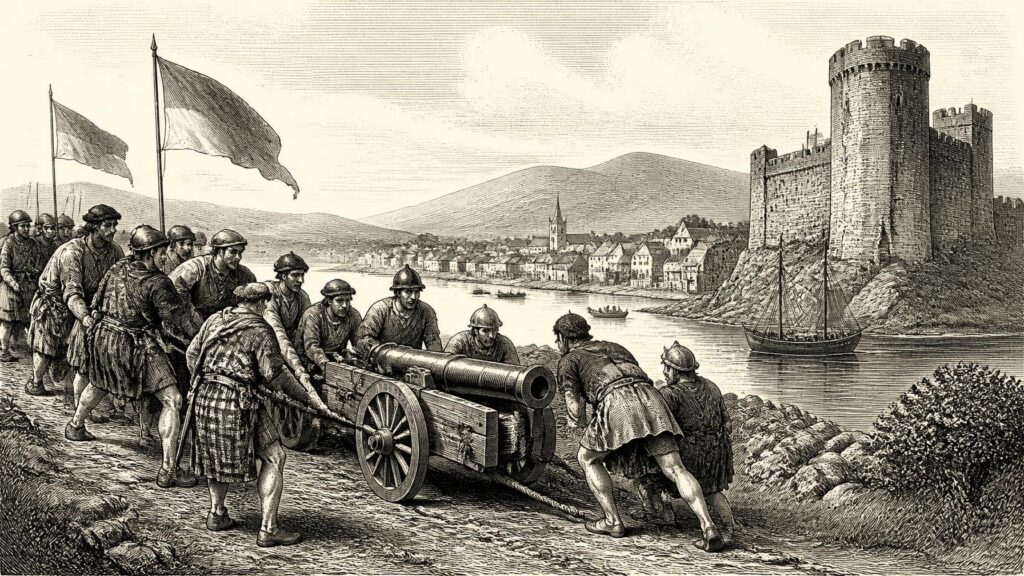
O’Donnell’s force hauled the artillery to Sligo and besieged the castle. The Annals of Ulster states that part of the town was broken down and that the place fell on the third day; Annála Connacht similarly says the siege-gun breached the castle. The garrison received quarter. From Sligo the victors moved into Tireragh, taking Collooney Castle, Loch Dargan Castle and Dún na Móna. Garrisons were installed in some places and hostages taken from others. This was an organised assertion of regional dominance, using both a new military resource and familiar instruments of lordship.
Conflict did not prevent diplomacy. Later in the year O’Donnell and O’Neill made peace under solemn guarantees involving God, church relics and the leading men of the Conallian and Eoganian peoples. Crucially, they agreed to remain at peace as Kildare and the king’s council should determine. O’Donnell subsequently travelled to Dublin, was honourably received there for a week, and returned safely; O’Neill did not attend. Dublin’s council therefore mattered even in a northern war, but its authority worked through negotiation rather than automatic command.
Parliament, Markets and Ports
Kildare also held a parliament at Dublin in 1516. The surviving statutory record gives a valuable, if narrow, view of the concerns of the administration and urban political community. Its acts confirmed the liberties of the church, the land of Ireland, Dublin and other corporate towns; dealt with taxation and letters issued under the English privy seal; and renewed provisions concerning absentees. Under Poynings’ Law, bills for an Irish parliament required prior approval in England, a reminder that the Dublin legislature was constrained by the king and council across the Irish Sea.
Several measures touched ordinary economic practice. One forbade buying corn except in market and restricted dealings in tithes; another required merchants importing from England to bring a stipulated proportion of longbows and arrows. Legislation also sought to channel imports and exports through designated main ports, while a further provision regulated foreign fishing by requiring part of the catch to be landed in Ireland. These laws should not be mistaken for proof that every rule was enforced throughout the island. They do show the priorities of government: reliable market exchange, customs control, access to food, maritime revenue and military readiness in the areas where its institutions could operate.
Faith, Learning and Mortality
Religion in 1516 was not separate from politics, travel or scholarship. The French knight’s journey to Lough Derg is one example. Another is tragic: a large party of friars from Cavan drowned on Lough Erne, among them John Mac Craith and Nicholas O’Cathain, both identified as Friars of Strict Observance. The annal provides no fuller account of the accident, but its notice reflects the importance of observant Franciscan life and the risks of movement by water in the lake country.
At Fenagh in County Leitrim, Muirgheas mac Pháidín Ó Maolconaire completed the Book of Fenagh, commissioned by Tadhg Ó Rodaighe, coarb of the monastery. Written in Classical Irish prose and verse from earlier materials, it set out the traditional dues, privileges and claims attached to the ancient foundation of St Caillín. Its production in this year is important evidence of learned continuity: Gaelic scholars did not merely preserve inherited texts, but recast them into authoritative books for institutions with living interests in land, status and revenue.
The annals also record the death of Cormac Ladhrach Mac Carthaigh Mór, lord of Desmond, praised as a patron of poets and exiles who had won and held his lordship through warfare. His death belongs beside the campaigns of Kildare and O’Donnell as a reminder that Munster, too, contained powerful Gaelic rulerships distinct from the Anglo-Irish earldom of Desmond represented in Kildare’s host.
A Year of Connected Power
In 1516, artillery, pilgrimage, parliaments, hostage-taking and manuscript culture were not separate stories. The French-supplied gun at Sligo and Kildare’s coalition at Leap Castle reveal a political landscape in which military innovation moved through personal networks and power depended on alliances crossing linguistic and legal frontiers. Dublin could legislate for markets and ports and mediate a northern peace, yet its deputy also ruled by the older practices of hosting, pledges and negotiated submission. Meanwhile, at Fenagh, a learned book asserted monastic rights in polished Irish. The year’s evidence captures an Ireland both deeply regional and actively connected: across the island, across the Irish Sea, and to wider European religious and military worlds.
Primary Sources
- The Annals of Ulster, Year U1516
- Annála Connacht, Annal 1516
- Annals of the Kingdom of Ireland by the Four Masters, Annal M1516
- Annals of the Four Masters: bibliographical and editorial information
- Calendar of State Papers, Ireland, Tudor Period 1509–1547
- Statute Law Revision Act 2007
- FitzGerald, Gerald (Gearóid Óg, Garrett McAlison)
- O'Carroll (Ó Cearbhaill), Maolruanaidh
- O'Donnell, Manus (Ó Domhnaill, Maghnas)
- Butler, James
- The hegemony of the earls of Kildare, 1494–1520
- Tudor Policy and the Kildare Ascendancy in the Lordship of Ireland, 1496–1534
- The Book of Fenagh: supplementary volume
- The Book of Fenagh: Supplementary Volume (PDF)
- Aisling Tundail
- Poynings’ Law
- The Bills and Statutes of the Irish Parliaments of Henry VII and Henry VIII (1486–1543)
- Statute Rolls of the Irish Parliament: Richard III to Henry VIII
- Ireland in the Reign of Henry VIII: The Making of Tudor Political Theology, 1515–47
- The Political and Military Career of the Ninth Earl of Kildare, 1513–1534 (doctoral thesis)
- English Lordship of Ireland and the Irish Sea World: Re-assessing the Origins of the Kildare Ascendancy, c.1390–c.1513
- Leap Castle, Birr (Mercy Convent), The Schools’ Collection