

Port na dTri Namhad1526 CE
In 1526, Ireland’s fragmented political order was shaped by failed diplomacy, raiding, fortification and contested successions. Gerald FitzGerald, earl of Kildare, unsuccessfully mediated between Conn Bacach O’Neill and Manus O’Donnell, whose rivalry centred on the Tír Chonaill–Tír Eóghain frontier and O’Donnell’s castle at Port na dTri Namhad. O’Donnell forces raided Tír Eóghain and defeated opponents in Connacht, securing hostages and destroying castles while warfare devastated crops and communities. Succession disputes followed deaths among O’Reilly, O’Dochartaigh and O’Rourke kindreds; church office also provoked violence. Severe weather killed raiders. Kildare’s English summons weakened mediation, leaving conflicts unresolved across the island’s competing lordships.
Dateline
In 1526, the most consequential Irish struggles lay not in a single kingdom-wide war but in a chain of connected disputes: over frontiers, lordships, crops, castles and the authority to make peace. The year’s clearest focal point was the north-western border between Tír Chonaill and Tír Eóghain, where the O’Donnells and Conn Bacach O’Neill competed for influence. Yet the same pressures were visible from Cavan to Connacht and from Dublin to the Wicklow uplands. Ireland remained a land of many political communities, linked by marriage, fosterage, raiding, ecclesiastical institutions and bargaining as much as by formal allegiance.
A Peace That Did Not Hold
The year opened with an attempt at high-level conciliation. The Annals of Ulster place Conn Bacach O’Neill of Tír Eóghain and Manus O’Donnell, acting for the O’Donnell lordship of Tír Chonaill, before Gerald FitzGerald, ninth earl of Kildare, in the spring. Kildare was the king’s deputy in Ireland, though the Irish annals often styled him Lord Justice or Justiciary. The purpose was to make peace between the Cenél nEógain, the people of O’Neill, and the Cenél Conaill, the people of O’Donnell.
This was a substantial political gathering rather than a private interview. The annals say that many leading men among both the Irish and the English of Ireland assembled to assist the settlement. That detail matters. Kildare’s government was strongest around Dublin and the Pale, but his authority also depended on his ability to convene, reward and mediate among powerful Gaelic and Anglo-Irish lords. Conn Bacach was a Geraldine ally and kinsman; Manus O’Donnell was the prominent heir and military lieutenant of his father, Aodh Dubh O’Donnell. Their appearance before Kildare showed that Dublin remained an important diplomatic centre even where it could not enforce its will.
The meeting failed. No peace was ‘knit’, in the words of the Annals of Ulster, and the parties went home safely but unreconciled. The failure should not be mistaken for diplomatic irrelevance. It demonstrated that the language of negotiated peace, arbitration and safe conduct was shared across political boundaries. But it also exposed its limit: neither Kildare nor the assembled magnates could settle a contest rooted in control of the borderlands and in the standing of two great lordships.
Raid, Fortress and Frontier
Military action followed quickly. The Annals of the Four Masters record that, after Manus returned from Dublin, Aodh Dubh O’Donnell and Manus led their forces into Tír Eóghain at the beginning of spring. They carried off prey, devastated territory and, in a vivid seasonal detail, feasted on their takings during Shrovetide at Coill na Lón in Síl Baoighill before returning home with booty. Such a raid was not merely indiscriminate destruction. Livestock, food stores and portable goods sustained an army, damaged an opponent’s capacity to retaliate, and advertised a lord’s ability to protect and reward followers.
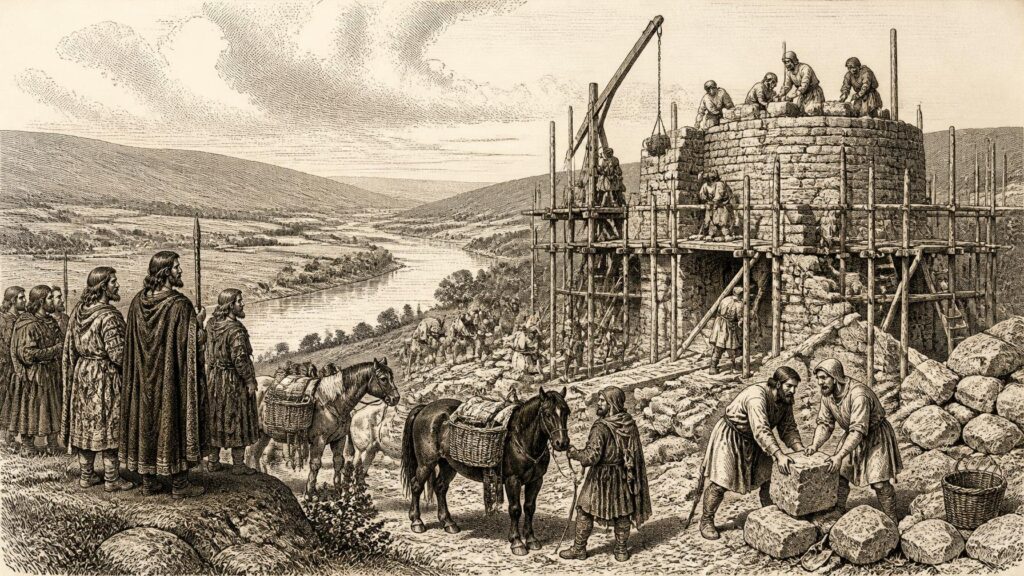
A fortification near Lifford made the rivalry still more concrete. The annals state that Conn Bacach marched to prevent Manus O’Donnell from building a castle at Port na dTri Namhad, ‘the port of the three enemies’. A modern biographical study of Manus notes that foundations may already have been under way by 1524, while treating 1526 as the year in which the important castle-building project began in earnest. The precise construction sequence cannot be fixed beyond that, but work was plainly active enough in 1526 to provoke armed intervention.
The proposed stronghold stood in a contested district close to the routes between Tír Chonaill and Tír Eóghain. It was therefore a claim expressed in masonry: a defensible base from which the O’Donnells could watch movement, shelter men and hold a strategic crossing-area. Conn’s intervention failed. Manus’s troops met the foremost part of O’Neill’s host and captured Henry, son of John O’Neill. The Four Masters say Conn fled; the Annals of Ulster, more restrained, say he withdrew without notable wider loss. Taken together, the accounts firmly establish Henry’s capture and O’Neill’s retreat, while warning against treating every annalistic flourish as a literal battlefield report.
Connacht Under Pressure
The year’s heaviest fighting was in Lower Connacht, where Aodh Dubh O’Donnell’s far-reaching influence was challenged. Brian, son of Feidhlimidh O’Conor, Tadhg, son of Cathal Óg O’Conor, and members of the Mac Donough kindred formed a confederacy against O’Donnell. Their raids in lower Carbury brought the conflict into a region where lordship depended on local alliances and on the ability to control cattle, harvests, castles and hostages.
O’Donnell responded with a mobilisation drawing on chiefs of Tír Chonaill, Maguire of Fermanagh and the wider military rising-out of Fermanagh. He demolished the castle or residence at Grange, associated with Brian O’Conor’s descendants, then ravaged Moylurg. His opponents in turn gathered around Sligo, cut down crops and attempted to take the settlement. Their target was significant: Sligo sat at the meeting point of north Connacht and the routes into Ulster, and its security was central to O’Donnell influence south of his own lordship.
O’Donnell hurried to Sligo’s relief. The opposing force withdrew towards Bel an Droichid, where it was defeated. The annals name the death of Melaghlin, son of Owen Mac Donough, and report the capture of horses, weapons and armour. This was warfare with immediate consequences for ordinary inhabitants. Armies did not live separately from the countryside: they requisitioned food, seized animals, burned settlements and targeted standing corn. The record of crops deliberately cut down near Sligo, then later carted into Sligo or destroyed by O’Donnell’s army, shows how grain became both a military resource and a weapon against resisting communities.
Before All Hallows, probably late in the autumn but without a securely recorded day, O’Donnell campaigned again in Tirawley at the request of the descendants of Richard Burke. He took and demolished the castles of Caerthanan and Cros Maoilfhionna, extracted hostages, and compelled settlements from the Burkes’ rivals, the Barretts, and from Mac Donough and O’Conor interests. Hostages were not incidental trophies. They were guarantees that agreements made under pressure would be observed after an army moved on. This campaign therefore combined destruction with the reconstruction of political obedience on O’Donnell’s terms.
Succession, Church and Weather
Several deaths reveal the vulnerability of local order. Eóghan Ruadh O’Reilly died in East Breifne, and a serious succession struggle followed. Fergal, son of John O’Reilly, was eventually recognised as O’Reilly despite the claims of older rivals, on the advice of Kildare and other English and Irish nobles. Kildare’s role did not mean that East Breifne had become a simple extension of Dublin rule. Rather, it showed how an external arbiter could lend useful weight to one candidate in a contested Gaelic succession.
In Inishowen, Eachmarcach O’Dochartaigh also died, triggering another dispute before Gerald, son of Domhnall, was chosen lord. In west Breifne, Tadhg, son of Eogan O’Rourke, was killed treacherously by people belonging to his own brother. These notices underline a central fact of sixteenth-century politics: leadership was not automatically inherited by the eldest son. Election or ‘styling’ within a ruling kindred could preserve flexibility, but it could also turn bereavement into conflict.
Religion was inseparable from this world rather than remote from it. Glasny Magennis, abbot of the monks of Newry and prior of Down and Saul, was killed by Donnell Óg Magennis and his kinsmen. The killing of a senior churchman by members of his own extended family illustrates how ecclesiastical office, wealth and kinship could intersect dangerously. Monasteries and priories remained places of prayer, learning, hospitality and landed authority; their offices could carry temporal as well as spiritual significance.
The annals also preserve a stark environmental episode. In January, Godfrey O’Kane, heir to a lordship, entered Gleann Conchadhain on a raid. Intense winter cold overwhelmed him and companions; his body was not found until the end of Lent. It is only one local report, not evidence for a general Irish climate crisis, but it is a reminder that weather could shape travel, campaigning and survival as decisively as any political calculation.
Kildare Summoned
In August, Henry VIII summoned Kildare and his rival Piers Butler to the English court. The immediate context was their enduring feud and the crown’s concern about the political disorder it fostered, alongside fears surrounding the overseas dealings of the earl of Desmond. Kildare’s departure for England removed, or at least weakened, the figure who had convened the spring peace effort and influenced the O’Reilly succession. His detention there would continue for years.
Thus 1526 closed without a durable northern settlement, while O’Donnell power had been forcefully displayed in Connacht and construction at Port na dTri Namhad had survived O’Neill opposition. The year did not create the island’s fractured political order; it exposed how actively that order was made and remade. Castles rose, crops were cut, hostages changed hands, clerics were drawn into kinship violence, and rulers sought peace even as they prepared for the next campaign.
Primary Sources
- Annals of the Four Masters, Annal M1526
- The Annals of Ulster, Year U1526
- Annála Connacht
- Annals of Loch Cé A.D. 1014–1590
- FitzGerald, Gerald (Gearóid Óg, Garrett McAlison)
- O'Neill (Ó Néill), Conn ‘Bacach’
- O'Donnell, Manus (Ó Domhnaill, Maghnas)
- O'Donnell (Ó Domhnaill), Sir Aodh Dubh
- O'Reilly (Ó Raghallaigh), Cathal
- O'Byrne, Seán
- O'Connor Roe (Ó Conchobhair Ruadh), Tadhg Buidhe
- Letters Patent of Henry VIII Relating to the Earl of Ormonde and the Earl of Kildare, 5 November 1526
- Fitzgerald, Gerald, Ninth Earl of Kildare (1487–1534), Lord Deputy of Ireland
- English Lordship of Ireland and the Irish Sea World: Re-assessing the Origins of the Kildare Ascendancy, c.1390–c.1513
- Annals of Connacht: Editorial and Bibliographical Information
- CELT: Translated Texts
- CELT: Irish Texts
- Annals of the Four Masters
- Dictionary of Irish Biography: Bibliographic Abbreviation Conventions
- Ireland, 1494–1603