State Papers
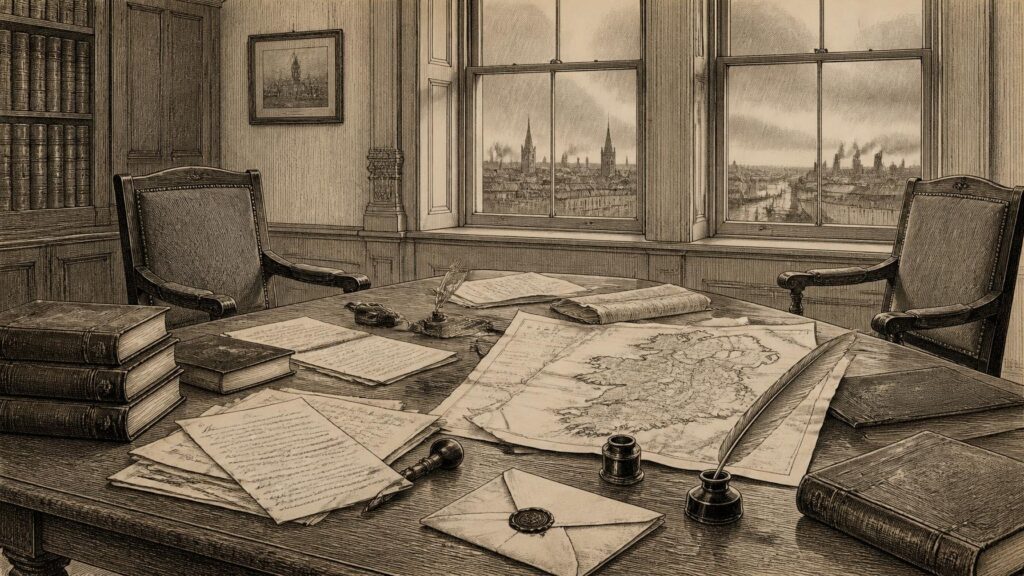
AI generated historical illustration, not a contemporary photograph.
At a Glance
The peace process in Ireland did not emerge from a single dramatic revelation, nor can it be reduced to the signatures placed on the Belfast Agreement on 10 April 1998. It was made through years of public argument, private contact, official memoranda, draft texts, constitutional calculation and painstaking record-keeping. State papers are indispensable to that history, but they are neither neutral nor complete. They show how governments understood the conflict, how they sought to manage risk and how British-Irish co-operation became central to a settlement; they do not, by themselves, contain the full experience of violence, bereavement, political mobilisation or everyday life.
Peace Documentation
The phrase “state papers” can sound deceptively simple. In Irish archival practice it may refer narrowly to official records transferred from departments of government to the National Archives of Ireland. In a wider historical sense, it includes cabinet conclusions, ministerial correspondence, diplomatic despatches, briefing files, memoranda, minutes, legal advice, treaty papers and records made by civil servants. For the Northern Ireland peace process, the relevant state record is necessarily distributed. Important British files lie at The National Archives at Kew; Irish departmental files are held by the National Archives of Ireland; Northern Ireland public records are in the Public Record Office of Northern Ireland (PRONI); and official texts, parliamentary proceedings and political papers are preserved elsewhere.
This dispersal reflects the subject itself. The conflict was not solely an internal matter for Northern Ireland, nor merely a bilateral dispute between Dublin and London. It involved constitutional relationships within Northern Ireland, relations between Northern Ireland and the Republic, and relations between the Irish and British Governments. The three-stranded form eventually expressed in the 1998 settlement had earlier appeared in various negotiations and official proposals. A historian therefore has to read across jurisdictions, institutions and genres rather than treating any one government’s archive as a complete account.
The British archive is especially large but must be read with care. The National Archives’ guide to the Troubles makes the essential point that its records were created by United Kingdom departments and thus reflect the priorities, language and assumptions of successive UK Governments. Its catalogues identify series from the Prime Minister’s Office, Cabinet Office, Northern Ireland Office, Foreign and Commonwealth Office, Home Office and Ministry of Defence. The same guide notes that many relevant files remain available only in paper form, while some are still closed or retained by departments. [The National Archives, ‘The Troubles in Northern Ireland’]
Irish state papers have a different institutional history and a different perspective. The National Archives of Ireland explains that its annual release normally brings departmental records into public consultation after thirty years under the National Archives Act 1986. The later National Archives (Amendment) Act 2018 permitted an earlier release, after twenty years in specified circumstances, of records concerning the peace process leading to the Belfast/Good Friday Agreement. Files from the Departments of the Taoiseach, Foreign Affairs, Justice and the Office of the Attorney General have consequently made it possible to compare Irish and British negotiating records much more closely than was once possible. [National Archives of Ireland, ‘Annual Release of State Records’]
That access matters because the older public story of the peace process was often fashioned from speeches, newspapers, memoirs and the final agreement itself. Those remain valuable sources, but official records expose the machinery behind public language: drafts revised at speed; options rejected; anxieties about wording; arguments over sequencing; and the ordinary administrative work that made negotiation possible. Yet the archive should not be mistaken for a confessional. A file records what someone chose to put in writing, what an office thought useful to preserve and what rules later allowed the public to see. Silence, omission and classification are part of the evidence.
Inherited Conflict
The peace process of the 1990s cannot be understood without the constitutional settlement created by partition and the history of instability that followed. Northern Ireland was established in 1921 within the United Kingdom. Its unionist-majority institutions and its nationalist minority existed amid conflicting national allegiances, unequal political power and, for many nationalists and republicans, a continuing rejection of partition. The civil-rights movement of the late 1960s brought discrimination in housing, voting, employment and policing into sharp public focus. The ensuing crisis, intercommunal violence and state security response developed into the prolonged conflict conventionally called the Troubles.
It is important not to impose a false consensus on this background. Unionists generally defended Northern Ireland’s place in the United Kingdom and feared that constitutional change would diminish their identity and security. Nationalists and republicans generally sought constitutional change towards a united Ireland, though they differed sharply over methods, timescales and political strategy. The British state claimed responsibility for Northern Ireland’s administration and security; the Irish state asserted an interest rooted in national identity, constitutional claims and the practical effects of the conflict. Other actors—churches, prisoners’ relatives, victims’ groups, trade unionists, women’s organisations, community workers and international figures—also shaped the conditions in which formal politics occurred.
The collapse of the Northern Ireland Parliament in 1972 and the introduction of direct rule from Westminster did not remove the constitutional problem. The Sunningdale Agreement of 1973 proposed power-sharing and a Council of Ireland, but its institutions fell in 1974 after the Ulster Workers’ Council strike and the withdrawal of support on which they depended. State records from that era demonstrate that constitutional design was inseparable from the question of consent: no arrangement could endure if it lacked sufficient legitimacy among those expected to operate it. Later negotiations, including the Anglo-Irish Agreement of 1985 and the Brooke-Mayhew talks of 1991–92, did not settle the conflict, but they created precedents, relationships and vocabulary that mattered in the 1990s.
The Anglo-Irish Agreement was particularly significant because it established an intergovernmental role for Dublin in Northern Ireland affairs through the Anglo-Irish Intergovernmental Conference, while confirming that Northern Ireland’s constitutional status would not change without the consent of a majority there. It provoked intense unionist opposition, yet it also institutionalised regular official co-operation between the two Governments. The Houses of the Oireachtas’ historical account rightly identifies that co-operation as an important precursor to the later peace process, while the National Archives at Kew directs researchers to Foreign Office material on Irish governmental and overseas reactions to the Agreement. [Houses of the Oireachtas, ‘Ireland through the decades’; The National Archives, ‘The Troubles in Northern Ireland’]
There is a temptation, especially in commemorative writing, to present each unsuccessful initiative as a mere prelude to an inevitable 1998 outcome. The evidence does not justify that confidence. Sunningdale failed; the Anglo-Irish Agreement was bitterly contested; and the early 1990s talks did not produce a settlement. Their significance lies not in destiny but in accumulation. They established that the constitutional relationships had to be addressed together, that the Irish Government could not simply be excluded, and that durable change required some form of democratic consent. Such lessons were available to later negotiators, but did not make their choices easy.
Private Declarations
The early 1990s brought a more serious possibility of movement, although the route was uncertain. Secret and semi-secret contacts between representatives of the British Government, the Irish Government, Sinn Féin and others have attracted enduring public interest. Official files can clarify dates, channels and governmental assessments, but they do not reduce the process to a hidden bargain. Private contact and public politics were mutually dependent. Governments required ways to test whether violence might cease; parties had to maintain credibility with their supporters; and each side needed public formulations that did not appear to surrender its core position.
The Downing Street Declaration, issued jointly by Prime Minister John Major and Taoiseach Albert Reynolds on 15 December 1993, was a major public statement of principles. It recognised the right of the people of Ireland, north and south, to solve issues between them by agreement, while affirming that Britain had no selfish strategic or economic interest in Northern Ireland and would uphold the democratic wishes of the people of Northern Ireland. Its wording was carefully balanced. It neither promised Irish unity nor affirmed permanent partition irrespective of consent. The text is preserved among the documentary collections of the Conflict Archive on the Internet (CAIN), which offers an extensive chronology and primary-source archive for the peace process. [CAIN, ‘Irish Peace Process: List of Source Documents’]
It would be wrong, however, to describe the Declaration as a simple breakthrough authored by two leaders. Its preparation involved officials and drew upon a long history of British-Irish consultation. It also had to be interpreted by parties whose constituencies had different fears. Republicans tested whether the language of self-determination offered a credible democratic route; unionists scrutinised the implications for the Union; and many people who had lost relatives or lived through intimidation judged political statements against their experience of violence. State papers can reveal official intention, but they cannot decide how a declaration was received in homes, workplaces, prisons or streets.
The Provisional IRA’s ceasefire of 31 August 1994 and the loyalist ceasefire announced in October transformed the political context without resolving it. A ceasefire was not peace, and it did not produce trust automatically. Questions of decommissioning, prisoners, policing, participation in talks and the future of constitutional arrangements became more urgent. The ceasefires also exposed a recurring difficulty: each step requested as proof of good faith could be interpreted by another participant as a demand for unilateral concession.
PRONI’s collaboration with CAIN demonstrates the value of later archival release for this period. In 2021 more than 440 formerly secret documents, including material from 1993 and 1994, were added online. The Department for Communities described them as offering insight into the emergence of the peace process and into the roles of the British and Irish Governments and the United States administration. That is useful evidence, but it should not encourage a view that digitised files have exhausted the record. Release remains selective, and the newly visible material needs to be read against the larger archive, contemporary press reporting and other participants’ papers. [Department for Communities, ‘PRONI: Secret records now available online through CAIN’]
Multiparty Governments
One of the most consequential developments of the 1990s was the increasingly close working relationship between the British and Irish Governments. This was not an abandonment of their different constitutional positions. Rather, it was an acceptance that neither could secure a settlement alone. British ministers and officials needed the Irish Government’s participation to make a new arrangement credible to nationalists and republicans. Dublin needed London’s agreement because the United Kingdom retained sovereign responsibility for Northern Ireland and because implementation required British legislation, administrative capacity and political leadership.
For historians, Irish state papers are especially important here because they correct a common imbalance in accounts based chiefly on British records. They show the Irish Government not as an outside observer but as a negotiating actor: defining objectives, responding to British drafts, considering legal implications, communicating with parties and trying to maintain domestic support. The National Archives of Ireland’s 2025 release description confirms that Anglo-Irish records relating to Northern Ireland and the peace process, including the Good Friday Agreement, were being released from the mid-1990s through to December 2004 from several key departments. [National Archives of Ireland, ‘Annual Releases of Records of Departments of State, 2025’]
The intergovernmental relationship was nevertheless only one part of a wider negotiation. The peace process had to involve Northern Ireland parties with incompatible aims. The Ulster Unionist Party, Democratic Unionist Party, Social Democratic and Labour Party, Sinn Féin, Alliance Party, Progressive Unionist Party, Ulster Democratic Party, Northern Ireland Women’s Coalition and Labour Coalition all entered the political field in different ways and with different degrees of influence. Not every party accepted the same terms of participation; not every party supported the final agreement. The process was inclusive by the standards of earlier initiatives, but it was never frictionless or universal.
The role of Senator George Mitchell, chair of the multi-party talks, was also significant. His contribution is sometimes exaggerated into a story of outside rescue. The documentary record suggests something more precise: an external chair could help manage procedures, formulate proposals and sustain contact when local parties distrusted one another, but he could not substitute for agreement among the participants or for the authority of the two Governments. The Mitchell Principles, asking parties to commit to democratic and exclusively peaceful means, gave a procedural framework for participation. They did not erase disagreement about what constituted adequate commitment in practice.
American engagement mattered beyond Mitchell personally. The United States administration gave attention and prestige to the process, while Irish-American networks and political opinion formed part of the wider international environment. Yet the settlement was not imposed from Washington. Its legal and constitutional mechanisms were negotiated principally through the parties and the two Governments. The official record should therefore be used to resist two equally misleading versions: that peace was purely an internal achievement, and that it was simply delivered from outside. It was a negotiated Irish, British and international process, with power unevenly distributed among its participants.
Negotiated Agreement
The multi-party talks that began in June 1996 proceeded through repeated deadlock, procedural dispute and interruption. The National Archives’ themed collection reproduces extracts from Northern Ireland Office records of a Stormont session on 12 June 1996, illustrating the mundane but consequential work of proposals, agendas and drafts. Such documents are reminders that political outcomes are often made in rooms far removed from later commemorative images: by deciding who speaks, what paper is tabled, whether a phrase is bracketed and what may be postponed. [The National Archives, ‘Belfast (Good Friday) Agreement 1998 Themed Collection’]
The talks had to address questions that could not sensibly be separated. Northern Ireland’s internal institutions were linked to North-South arrangements; both were linked to relations between the British and Irish Governments. Constitutional status was linked to rights and identity. Decommissioning was linked to confidence and implementation. Prisoner release, policing and justice were linked to public legitimacy. Each subject could appear to one side as a necessary protection and to another as a dangerous concession.
This helps explain why the final settlement was elaborate. The Belfast Agreement contained a Multi-Party Agreement involving Northern Ireland parties and a British-Irish Agreement between the two Governments. Its institutional architecture is commonly described in three strands. Strand One created devolved institutions in Northern Ireland, including an Assembly and power-sharing Executive. Strand Two established North/South Ministerial Council arrangements and implementation bodies. Strand Three provided British-Irish institutional arrangements, including a British-Irish Council and an intergovernmental conference.
The Agreement was not merely a blueprint for administrative bodies. It sought to change the constitutional terms on which disagreement could be pursued. It affirmed the legitimacy of both unionist and nationalist identities, recognised the right of people in Northern Ireland to identify and be accepted as Irish or British or both, and established that any change in Northern Ireland’s status would occur only with majority consent. The official UK publication of the Agreement remains the primary public text for these provisions. [UK Government, ‘The Belfast Agreement’]
Interpretation must be distinguished from documentary fact. It is a fact that the Agreement created institutions and articulated principles of consent, equality and parity of esteem. It is an interpretation to say that it “solved” the constitutional question. A more cautious reading is that it transformed the framework within which the question could be contested. It created democratic mechanisms for disagreement, but it did not eliminate conflicting aspirations or guarantee that institutions would operate continuously. The later history of suspensions, restored devolved government and continuing disputes demonstrates the difference between agreeing institutions and sustaining them.
Constitutional Transformation
The peace process required constitutional action, not simply political endorsement. In the Republic of Ireland, the Nineteenth Amendment of the Constitution Act 1998 permitted the State to consent to be bound by the British-Irish Agreement and provided for changes to Articles 2 and 3. The revised constitutional language retained an aspiration to a united Ireland but located it within peaceful means, democratic consent and the recognition of the equal right of people in Northern Ireland to identify as Irish or British or both. [Irish Statute Book, ‘Nineteenth Amendment of the Constitution Act, 1998’]
This change carried profound symbolic weight. Articles 2 and 3 had long been read by unionists as a territorial claim over Northern Ireland. Their amendment was therefore not a technical adjustment; it was part of a wider exchange in which constitutional aspiration was reframed through consent. Conversely, nationalist participation in Northern Ireland institutions and acceptance of the principle of consent did not mean the disappearance of Irish unity as a political objective. The Agreement made constitutional change conditional on democratic support, rather than defining either the Union or unity as beyond political contest.
On 22 May 1998, referendums took place in Northern Ireland and the Republic. The result endorsed the Agreement in both jurisdictions. Official Oireachtas material records the commonly cited outcomes: approximately 71 per cent voting in favour in Northern Ireland and 94 per cent in the Republic. These figures should be treated as evidence of strong overall support, not proof of a homogeneous public view. Voting patterns, abstention and the intensity of opposition mattered then and matter still. [Houses of the Oireachtas, ‘Northern Ireland: Statements’, 17 January 2017]
The constitutional settlement also required British legislation and the formal British-Irish Agreement. The distinction between the multi-party text and the interstate agreement is important. The first expressed the political settlement among participants in Northern Ireland; the second created obligations between the Governments. State papers are particularly useful for tracing how such distinctions were negotiated, because legal drafting often preserves issues that political summaries smooth over. A historian must attend to which text is being cited, who was a party to it and what domestic legal action was required to bring it into operation.
Documentary Limits
State papers are powerful historical evidence because they preserve contemporaneous reasoning. A memorandum can show what ministers were told before a decision; a draft can reveal alternatives that did not survive; a minute can identify the questions officials considered urgent. Files also make it possible to follow the sequence of negotiations rather than reading later memoirs backwards into the past. This is especially valuable in a process where the wording of “consent”, “self-determination”, “decommissioning”, “equality” or “normalisation” could bear different meanings for different readers.
But official records have structural limits. They usually privilege people with access to government. They are written in bureaucratic language, shaped by departmental responsibilities and classification rules. An intelligence assessment is not a transparent statement of fact; it is evidence of what an agency believed, reported or wished a minister to consider. A ministerial briefing may simplify opponents’ views. A record of a meeting may be selective, written after the event or designed for a particular administrative purpose. Researchers should therefore ask who created the document, for whom, when, under what constraints and with what expected use.
Absence is equally important. A file may omit oral conversations, unofficial contacts or matters judged too sensitive to record in detail. Some records remain closed because of legal, security, personal-data or preservation considerations. PRONI explains that public records can be exempt from release under freedom of information legislation, while privately deposited archives may be subject to access conditions imposed by their owners. Its conflict-related holdings include many court records and inquest files, but it does not hold every record relating to every case. [PRONI, ‘Why are some records at PRONI closed?’; PRONI, ‘Access to Conflict Related Records’]
These qualifications are not an argument against using official archives. They are an argument for using them critically and alongside other evidence. Political party archives show how organisations explained developments to members. Newspapers record public dispute, though they too have editorial assumptions. Oral testimony can recover experience, motivation and emotion, but memory is retrospective and may be influenced by later events. Court records, inquests and victims’ testimony can reveal the human costs that policy files may reduce to security categories or statistics. Ephemera—leaflets, posters, newsletters and badges—shows how political claims circulated outside cabinet rooms.
The Linen Hall Library’s Northern Ireland Political Collection is crucial in this respect. Begun when librarian Jimmy Vitty preserved a civil-rights leaflet in 1968, it has grown into a collection of more than 350,000 items, including pamphlets, posters, periodicals and archives from across political and social traditions. It contains material relating to, among others, the civil-rights movement, the Peace People, women’s organisations and the Northern Ireland Women’s Coalition. This is not a substitute for state records; it is a necessary counterweight to them. [The Linen Hall, ‘Northern Ireland Political Collection’]
Archival Ethics
The opening of peace-process records raises an ethical question as well as a scholarly one. Public access can illuminate how decisions were made and enable more accurate historical work. It can test claims in memoirs, expose official misunderstanding and demonstrate the labour of negotiation. Yet release can also affect living people, revive contested allegations, reveal personal information or complicate unresolved legal and investigative processes. There is no responsible archival principle that says all secrecy is justified; neither is there one that says all information can safely be opened at once.
The pace of release has itself become part of the historical story. The National Archives of Ireland’s annual releases have made more Irish material accessible, while the UK National Archives has expanded digital access through the Northern Ireland Digitisation Project. In April 2026, the Northern Ireland Office and The National Archives announced the online publication of approximately 1,000 already-open UK Government records relating to the early stages of the Troubles, with further digitisation planned. Such projects improve public access, but digitisation is not the same as comprehensive disclosure: it makes selected open records easier to consult. [Northern Ireland Office and The National Archives, ‘UK Government records relating to the Troubles published by the National Archives’]
There is also a danger that online availability changes what scholars use. Digitised documents are easier to find, cite and teach from than uncatalogued or closed files. Consequently, the accessible archive can acquire undue authority simply because it is visible. The historian’s task is to distinguish between the surviving record and the total historical reality. Catalogues, closure notices and finding aids are themselves valuable evidence because they reveal the shape and limits of what can currently be known.
For the peace process, secrecy also has a political afterlife. Claims that a particular leader “gave away” too much, that an agreement was secretly predetermined, or that one community was deceived by language often rest on partial documents or retrospective interpretation. Some private understandings undoubtedly existed; negotiation commonly requires confidential exploration. But no isolated memorandum should be treated as the final meaning of a settlement. It must be checked against subsequent drafts, public commitments, formal texts, legal implementation and the actions of all parties.
Memory Evidence
The peace process has generated powerful stories. One common narrative holds that a small group of exceptional individuals simply decided to make peace and persuaded everyone else to follow. Another holds that the Agreement was an inevitable consequence of military stalemate. A third presents the settlement as a straightforward victory for one constitutional tradition over another. Each contains fragments of truth, but none is sufficient.
Documented evidence supports the importance of leadership: Albert Reynolds, John Major, Bertie Ahern, Tony Blair, Mo Mowlam, George Mitchell, John Hume, David Trimble, Gerry Adams and many others were important actors. It also supports the importance of institutional persistence by officials who maintained channels of communication. Yet leadership operated within constraints created by public opinion, party organisation, electoral calculation, violence, ceasefires, international attention and the accumulated failures of earlier settlements. To describe peace as the work of leaders alone is to obscure the wider society that had to accept, criticise, vote for, implement and live with the agreement.
The claim that the Agreement ended all conflict is similarly misleading. It did help to end the large-scale political violence associated with the Troubles and provided a framework within which constitutional questions could be pursued peacefully. But violence did not disappear entirely, trauma did not vanish and disagreements over identity, flags, parades, language, policing, legacy and the operation of institutions continued. Historians should not diminish the scale of the achievement by demanding perfection from it; neither should commemoration conceal its limits.
Folklore and political memory have their own value. Stories told in families, communities and former workplaces reveal how people make meaning from events. They may preserve experiences absent from official papers. They are not automatically reliable guides to chronology or causation, however. A responsible historical article should identify them as recollection or tradition rather than presenting them as verified fact. The same standard applies to memoirs. They can be rich sources, especially when authors participated directly, but they are arguments about the past as well as records of it.
Historical Perspective
The archive does not supply a single authoritative moral verdict on the peace process. It does, however, make certain conclusions difficult to avoid. First, the settlement was not a sudden departure from all that preceded it. It drew on earlier British-Irish co-operation, especially the recognition that the constitutional problem involved relationships within Northern Ireland, across the island and between the two states. Secondly, the Agreement’s durability depended on ambiguity in some areas and precision in others. Its language had to be broad enough to allow competing identities to coexist, but concrete enough to establish institutions, rights and procedures.
Thirdly, the peace process was a constitutional transformation as well as a security process. The reciprocal changes made by Britain and Ireland, including the amendment of Articles 2 and 3 and the commitment to consent, helped create conditions in which former absolutes could be recast. Fourthly, there was no single archive of the peace process. British, Irish and Northern Ireland state files must be read with party papers, public ephemera, parliamentary debate, legal texts, oral histories and testimony from those affected by violence.
Finally, access to records is not a marginal technical issue. It affects who can tell the history. If the documentary record is restricted to the papers of governments, the past may appear to be made only by governments. If party and community collections are ignored, political debate is reduced to official policy. If victims’ voices are absent, the human stakes of negotiation become abstract. The best historical work does not flatten these sources into one narrative. It places them in tension, acknowledges their different authority and keeps uncertainty visible.
Closing Assessment
State papers are among the most important sources for understanding the peace process because they reveal the workings of government behind public events. They show the growth of British-Irish co-operation, the complexity of multi-party negotiation and the legal care with which the 1998 settlement was constructed. They also show why history must be written cautiously: official records are partial, interested and governed by rules of preservation and access.
The Belfast/Good Friday Agreement was made through compromise, institutional imagination and the willingness of many people to accept a future in which constitutional disagreement would be conducted by democratic means. Its archive is still opening. That continuing release will deepen knowledge, challenge comfortable stories and sometimes complicate established reputations. It should not be expected to yield a final secret that explains everything. Its greater value lies in allowing a more exact history: one attentive to documents, silences, competing memories and the unfinished work of reconciliation in Ireland.