

Delvin’s May Captivity1528 CE
In 1528 Richard Nugent, Lord Delvin, vice-deputy during Kildare’s detention in England, was captured by Brian Ó Conchobhair Fáilghe after challenging the black rent paid by Meath communities. His imprisonment until February 1529 exposed Dublin government’s military weakness and dependence on magnates. Kildare’s continuing rivalry with Piers Butler, later earl of Ossory and deputy, deepened instability, while John Alen became chancellor after Hugh Inge’s death. Across Ireland, successions in Thomond, Bréifne and Moylurg, Uí Néill violence, Scottish-linked campaigning, learned and religious patronage, charitable hospitality, and a destructive pre-Christmas storm demonstrated resilient regional political, cultural and economic life beyond the Pale.
Dateline
A Government Taken Hostage
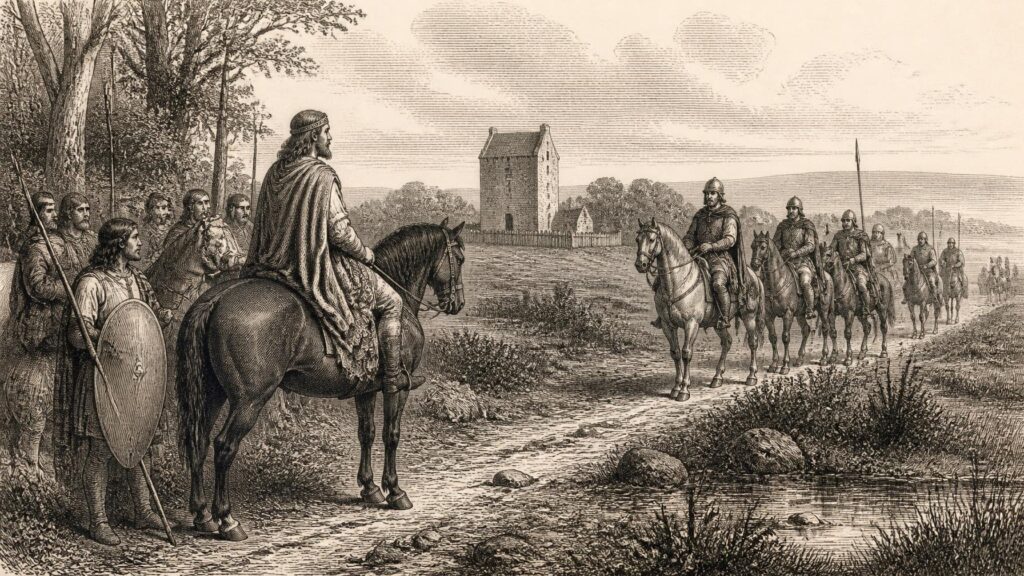
In 1528, the most revealing Irish political event was not a royal conquest or a parliamentary settlement, but the seizure of the king’s acting governor. Richard Nugent, Lord Delvin, served as vice-deputy while Gerald FitzGerald, ninth earl of Kildare, remained under restraint in England. In May, Brian Ó Conchobhair Fáilghe of Uí Fhailí captured Delvin during a meeting on the Offaly frontier. Delvin’s captivity exposed the limits of government from Dublin: the administration could claim authority over the lordship of Ireland, but it could neither reliably protect its representative nor settle its relations with the powerful lordships bordering the Pale.
The immediate dispute concerned the payment commonly termed the black rent, a protection payment drawn from parts of Meath by the Ó Conchobhair Fáilghe lordship. Such payments were a practical acknowledgement that the military frontier did not coincide neatly with legal claims. Delvin’s attempt to stop it challenged an arrangement that helped avert raids but also advertised the weakness of the Pale’s defences. Brian’s response was decisive. He enticed Delvin to a parley, took him prisoner, and refused release until his demands were met. Later narratives give 12 May as the day of the capture, but the contemporary official correspondence securely places the crisis in mid-May; it is wiser to date the seizure to that month rather than insist on a precise day.
The arrest was personally humiliating for Delvin but politically damaging on a much larger scale. The Dublin council wrote urgently to Cardinal Wolsey, while Archbishop Hugh Inge of Dublin and Chief Justice Patrick Bermingham sought help from the duke of Norfolk. The council selected Sir Thomas FitzGerald, Kildare’s brother, to act as captain for local defence. That expedient itself showed how dependent the government remained upon magnate connections, even when the leading magnate was absent in England. Delvin would not be freed until February 1529, after terms restoring the disputed payment had been accepted; the failure therefore belonged squarely to 1528, although its resolution did not.
The Pale’s Unsteady Politics
Delvin’s fate came after months of warning. In February, Inge and Bermingham had described the vice-deputy as unequal to defending the Englishry, the area of more sustained English law centred on Dublin, Meath, Kildare and Louth. Their alarm was not simply an institutional quarrel. Defence required paid soldiers, supplies, horses, fortified positions and cooperation from local communities; all were difficult to command when revenue was thin and rival lords could mobilise their own followers. The Dublin administration’s dependence on negotiated local power was therefore structural, not an accidental failure of one official.
The background was the bitter rivalry between Kildare and Piers Butler. Kildare, a Geraldine magnate with extensive Irish alliances, had been summoned to England in 1526 and was still detained in 1528. In July he instructed allies, particularly the Ó Conchobhairs, to renew attacks on the king’s subjects; this was a later escalation in a year already destabilised by Delvin’s seizure. The instruction led to Kildare’s imprisonment and brought him close to a treason trial. It also demonstrated why English ministers distrusted a system in which a governor’s ability to manage Ireland appeared to rest on the private affinities of a single earl.
Butler’s position changed markedly in February. He surrendered his contested claim to the earldom of Ormond, which passed to Thomas Boleyn, in return for creation as earl of Ossory and a division of the Ormond inheritance. The bargain tied an Irish succession dispute to the Boleyn family’s growing prominence at Henry VIII’s court, yet it did not end the local contest for power. In late summer the crown reappointed Ossory to the deputyship; he was installed at Dublin in October. Maolruanaidh Ó Cearbhaill of Éile and other midland lords attended, an indication that inauguration and alliance-making mattered as much as a royal letter of appointment. Still, Ossory inherited a government unable to recover Delvin promptly or impose its will across the frontier.
Changes in church and administration added to the sense of transition. Hugh Inge, Dominican archbishop of Dublin and lord chancellor, died on 3 August during an outbreak described as the English sweat. On 19 September John Alen, a learned cleric and close associate of Wolsey, was appointed chancellor of Ireland. Alen would not become archbishop of Dublin until the following year, so in 1528 his appointment was an administrative, rather than an episcopal, intervention. It nevertheless signalled the importance London attached to placing trusted servants around the machinery of the Dublin government.
A New King in Thomond
Far from Dublin, a major succession occurred in Thomond, the Ó Briain lordship west of the Shannon. Toirdhealbhach Donn Ó Briain died in 1528 after a long rule, and his son Conchobhar mac Toirdhealbhaigh Ó Briain succeeded him. The Annals of Ulster portray the dead ruler as prosperous, generous in hospitality, formidable against enemies and protective of friends; the Annals of the Four Masters similarly emphasise his hospitality and his resistance to English power. Such memorial language was conventional, but it is still valuable evidence of the virtues expected of a Gaelic ruler: martial capacity, lordly generosity and guardianship of dependants.
Conchobhar’s accession did not make Thomond a province of the Dublin administration. It remained a substantial regional polity whose rulers negotiated, fought and allied with neighbouring powers on their own terms. The annals’ simple phrase that Conchobhar “was made king in his place” should not be mistaken for an English-style hereditary coronation. It records the successful transfer of leadership within a dynastic and political community, in which kinship, support among leading families and the ability to command followers all counted. In 1528, while officials in Dublin struggled to preserve authority on the Offaly border, Thomond’s succession illustrates the continuing vitality of Gaelic political order.
Other deaths and successions underline the same regional pattern. Eóghan Ó Ruairc, lord of Bréifne, died after penance and unction. Cormac Mac Diarmada of Moylurg also died, succeeded by his brother Diarmaid. The sources celebrate both men for hospitality as well as warlike leadership. This was not ornamental praise alone. A lord’s household distributed food, protection and reward to retainers, dependants, clerics, learned families and travellers; its capacity to do so was a foundation of standing and authority.
Ulster, Learning and Lordship
Violence within the Uí Néill world also left a firmly dated mark. The Four Masters date the killing of Conn, son of Niall son of Art Ó Néill, to 15 April; the Annals of Ulster places it after Easter. He was slain by Ruaidhrí, son of Art Óg Ó Néill, with men of the Maguire kindred. The revenge was immediate and grim: two sons of Art Óg, previously held captive, were hanged by Conn’s sons. The episode is a reminder that political competition operated within ruling lineages as well as between them, and that hostages remained integral to enforcing claims and agreements.
North-western politics had a wider, maritime dimension. The Four Masters records that an army led by an Ó Domhnaill, accompanied by a substantial Scottish contingent under Alexander Mac John Cahanagh, entered Moylurg. It cut a passage through the difficult route at Bealach Buidhe, obtained hostages and rents from Mac Diarmada, and returned safely. The entry offers a brief but important glimpse of the seaways linking Ulster and Gaelic Scotland, and of warfare directed towards tribute, movement and political submission rather than permanent occupation. Because this account survives in a later compilation, its details should be treated with appropriate caution; its placement in the annal for 1528, however, makes it relevant evidence for that year’s remembered politics.
The year’s annals also preserve a quieter record of intellectual and charitable life. Ruaidhrí Mac Craith, termoner of Termon Daveog, was praised as an antiquarian, a generous host to strangers and keeper of a general guesthouse in Ulster. Ruaidhrí Ua Luinín, ollamh or chief learned man to Maguire, died and was remembered for history, poetry, philosophy and specialised learning; another Ruaidhrí, Ua Catháin of Claeninis, was likewise called eminent in history and a man of God. Their notices show that learned lineages and ecclesiastical estates still sustained scholarship in Irish, alongside courts and towns shaped by English legal institutions.
Hospitality linked elite culture to daily economic life. At Sligo, John Ó Cróidhín, a merchant renowned for maintaining a guesthouse for the poor and needy, died on 14 March. The annalist’s remark that he “bought more than he sold” is not an account book, but it conveys an ideal of a prosperous trader using his resources generously. In Donegal, Fionnghuala Ó Briain, widow of Aodh Ruadh Ó Domhnaill, died on the first day of Lent, 5 February. She had worn the Franciscan habit for twenty-two years and was buried at Donegal friary. Her commemoration for almsgiving and charity shows both the prestige of Franciscan devotion and the public role aristocratic women could exercise through religious patronage.
Storm Before Christmas
The year closed with environmental disruption. The Four Masters reports a great wind on the Friday before Christmas which felled trees across Ireland, damaged stone and timber buildings, brought down the wall of Donegal monastery and wrecked or sank vessels. The chroniclers do not allow a modern reconstruction of its full track or losses, but the report matters. A severe storm could interrupt coastal traffic, damage fisheries and shipping, destroy stored materials, and impose costly repairs on religious houses and households. Donegal friary, connected to the Ó Domhnaill dynasty and to the religious world that commemorated Fionnghuala earlier that year, appears again as a vulnerable physical place rather than merely an institution in a chronicle.
Thus 1528 was a year of conspicuous governmental failure in the centre and enduring regional power elsewhere. Delvin’s imprisonment revealed the Pale’s precarious frontier arrangements; the arrival of Ossory and Alen foreshadowed a more interventionist royal response. Yet the deaths, successions, learned households, merchant charity, Franciscan observance, Scottish connections and storm damage recorded across the island show an Ireland that cannot be reduced to Dublin’s crisis. It was a polity of overlapping jurisdictions, mobile armed followings, resilient local institutions and communities whose political, spiritual and material lives were intimately connected.
Primary Sources
- The Annals of Ulster: Year U1528
- Annals of the Four Masters: Annal M1528
- FitzGerald, Gerald (Gearóid Óg, Garrett McAlison)
- Butler, Piers (‘Piers Ruadh’)
- Nugent, Richard
- O'Connor Faly (Ó Conchobhair Failghe), Brian
- Alen (Allen), John
- Inge, Hugh
- O'Carroll (Ó Cearbhaill), Maolruanaidh
- O'More (Ó Mordha), Conall
- Butler, Lady Margaret
- Reynolds, Charles
- Defending the English Pale: the viceroyalty of Richard Nugent, third baron of Delvin, 1527–8
- The Reemergence of English Policy as a Major Factor in Irish Affairs, 1520–34
- State Papers Published Under the Authority of His Majesty's Commission: King Henry the Eighth, Part III, Volume 2
- Calendar of the State Papers Relating to Ireland, 1509–1573, Volume 1
- Chronicle of the Law Officers of Ireland: Lord Chancellors and Keepers of the Great Seal
- Ireland under the Tudors, Volume I
- Calendar of State Papers: Ireland, Tudor Period, 1509–1547
- The Beginnings of Modern Ireland