

The Drumcree Compact1563 CE
In 1563, Sussex’s Ulster campaign against Shane O’Neill faltered through inadequate supplies, difficult terrain and limited Pale support. His forces reached Armagh, crossed the Blackwater and seized cattle, but failed to force battle or diminish O’Neill’s authority. Negotiations led by Thomas Cusack produced September’s Drumcree Compact, recognising O’Neill as lord O’Neill, promising conditional confirmation of Tyrone, accepting customary leadership claims and removing Armagh’s garrison. Yet parliamentary obstacles and English reservations made it temporary. The settlement demonstrated Tudor dependence on accommodation with Gaelic power. Conflict, rural disruption and uncertainty over Ulster’s governance persisted, while Christopher Nugent’s Cambridge matriculation reflected cultural connections.
Dateline
In 1563, Ireland’s most consequential contest was not settled by a great pitched battle. It turned instead on the failure of a royal army in Ulster and on a negotiated settlement at Drumcree, County Meath. Shane O’Neill, the dominant Gaelic lord of Tír Eoghain, had already shown that he could not be treated simply as a rebel to be summoned, punished or replaced. Thomas Radcliffe, third earl of Sussex and Elizabeth I’s lord lieutenant, wished to break his power by force. By autumn, however, the crown’s representative, Sir Thomas Cusack, was agreeing terms which publicly acknowledged O’Neill’s standing as “the lord O’Neill”. The agreement exposed both the reach and the limits of Tudor government in Ireland.
An Ulster Campaign Falters
The immediate military story is unusually clear. Sussex began a new expedition against O’Neill in early April. On 6 April his army reached Armagh, a place of major strategic and symbolic importance: it lay within O’Neill’s sphere of influence but housed an English garrison. The force was meant to constrain Shane, protect allies and demonstrate that the queen’s authority could be carried beyond the Pale. Yet it was inadequately supplied, and the campaign soon displayed the difficulties of moving and feeding an army in Ulster. Before the end of the month Sussex withdrew without bringing O’Neill to battle.
A second advance followed within a fortnight. Sussex’s force crossed the Blackwater and pushed westwards towards Clogher. It captured a substantial prey of cattle—later accounts put the number at about a thousand—but this was not the decisive victory intended. The cattle were useful provisions for troops whose supply system was failing; their seizure also illustrates how warfare bore directly upon the pastoral wealth on which lordships and households depended. O’Neill declined to offer the engagement Sussex sought. The army’s movement through a landscape of woods, rivers, narrow routes and dispersed settlements could harry an opponent and take livestock, but it could not itself turn a raid into political submission.
Sussex called for a more general hosting, but support among the political community of the Pale was reluctant. That reluctance mattered. Crown authority in Ireland depended not only upon soldiers sent from England but upon magnates, landowners, tenants, victuallers and local military followings providing men, transport, food and money. The campaign therefore revealed a practical truth behind the formal claims of government: even a lord lieutenant could not wage a sustained northern war without dependable local cooperation. Sussex retired to Drogheda with O’Neill’s power materially diminished neither by battle nor by settlement imposed at the sword’s point.
Shane O’Neill’s Position
Shane’s authority rested on more than resistance to English arms. He had been inaugurated by Gaelic custom as O’Neill at Tullaghogue, while also seeking recognition through the crown’s legal and aristocratic language. His dispute with government involved the earldom of Tyrone, inherited claims arising from the settlement made with his father Conn Bacach, and the wider office and precedence of O’Neill. These were not interchangeable claims. English officials argued that an earldom was a grant from the crown. Shane and his advisers maintained that Conn had held responsibilities as the head of the O’Neill kindred and that those customary political rights could not simply be detached from the lordship.
That disagreement affected other Ulster rulers. O’Neill claimed traditional leadership and service from subordinate captains, and his ambitions pressed heavily upon neighbouring lords, notably the O’Reillys and Maguires. His position was also entangled with the O’Donnells of Tír Chonaill and with the Scottish MacDonnells established in the Glens and Route of north-east Ulster. None of these relationships was fixed. The Dublin government had considered the MacDonnells possible allies against Shane, but their military usefulness and political reliability remained uncertain. In June, news that James MacDonnell’s wife Agnes Campbell was making approaches in Scotland sharpened Elizabeth’s distrust of that connection and encouraged a reconsideration of policy towards O’Neill.
For people outside the leading families, the evidence for 1563 is most visible through war’s demands. Cattle were movable food, wealth and status; taking them weakened an adversary while sustaining armed followers. Soldiers waiting for provisions, irregular levies expected from the Pale, and the movement of troops through Armagh and the Blackwater country point to disrupted farming and insecurity, even where no individual household is named in the records. It would be unsafe to claim a general famine or a single island-wide crisis from this evidence. But the year’s campaigning plainly shows that ordinary rural life was vulnerable to the logistics of lordship and war.
Cusack’s Alternative
The failure of Sussex’s offensive strengthened those who advocated negotiation. Thomas Cusack, a veteran administrator and former lord chancellor, travelled to England in March 1563 and successfully argued against Sussex’s belligerent course. In August Elizabeth authorised Cusack to negotiate with Shane O’Neill. The same month, she ordered the release of Gerald FitzGerald, fifteenth earl of Desmond, who had been kept in England amid the crown’s efforts to restrain the destructive rivalry between Desmond and Thomas Butler, tenth earl of Ormond. These decisions did not resolve every Irish dispute, but together they showed a preference for managing powerful regional lords through accommodation when coercion had proved costly or ineffective.
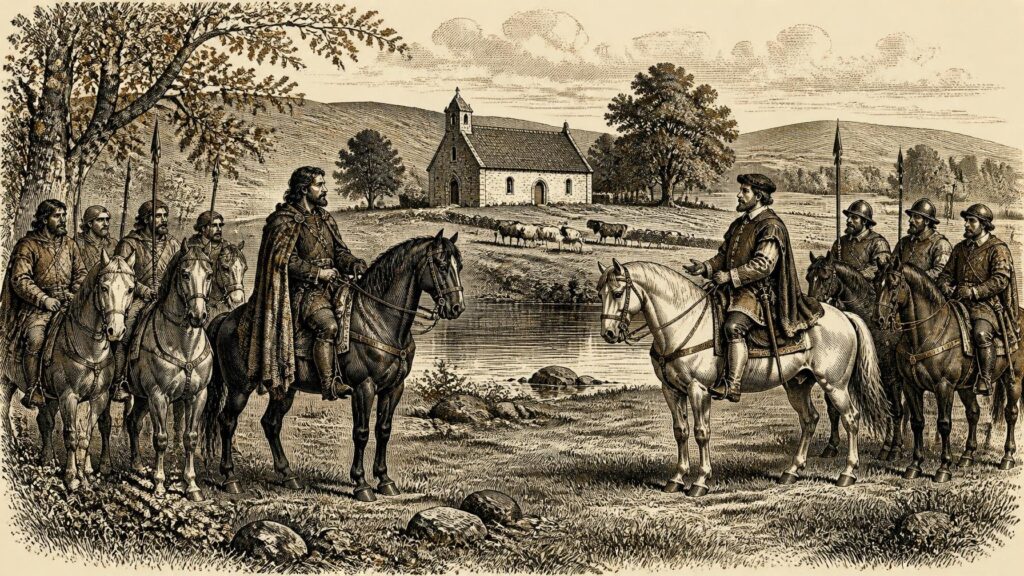
In September, Cusack and O’Neill reached their peace at Drumcree. Later narrative accounts commonly date it to 11 September, while the principal modern biographical studies place it securely in that month. The distinction is worth keeping: the month and agreement are firm; the exact day should not bear more interpretative weight than the surviving evidence can sustain. The settlement acknowledged Shane as “the lord O’Neill”, promised that his title to Tyrone would be confirmed once the competing Dungannon title had been removed by statute, and accepted in principle his right to the leadership and service customarily due to O’Neill. It also conceded the practical force of his claims over the O’Reillys and Maguires.
The articles went further. Shane sought authority as a commissioner to hear causes in Ulster, safeguards before being required to attend the lord lieutenant, and an investigation of the alleged poisoning attempt associated with Sussex’s servant Smith. He also requested a suitably born English wife; the queen’s representatives did not reject the request outright. Most immediately, the settlement brought the withdrawal of English garrisons from Armagh. For Shane, this was both a practical gain and a public vindication. For the crown, it was an admission that a fortified outpost could be expensive to maintain if the surrounding country remained hostile.
A Settlement With Limits
Drumcree was not a simple Tudor recognition of an independent Ulster. Nor was it an enduring submission by Shane. Its terms attempted to translate a Gaelic lordship into the crown’s framework while preserving enough of its customary authority to secure peace. That balancing act was inherently unstable. Several promises required an act of the Irish parliament, but calling a parliament was politically inconvenient and practically difficult. Whitehall also recoiled from aspects of the agreement, particularly the proposed English marriage and the prospect of examining the poisoning allegation. The compact therefore created a pause rather than a final constitutional settlement. The negotiations continued to trouble relations through the following winter and spring.
Religion was present in the background, though it was not the central issue of the Drumcree talks. Under Sussex, the ecclesiastical changes demanded by both Mary I’s Catholic and Elizabeth I’s Protestant regimes had been enacted with considerable continuity among office-holders. In 1563, however, the diplomatic record concerning Shane centred upon lordship, security, jurisdiction and military presence rather than a confessional programme for Ulster. It is therefore misleading to present the agreement as either a religious settlement or an episode detached from the Reformation. It belonged to a kingdom in which political power, landholding and church organisation were already being reshaped, but its immediate purpose was peace between the crown and the strongest lord in the north.
Learning and Wider Connections
Elsewhere, quieter evidence points to the mixed cultural world of Tudor Ireland. On 12 May 1563 Christopher Nugent, Baron Delvin, matriculated at Clare Hall, Cambridge. A Westmeath magnate whose estates stood near the Pale’s frontier and whose household operated across English and Irish-speaking society, he later prepared an Irish-language primer at Elizabeth’s request. His admission to Cambridge does not describe the experience of most Irish people, but it shows that education, language and advancement could connect an Irish lordly family to English institutions even as war tested the crown’s authority in Ulster.
By the close of 1563, the result was paradoxical. Sussex had failed to conquer Shane O’Neill; Cusack had secured an agreement that acknowledged his authority; and neither side had solved the underlying question of who could govern Ulster, by what law and with whose consent. The year’s significance lies in that contradiction. At Drumcree, Tudor officials accepted that peace required dealing with O’Neill as a political force. The subsequent failure to convert that accommodation into a workable and ratified settlement ensured that the question would return, more violently, in the years ahead.
Primary Sources
- Calendar of State Papers Relating to Ireland, 1509–1573
- State Papers Ireland 1509–1782: government papers on Irish affairs
- O'Neill, Shane (Seaán)
- Cusack (Cusacke, Cusake), Thomas
- Radcliffe, Thomas
- Fitzgerald, Gerald
- Fitzgerald, Gerald fitz James
- Butler, Thomas
- MacDonnell, James
- MacDonnell, Sorley Boy
- Piers, William
- St Lawrence, Christopher
- Nugent, Christopher (Criostóir Nuinseann)
- O'Donnell (Ó Domhnaill), An Calbhach
- Creagh, Richard
- Holdings: Articles of agreement between T. Cusake and Shane Oneale, 1563
- Calendar of the State Papers relating to Ireland
- Ireland Under the Tudors, Volume II
- Brazen as Falstaff, devious as Iago: Sir Ralph Lane’s approach to holding office in Ireland and Virginia
- Calendar of State Papers: Ireland, Tudor Period, 1566–1567
- Calendar of the State Papers Relating to Ireland, of the Reigns of Henry VIII, Edward VI, Mary, and Elizabeth: 1509–1573