

Castleforward’s Demolition1529 CE
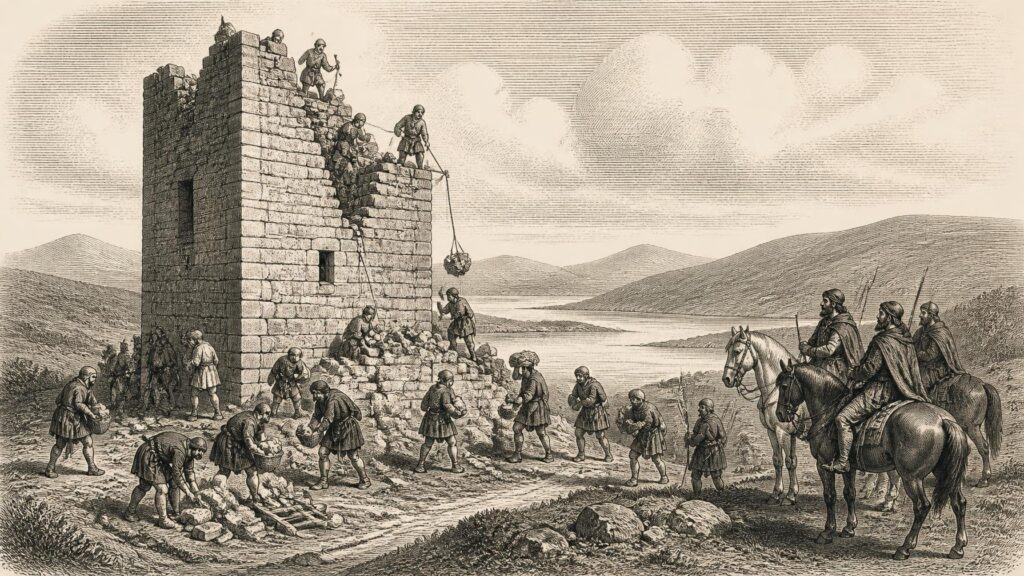
In 1529, local violence, succession and cautious royal intervention shaped Ireland. In Tír Chonaill, Manus Ó Domhnaill captured and demolished Castleforward after a Scottish MacDubhghaill was killed there, weakening a rival power centre amid family conflict. Annals recorded killings and feuds across Ulster, involving lords, clergy and ruling kindreds. James fitz Maurice FitzGerald, earl of Desmond, died without a legitimate son, succeeded by his elderly uncle Thomas, whose alliances helped secure Munster interests. Sir William Skeffington negotiated peace between Desmond and Ossory while assessing royal authority. Learned jurists and poets also died, demonstrating the continuing importance of Gaelic professional culture.
Dateline
In 1529, Ireland’s political map was marked less by a single national crisis than by sharp local contests, a consequential succession in Munster, and a cautious renewal of English royal intervention. The year’s annals preserve a notably northern sequence of killings, broken alliances and the destruction of a castle near the frontier of Tír Chonaill. They also record the deaths of leading legal and poetic scholars, reminders that warfare and learned culture were sustained side by side. In the south, the sudden death of James fitz Maurice FitzGerald, earl of Desmond, altered the balance among the great lordships of Munster.
Some events can be dated with unusual precision; others are recorded only as having occurred during the year. The Irish annals were compiled or copied later and sometimes differ in detail, especially in personal names and places. They nevertheless provide unusually close evidence for how contemporaries understood authority: through lordship, kinship, hospitality, learned office, castles, cattle, tribute and the ability to make or break peace.
A Castle Taken Down
The most vivid northern episode occurred at Cúil Mhic an Treoin, identified in one annalistic tradition with Castleforward, on the borderland towards Inishowen. A son of Mac Dubhghaill, or MacDowell Mac Dugald, from Scotland was killed at the castle doorway by Aodh Buidhe Ó Domhnaill. The Annals of the Four Masters specifies a sword-stroke; Annála Connacht gives the same encounter in similarly emphatic terms. Soon afterwards Manus Ó Domhnaill took the castle.
Manus did not simply occupy it. The annal says that he called a council to decide what should be done, and that the decision was to demolish the stronghold. That detail is important. A castle was not merely a residence but a fortified claim on a route, locality and dependent population. To capture it might deny an enemy shelter, a garrison point and a place from which to gather renders. To demolish it went further: it made immediate reoccupation harder and signalled that Manus did not intend the place to remain a rival centre of power.
The episode belongs to tension within the Ó Domhnaill kindred as well as to the wider sea-connected world of north-western Ireland. Manus, then a leading figure in Tír Chonaill, was in conflict with his half-brother Aodh Buidhe. The presence of a Scottish MacDubhghaill at the castle likewise reflects the close military and family connections across the North Channel. Men, mercenary service and political alliances moved between the Hebrides, western Scotland and Ulster; the sea joined these regions as much as it separated them. Yet the sources do not permit a fuller reconstruction of who controlled Castleforward before the attack, how long the fighting lasted, or the exact date of its demolition.
Violence, Kinship and Local Authority
Other notices from 1529 show how fragile agreements could be. Brian Ballach, son of Niall and grandson of Conn Ó Néill, was killed by Cormac Mac Quillín after the two had departed Carrickfergus together “in company and friendship”, in the wording of the Four Masters. The annal’s stress on prior companionship makes the killing a breach of trust, not simply another battlefield death. Carrickfergus, an important walled port and royal foothold on the Antrim coast, was a natural meeting place for lords whose territories and interests overlapped around the north-east.
In Fermanagh, the deaths of Cathal, son of Eoghan son of Aodh Mag Uidhir, and of Eoghan Mac Maghnusa and his wife Gráinne Maguire were entered in the annals. The records also describe a fatal attempt to intervene in a quarrel between the people of Cúil and Machaire. The Annals of Ulster calls the victim Brian Ruadh, parson of Achadh-Urchair and son of a bishop Maguire, killed by an arrow; the Four Masters names Brian Roe, son of John Maguire, struck by a dart. The overlap may preserve differing traditions of the same disturbance, but the evidence is not sufficient to state that conclusively.
What is clear is that clerical status did not place a man outside local conflict. Parish clergy, hereditary ecclesiastical families and secular kindreds were interwoven in the political life of Gaelic lordships. Disputes over land, cattle, honour and allegiance could draw in clerics as mediators or victims. Such violence affected ordinary households directly: a local feud could mean the loss of a protector, the disruption of grazing and cultivation, or fresh demands for followers and provisions.
Factional killing was also reported in Fanad. Domhnall Óg Mac Suibhne, lord of Fanad for eleven years, died after taking the habit of the Order of the Blessed Virgin Mary. In the same year Edmond Mac Suibhne and his son, Edmond Roe, were killed by another member of the extended family. The paired notices show both a conventional Christian preparation for death by a lord and the persistence of lethal competition within a ruling lineage. Succession was rarely an automatic transfer from father to eldest son; seniority, military support and the interests of collateral branches mattered greatly.
The Desmond Succession
The year’s largest political change came in Munster. James fitz Maurice FitzGerald, earl of Desmond, died suddenly on 18 June 1529, according to modern biographical reconstruction from the state papers and other contemporary material. Annála Connacht describes an illness lasting three nights and places his death around the feast of St John; it also praises him as a patron of poets and exiles and as a figure of great bounty. The difference in formulation is a useful warning against forcing the sources into greater precision than they possess, but there is no doubt that his death fell in 1529.
James left no legitimate male heir. His uncle Thomas fitz Thomas FitzGerald succeeded to the earldom, though the numbering of the Desmond earls differs between genealogical traditions and modern reference works. The succession mattered because the Desmond lordship stretched across much of south-western Munster and was embedded in prolonged conflict with the Butlers and with rival Geraldine branches. James had pursued ambitious, destabilising alliances and had recently faced serious opposition from Piers Butler, earl of Ossory, and from members of his own family.
Thomas was about seventy-five when he succeeded. His immediate concern was not an abstract title alone but the defence of a precarious political inheritance and the future of his grandson. In October 1529 he granted his Waterford possessions in fee to John FitzGerald, lord of the Decies, and John’s son Gerald MacShane. This was both repayment for support and an attempt to secure allies. Land, marriage and lordship were the practical instruments through which a disputed dynasty sought continuity.
In November, Sir William Skeffington negotiated a peace between the earls of Ossory and Desmond. It did not end the underlying Geraldine–Butler rivalry, but it was a meaningful pause after years of raids, sieges and reciprocal alliances. Peace in this setting meant more than the absence of fighting between two magnates. It could allow tenants to sow and harvest, merchants and drovers to travel with less danger, and lesser lords to avoid choosing immediately between powerful neighbours.
Royal Government Returns Cautiously
It would be misleading to portray 1529 as the start of a fully effective English reconquest. Henry VIII’s government did seek a stronger grip on the lordship, but its resources and reach remained limited. Henry’s young illegitimate son, Henry FitzRoy, duke of Richmond, became nominal lord lieutenant in 1529. Sir William Skeffington was sent to Ireland in July to examine the country’s military condition. From September, a secret council governed in Dublin while Skeffington gathered information and attempted to restore agreement among leading lords. He did not become lord deputy until 1530.
The distinction matters. Royal policy depended heavily on negotiation with magnates rather than direct administration over the island. Gerald FitzGerald, ninth earl of Kildare, remained an exceptionally influential figure even while his position at the English court was uncertain. Piers Butler held the deputy lieutenancy during part of this period and remained lord treasurer. The crown’s representatives could broker a peace in Munster, but their ability to enforce policy far beyond the Pale was uneven.
Church affairs also reveal this mixed political landscape. In 1529 Edmund Butler, archbishop of Cashel, held a provincial council at Limerick. One ruling permitted the mayor of Limerick to imprison clergy indebted to the mayor without incurring excommunication. The surviving report is narrow, but it offers a revealing glimpse of practical negotiation between ecclesiastical authority and urban government. It also demonstrates that church institutions were not detached from credit, property and civic jurisdiction.
Law, Poetry and Learned Memory
Amid the killings and successions, the annals recorded losses in the learned professions with exceptional respect. Cosnamhach Mac Aodhagáin, buried at Elphin, was described as outstanding in fénechas, poetry and lay brehonship. Domhnall Mac Aodhagáin of Ormond was called head of the learned men of Leth Moga in law and poetry. Annála Connacht additionally marked the deaths of Domhnall Cam Ó hUiginn and his son Aodh, both praised as poets, and of legal specialists of the Mac Birrthagra family.
These notices are evidence of a living professional culture, not a nostalgic survival. Learned families trained specialists in legal learning, genealogy, historical memory, formal praise-poetry and the Irish language’s demanding literary registers. A brehon was a legal expert whose work could include advising a lord, assessing compensation and applying inherited legal texts and customs. Poets were not merely entertainers: their compositions preserved lineage, reputation and political claims. Their patrons expected learning to reinforce authority, while scholars depended on lordly protection, land and hospitality.
Thus 1529 was a year in which a castle was deliberately erased, a Munster earldom changed hands, and the crown tested a new administrative approach. But it was also a year when Irish chroniclers considered the deaths of jurists and poets worth recording beside those of lords and warriors. Their choices reveal an Ireland governed through several overlapping systems: royal office in Dublin, urban institutions in towns such as Limerick, aristocratic lordship in Munster, and Gaelic kin-based power supported by castles, clerics and learned families across the north and west.
Primary Sources
- Annals of the Four Masters, Volume 5 English Translation
- Annála Connacht, Annal 1529
- The Annals of Ulster, Year U1529
- O'Donnell, Manus (Ó Domhnaill, Maghnas)
- FitzGerald, James fitz Maurice
- Fitzgerald, Thomas
- Skeffington, Sir William
- Kings Letters, Instructions &c; Appointment of Sir William Skeffington as Lord Deputy
- State Papers Ireland 1509–1782: Government Papers on Irish Affairs
- Butler, Piers (‘Piers Ruadh’)
- FitzGerald, Gerald (Gearóid Óg, Garrett McAlison)
- Butler, Edmund
- Mac Aodhagáin, Giolla na Naomh
- Law, Poetry and Medicine: The Literate Professionals in Autonomous Gaelic Ireland, c.1250–c.1630
- Of the Lawes of Irelande
- Afterlives of the ‘Brehon Laws’
- Galway City
- Hardiman: The History of the Town and County of the Town of Galway
- Ireland in the Reign of Henry VIII
- Calendar of the State Papers Relating to Ireland, 1509–1573
- The Beginnings of Modern Ireland
- The Placenames Database of Ireland
- FitzGerald, Lady Margaret