Irish Politics
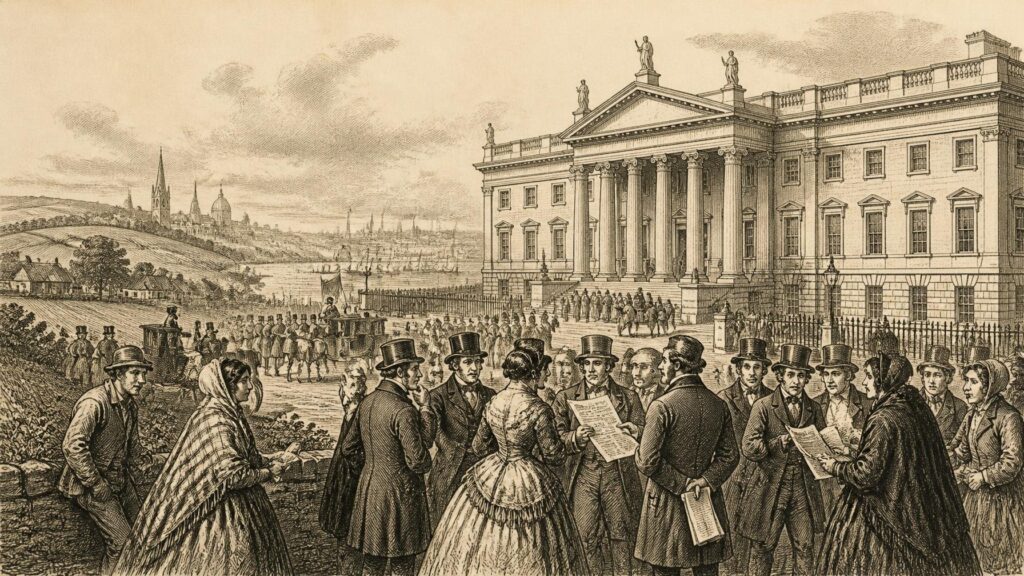
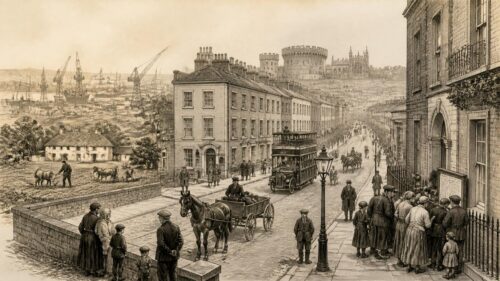
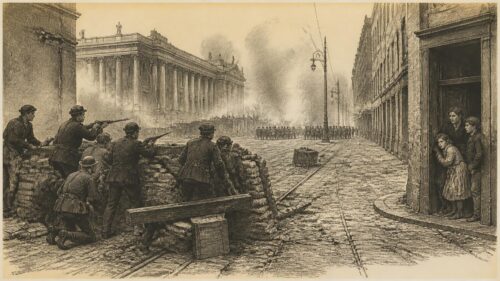
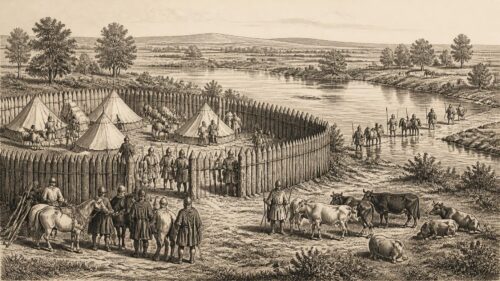
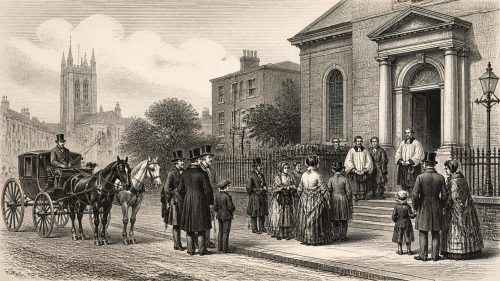
AI generated historical illustration, not a contemporary photograph.
At a Glance
Irish politics has never been a single, uninterrupted story of national advance. It has been shaped by overlapping systems of lordship, colonial administration, parliamentary privilege, popular mobilisation, religious division, revolutionary government, partition and constitutional democracy. Its most enduring disputes have concerned a deceptively simple question: who possesses the legitimate authority to make law for the people of Ireland? The answers have varied sharply according to period, place and political allegiance. They have also been conditioned by unequal access to property, votes, office, education and force. A historical account therefore needs to resist both the comforting idea that present institutions were inevitable and the equally misleading claim that politics was merely a succession of betrayals. Ireland’s political past was made through argument, organisation, coercion, compromise and choices whose outcomes were often uncertain.
Political Origins
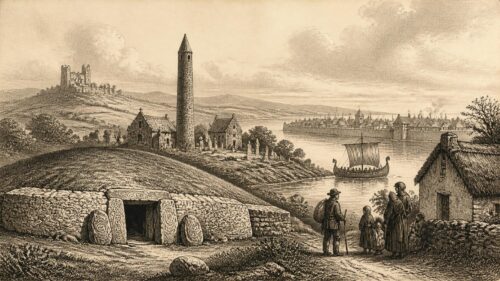
Politics in medieval Ireland did not begin with a modern state, a national electorate or a parliament representing all inhabitants. Gaelic Ireland contained numerous kingdoms and lordships, linked by kinship, tribute, military power, ecclesiastical influence and negotiated obligations. Kingship was personal and territorial rather than national in the present sense. Authority rested partly upon inherited status, but succession was commonly contested within ruling kindreds. Legal learning, preserved in the corpus now called the Brehon laws, supplied concepts of compensation, rank and customary obligation, although legal ideals and practical power were never identical. The island also possessed important church centres, trading settlements and regional dynasties, each capable of shaping political relationships.
It is tempting to describe this order as either an ancient democratic commonwealth or a realm of unchanging tribal disorder. Neither description is supportable. The surviving legal and literary materials were written down in particular contexts, often by learned elites, and they do not offer a transparent record of everyday political life. What can be said with confidence is that governance was plural. Authority was dispersed among kings, nobles, churches, legal specialists and local communities, and political boundaries shifted frequently. The idea of a high kingship of Ireland had real ceremonial and ideological importance, but its practical reach depended on the resources and alliances of individual rulers. It did not create a continuously centralised Irish state.
The Anglo-Norman intervention after 1169 altered this political landscape profoundly. Invited initially into Leinster politics, Anglo-Norman lords soon established fortified lordships, boroughs and new tenurial arrangements. English royal government claimed authority in Ireland through the lordship granted by the papacy and exercised it most intensively in areas that later became known as the Pale. Yet conquest was incomplete and unstable. Gaelic rulers remained powerful in much of the island, while many settler families developed local interests and identities that did not simply mirror those of the English crown.
From this encounter emerged the central problem that would recur in different forms for centuries: Ireland contained several political communities, but English monarchs increasingly asserted a superior jurisdiction over them. The institutions created to sustain that claim were neither neutral nor universally representative. They served royal administration, landholders and urban interests before they served anything resembling a nation of equal citizens. Nevertheless, they provided a framework within which ideas of law, consent and assembly acquired lasting political force.
Colonial Parliament
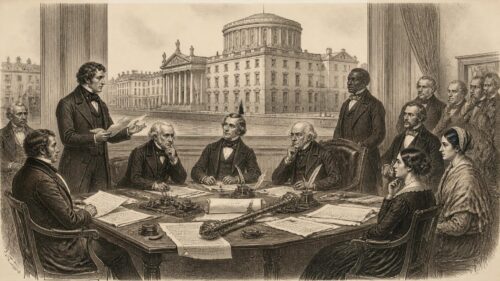
The first recorded meeting called an Irish parliament took place at Castledermot, County Kildare, in 1264. As the Houses of the Oireachtas notes, it was not a parliament in the modern representative sense: those involved were landowning knights and jurors assembled in a royal administrative setting. Over subsequent centuries, however, a Parliament of Ireland developed, drawing on English parliamentary forms. It comprised a House of Lords and a House of Commons, and it dealt with taxation, legislation and the business of government in the lordship and, after 1541, kingdom of Ireland.
Its reach was limited from the beginning. Representation reflected counties, boroughs and corporate interests within the territory effectively controlled by the crown. Much of Gaelic Ireland lay outside its regular operation. The membership of the commons was narrow, while the lords represented a small elite of ecclesiastical and lay magnates. This was a political institution in Ireland, but it was not an all-Ireland legislature in a democratic or national sense. Its history demonstrates both the early presence of parliamentary practice and the profound exclusions that accompanied it.
The authority of this parliament was further constrained by the changing relationship between Dublin and London. Poynings’ Law, enacted at Drogheda in 1494–95, required proposed Irish legislation to be certified through the Irish executive and approved by the English king and council before it could be introduced in the Irish Parliament. The original purpose was connected with royal efforts to control unstable Anglo-Irish governance, but its consequence was to make legislative initiative dependent on authorities outside Ireland. The law became an enduring symbol of constitutional subordination, though the precise operation of the measure changed over time.
The Tudor Reformation intensified the connection between political authority and religious allegiance. The Irish Parliament recognised Henry VIII as King of Ireland in 1541 and passed legislation extending the English Reformation settlement. Yet religious change was uneven, and the majority of the population remained Catholic. The crown’s later military conquest, plantation schemes and administrative expansion made politics increasingly inseparable from confessional identity, land ownership and loyalty to the state. Parliamentary government was not merely a forum for debate; it was an instrument through which conquest and social reconstruction were enacted.
That fact matters when judging later appeals to an ancient Irish parliament. The institution had genuine historical continuity, but it was never detached from the unequal power that produced it. Irish political memory has often celebrated Parliament House in Dublin as a lost national legislature. Such memory contains an important truth: Ireland did have a legislature before 1801. Yet it can obscure the narrower truth that this legislature represented a restricted Protestant political world, rather than the whole people of the island.
Protestant Ascendancy
The upheavals of the seventeenth century remade political life. Rebellion in 1641, the Confederate Catholic association based at Kilkenny, Cromwellian conquest, Restoration settlements and the Williamite wars all brought questions of land, religion and sovereignty to the fore. The Confederation of Kilkenny, meeting between 1642 and 1649, established a General Assembly and an elaborate administrative structure. It was an important experiment in Catholic political organisation, though it operated amid civil war and was not a parliamentary state in the later constitutional sense. Its fate also illustrated the difficulty of building durable authority while military and international pressures remained unresolved.
After the Williamite victory, the political order hardened into what historians call the Protestant Ascendancy. Catholics were excluded from parliament and from many forms of public power; Presbyterian dissenters also encountered disabilities, though their position differed markedly from that of Catholics. The penal laws were not a single unchanging code, and their enforcement varied, but they institutionalised a hierarchy in which land, office and political rights were closely connected to membership of the established church. The Parliament of Ireland survived, but its electorate and membership were overwhelmingly Protestant and propertied.
Its constitutional dependence also remained contested. The British Declaratory Act of 1719 asserted Westminster’s right to legislate for Ireland and strengthened the appellate authority of the British House of Lords. In the later eighteenth century, a combination of Irish parliamentary agitation, imperial war and the presence of the Irish Volunteers created an opportunity for reform. In 1782, the restraints associated with Poynings’ Law were modified and the British claim of legislative supremacy was repealed. The settlement commonly called Grattan’s Parliament gave the Irish legislature a greater degree of autonomy.
It is important to distinguish contemporary rhetoric from later legend. The parliament of 1782 was independent in significant legislative respects, and its assertion of autonomy profoundly influenced later nationalists. But it was not democratic. Borough representation was notoriously distorted, elections were restricted by property qualifications, and Catholics could not sit in parliament. The legislature’s achievements included measures that loosened commercial restrictions and some advances in religious relief, yet it remained governed by patronage, elite influence and the requirements of the Protestant establishment.
For some reformers, the answer was to broaden the political nation. The United Irishmen, founded in Belfast and Dublin in the 1790s, initially sought parliamentary reform and a civic union of Catholic, Protestant and Dissenter. Their programme became increasingly radical under repression and war. The rebellion of 1798 was crushed with extreme violence, leaving a legacy of grief, fear and partisan remembrance. It also provided the immediate political setting for the Act of Union. The later claim that union alone caused every nineteenth-century Irish grievance is too simple, but the Union cannot be understood apart from the anxieties created by rebellion, French revolutionary war and the perceived fragility of the Ascendancy state.
Union Politics
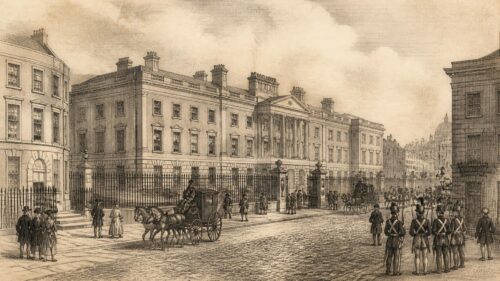
The Acts of Union, passed in 1800 and effective from 1 January 1801, abolished the Parliament of Ireland and incorporated Ireland into the United Kingdom of Great Britain and Ireland. Irish representation moved to Westminster: one hundred members of the House of Commons and thirty-two Irish peers were to sit in the imperial parliament. Dublin retained an administration centred on Dublin Castle, including the lord lieutenant and chief secretary, but ultimate legislative authority lay in London. Parliament House, once the seat of the Irish legislature, eventually became home to the Bank of Ireland.
The Union was supported by some who believed that a united parliament would provide security, economic opportunity and a route to Catholic emancipation. It was opposed by others who regarded it as the destruction of Ireland’s constitutional independence. Patronage, compensation for disfranchised borough interests and claims of pressure or corruption were central to contemporary controversy. The moral legitimacy of the Union has consequently been debated ever since. What is documented beyond dispute is that the political structure of the island changed decisively: an Irish legislature ceased to exist, and campaigns for Irish self-government thereafter had to confront Westminster.
Catholic emancipation became the first great test of Union politics. Daniel O’Connell combined electoral organisation, mass meetings, legal argument and moral pressure to demand admission for Catholics to parliament. The Catholic Relief Act of 1829 permitted Catholics to sit at Westminster, but the simultaneous raising of the county franchise qualification restricted the electorate. Emancipation was therefore a major constitutional breakthrough without being democratic equality. It showed that disciplined extra-parliamentary mobilisation could change imperial policy, while also showing that concessions might be accompanied by new exclusions.
O’Connell’s later Repeal movement sought restoration of an Irish parliament. His vast public meetings, often remembered as ‘monster meetings’, made visible a popular political nation far larger than the old Ascendancy electorate. Yet the movement’s outcome was constrained by state power, divisions among supporters and the threat of violence. The prohibited meeting at Clontarf in 1843 revealed the limits of peaceful mobilisation when the government was prepared to intervene. Repeal did not succeed, but its methods of association, press work, public ritual and electoral discipline shaped subsequent Irish politics.
The Great Famine transformed the political context. It exposed the inadequacies of relief policy, intensified emigration and altered social relations. Historians differ in emphasis when assessing British responsibility, administrative capacity and the role of laissez-faire assumptions, but there is no serious doubt that the catastrophe weakened confidence in the Union among many Irish people. At the same time, politics was not reducible to constitutional nationalism. Tenant right, land ownership, poor-law administration, local government and religious organisation were all arenas in which power was fought over.
By the later nineteenth century, Isaac Butt’s Home Rule movement, Charles Stewart Parnell’s Irish Parliamentary Party and the Land League brought parliamentary nationalism to extraordinary influence. Home Rule envisaged devolved self-government within the United Kingdom, not immediate full separation. Parnell’s party used tight discipline at Westminster to make Irish support indispensable to British Liberal governments. The first Home Rule Bill failed in 1886; the second passed the Commons but was rejected by the Lords in 1893. Their failure did not settle the question. Instead, it deepened the political organisation of both Irish nationalism and Ulster unionism.
Popular Mobilisation
The nineteenth century broadened political participation unevenly. Parliamentary franchise reform gradually expanded the electorate, while local government offered a further arena for political training. The Local Government (Ireland) Act 1898 created elected county and district councils and extended the local government vote to many women before women received the parliamentary franchise. County halls, town councils, boards and party conventions became sites where national questions met local interests: road building, sanitary policy, housing, rates, patronage and land could all acquire ideological importance.
Political culture was equally shaped by newspapers, voluntary associations, churches, trade unions, cultural organisations and commemorations. The Gaelic League encouraged a cultural nationalism that did not automatically entail separatism, but it created networks and symbols later drawn into political activism. The Ancient Order of Hibernians, Orange institutions, temperance groups, women’s organisations and labour bodies gave adherents social worlds as well as political languages. It is misleading to treat these associations as mere background. They trained organisers, raised funds, defined communities and created habits of collective action.
Women’s participation is especially important. Women were active in nationalist, unionist, labour, charitable and local political work long before they could vote in parliamentary elections. Suffrage campaigners pressed claims to citizenship through petitions, public meetings, journalism and civil disobedience. The Representation of the People Act 1918 greatly enlarged the electorate, enfranchising all men over twenty-one subject to limited exceptions and women over thirty who met property qualifications or certain household conditions. It did not establish equal adult suffrage, but it was a transformative enlargement of political participation.
The 1918 election consequently took place before an electorate dramatically different from that of earlier decades. Sinn Féin won a decisive majority of Irish seats, though its success varied by region and was aided in many constituencies by uncontested returns. The Irish Parliamentary Party, which had dominated nationalist representation before the First World War, was almost wiped out. Unionism retained strong support, particularly in the north-east. These results were not a simple plebiscite on one uniform future for the whole island; the franchise, wartime circumstances, local contests and regional loyalties all mattered. Yet the election gave Sinn Féin a powerful representative claim that it used to establish Dáil Éireann.
Labour’s place in this period also deserves care. Organised labour was a significant force in urban Ireland and in the wider British trade-union movement. The Irish Labour Party did not contest the 1918 election, partly to avoid splitting the nationalist vote in what was presented as a contest over Ireland’s political status. That choice helped produce a parliamentary result dominated by the constitutional question. It did not mean that class, wages, housing or industrial relations disappeared. Rather, national and social questions interacted in ways that would continue to complicate politics after independence.
Revolutionary Legitimacy
The years from 1912 to 1923 brought constitutional crisis, armed mobilisation, revolution and civil war. The third Home Rule Bill became law in September 1914 but was suspended because of the First World War. Before that suspension, unionists had organised the Ulster Volunteer Force and nationalists the Irish Volunteers; both developments demonstrated how far constitutional disagreement had become militarised. The Easter Rising of 1916 was a military failure in immediate terms, but the execution of leaders and the political aftermath changed public opinion and nationalist organisation.
When the First Dáil assembled in Dublin’s Mansion House on 21 January 1919, it embodied a rival account of legitimacy. Sinn Féin members elected to Westminster declined to take their seats there and instead invited all Irish representatives to join an Irish assembly. The Dáil adopted a constitution, a declaration of independence and a democratic programme. Its official records demonstrate the deliberate constitutional character of the event: the assembly was not presented merely as a revolutionary committee, but as a parliament claiming authority from an electoral mandate.
This claim, however, was contested. Unionists did not attend and did not accept the Dáil’s jurisdiction. The British government treated it as an illegal organisation and prohibited it later in 1919. Moreover, the Dáil’s constitutional activity unfolded alongside the guerrilla conflict known as the War of Independence. The relationship between the civilian Dáil, the Irish Republican Army and local activists was neither seamless nor fixed. Dáil departments, republican courts and local councils sought to displace British authority in parts of the country, but their effectiveness varied. Coercion, persuasion, administrative improvisation and community support all played roles.
The existence of republican courts is often used to illustrate a parallel state. That description is useful if it is not romanticised. The courts handled real disputes and sometimes acquired substantial local legitimacy, but they functioned under conditions of conflict and uneven authority. Their records show an attempt to make revolutionary power appear orderly, legal and accountable. They also reveal the difficulty of separating law from politics when rival governments claim jurisdiction.
The Anglo-Irish Treaty, signed on 6 December 1921, ended the war between the British government and the Irish delegation, but it divided the revolutionary movement. It provided for an Irish Free State with dominion status, an oath linked to the crown and a settlement under which Northern Ireland could opt out. The Treaty debates in the Second Dáil were a constitutional argument of exceptional intensity. Supporters held that the agreement offered the maximum attainable freedom and the machinery of a sovereign state. Opponents argued that it surrendered the republic proclaimed and defended since 1916.
The vote of 7 January 1922 approved the Treaty by 64 votes to 57. That narrow decision did not resolve the underlying question of authority. Instead, it split Sinn Féin, the army and many local communities. The Civil War that followed was not inevitable in a mechanical sense; political leaders explored compromises and elections were held. But armed occupation, mutual distrust, competing military commands and incompatible claims of constitutional legitimacy drove the conflict towards violence. Its legacy endured in party alignments, family memory and political language long after the fighting ended.
Divided Institutions
Partition was not simply an accidental by-product of the Treaty. It had been built into the Government of Ireland Act 1920, which created separate parliaments for Northern Ireland and Southern Ireland. The southern parliament proved stillborn because Sinn Féin refused to recognise it. Northern Ireland’s parliament, opened in 1921 at Belfast City Hall and later housed at Stormont, became the governing legislature for six counties with a unionist majority. The border reflected political, demographic and strategic calculations rather than a clean division of communities. Nationalists remained a substantial minority within Northern Ireland, while unionists and other minorities lived in the new Free State.
For unionists, Northern Ireland offered constitutional security within the United Kingdom. For many nationalists, it represented the partition of the island and the entrenchment of an unwanted political order. These were not merely abstract positions. They influenced access to housing, employment, policing, local government and public symbols. The Northern Ireland Parliament possessed significant devolved powers, yet it functioned within a system in which the Unionist Party held office continuously from 1921 until 1972. Critics documented discrimination and gerrymandering in aspects of local government, while defenders emphasised the state’s vulnerability and the continuing refusal of many nationalists to accept its legitimacy.
A careful historical judgement must acknowledge both the constitutional framework and the human consequences. Northern Ireland was not simply an administrative unit imposed upon passive populations; it had active political supporters and institutions. Nor was it a consensual democracy in which all communities enjoyed equal confidence. The structures of government were shaped by the overriding unionist imperative of maintaining the Union, while nationalists often found that their citizenship was formally recognised but politically precarious.
South of the border, the Irish Free State began amid civil war, financial constraint and the challenge of constructing routine government. The 1922 Constitution created an Oireachtas with a Dáil and Seanad, an executive responsible to parliament, courts and a system of proportional representation by the single transferable vote. It also retained constitutional links required by the Treaty. The document’s declaration that governmental authority derived from the people was politically significant, even though the state’s jurisdiction covered only twenty-six counties and its early years were marked by emergency measures and repression.
Political division in the Free State settled gradually into electoral competition. Cumann na nGaedheal, the pro-Treaty governing party, emphasised order, fiscal caution and the institutions of the new state. Fianna Fáil, founded by Éamon de Valera and other anti-Treaty republicans, entered the Dáil in 1927 after refusing the oath for several years. Its eventual acceptance of parliamentary participation was a major act of political normalisation. The civil-war split did not disappear, but it was increasingly channelled through elections, cabinet government and constitutional amendment rather than armed conflict.
Constitutional Settlement
Fianna Fáil’s election victory in 1932 marked a peaceful transfer of power of great importance. In a state born from revolution and civil war, the defeated government relinquished office and the new administration worked through existing institutions. De Valera’s governments then dismantled many Treaty-era constitutional ties, including the oath of allegiance and the office of governor-general. The process was incremental rather than one dramatic declaration of independence. It demonstrated how constitutional change could be used to alter the state’s international and domestic character without abolishing parliamentary democracy.
Bunreacht na hÉireann, approved by referendum and brought into operation on 29 December 1937, replaced the Free State constitution. It created the offices of President and Taoiseach, defined the Oireachtas as Dáil Éireann and Seanad Éireann, and entrenched judicial review. Its language combined popular sovereignty, Irish national identity, social aspiration and a strong acknowledgement of religion. Articles 2 and 3 then expressed a claim to the national territory while accepting that the state’s laws applied only within its jurisdiction. This wording was a source of enduring controversy, particularly in Northern Ireland.
The constitution should not be treated as a finished expression of a timeless national consensus. It was drafted in a particular political climate and passed with a majority, not unanimity. Its operation has changed through judicial interpretation, ordinary legislation and constitutional amendments approved by referendum. The document’s endurance owes something to its flexibility, but also to its place in public political culture. Irish voters have repeatedly been asked to decide amendments on issues ranging from European integration and presidential terms to divorce, reproductive rights, marriage equality and citizenship. Referendums have therefore become a distinctive feature of political legitimacy in the state.
The declaration of the Republic of Ireland in 1949 completed another stage in separation from the Commonwealth. Yet political independence did not remove external dependence or internal debate. Economic policy, emigration, church influence, education and social welfare remained contested. The party system was often dominated by Fianna Fáil and Fine Gael, whose origins lay in the Treaty division, but ideology did not map neatly onto that inheritance. Labour, smaller parties and independents periodically exercised influence, particularly in coalition governments.
Proportional representation has also mattered. The single transferable vote permits voters to rank candidates and gives independents and smaller parties opportunities that a simple plurality system might deny. Attempts to replace it through constitutional referendums in 1959 and 1968 were rejected. This does not make Irish politics uniquely consensual; clientelism, localism and personal vote-seeking have often been criticised. But the electoral system has encouraged parties to attend to transfers, local networks and coalition possibilities. It has helped make politics more competitive than accounts focused solely on two large parties sometimes suggest.
Northern Conflict
In Northern Ireland, demands for civil rights gathered force in the 1960s. Activists criticised discrimination in housing and local government, the unequal weight of some local electoral arrangements, policing practices and emergency powers. Their campaign drew inspiration from international civil-rights movements, but it arose from specifically Northern Irish conditions. Unionist leaders feared that reform might weaken the state and encourage Irish unity; nationalists and many liberals regarded reform as essential to equal citizenship. Street demonstrations, counter-demonstrations and police responses escalated tension.
The conflict later known as the Troubles involved republican and loyalist paramilitary organisations, the Royal Ulster Constabulary, the British Army, the Northern Ireland government and the Irish government, as well as civilians who bore the greatest cost. It cannot adequately be explained as an ancient religious feud. Religion was an important marker of communal identity, but the conflict concerned constitutional allegiance, political power, state legitimacy, discrimination, territorial claims and the use of violence. Nor can it be reduced to a contest between two homogeneous blocs: there were major differences within unionism, nationalism, republicanism, loyalism and the wider population.
The British government prorogued the Northern Ireland Parliament in 1972 and introduced direct rule from Westminster. This ended fifty years of devolved unionist government but did not end violence. Political initiatives followed, including the Sunningdale Agreement of 1973, which proposed power-sharing and a Council of Ireland. Its collapse in 1974, after opposition including the Ulster Workers’ Council strike, demonstrated the fragility of institutional settlements that lack sufficient support among the communities expected to sustain them.
The Anglo-Irish Agreement of 1985 gave the Irish government a consultative role in Northern Ireland affairs, provoking fierce unionist opposition but establishing an important principle of formal intergovernmental cooperation. The peace process of the 1990s involved negotiations among parties and governments, changes in republican and loyalist calculations, ceasefires, civil society pressure and international involvement. No one factor explains the outcome. Historical interpretation should resist claims that a single leader, party or state ‘solved’ the conflict. The achievement was collective, incomplete and dependent on compromises that many participants once considered impossible.
The Belfast or Good Friday Agreement, signed on 10 April 1998 and endorsed in referendums on 22 May, provided a new constitutional framework. It affirmed that Northern Ireland’s status could change only with the consent of a majority there, recognised the right of people to identify as British, Irish or both, and established institutions across three relationships: within Northern Ireland, between north and south, and between Ireland and Britain. The Irish Constitution was amended, replacing the territorial claim in its earlier form with an aspiration to unity by peaceful means and consent.
Democratic Practice
The Agreement did not abolish political difference; it institutionalised methods for managing it. The Northern Ireland Assembly and Executive were designed around power-sharing, with safeguards intended to prevent one communal designation from governing alone. The North South Ministerial Council and implementation bodies acknowledged practical interdependence on the island. The British-Irish Council and British-Irish Intergovernmental Conference recognised wider relationships across these islands. Such arrangements are sometimes criticised as cumbersome, but their complexity reflects the complexity of the constitutional problem they address.
Power-sharing has repeatedly encountered suspension, mistrust and dispute. That instability should not be taken as proof that the agreement failed. It is evidence that political institutions operate within a society carrying deep memories of violence and unequal power. The more significant historical comparison is with the alternatives that preceded it: majoritarian rule distrusted by one community, direct rule lacking local accountability, or violence as a means of political expression. The agreement created constitutional routes through which identity and sovereignty could be argued without requiring immediate victory for either union or unity.
In the Republic, politics since the late twentieth century has also changed through European integration, economic transformation, social movements and constitutional referendums. Membership of the European Communities from 1973 altered law-making, trade and policy horizons. Economic growth and crisis changed the political salience of taxation, housing, public services and migration. Campaigns for equality and social reform made referendums occasions of sustained public debate. These developments do not erase older questions of sovereignty and identity, but they broaden the field of politics beyond the traditional constitutional divide.
Historical evidence cautions against portraying Irish voters as naturally conservative, naturally radical or permanently attached to any one party. Electoral outcomes have shifted in response to leadership, policy, economic circumstances, local candidates and long-term social change. The decline of automatic deference to church and party, the growth of issue-based campaigning and the increasing importance of younger and urban voters have all altered political practice. Yet local representation remains highly valued, and county, constituency and community identities continue to shape how national politics is experienced.
There is also no single Irish political tradition. Parliamentary nationalism, republican separatism, unionism, socialism, liberal reform, conservatism, feminism, environmentalism and community politics have each contributed to the political record. They have frequently overlapped. A person could be nationalist and socially conservative, unionist and reforming, republican and labour-oriented, or committed to Irish unity while rejecting paramilitary violence. Historical categories are necessary, but they should not flatten the lives of people who acted within them.
Historical Judgement
The history of Irish politics is best understood as a history of competing legitimacies. Medieval lordship, crown authority, parliamentary privilege, popular sovereignty, imperial union, national self-determination and consent across divided communities have all supplied languages through which power has been justified. None simply replaced the others. Old institutions and memories often survived within new arrangements. The Oireachtas recalls both parliamentary continuity and revolutionary innovation; Northern Ireland’s institutions embody both the constitutional link to the United Kingdom and formal recognition of Irish identity; referendums express popular sovereignty while operating within carefully framed constitutional rules.
Documented evidence is strongest where records survive: statutes, parliamentary debates, election results, government papers, newspapers, court files and private correspondence. Such sources can establish when institutions met, what laws said and how political actors described their aims. They cannot by themselves settle every question of motive or public feeling. Historians must interpret silences, competing testimony and the gap between official language and lived experience. A declaration of equality does not demonstrate equality in practice; an election result does not disclose every reason a voter made a choice; a later memoir may preserve insight while also reshaping memory.
Folklore and political memory have their own importance, but they must not be mistaken for unfiltered fact. Stories of ancient national unity, of wholly harmonious parliamentary independence, of unanimous revolutionary support or of permanently fixed communal identities simplify a more difficult past. They endure because they offer moral clarity and collective belonging. Historical work need not mock them. It should instead ask when they emerged, whom they served and what evidence they omit.
What emerges is neither a tale of inevitable national liberation nor one of perpetual sectarian conflict. Ireland’s political history contains exclusion and violence, but also repeated efforts to widen participation, subject power to law and make rival identities compatible with democratic government. The success of those efforts has always been partial. Their survival has depended on accepting that constitutional arrangements are not sacred relics but human agreements, requiring maintenance, criticism and revision. That is the most useful historical inheritance of Irish politics: not a final answer to sovereignty, but a hard-won recognition that legitimacy must continually be argued, tested and renewed.