Irish Ground
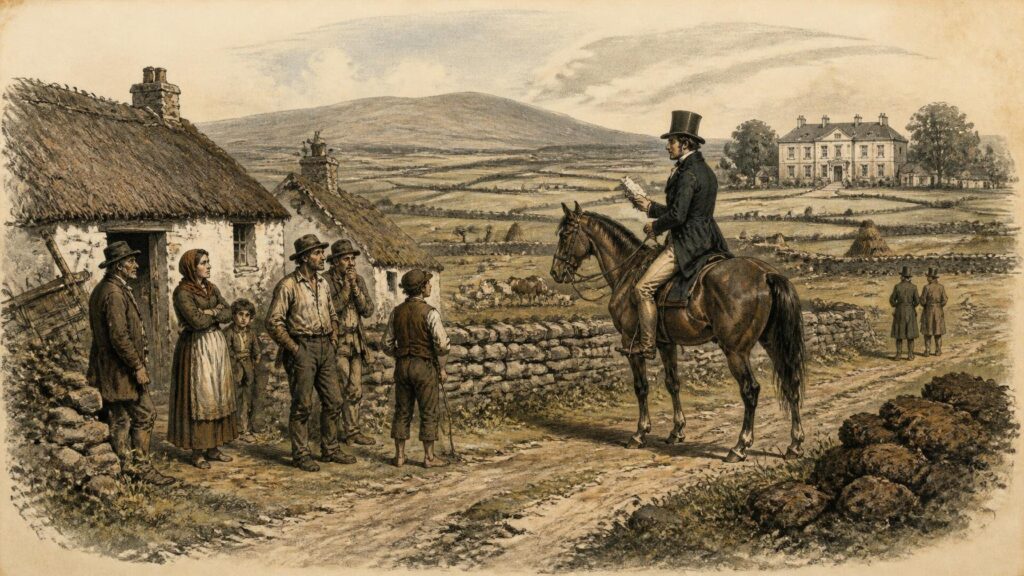
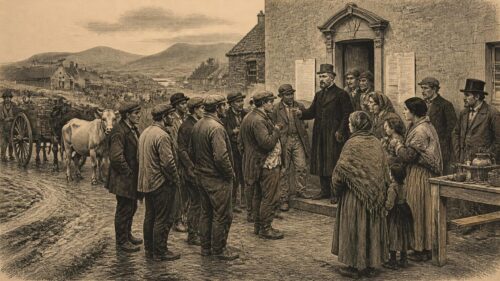
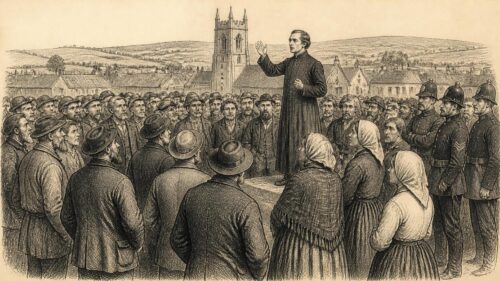
AI generated historical illustration, not a contemporary photograph.
At a Glance
Land in Ireland has never been merely soil measured in acres. It has been livelihood, inheritance, political authority, a source of legal dispute and a powerful language of belonging. Its history cannot be reduced to a simple tale of dispossession followed by liberation: the evidence instead reveals successive systems of use, tenure, conquest, rent, resistance and ownership, each unevenly experienced by people of different class, religion, gender and region.
Living Ground
Ireland’s physical landscape set broad conditions without dictating a single social outcome. Its western seaboard, uplands, bogs, river valleys and fertile eastern and southern plains produced markedly different patterns of cultivation and settlement. Good pasture, arable land, woodland, turf, fishing grounds and common grazing all carried value, but that value depended on labour, access and custom as much as on ownership in the modern legal sense. A field was a place of crops; a bog supplied fuel; a mountain provided summer grazing; a lane or river crossing could determine whether a holding was viable. Rural communities therefore treated land not as an abstract commodity alone but as an interconnected resource.
Archaeology demonstrates that people altered Irish landscapes over very long periods. Clearance, tillage, enclosure, drainage and grazing all changed vegetation and soils. Yet it would be misleading to imagine a timeless, harmonious ancient countryside later ruined by outsiders. Communities made difficult choices, and land use altered with population, climate, technology, trade and political power. Early settlement evidence can indicate cultivation or habitation, but it rarely tells historians precisely who possessed a particular piece of ground, on what terms, or with what degree of security. Modern ideas of individual freehold ownership should not be projected backwards without caution.
The Irish language preserves a vocabulary of locality that is itself historical evidence. Townland names, parish names, field names and placenames may recall woods, rivers, fortifications, saints, families, soils or vanished forms of settlement. They must nevertheless be handled carefully. A name may have changed spelling, been translated imperfectly, or acquired an appealing explanation long after its origin was forgotten. Folklore can preserve genuine local memory, particularly about boundaries, famine settlements, evictions and former houses, but it is not self-authenticating proof. It gains historical force when compared with maps, valuations, leases, censuses, estate papers, oral testimony and material remains.
Land was also social space. The arrangement of cabins, farmyards, demesnes, villages, roads and market towns reflected distinctions of status. A landlord’s house and designed grounds could proclaim authority; a tenant’s carefully improved field could represent years of work vulnerable to a rent rise or notice to quit. Common rights to cut turf, gather seaweed, graze animals or draw water could be as important to poorer households as the acreage they formally occupied. In many districts, the difference between survival and destitution lay not in ownership of a farm but in access to such shared resources.
Gaelic Tenure
Before the consolidation of English common law across Ireland, landholding in Gaelic lordships operated through institutions and relationships unlike later landlord and tenant arrangements. Medieval Irish legal texts and later descriptions point to a world in which kinship groups, clientship, cattle wealth, lordship and obligations of food rent or service mattered greatly. Rights over land were embedded in social rank and reciprocal duties. That does not mean that land was held in a simple collective ownership by an undifferentiated clan. Different people possessed different claims, and powerful families exercised substantial control. Nor did it mean that no land was cultivated intensively or inherited within families.
Much evidence for Gaelic tenure reaches us through sources written by outsiders, including English administrators hostile to Irish law and custom. Sir John Davies, writing after the Tudor conquest, depicted tanistry and forms of redistributive inheritance as unstable and inimical to improvement. His account is important because it shows the arguments used to justify imposing English legal forms. It is not, however, a neutral ethnographic description. Davies wrote as a crown lawyer whose political purpose was to demonstrate the superiority of English rule. Historians consequently read such material against Irish legal texts and against the practical evidence of lordship, settlement and agricultural life.
The term tanistry is often used as if it described all Gaelic succession neatly. In broad outline, it referred to the selection of a successor within a leading kin group rather than automatic succession by the eldest son. The practical operation of succession varied, and conflict within ruling families was real. Estates, offices and authority could be contested. But the familiar claim that Gaelic society knew no settled property, no improvement and no enduring attachment to place is an old colonial judgement rather than an acceptable historical conclusion. It confuses a legal system different from English primogeniture with an absence of order.
Land in Gaelic Ireland was inseparable from cattle and tribute. Lords drew resources from subordinate groups; ecclesiastical lands possessed distinctive status; learned families, military followers and office holders might be maintained through rights in land or produce. Seasonal movement to upland pasture occurred in some regions, while tillage remained significant in others. The balance between cattle and crops shifted according to locality and period. Rather than a fixed opposition between pastoral Gaelic Ireland and agricultural English Ireland, the better interpretation is one of mixed economies shaped by ecology and power.
The Anglo Norman settlement after the late twelfth century added further layers. In areas of dense lordship, manors, boroughs, castles, churches and grain-producing estates were established. English legal forms were stronger in some eastern and southern districts than in many Gaelic lordships, but the boundary between supposedly English and Irish worlds was porous. Families intermarried, languages and customs travelled, and local practice adapted. The later medieval Irish landscape was not divided into two sealed civilisations. Its land systems were plural, changing and often contested.
Colonial Claims
The Tudor reconquest transformed the political meaning of land. English governments sought to make authority over territory legible, taxable and secure through royal law. Surrender and regrant offered Irish chiefs recognition of title from the crown in return for submission, altered succession and stated obligations. In theory, this could incorporate local elites into a Tudor political order. In practice, it recast land as an estate held under a monarch whose officers claimed authority to determine title, inheritance and forfeiture. That shift proved momentous.
Military campaigns, rebellions, attainders and legal investigations made land a principal instrument of conquest. When land was declared forfeited, it could be granted to soldiers, officials, investors or settlers. The process was not uniform and did not simply sweep aside every older occupier. Some Irish landholders retained property, negotiated with the crown or acquired interests under the new legal order. Others lost control, became tenants on land their families had previously dominated, or were displaced altogether. The unevenness matters: broad narratives of confiscation are historically sound, but local outcomes must be established case by case.
The dissolution of monasteries added another major redistribution. Religious houses had been significant landholders, employers, landlords and providers of hospitality or relief. Their lands and rights were transferred into crown control and then frequently granted or sold. This affected not only ecclesiastical wealth but local patterns of tenancy and administration. It also complicated later memories of land loss, since former monastic property entered the estates of a variety of new proprietors rather than passing through one single process.
Colonial policy was closely tied to ideas of improvement. Officials and undertakers spoke of building, enclosure, market towns, tillage, Protestant settlement and orderly rents. Such language was never merely economic. Improvement implied a judgement that existing inhabitants and land uses were deficient, while the incoming or compliant proprietor was represented as productive and civilising. Some new settlers undoubtedly invested capital, built mills, drained land and developed commercial agriculture. Yet improvement could also mean the reorganisation of land to extract rent, secure military control or create space for favoured populations. It was a programme of power as well as husbandry.
The legal documentation generated by conquest became part of its machinery. Inquisitions, grants, surveys and patents converted complex local relationships into categories legible to the state. They could identify land, people, rents, boundaries and alleged rights, but they did not record these matters from an equal social position. A survey usually served a fiscal, military or proprietary purpose. It may be extraordinarily valuable evidence while still reflecting the assumptions of those who commissioned it. Reading such records critically is essential to any history of Irish land.
Plantation Landscapes
Plantation was the most conspicuous early modern method of using land to secure political change. Schemes in Laois and Offaly, Munster and Ulster differed in scale, timing and outcome, but they shared a conviction that confiscated territory could be reorganised through settlement, grants and new institutions. Plantation did not create all division in Ireland, nor did every settler prosper, but it deepened connections between landholding, religion, state allegiance and ethnicity. Its consequences became particularly enduring in Ulster.
The Ulster Plantation followed the collapse of the Gaelic earldoms after the Nine Years’ War and the departure of leading Ulster lords in 1607. Crown policy allocated much confiscated land in several counties to English and Scottish undertakers, servitors, church interests and the London companies. Conditions attached to grants included settlement, buildings and particular forms of tenure. The stated design was both strategic and social: a population considered loyal to the crown would occupy and develop the territory. The result was neither wholly planned nor wholly successful. Surveys and official enquiries recorded incomplete buildings, weak towns and failures to meet settlement obligations.
Native Irish people did not disappear from plantation counties. They remained as tenants, labourers, neighbours and, in some places, substantial local figures. Settler landlords could find the rents paid by Irish tenants economically useful, creating a practical tension between official schemes of replacement and estate calculation. Meanwhile, Scottish settlement was especially influential in parts of north-east Ulster. The religious and demographic pattern that later shaped northern politics emerged from this history, though it should not be treated as mechanically inevitable. Population movements, economic change, intermarriage and political crises continued to reshape the region.
In Munster, plantation followed the defeat of the Desmond rebellion. Large grants were made to undertakers, but the settlement faced instability, difficulties of finance and renewed warfare. Some estates changed hands; others relied upon existing inhabitants and practices more than plantation rhetoric allowed. The experience demonstrates why land history requires attention to implementation. A patent, map or official plan records intention and title, not necessarily successful settlement on the ground.
The seventeenth century brought further and more extensive upheaval. The 1641 rebellion, Confederate wars, Cromwellian conquest and Restoration settlements produced changing claims of loyalty, rebellion, innocence and forfeiture. The Civil Survey and the Down Survey were indispensable instruments in this process. They listed proprietors, described land quality and use, and mapped territory in anticipation of redistribution. Their survival gives historians remarkable access to mid seventeenth-century landscapes. It also reveals the cold administrative side of dispossession: acreage, denomination, religion and value could become entries in a state project of seizure and allocation.
It is tempting to treat the Down Survey maps as photographic representations of a settled reality. They were not. They were working documents made for a particular political purpose, and their precision varied. Boundaries, acreages and labels require comparison with other evidence. Even so, they are among the most consequential records in Irish history because they connected military victory to territorial reordering. Later memories of confiscation, especially among Catholic landed families, had strong roots in these seventeenth-century settlements.
Estate Order
By the eighteenth and early nineteenth centuries, much productive land in Ireland was organised through landed estates. A comparatively small number of proprietorial families held extensive property, while tenants occupied farms under leases, yearly arrangements or other agreements. This is the familiar setting of the Irish “Big House”, but the phrase can obscure a wide range of estates. Some proprietors lived abroad; some resided locally; some were wealthy and politically influential; others were debt-ridden. Tenants likewise ranged from substantial graziers and middlemen to smallholders, cottiers and labourers with precarious access to a patch of ground.
Estate papers are central to reconstructing this world. Leases identify parties, terms, rent and acreage. Rentals list sums due and sometimes arrears. Letter books preserve exchanges between landlords, agents and tenants. Account books record expenditure on roads, drainage, building, relief or legal action. Maps can identify holdings, tenants, field boundaries and planned improvements. The National Archives of Ireland rightly warns that the survival of such collections is uneven: many were lost, remain private or are held across several repositories. A surviving estate archive may be rich, but it is never the whole history of an estate.
These records are also records of management rather than transparent testimony. An agent’s report might describe a tenant as idle, insolvent or troublesome; a tenant’s petition might characterise a landlord as oppressive or indifferent. Either may be partly accurate, self-interested or both. The historian’s task is not to discard partisan documents but to identify their purposes and test them against other materials. A notice to quit, a rent book, a Poor Law record, a valuation and an oral tradition may illuminate the same event from sharply different angles.
Leaseholding could offer security, especially where long leases encouraged improvement. It could also create complications. Middlemen sometimes took large leases and sublet land at profit, placing a layer between proprietor and occupier. Subdivision of holdings supported families in periods of population growth but could produce tiny plots and intense dependence on the potato. Smallholders might combine a little land with seasonal labour, spinning, fishing, migration or work on larger farms. The countryside was not composed simply of landlords and tenants; it contained a hierarchy of occupiers and non-occupiers.
Political power followed property. Before reforms of the nineteenth century, the franchise was closely associated with qualifications rooted in landholding. Landlords and their agents could exercise considerable electoral influence, though tenants were not invariably obedient. Local offices, grand juries, magistracy and parish institutions reinforced proprietorial authority. Religion mattered too. The Protestant ascendancy rested not only on belief but on a structure in which political rights, office and much landed wealth were unevenly distributed. Yet not every Protestant was a landlord, not every Catholic was landless, and local alignments could be more complicated than a simple confessional map suggests.
Improvement became the moral vocabulary of estate society. Drainage, enclosure, new farm buildings, roads, tree planting and the consolidation of small holdings were presented as rational progress. In some circumstances these changes increased output and made farms more viable. In others they removed people from common rights, destroyed dispersed settlement patterns or made the poor more dependent on wage labour. The same drainage channel or stone wall could be seen as an agricultural benefit by an estate office and as the boundary of exclusion by a family whose customary access had narrowed.
Famine Rupture
The Great Famine exposed the vulnerability of the land system with catastrophic force. Potato blight struck a society in which many rural households depended heavily on the crop, whether as smallholders, cottiers or labourers paid partly through access to land. The disaster cannot be explained by land tenure alone. Disease in the potato crop, poverty, market structures, relief policy, public finance and imperial governance all mattered. But the organisation of land determined who had reserves, who could grow alternatives, who owed rent, and who possessed the political influence to withstand crisis.
Mortality and emigration reshaped the countryside. The poorest people were most exposed, especially those with little or no secure land. Cabins vanished, villages contracted and holdings were consolidated in many districts. Evictions occurred before, during and after the worst years of the Famine; some were formal and recorded, while others took the form of surrender, assisted emigration or pressure to leave. It is neither accurate to deny the reality of mass eviction nor sufficient to portray every proprietor as acting from the same motive. Landlords faced collapsing rents, poor-rate demands, debt and legal pressures, but their responses varied from relief and retention of tenants to clearance and demolition.
Famine-era sources require especial care. Workhouse records, relief lists, newspapers, estate correspondence, shipping records and official reports yield names and numbers, but each has blind spots. A household that disappeared from a townland may have emigrated, died, entered an institution, moved locally or been evicted. A landlord’s claim to have provided relief may be genuine while omitting people excluded from that aid. National statistics describe scale but rarely restore individual experience. The moral power of Famine memory should not exempt historians from the work of distinguishing what a record proves from what it suggests.
The Encumbered Estates Court, established in 1849, was another turning point. It aimed to facilitate the sale of indebted estates, freeing property from complicated claims and allowing creditors to be paid. The Famine intensified landowners’ financial difficulties, though indebtedness predated the crisis for many estates. Sales did not simply replace one old landlord class with a wholly new entrepreneurial order. Purchasers included professionals, investors and existing landed interests; results varied by county. Still, the court contributed to a significant reshaping of proprietorship and created new opportunities for people with capital.
After the Famine, population decline and consolidation encouraged a transition away from the densest patterns of subdivision. Cattle and pasture assumed greater importance in many places, while stronger tenant farmers could improve their position. This did not mean that rural poverty disappeared. Agricultural labourers, landless families and occupants of marginal western holdings remained highly vulnerable. Nor did it mean that population loss was welcomed or painless. Empty cottages and ruined villages became potent sites of commemoration, sometimes accurately linked to Famine eviction and sometimes attached to stories whose precise date or cause cannot now be confirmed.
Tenant Resistance
Land conflict did not begin with the Land League. Ireland had a long history of secret societies, resistance to tithes, opposition to rents, threats against agents and conflicts over grazing, conacre, access and eviction. Such unrest could be local, defensive and directed at immediate grievances rather than at a national programme. Violence must not be romanticised: intimidation, assault and murder caused real suffering. Equally, it should not be explained as irrational criminality detached from material conditions. Rural protest often emerged where tenants and labourers perceived rents, exactions, evictions or changes in land use as intolerable.
The crisis of the late 1870s gave these traditions a new political form. Agricultural depression and renewed distress, particularly in the west, coincided with the organisational ability of Michael Davitt, Charles Stewart Parnell and others. The Irish National Land League mobilised tenants around demands commonly remembered as the Three Fs: fair rent, fixity of tenure and free sale. The formula did not answer every question of rural inequality, but it made a powerful case that tenants who had improved holdings should not be exposed to arbitrary rent increases or eviction.
The Land War was neither a conventional war nor a single centrally controlled campaign. It comprised meetings, rent strikes, legal cases, evictions, boycotts, relief activity, police action, coercive legislation and outbreaks of violence. Women played indispensable roles, especially through the Ladies’ Land League, which organised relief for evicted families and documented eviction cases during the imprisonment of male leaders. Their labour demonstrates that agrarian politics was not exclusively male, even though public leadership and parliamentary history have often been presented that way.
The word “boycott” entered international usage through the case of Captain Charles Boycott, an estate agent in County Mayo who was socially and economically isolated during the agitation of 1880. The episode became emblematic, but it can distort understanding if treated as representative of every encounter. Boycotting ranged from collective refusal of social or economic dealings to severe forms of intimidation. It was a weapon intended to prevent replacement tenants, or “land-grabbers”, from benefiting when neighbours were evicted or unable to pay. It brought communal pressure into the centre of land politics.
Land agitation connected with constitutional nationalism but was not identical to it. Many activists hoped that agrarian reform would strengthen the case for Home Rule; some landlords and unionists feared that both property and the Union were under attack. Tenant purchase could appeal across political divisions because it offered a way to end chronic conflict without revolutionary expropriation. Yet purchase also raised questions: which tenants would qualify, how would landlords be compensated, who would pay the state advances, and what would happen to labourers and people with insufficient land to buy?
Nationalist memory often presents the Land League as a united popular movement sweeping away an alien landlord order. There is truth in its breadth and importance, but unity was incomplete. Substantial farmers frequently had more to gain from security and purchase than labourers or occupiers of minute plots. Some tenants resisted paying rent while others complied. Some landlords were harsh, absentee or financially extractive; others negotiated reductions, invested locally or supported reform. The system was unequal even where personal relationships were amicable. Individual benevolence did not remove the structural insecurity of tenancy.
Legislative Change
Legislation gradually changed the balance of power. The Landlord and Tenant Act of 1870 gave limited recognition to tenant improvements and compensation in certain circumstances, but it did not settle the conflict. The Land Law Act of 1881 was more consequential. It established the Land Commission and introduced a system through which many tenants could seek judicially determined fair rents. This did not abolish landlordism immediately, but it constrained proprietorial freedom and made the state an active arbiter of rural relations.
The first judicial rents were often reduced, a development with serious implications for landlords whose income supported debt, settlements and household expenditure. The legal system also created a large archive: applications, maps, valuations and correspondence can show how general law reached individual holdings. Such files are invaluable, though they should not be mistaken for a complete rural census. People outside formal tenancies, including many labourers and marginal occupants, were less visible in the records and less well served by reforms centred on the tenant farmer.
From the 1880s, land purchase became the increasingly favoured solution. The Ashbourne Acts provided state-backed advances, while later measures expanded the process. The Irish Land Act of 1903, commonly called the Wyndham Act, was particularly important. It built on the Land Conference of 1902, where representatives associated with landlord and tenant interests negotiated a compromise. Its machinery encouraged sales, with state finance enabling tenants to buy and a bonus encouraging landlords to sell estates. The legislation was not an act of simple generosity by any party; it reflected the recognition that a durable settlement required a transaction acceptable to both sellers and purchasers.
The result was a vast transfer of ownership. Tenant purchasers repaid annuities over time, while landlords received compensation and could clear debts or reinvest. The process did not happen everywhere at the same pace, nor did it dissolve every estate instantly. Problems of title, valuations, untenanted land, sporting rights, turbary, boundaries and subtenancies required administrative decisions. The 1903 Act itself reveals this complexity, containing provisions about maps, purchase agreements, ancient monuments, bog rights and disputes between proprietors. Land settlement was an administrative revolution as well as a political one.
It is reasonable to regard tenant purchase as one of the great transformations of modern Irish society. A social order built around rent-paying occupancy moved towards one dominated by owner-occupying farmers. But the achievement should not be exaggerated into a universal redistribution of wealth. Larger and stronger farmers were often best placed to benefit. Holdings in congested districts could remain too small or poor to support a family adequately. Labourers might obtain cottages and plots under separate legislation, yet they did not become equal participants in the new agrarian proprietorship. The land question was reduced, not magically extinguished.
The transformation also changed politics. Owner occupiers acquired a material stake in security, inheritance and conservative management of property. Some historians have interpreted this as helping to produce the social outlook of the independent Irish state: rural, property-conscious and cautious about radical redistribution. That interpretation is persuasive when offered as a major tendency, but should not erase regional variation, labour politics, emigration or the continuing influence of urban Ireland. Ownership did not create one political mind.
National Partition
The revolutionary decade and partition placed land reform within new constitutional settings. By the early twentieth century, much of southern Ireland had already moved substantially towards tenant ownership, although the process was incomplete. The Irish Free State inherited unresolved matters concerning estates, untenanted land, congestion and the distribution of viable holdings. Its Land Act of 1923 gave the Irish Land Commission further powers to acquire, divide, sell and rearrange land. The statute’s detailed provisions on finance, vesting, resale, bogs, rights of way and consolidation show that the state continued to treat land as a national administrative problem.
The Land Commission’s work was especially significant in western districts where congestion had long been identified as a challenge. Its officials could acquire estates, enlarge small holdings, create new farms and resettle families. Such programmes offered real opportunities to some people, but they also involved official judgement about who deserved land and how a countryside should be organised. Applicants, local politicians, neighbours and officials could compete fiercely. The Commission was neither a neutral machine nor simply a vehicle of popular justice; it was a state institution operating through files, inspections, valuations and discretion.
In Northern Ireland, land questions developed within a different political framework, though tenant purchase and estate break-up were also important. Partition did not erase shared histories of estate society, tenancy and agricultural change, but it meant that law, administration and political symbolism increasingly diverged. In the north, land could intersect with unionist identity, nationalist grievance, rural class interests and later debates over planning and development. Across the border, the older geography of plantation and settlement continued to influence historical memory, sometimes with more force in politics than in everyday agricultural practice.
Land remained connected to sovereignty. The new southern state’s capacity to complete purchase and redistribute certain estates had symbolic value: it demonstrated that political independence could be made tangible in the ownership of farms. Yet sovereignty did not remove economic constraints. Small farms needed markets, credit, roads and viable production. The interwar state confronted emigration, uneven land quality and rural poverty. Redistribution could correct particular inequalities but could not make every acre fertile or every holding sufficient.
Land annuities later became entangled in the Economic War between Ireland and Britain during the 1930s. The dispute illustrated how earlier purchase arrangements still shaped relations between the two states. What had begun as a mechanism for settling landlord and tenant claims became part of a contest over financial obligations and national autonomy. The episode is a reminder that the legal afterlife of land reform extended far beyond the farm gate.
Rural Legacies
The physical legacy of this history remains visible. Estate walls, gate lodges, demesnes, planned villages, abandoned cabins, labourers’ cottages, field systems, drainage works and former landlord houses all occupy modern landscapes. They should not be read as simple monuments. A well-kept demesne may testify to design, employment and privilege; a ruined house may speak of emigration, inheritance change, neglect or removal. Material remains invite questions but rarely answer them alone. Documentary research and local knowledge are needed before attaching a precise story to a site.
Historic maps are among the best tools for this work. The National Library of Ireland’s collections include estate surveys, military maps, copies of Down Survey material and Ordnance Survey mapping. Such sources allow researchers to trace changing place names, roads, buildings and field patterns. Griffith’s Valuation, published in the mid nineteenth century, offers another major point of reference, recording occupiers, immediate lessors and property values. It is invaluable for locating households and holdings, but it is a valuation record, not a complete account of residence, kinship or poverty.
Genealogical interest has encouraged many families to study the land their ancestors occupied. This can be deeply rewarding, but it is important to distinguish occupation from ownership. A name in a valuation or rent roll may show that a person occupied a house, field or farm at a particular time; it does not by itself establish that the family owned it, had lived there for generations or left under a particular compulsion. Similarly, the absence of a name may result from spelling variation, a move, a change in tenancy category or gaps in survival. Historical humility is particularly necessary where family stories meet fragmentary records.
Modern environmental concerns give the subject renewed importance. Bogs, hedgerows, wetlands, rivers and uplands have been shaped by long histories of extraction, drainage, enclosure and agricultural policy. Turf-cutting rights, commonage and access disputes show that older legal arrangements still influence contemporary choices. Conservation can itself produce conflict when measures intended to protect habitats restrict practices embedded in local economies and memory. A historical approach does not supply an automatic policy answer, but it can explain why apparently technical arguments about land use carry such emotional and political weight.
Land also endures in literature and commemoration. Famine ruins, eviction sites, big houses and boundary stones become symbols through poems, novels, songs and local storytelling. These representations often convey emotional truths about loss, attachment and power. They should not automatically be read as literal records, yet historians should not dismiss them. Cultural memory can identify experiences that official archives ignored, particularly those of labourers, women, migrants and people without formal title. The challenge is to let memory enlarge historical enquiry without allowing it to replace evidence.
Historical Evidence
The strongest history of Irish land is built by combining sources. Estate rentals show financial relationships; leases specify contractual terms; maps reveal spatial organisation; court files expose disputes; valuations capture a state assessment of property; census returns locate households; newspapers preserve public argument; official legislation defines changing rights; and oral accounts record later understandings of what happened. Each source has a different date, author, purpose and silence. No single document, however detailed, settles every question.
For the early modern period, surveys and grants provide unusually rich but politically charged evidence. The Civil Survey and Down Survey were created in the context of conquest and redistribution. For the nineteenth century, estate archives and Land Commission records make it possible to reconstruct local processes with impressive precision. They may show that a landlord reduced rent, that an agent demanded arrears, that a tenant purchased a holding, or that an estate was sold. They cannot automatically reveal how every participant felt, how a household managed hunger, or whether a legal decision seemed legitimate in a community.
Interpretation is unavoidable. The historian must decide how far a particular eviction reflects policy, how representative one estate is, or whether tenant purchase altered political culture. Such conclusions should be framed as interpretation, based on available evidence, rather than declared as incontrovertible fact. Folklore has a different status again. A story that a family was driven from a cottage may preserve a real inheritance of trauma, but it should be checked against maps, local newspapers, estate correspondence, Poor Law material and emigration records where possible. When confirmation cannot be found, uncertainty should remain visible.
There is no single Irish land story because there was no single Irish land system. Gaelic lordships, manorial districts, plantation settlements, Protestant estates, Catholic proprietors, tenant farms, commons, labourers’ plots, congested holdings and state schemes overlapped in time and place. The national importance of land arose precisely from this complexity. It joined intimate questions of home and subsistence to large questions of conquest, law, religion, class and independence.
The movement from estate landlordism to widespread owner occupation changed Ireland profoundly. It gave many farming families a security their predecessors had lacked and removed one of the most persistent sources of nineteenth-century political conflict. Yet it did not undo all earlier inequalities, nor did it end debates about access, viability, inheritance, environment or development. Irish ground remains historical ground: worked, mapped, remembered and argued over, with the marks of older settlements still present beneath modern fields and roads.