Shelter Systems
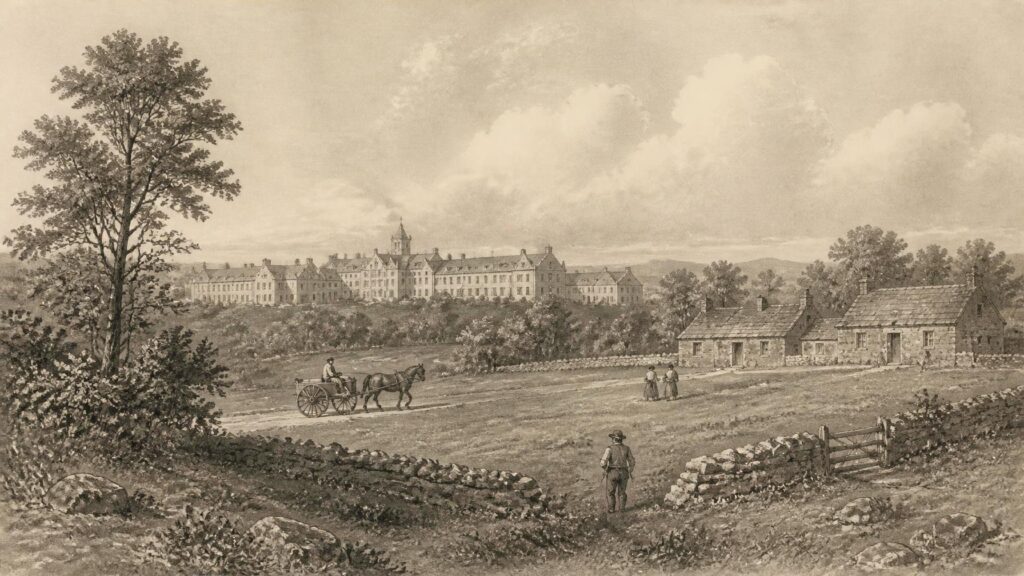
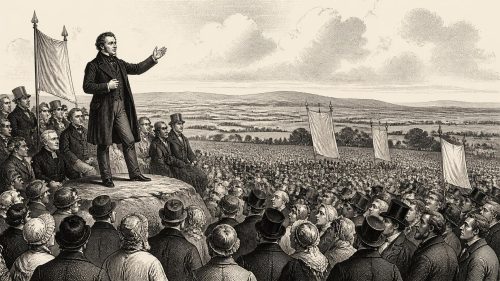
AI generated historical illustration, not a contemporary photograph.
At a Glance
In Irish history, housing and asylum were never wholly separate questions. A dwelling might be a rented room, a mud cabin, a labourer’s cottage, a tenement flat or a corporation house; an asylum might promise protection, treatment and relief while also imposing surveillance, separation and confinement. Both concerned the provision of shelter, but both were also shaped by unequal property, poverty, public health, religious influence and the expanding powers of government. This history uses the word “asylum” in its principal nineteenth-century Irish sense: an institution for people then described in official language as “lunatics” or “the insane”. Such terms are historically necessary when discussing records, but they are not acceptable descriptions of people today.
Shared Meanings
The pairing of housing and asylum can seem artificial if each is treated only as a modern policy field. In the past, however, they overlapped repeatedly. A lack of secure accommodation could expose people to illness, destitution and institutional admission. Poor Law officials, doctors, local ratepayers, landlords and charitable bodies all encountered people whose needs did not fit neat categories. The elderly, disabled, sick, unemployed, orphaned, pregnant, homeless or mentally distressed could pass between lodgings, family homes, hospitals, workhouses, prisons and asylums. The categories used by institutions were administrative decisions as much as descriptions of lived experience.
“Home” also needs careful handling. It can suggest privacy, affection and permanence, yet many Irish households possessed little of any of these. A home might be a single room shared by a large family, a labourer’s cottage dependent on insecure employment, or a dwelling on an estate where the owner could influence livelihood as well as tenancy. Conversely, a workhouse or asylum could be described by promoters as a place of refuge, without thereby becoming a home in the residents’ own sense. Historical evidence records buildings, rules, admissions and expenditure more readily than it records the emotional meanings of place. Interpretation is therefore necessary, but should not be mistaken for direct testimony.
Irish developments were also uneven. Before 1921, many laws and institutions operated across the whole island under the United Kingdom. After partition, Northern Ireland remained within the United Kingdom while the Irish Free State, and later the Republic of Ireland, developed a separate administrative and legislative path. A single Irish narrative must therefore recognise continuity in buildings, records and family histories, while avoiding the assumption that policy after 1921 was identical north and south.
Rural Dwellings
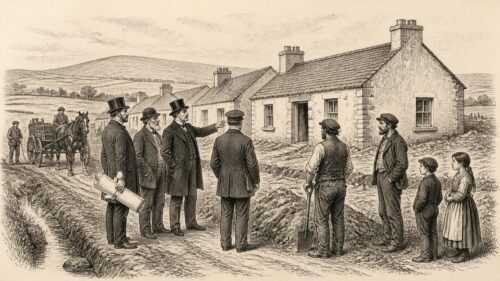
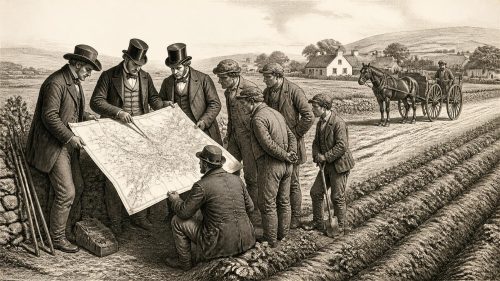
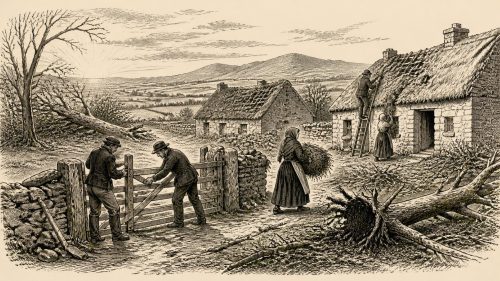
For much of the eighteenth and early nineteenth centuries, the housing of the rural poor was bound to landholding, seasonal work and demographic pressure. Small cabins and one-room dwellings were widespread, but their forms varied by region, available materials, household resources and custom. Stone, turf, mud walling, thatch and limewash belonged to practical local building traditions rather than to a timeless rural idyll. A modest house could shelter a household with a degree of independence; it could equally reveal insecurity where land was subdivided, rent was burdensome or employment was precarious.
Retrospective accounts often turn the Irish cabin into a single symbol of pre-Famine misery. The evidence supports no such uniform picture. Conditions could be harsh, and contemporary inquiries found severe overcrowding and poor sanitation, but household size, occupation, region and access to land mattered greatly. The number of hearths recorded for taxation purposes is useful evidence of small-scale housing, yet it cannot by itself measure comfort, poverty or family stability. Nor should the survival of vernacular cottages be treated as proof that their former occupants lived securely within them.
What can be said with confidence is that housing was tied closely to the structure of rural society. Tenants and labourers often depended upon estates and farmers for a place to live. The dwelling could be part of the bargain of employment, a condition of access to a small plot, or a resource vulnerable to eviction and economic change. This dependency mattered particularly in crises. The loss of a crop or job did not simply reduce income; it might threaten the household’s ability to remain in a locality at all.
The Poor Inquiry of the 1830s and later official investigations described pervasive material hardship. They are valuable but not neutral. Commissioners observed through the assumptions of reformers who wished to classify need and devise systems of relief. Their reports consequently make poverty legible to the state, while sometimes simplifying the mutual aid, kinship and local accommodation by which families survived. Documentary evidence establishes that hardship was extensive; it does not justify reducing rural people to passive victims without social resources of their own.
Urban Expansion
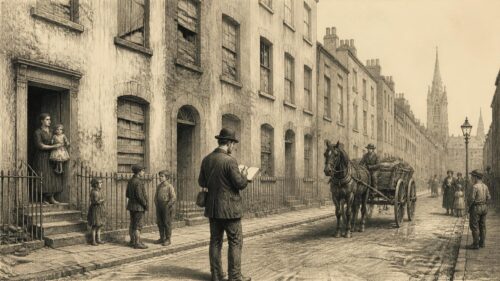
In the towns, housing was shaped by commercial development, migration, altered patterns of work and the reuse of older buildings. Dublin became the best documented example. Large Georgian houses constructed for affluent households were, over time, subdivided into flats and rooms as wealthier residents moved towards newer suburbs. Speculative landlords could derive rent from multiple households occupying former single-family properties. The result was not simply “old housing”, but a particular rental economy in which owners, agents and tenants negotiated from radically unequal positions.
By the early twentieth century, the scale of Dublin tenement life had become impossible for public authorities and reformers to ignore. The 1913–14 inquiry into the housing of Dublin’s working classes, appointed after the Church Street collapse, assembled testimony, inspection evidence and census material. It found 5,322 tenement houses in the city and reported that 45 per cent of its working-class population lived in them. Of 25,822 families in tenements, the inquiry recorded 20,108 living in one room. Its inspectors described shared entrances, cramped stairways, limited water supplies, decayed fabric and inadequate sanitary arrangements.
Those figures are stark, but their meaning should be handled precisely. They reveal a serious structural problem, not merely individual neglect. Tenement households included casual labourers, artisans, widows, families with irregular earnings and others whose economic circumstances restricted choice. Overcrowding was intensified by low wages, insecure employment and the shortage of affordable alternatives. Sanitary failures were tied to ownership patterns and deficient municipal capacity as well as to the daily practices of residents. To blame tenants for conditions that they did not control was a familiar moral judgement of the period.
Housing reform became entwined with labour politics and nationalist criticism of municipal governance. James Connolly and others treated the slum question as central to class inequality. Their language was political and polemical, not detached social science, but it reflected a real connection between employment, rent and health. The Dublin inquiry itself reported a higher death rate in the city than in comparable large centres in England, Wales and Scotland for 1911, and argued that substantial improvement depended upon confronting housing conditions. Housing had become an issue of public health, civic responsibility and national reputation.
Charitable Shelter
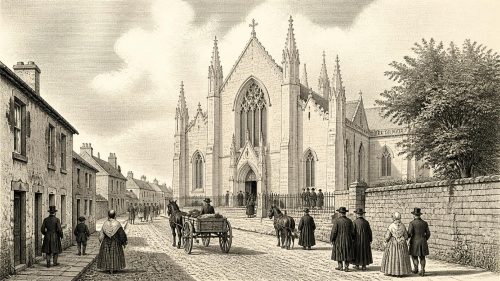
Before the Poor Law, relief in Ireland rested on a mixture of family assistance, parish measures, charitable institutions, private philanthropy and informal survival strategies. These arrangements were inconsistent. Their reach depended upon locality, religious affiliation, donor resources and the willingness of local elites to act. Dublin’s House of Industry, founded in 1772, is especially important because it demonstrates how one institution could accumulate many functions: relief for the poor, hospitals, facilities for children, detention spaces and accommodation for people considered mentally ill.
Such institutions did not emerge from a coherent welfare state. Rather, they assembled responses to visible poverty, begging, sickness and disorder. “Industry” implied that the poor should be disciplined into productive habits; charitable provision was therefore often moralising as well as compassionate. The distinction between help and control was blurred. A person accepted into an institution might receive food, clothing or medical attention, but could lose liberty, separation from family or the ability to determine daily life.
There were alternatives. Religious orders, voluntary hospitals and local benefactors created forms of care outside direct state administration. Jonathan Swift’s bequest supported St Patrick’s Hospital in Dublin, an institution founded in the eighteenth century for people deemed mentally ill. Quaker initiatives later contributed the Bloomfield Retreat. These institutions cannot be reduced to a single model: social class, payment, religion and admission practices differed. Nevertheless, access to more private or voluntary provision was often conditioned by money and social connection, while the poorest were increasingly directed towards public institutions.
The historical record does not support an easy contrast between benevolent charity and harsh state relief. Both could provide indispensable care; both could impose hierarchies. The relevant question is often who decided that care was needed, who bore its cost, and whether the person concerned had meaningful scope to refuse it. These questions would become sharper as the nineteenth-century state built more systematic institutions.
Workhouse Regime
The Irish Poor Law of 1838 created a network of unions and workhouses that transformed the institutional landscape. The workhouse was intended to provide relief to the destitute under a deliberately restrictive principle: conditions inside were to deter all but those judged to have no alternative. This was not a housing programme in the modern sense. It offered collective shelter in return for discipline, classification and the surrender of ordinary domestic arrangements. Families were commonly separated by sex and age; uniforms, schedules and regulated diets marked institutional life.
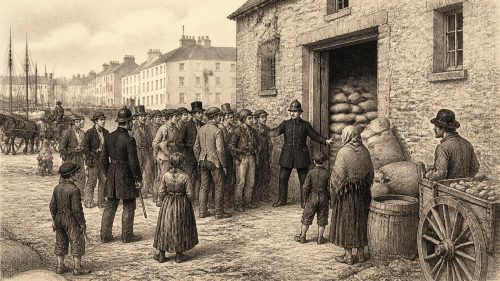
Workhouses were constructed before the Great Famine, but the catastrophe beginning in 1845 rapidly overwhelmed their intended capacity. Admissions rose as hunger, disease, eviction and displacement stripped households of their means of survival. The buildings became sites of shelter and suffering simultaneously. Many people entered because they needed food and a roof, not because the workhouse offered a desirable refuge. Fever and other infectious diseases spread under crowded conditions, while mortality reached appalling levels in numerous institutions.
It is important not to describe every workhouse experience as identical. Conditions differed according to date, local management, resources, disease and the scale of distress. Staff and guardians sometimes acted with genuine commitment; others could be indifferent, punitive or overwhelmed. Surviving minute books, admission registers and correspondence show systems under intense strain but cannot give a complete account of each inmate’s life. Individual letters and testimony, where they survive, are especially valuable because they recover voices otherwise submerged by administrative statistics.
The workhouse also affected the housing market outside its gates. The possibility of institutional relief could be invoked by landlords, officials or employers as an alternative to family support. During the Famine, however, the need for shelter far outstripped the capacity of workhouses. Auxiliary buildings, fever sheds and emigration routes became part of the wider geography of displacement. The workhouse was thus neither the sole cause of homelessness nor its solution. It was an institution created to manage extreme destitution in a society where secure housing was unequally distributed.
Asylum Foundations
Early provision for people labelled insane was limited, fragmented and often degrading. Cells in houses of industry, small local facilities, prisons and private arrangements could all be used. In 1817, parliamentary attention focused on the lack of appropriate accommodation for the “lunatic poor” in Ireland. Hansard recorded claims that provision outside a few places was extremely scarce. The same year, legislation enabled the establishment of asylums for pauper patients, and the 1821 Lunatic Asylums (Ireland) Act helped establish the district asylum system.
The new system was significant in international terms. Ireland was organised into districts whose grand juries could finance institutions for people of limited means. The Irish Architectural Archive describes the resulting scheme as the first publicly funded asylum system for mentally ill people in the world. That statement concerns public institutional provision, not a claim that Ireland had discovered humane treatment. Funding and geographic reach were genuine innovations; the experiences within institutions remained variable and frequently coercive.
The Richmond Lunatic Asylum in Dublin, opened for patients in 1814, occupied an important place in this history. Other district asylums followed in Armagh, Limerick, Belfast, Londonderry, Carlow, Ballinasloe, Maryborough, Clonmel and Waterford, among other places. New establishments continued through the mid-century and after the Famine. The expansion gave the state and local authorities a more regular mechanism for removing people from prisons, workhouses, streets and family households into specialised institutions.
Architectural plans made the assumptions of this system visible. Francis Johnston’s designs stressed low buildings, air and ventilation. Such features belonged to contemporary ideas of health and “moral treatment”, which valued orderly surroundings, work, observation and controlled recreation. Yet design ideals should not be confused with everyday reality. An asylum might have landscaped grounds and still be overcrowded; it might promise cure while functioning chiefly as long-term custody. Architecture could express optimism, economy and authority at once.
Institutional Lives
Admission records offer a partial window into the people who entered Irish asylums. Registers could record age, marital status, occupation, religion, birthplace, previous residence, next of kin and outcome. They show that asylum populations were not a single social group. Patients included agricultural labourers, domestic servants, artisans, farmers, married women, single people, people transferred from workhouses or prisons, and individuals whose families sought help. The very breadth of the records cautions against any assumption that asylums served only the homeless or abandoned.
At the same time, poverty was central to the public system. Pauper asylum provision linked mental distress to the ability, or inability, to pay. Families could struggle to care for a relative where housing was crowded, incomes insecure or behaviour considered dangerous. Admission might result from a crisis that a household could not manage. This need not mean relatives were uncaring. It may instead reveal the limited services available beyond family care and institutional removal. The archive is often clearer about certification and committal than about the negotiations, fear or exhaustion preceding them.
Historical language frequently pathologised conduct that today might be understood very differently. Grief, trauma, disability, epilepsy, dementia, addiction, learning disability, poverty and social nonconformity could intersect in admissions and diagnoses. It would be wrong to retrospectively diagnose every recorded patient, just as it would be wrong to assume all were misidentified. The appropriate conclusion is more limited: nineteenth-century classification was shaped by contemporary medical knowledge, legal procedures and social expectations, and those categories should not be accepted uncritically.
Work was often part of institutional routine. Farms, laundries, kitchens, workshops and grounds required labour, while doctors and managers could present productive occupation as therapeutic. Some patients may have found purpose or familiarity in such activities. Yet the institutional setting involved unequal power. Work could be treatment, economy and discipline simultaneously. A historical account must retain that ambiguity rather than choose between the comforting language of therapy and the simplifying language of exploitation.
Confinement Questions
Asylums were conceived as places of care, but their power to confine made legal safeguards essential. Nineteenth-century legislation laid down procedures for admission, inspection and discharge, partly because legislators feared unlawful detention and abuse. The existence of safeguards did not guarantee their effectiveness. Doctors, relatives, magistrates, governors and local officials exercised considerable influence, while patients often had little capacity to challenge decisions. The records of inspections and inquiries reveal continuing concern about standards, overcrowding and the proper use of restraint.
The Central Criminal Lunatic Asylum legislation of 1845 introduced another important distinction. A central institution near Dublin was created for people charged with offences and considered insane. This joined criminal justice and mental health in a purpose-built setting. The classification was consequential: people could be held not only because of illness but because of perceived danger, criminal allegation or legal incapacity. The creation of the Dundrum institution illustrates how the asylum system extended beyond poor relief into questions of security and state custody.
Contemporary critics did not all agree about the remedy for defective provision. Some wanted better buildings, more professional supervision or improved moral treatment. Others questioned the effects of large institutions themselves. By the later nineteenth century, asylums were commonly full or overcrowded, and the expectation of cure sat uneasily beside lengthy residence. An institution initially presented as a therapeutic refuge could become a permanent destination for people with chronic needs, limited family resources or no recognised place elsewhere.
Folklore around asylums is powerful and often bleak. Stories of disappearance, cruelty and irreversible committal persist in many communities. They should not be dismissed, because they can preserve memories of stigma and fear. But folklore is not automatically documentary proof of a specific event. Where records exist, they should be examined alongside oral history. Where records are absent or inaccessible, uncertainty must remain explicit. The larger historical fact is secure: institutionalisation carried a profound social stigma and could separate people from ordinary community life for years.
Housing Reform
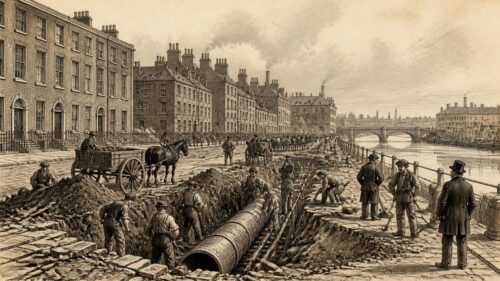
The later nineteenth century brought new arguments that public authorities should intervene directly in housing conditions. The Housing of the Working Classes legislation supplied powers that local bodies could use to address unhealthy dwellings, clear areas and provide replacement accommodation. Such powers did not automatically yield rapid transformation. Local finance, political will, land availability and disputes over compensation all shaped what could be done. In Dublin, reform proceeded against a backdrop of entrenched tenement ownership and a large low-paid population.
The 1913–14 Dublin inquiry became an unusually detailed indictment of the city’s housing. Its classifications of tenement buildings into structurally sound, borderline and unfit categories sought to make deterioration measurable. The report’s importance lay not only in its figures but in its official recognition that poor housing was a civic emergency. Its inspectors noted that many of the worst dwellings stood close to fashionable districts. The geography of poverty was therefore not confined to a distant margin: it was embedded in the capital’s commercial and political centre.
Rehousing could itself cause disruption. Slum clearance might remove residents from dangerous buildings, but replacement housing was not always provided swiftly, cheaply or near existing employment and family networks. A house is more than walls: its location affects access to work, schools, markets, relatives and community support. Officials tended to count units constructed or persons displaced. Residents measured changes through daily travel, rent, household size and the survival of neighbourly ties. Both perspectives are part of the history.
Rural reform followed different paths. The Labourers Acts facilitated the building of cottages for agricultural labourers through local authorities. These cottages are often remembered as an important material improvement, and many plainly were. They could offer separate rooms, gardens and improved sanitation compared with older accommodation. Yet entitlement depended on eligibility, local administration and finance. A cottage did not abolish low wages, seasonal unemployment or dependence on agricultural employers. Its historical significance lies in real improvement without assuming complete social transformation.
National Transition
The revolutionary years and the creation of the Irish Free State did not erase inherited housing and institutional problems. The new state assumed administrative responsibilities in conditions of limited resources, damaged infrastructure and competing demands. The Department of Local Government and Public Health, established in 1924, supervised local government, housing and public health functions. Its work continued earlier concerns with sanitary conditions and working-class accommodation while placing them within a new national political framework.
Housing held symbolic as well as practical importance. A state seeking legitimacy could present new cottages and urban schemes as evidence of progress, domestic stability and national reconstruction. Housing policy was nevertheless shaped by constrained public finances and by the persistence of private ownership as the dominant model. The ideal of the self-contained family house carried great cultural force, but it could obscure households that did not conform to it: single people, people in lodgings, large extended families, institutional residents and those unable to secure mortgages or tenancies.
The Housing (Financial and Miscellaneous Provisions) Act 1932 supported local authority building through state contributions to loan charges. Official accounts show that larger contributions could be available where people were displaced by slum-clearance operations. This was a practical acknowledgement that demolition created a rehousing obligation. It also reveals a recurrent feature of Irish housing administration: legislation, subsidy and local capacity mattered as much as a declaration of policy. A clearance scheme without adequate replacement homes could simply move hardship elsewhere.
Partition requires attention here. In Northern Ireland, housing remained within a United Kingdom legal and political framework, although local conditions and political structures gave it distinctive characteristics. In the Free State, later Ireland, legislation and administration followed a separate course. For families with connections across the border, however, older institutions and patterns of migration continued to blur the neatness of constitutional division. The historical geography of shelter was larger than the borders of individual departments.
Public Building
By the middle decades of the twentieth century, local authority housing had become a major element of social provision in the Republic. Municipal schemes replaced some overcrowded central-city dwellings and accommodated growing families in expanding suburbs and towns. The scale of building was substantial: parliamentary research has noted that social housing accounted for more than half of all completed houses in the State during the 1950s. This was a major departure from the older reliance on private landlords and charitable expedients.
The gains were tangible. New houses commonly supplied indoor space, sanitation, gardens or yards and a degree of domestic privacy unavailable in one-room tenements. Residents built communities, clubs, schools and informal networks in new estates. It would be patronising to describe such places only through official plans. Their history belongs to tenants and owners who made homes, raised children, cared for neighbours and contested poor services.
Yet public building had limits. Large estates could be placed far from workplaces or mature amenities. Maintenance, transport and the timing of schools, shops and community facilities mattered. Some schemes became associated in public discourse with poverty or social difficulty, a stigma that could attach to residents rather than to planning decisions and wider inequalities. Historical interpretation should resist the temptation either to celebrate all suburban development as liberation or to portray it entirely as segregation.
The Housing Act 1966 consolidated and amended Irish housing law. It included provisions relating to local authority duties, loans, grants, overcrowding and housing management. Consolidation signalled the maturity of a large administrative field, but it did not end the underlying tension between public provision and encouragement of private ownership. In later decades, tenant-purchase policies reduced parts of the local authority stock, while the voluntary and co-operative sector gained a more formal role. The balance between construction, subsidy, ownership and rent continued to shift.
Care Transformation
The history of asylums also changed markedly after independence, though more slowly than reform rhetoric sometimes implied. District asylums were renamed mental hospitals, but renaming did not itself transform the size or character of institutions. Many remained large, remote and long-stay. Their populations included people with severe mental illness, people with intellectual disabilities, elderly people and others for whom community supports were limited. The asylum’s endurance reflected not merely professional preference but the scarcity of housing, income and care arrangements outside it.
This is where the connection with ordinary housing becomes especially clear. Community care cannot function solely through medical policy; it requires a place to live, income, family or personal support, accessible services and protection from discrimination. When these are absent, discharge from an institution can mean insecurity rather than freedom. Conversely, a family’s capacity to support a relative can be strained by overcrowding, poverty or inaccessible accommodation. Institutional history and housing history therefore illuminate one another.
From the later twentieth century, policy increasingly favoured care in the community and the closure or reduction of large psychiatric hospitals. This direction reflected changing understandings of rights, treatment and citizenship. It also responded to criticism of custodial institutional life. The process was uneven, and accounts of it should not imply that every former patient received adequate support or that community provision was always ready when beds closed. Deinstitutionalisation was a historical transition, not a completed moral triumph.
The surviving fabric of former asylums has become contested heritage. Some sites have been adapted for health, education, housing or other uses; others remain subject to redevelopment pressures. Their architecture can be aesthetically striking, but it must not be romanticised. Buildings preserve evidence of design, labour and public investment, while also recalling separation, stigma and unequal authority. Sensitive interpretation should hold those meanings together.
Archival Silences
Records are abundant in some respects and silent in others. Admission registers, minute books, architectural drawings, annual reports, census returns, inspection reports and legislation reveal how institutions were conceived and managed. They can identify names, occupations, rates of expenditure, building projects and official anxieties. The National Archives of Ireland holds important material relating to lunatic asylums, including Office of Public Works series and other administrative collections. Such records make it possible to trace systems that once seemed anonymous.
But archives also reproduce power. The person entering a workhouse or asylum was usually described by officials, doctors or relatives. A diagnosis may tell us more about a contemporary institution than about an individual’s own understanding. A discharge marked “recovered” or “not improved” is administratively useful but emotionally thin. A housing inspection can document a leaking roof or shared privy without recording the affection, conflict, resilience or shame experienced within a household. Historians should read against the grain, but they cannot simply fill every silence with imagined feeling.
Family research can make institutional history more personal, especially where registers provide places of origin, next of kin and dates. It also requires discretion. The public availability of old records does not remove the ethical need to avoid sensationalism about illness, poverty or criminal accusation. A respectful history distinguishes between what the record states, what may reasonably be inferred, and what remains unknown. This is particularly important when descendants may encounter ancestors in documents created under stigmatising conditions.
Folklore, local memory and family stories have a role alongside formal archives. They may retain names, places and emotional truths absent from administrative files. Their status should be made clear: they are evidence of remembrance and community meaning, though not always proof of precise dates or events. When brought into conversation with documentary sources, they can complicate an official story that otherwise privileges administrators over residents.
Lasting Legacies
The long history of shelter in Ireland is not a simple march from neglect to progress. Cabins, tenements, workhouses, asylums, cottages, corporation estates and community services each answered particular needs while creating fresh constraints. The most durable lesson is that material shelter cannot be separated from authority. Who owns a house, who sets the rent, who qualifies for relief, who judges a dwelling unfit, who certifies illness, and who decides whether someone may leave an institution: these are historical questions about power as much as welfare.
Documented evidence shows recurring connections between inadequate housing, poverty, health and institutionalisation. It also shows the capacity of public investment to improve sanitation, space and security. Interpretation suggests a further point: Irish society often treated the private household as the preferred solution to dependency, while failing many households that lacked resources to provide care or secure accommodation. Large institutions then absorbed some of the consequences. That interpretation is supported by the history, but it should remain open to refinement as more local records and personal testimonies are studied.
There is no warrant for nostalgia. The rural cottage was not automatically secure; the Georgian house was not automatically humane once subdivided; the asylum was not automatically a sanctuary; the new estate was not automatically a complete remedy. Equally, a history of hardship should not erase achievement. Reformers, tenants, residents, nurses, families, local officials and voluntary bodies all contributed, in different and sometimes conflicting ways, to better conditions. The past is most useful when it resists both romantic consolation and fatalism.
Housing and asylum belong together because both ask what a society owes people who need shelter, care or support. In Ireland, the answers have been delivered through family, charity, landlordism, local taxation, central government and institutions. Their legacy remains visible in streetscapes, archives, former hospital grounds and the memories attached to them. To understand those places is to recognise that dignity depends not only on a roof, but on security, belonging, autonomy and the ability to remain part of ordinary social life.