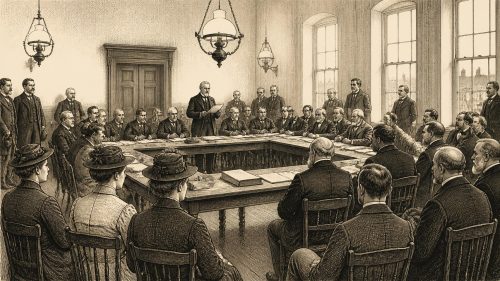
Parish Power
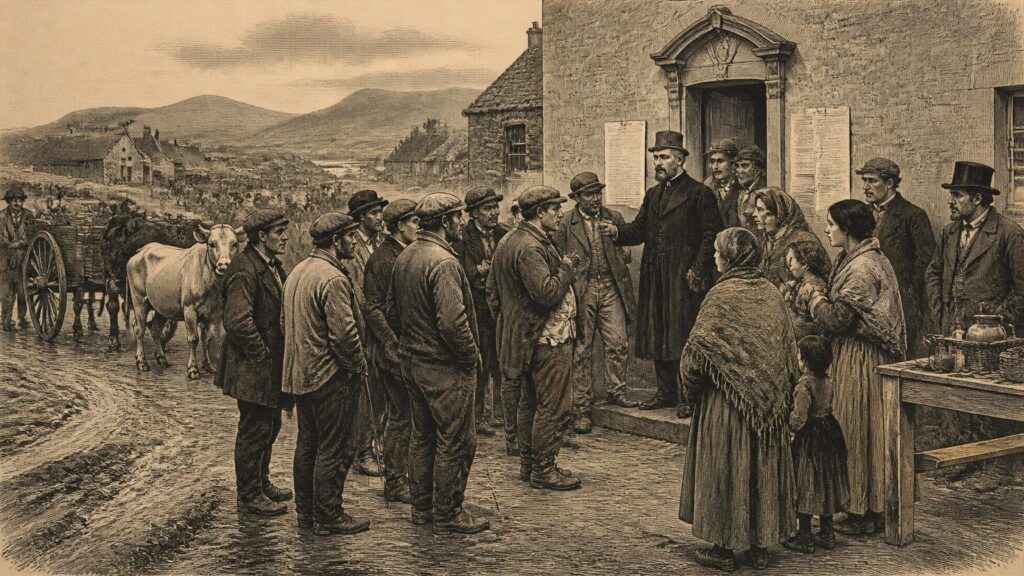
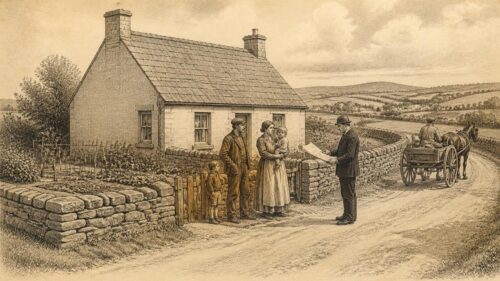
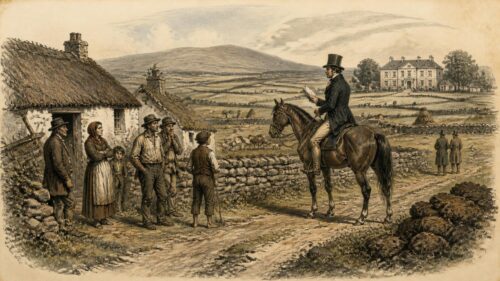
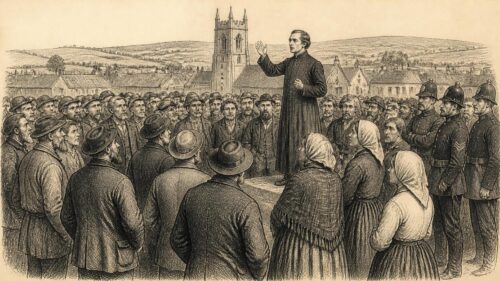
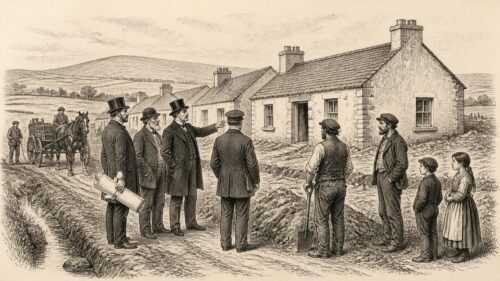
AI generated historical illustration, not a contemporary photograph.
At a Glance
Rural community leadership in Ireland was never simply the story of the person who spoke loudest at a meeting, owned the most land, or held a formal office. It was a shifting practice exercised through households, kin networks, churches, estates, fairs, schools, voluntary associations and public bodies. Authority could rest upon property and patronage, but also upon literacy, religious standing, local knowledge, organisational skill and the capacity to bring neighbours into collective action. Its history therefore reveals both the practical workings of everyday rural life and the larger transformations of conquest, famine, land reform, nationalism, partition and state building.
Local Worlds
To speak of rural Ireland as though it were a single community is misleading. The island contained sharply differing landscapes, farm sizes, languages, religious traditions and relationships to towns. A cattle farmer in east Cork, a cottier in Connemara, a smallholder in Donegal, a Presbyterian flax grower in County Down and a labourer in south Leinster inhabited rural societies connected by common pressures but not governed by identical customs. The townland, rather than the modern village, was often the intimate territorial unit. It named a small district of fields, houses, lanes, bog, shore or mountain pasture; neighbours knew who held which plot, whose children had emigrated, which family had a claim to respectability and where conflict lay beneath apparent agreement.
Leadership worked within these close social worlds. It could be conspicuous, as when a priest, landlord, shopkeeper, schoolmaster or elected councillor acted publicly. It could also be dispersed. Women who organised care during sickness, older people who mediated quarrels, farmers who arranged labour exchanges, and emigrants who remitted money all influenced communal decisions without necessarily appearing in official minute books. Historians must consequently distinguish between recorded office and social authority. Surviving documents tend to preserve the voices of people able to write, pay rates, attend meetings, own property or communicate with government. They tell us much, but not everything, about those who led or shaped rural life.
Nor was leadership invariably benevolent. It could mean coordinating relief, defending a neighbour from eviction or founding a creamery; it could equally mean controlling access to employment, enforcing political conformity, policing moral behaviour or deciding who deserved charity. Rural leaders were often intermediaries between a locality and the outside world. They translated official rules into local practice, carried petitions upwards, distributed resources downwards and, at times, insulated communities from distant authority. The importance of such brokerage helps explain why political contests in Ireland were so frequently fought through local institutions.
Early Authority
The earliest written evidence for Irish political and legal organisation must be handled with care. Medieval law texts were copied and reshaped over long periods, and they do not provide a simple photograph of everyday life at one precise date. They nonetheless indicate that authority in early Irish society was plural. The túath, often rendered as a petty kingdom or people, was a political and legal community whose members owed obligations to a ruler, kin groups and recognised legal specialists. Cattle, land, clientship and honour were central to its social order. Leadership was attached to rank, but it was not identical with absolute command.
The legal material preserved through the Corpus of Electronic Texts at University College Cork points to an order in which kings, ecclesiastical figures, poets and jurists possessed different forms of standing. A king could command military and political allegiance, while learned judges, later called brehons in English usage, interpreted customary law. Churchmen acquired major influence as monasteries and churches became holders of land, centres of learning and places of refuge. The practical consequence was that rural authority could be divided among several recognised figures. A local lord did not govern alone; clerics, learned families and powerful kindreds could constrain, advise or legitimise him.
This should not be romanticised as an egalitarian village democracy. Early Irish society was hierarchical, and dependence on superior households was fundamental. Women’s legal capacities varied with status and circumstance, while enslaved and unfree people stood far outside the political world of elite law. Yet the legal emphasis on compensation, sureties and negotiated settlement suggests a society in which relationships had to be maintained rather than simply ordered from above. Leadership depended upon reputation and the ability to uphold obligations. A ruler unable to protect followers, obtain hospitality, settle disputes or secure prosperity risked losing authority.
Folklore later attached stories of ideal kings, wise judges and heroic chiefs to particular hills, wells and ruins. Such traditions can preserve valuable evidence of how communities remembered place, but they cannot by themselves establish the character of prehistoric or early medieval government. The documented record supports a more modest conclusion: rural leadership had deep roots in local territorial communities, but it emerged through overlapping claims of kin, land, law and religion rather than through a single uniform Irish institution.
Lordship Patterns
The Anglo Norman intervention from the late twelfth century did not replace one neatly bounded Irish system with another. It created a changing mosaic. In some regions, English common law, manorial practices, boroughs, castles and ecclesiastical reform became influential. In others, Gaelic lordships retained substantial autonomy for centuries. Even within lordships, rural people encountered authority through rents, military exactions, tenurial arrangements, customary rights, markets and church structures. The Statutes of Kilkenny of 1366, preserved in an English translation by the CELT project, are evidence not of complete control but of anxiety about blurred identities and competing legal practices.
Gaelic chiefs and Anglo Irish magnates alike required local agents. Stewards, tenants, clergy, hereditary learned families and heads of dependent households carried out much of the work of rule. In this setting, leadership could be hereditary but remained vulnerable to faction, alliance and competition. The rural community was not an autonomous body standing outside lordship. It was often constituted through it: obligations of food, labour, military service and rent connected ordinary households to wider chains of power. Yet local people had room to bargain, evade, migrate, appeal to rival patrons or use customary expectations against their superiors.
The Tudor and Stuart reconquest, plantation and extension of county administration altered these relationships profoundly. English legal forms were extended more widely, land was surveyed and redistributed, and new Protestant landowners, clergy and officials acquired power. In Ulster especially, plantation settlement produced communities in which religion, descent, tenancy and political loyalty became closely interwoven. Elsewhere, Catholic gentry, substantial tenants and clergy continued to exercise local influence despite legal restrictions. The result was not the disappearance of older local ties but their incorporation into a state increasingly concerned with taxation, order and land title.
By the eighteenth century, the rural hierarchy was commonly described through landlord, agent, middleman, tenant and labourer. The categories conceal important regional variation. Some landlords were resident and active in county affairs; others were absentees represented by agents. Some tenants held considerable farms and sublet to poorer occupiers; others survived on precarious patches of land. Leadership among the rural population was therefore often socially divided. A prosperous farmer could represent neighbourhood interests against an estate while also exercising authority over cottiers and labourers. Community spokesmen could be both defenders and disciplinarians.
Parish Influence
The parish became one of the most durable frames through which rural leadership was understood. It was not merely a religious territory. It could shape schooling, charity, social reputation, political mobilisation and patterns of marriage and sociability. The Church of Ireland parish vestry historically carried civil as well as ecclesiastical responsibilities, including local taxation for certain purposes. Roman Catholic parishes, though disadvantaged under the penal laws and without equivalent formal civic powers, nevertheless provided a powerful network of pastoral authority and collective identification.
After Catholic emancipation in 1829, priests were increasingly visible public figures in many rural districts. Their influence did not arise solely from doctrine. They possessed education, access to newspapers and correspondence, connections beyond the locality, and a regular opportunity to address congregations. They might advocate electoral candidates, support schools, organise relief subscriptions, arbitrate disputes or assist emigrants. Daniel O’Connell’s mass politics demonstrated the value of this parish network. Priests helped convene meetings, collect the Catholic rent and link national demands with local grievances.
However, the familiar image of an all powerful priest controlling a passive peasantry is too crude. Clergy depended upon parishioners for income, goodwill and practical cooperation. They disagreed among themselves, and their political interventions could provoke resistance. In mixed or Protestant districts, ministers, Presbyterian elders, Orange organisers and lay notables offered alternative centres of leadership. Moreover, local religious authority interacted with class. A priest from a farming background might share the outlook of stronger tenants; a minister’s influence could be shaped by the interests of a landlord or congregation. Parish power was real, but contingent.
Women’s work was especially important within parish life, though often less visible in formal narratives. Confraternities, charitable visiting, religious fundraising, school committees and household networks created spaces in which women exercised influence. This influence could reinforce clerical priorities, but it could also give women a practical voice in the management of local welfare. Evidence from memoir, parish material and later oral history indicates the importance of such activity, while also warning against assuming that every rural woman participated on equal terms. Age, marital status, property, literacy and respectability affected who could act publicly.
Relief Governance
The nineteenth century brought a major expansion of formal local administration. Before then, the grand jury system, dominated by landowners and magistrates, managed county expenditure on roads, bridges and other works. Presentment sessions brought some local consultation, but participation was tightly restricted. The Poor Relief Act of 1838 created a more systematic structure across Ireland: poor law unions centred on workhouses and administered by boards of guardians. The National Archives explains that the original system comprised 130 unions, with boards combining elected guardians and ex officio magistrates.
These bodies mattered because they made local leadership administrative. Guardians dealt with rates, workhouse admissions, contracts, medical services and relief. Their meetings generated minutes, correspondence and disputes that reveal both the reach and limitations of government. A guardian could become a significant rural figure not because he commanded a private following but because he sat at the junction of local distress and official resources. The franchise was property based and therefore unequal, yet the boards gave certain tenants, merchants and professionals experience of election, committee procedure and public argument.
The workhouse system was widely feared. Admission could separate families, impose discipline and carry social stigma. Its very unpopularity made the actions of local guardians politically charged. Decisions on outdoor relief, medical provision, contracts and the interpretation of regulations could become matters of intense local concern. Leadership in this context involved navigating a bureaucracy headquartered beyond the parish. It also revealed conflicts within communities: ratepayers resisted charges, officials worried about fraud, and the destitute were judged according to moral assumptions about work, family and deservingness.
The material record should not be mistaken for a complete account of rural poverty. Workhouse registers identify people at moments of crisis, not the full texture of their lives. Nor do board minutes directly disclose the views of those unable to attend meetings. They are nevertheless indispensable evidence because they show how rural authority was formalised. The state did not simply impose administration from above. It relied upon local men, and eventually some local women, to make its institutions function.
Famine Authority
The Great Famine exposed the strengths and failures of rural leadership with exceptional cruelty. Potato blight struck a society already marked by land hunger, dependence on seasonal labour, insecure tenure and deep inequality. There was no single Irish experience. Conditions varied by region, resources and access to markets, but the catastrophe placed extraordinary pressure upon landlords, clergy, local relief committees, boards of guardians and state officials. The National Archives’ guide to famine sources records that relief committees were created at county, baronial, parish and electoral division levels in 1846. Their intended membership brought together magistrates, clergy, officials and selected local gentlemen.
Such committees show how government imagined local leadership: respectable, propertied and religious men would identify distress, raise subscriptions, organise employment and distribute food. In practice, competence and commitment varied. Some committees worked energetically; others quarrelled over jurisdiction, subscriptions or access to public works. The archival record preserves disputes over the formation and operation of committees, including disagreements about representation and the distribution of aid. Those conflicts are important. They demonstrate that relief was never a neutral technical process. It involved decisions about whose suffering counted, who possessed authority and how scarce resources should be used.
Clergy often became indispensable intermediaries because they knew parish conditions and could communicate urgent needs. Their presence should not obscure the activity of poorer people themselves. Men and women petitioned, travelled in search of work or food, entered workhouses, appealed to landlords, relied on kin and emigrated where possible. These actions were forms of agency under appalling constraint, not proof that relief structures worked adequately. Leadership during famine was frequently reactive and tragically insufficient. Local knowledge could identify hunger; it could not overcome the scale of crop failure, disease, eviction and inadequate policy.
Later family narratives naturally focus on courage, charity and endurance. Those memories deserve respect, but historians must test them against contemporary correspondence, relief lists, workhouse records and demographic evidence. Folklore may preserve the name of a generous neighbour or cruel agent; documentation can sometimes confirm the event, but sometimes cannot. The famine’s central historical lesson for rural leadership is sobering: communities possessed networks of mutual aid, yet social solidarity was bounded by class, resources and the coercive structures of the time.
Land Agitation
After the famine, the land question became the principal arena in which rural leadership was remade. Population decline, changing agricultural markets, estate indebtedness and the survival of insecure tenures created persistent tension. The Land League, founded in 1879 amid agrarian crisis, transformed scattered local grievance into a mass movement. Ask About Ireland’s account of the Mayo origins identifies the Castlebar meeting of 16 August 1879 and the roles of James Daly and Michael Davitt in establishing the Mayo Land League. National figures mattered, but the organisation depended upon local branches, committees, collectors, speakers and messengers.
Land League leadership was strikingly mixed. Priests, shopkeepers, journalists, tenant farmers, labourers and local nationalists might all participate. The substantial farmer frequently supplied confidence, literacy and money; poorer neighbours supplied numbers and local intelligence. This coalition could be powerful, but it was not free of tension. The interests of a tenant seeking a rent reduction did not always match those of a landless labourer seeking wages or a cottage. To describe the movement simply as peasant unity conceals these differences.
Boycotting became one of the best known instruments of rural collective action. Its force lay in social coordination: a person who took an evicted farm, enforced a landlord’s demands or defied local resolutions might be denied labour, trade and ordinary neighbourly contact. Such tactics could operate without widespread physical violence, though intimidation and violence also occurred during the Land War. The moral language of communal discipline gave local leaders influence, but it also made them responsible for deciding the boundaries of belonging. A movement seeking justice for tenants could impose severe pressure upon individuals judged to be disloyal.
The Land War also trained a generation in organisation. Meetings required chairs and secretaries; funds required treasurers; petitions and reports required writers; prisoners’ families required assistance. Women organised through Ladies’ Land League branches after the suppression of the Irish National Land League, and their work complicates older accounts centred solely on male leaders. Their participation was significant, even though public political authority remained heavily gendered. The campaign’s legacy was institutional as well as emotional: rural people acquired experience in association, negotiation and electoral politics that would shape later local government.
Democratic Councils
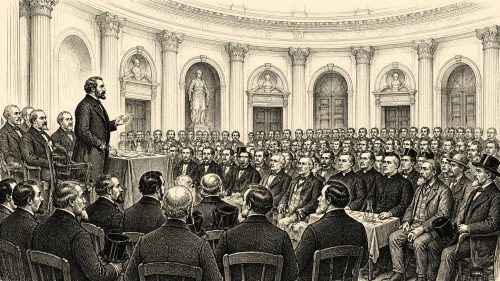
The Local Government Ireland Act of 1898 marked a decisive change in the formal structure of rural leadership. Its text, available through the Irish Statute Book, reorganised county administration and established elected local authorities. The measure abolished the governing functions of grand juries and created county councils, rural district councils and other bodies. It did not create democracy from nothing; poor law elections and earlier local institutions had already accustomed some people to public office. But it greatly broadened the arena in which rural men and women could seek authority through election rather than inherited rank.
County councillors dealt with roads, rates, public works and other matters essential to country life. Rural district councils exercised functions including sanitation and housing, while rural councillors also served as guardians in many places. This made local government unusually close to practical needs. A road could determine access to market; drainage affected farms and homes; a housing scheme could alter the prospects of labouring families. Councils therefore became places where national identities and local material interests met.
The political effects were considerable. In much of Ireland, nationalist farmers, traders, teachers and professionals displaced landlords from leading positions. Yet social change was incomplete. Holding office demanded time, confidence, networks and knowledge of procedure. Local elites changed composition rather than disappearing. The councillor was often a stronger farmer or middle class figure, capable of presenting himself as the voice of the district while retaining considerable personal influence. In unionist areas, especially in the north east, local politics reflected different religious and constitutional alignments.
Women gained an important, though limited, foothold. The franchise arrangements and eligibility rules were restrictive, but women could stand for poor law and rural district offices before they could sit on county councils. The National Archives’ Kerry account records that Anne Rowan, Frances Donovan and Teresa Leonard formed a Women’s Poor Law Guardian committee ahead of the 1898 elections, while Lady Castlerosse was elected in Killarney. These examples do not mean that women’s participation was widespread or socially representative. They do demonstrate that rural leadership was not exclusively male, even within institutions designed in a male dominated political culture.
Cooperative Leadership
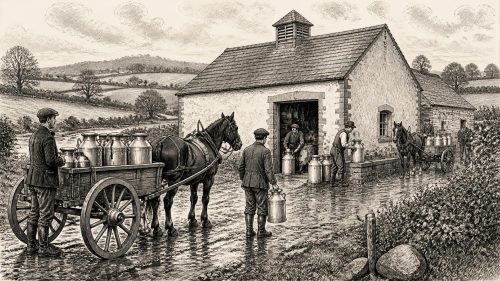
A different model of rural leadership emerged through agricultural cooperation. Sir Horace Plunkett and his allies promoted cooperative creameries, credit societies, purchasing groups and other associations as a means of improving farming, marketing and rural life. The Irish Agricultural Organisation Society was founded in 1894. Its programme was not simply economic. It proposed that farmers should learn habits of collective management, business discipline and self help. A creamery committee or cooperative board created new local offices and demanded skills in accounting, negotiation and technical decision making.
The cooperative movement was sometimes represented by its promoters as a harmonious alternative to politics. The historical evidence is more complicated. Cormac Ó Gráda’s work on Irish agriculture after the Land War notes tensions between the formal leadership of the cooperative movement and Catholic clergy, while also observing strong clerical involvement in many local creameries. There were disputes over control, ideology, credit, commercial risk and the authority of shopkeepers or private traders. Cooperation changed local power; it did not suspend it.
Nevertheless, cooperatives created durable opportunities for collective leadership. Farmers who had been accustomed to selling produce through merchants could become members of societies that owned plant and appointed managers. The relationship between member, committee and expert was never equal in a simple sense, but it involved a more participatory economic structure than private trade alone. Creameries in particular became focal points in many districts, affecting employment, transport, dairy practice and social networks. Their leaders had to balance local loyalties with wider markets and regulations.
The movement also illustrates the difficulty of separating cultural from economic history. Cooperative advocates associated improved farming with education, thrift, temperance, better household management and national regeneration. Critics could regard this language as paternalistic, especially where elite reformers lectured small farmers about modernity. Both interpretations contain an element of truth. The cooperatives encouraged local initiative, but their ideal of leadership often assumed that experts and respectable farmers should guide the wider community.
Revolutionary Claims
The revolutionary years from 1916 to 1923 placed rural leadership under extraordinary strain. Sinn Féin clubs, Irish Volunteers, Cumann na mBan branches, trade unions, Gaelic League circles, local councils and republican courts all competed with or supplemented the authority of the British administration. In many places, the same people appeared in more than one setting: a councillor might be a nationalist organiser, a teacher a cultural activist, a farmer a member of a local republican committee. Elsewhere, loyalties were divided and public participation dangerous.
Dáil Éireann’s attempt to create alternative institutions gave local legitimacy a new political significance. Republican courts, arbitration mechanisms and local fundraising depended on acceptance from those using them. Their effectiveness varied widely. They should not be treated as evidence that British authority vanished from the countryside, nor should they be dismissed as mere symbolism. Their importance lay in showing that rural communities could be asked to recognise an authority created through national mobilisation rather than statute. In practice, acceptance depended on local relationships, intimidation, conviction and the shifting balance of force.
The War of Independence and Civil War made leadership hazardous. Informers, policemen, soldiers, republicans, unionists, officials and ordinary families faced threats whose intensity differed from district to district. Rural people frequently sought to protect households rather than embody ideological purity. This is one reason why later memories can be selective. A family may remember a local commander as a patriot, mediator or provider; another may remember the same person as coercive. Historians need contemporary evidence and multiple perspectives before converting local memory into general judgement.
Partition in 1921 added another decisive divergence. Six north eastern counties became Northern Ireland within the United Kingdom, while the twenty six county Irish Free State was established in 1922. Rural leadership thereafter developed within separate political systems. Shared inherited institutions and family connections remained important, but it is inaccurate to write as though all Irish rural communities experienced the new constitutional order in the same way.
State Management
In the Irish Free State, local government was reshaped during the 1920s and 1930s. Rural district councils were abolished in 1925, reducing one layer of representative local administration. County councils remained important, but the growth of central departments and the later county management system altered the balance between elected representatives and professional administrators. The change did not end rural political leadership. Councillors, party organisers, clerics, cooperative figures and influential farmers continued to mediate between households and the state. It did, however, narrow the range of bodies through which local decisions were made.
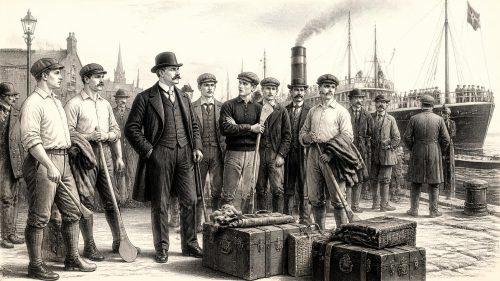
Rural life in the new state was also shaped by emigration, land division, housing schemes, education, electrification and changing agricultural policy. Leadership often involved securing a road, a school improvement, a cottage, a grant or a public service for a district. Such work could be dismissed as parish pump politics, but this phrase understates its significance in communities where public infrastructure was uneven. Patronage and public service were frequently intertwined. A representative who delivered benefits could gain durable loyalty; a community excluded from them could deepen its sense of grievance.
Muintir na Tíre offered another model. Founded by Fr John Hayes in the 1930s, it organised parish based guilds devoted to rural improvement, self help and Christian social principles. Maynooth University research describes its role in rural sociology and community development, including its association with the Limerick Rural Survey of 1958 to 1964. The movement encouraged communities to identify local needs and undertake practical projects. Its language of mutual responsibility appealed in an Ireland concerned about rural decline, but it was also shaped by Catholic social thought and the authority of clergy.
This history invites a balanced assessment. Muintir na Tíre helped establish a vocabulary of community action and created opportunities for local volunteers. Yet its parish centred model could reinforce conservative assumptions about religion, gender and social order. It was not a radical movement aimed at overturning property relations. Its leadership ideal was collaborative but guided: experts, priests and respectable local committees would help rural people improve themselves. That formula reveals both the possibilities and boundaries of mid twentieth century community development.
Gendered Authority
Women’s leadership is easy to overlook because many sources define public action in masculine terms. Electoral registers, council minutes, land agitation reports and cooperative records are often dominated by men. Yet rural households depended on women’s management of food, care, credit, kinship and informal labour. Women maintained correspondence with emigrants, organised religious and charitable activity, participated in cultural organisations and, in particular circumstances, entered formal politics. Their authority might be strongest within family and neighbourhood networks, but those networks had wider economic and political consequences.
During the Land War, women’s branches demonstrated organisational ability in fundraising, propaganda and support for prisoners’ dependants. In the revolutionary era, Cumann na mBan members carried messages, organised supplies, raised funds and participated in political activism, although their work was often later subordinated in public commemoration. In local government, women’s eligibility for poor law and district bodies provided a route into civic affairs before parliamentary equality was achieved. Individual examples should not be inflated into a claim of broad equality; property qualifications, domestic responsibilities and social disapproval remained formidable barriers.
Gender also shaped male authority. The ideal rural leader was often imagined as a household head, a successful farmer, a provider and a defender of family honour. This expectation excluded men without land or secure employment as well as women. It helps explain why leadership could be contested along class lines. Agricultural labourers, smallholders and unmarried people might share a locality but not enjoy equal influence within it. The community was a network of obligations, not a level field.
Folklore and oral testimony can illuminate women’s roles because they preserve domestic and neighbourly knowledge omitted from official records. But they require careful reading. A story passed down decades later may elevate the self sacrificing mother, the charitable mistress or the stern local woman into a moral type. Such accounts tell historians about memory and values; they do not automatically establish dates, motives or representative experience. The strongest history places oral tradition in conversation with letters, newspapers, censuses and institutional records.
Memory Evidence
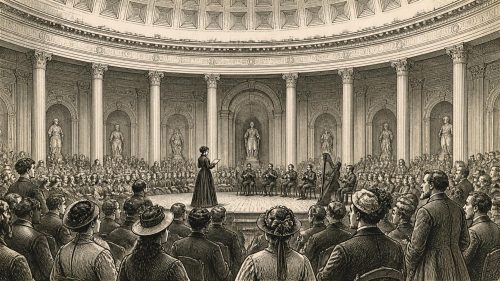
Rural leadership generated abundant memory because it was experienced face to face. A councillor might also be a neighbour, a creamery director, a school manager or a relative. A priest’s sermon, an agent’s decision, a landlord’s visit or a meeting in a hall could remain in family recollection for generations. The National Folklore Collection and the Schools’ Collection, accessible through Dúchas, are valuable for tracing how communities narrated local authority. They contain stories of fairs, faction fights, cures, evictions, local characters and communal labour.
These sources are especially useful when treated as evidence of remembrance rather than as unfiltered records of the past. A tale of a landlord humbled by tenants, for example, may encode a community’s later desire for justice; a story about a wise priest may express religious loyalty; a recollection of a neighbourly labour exchange may contrast an idealised past with present change. The term meitheal is often used to evoke cooperative labour among neighbours. It reflects a real tradition of reciprocal help, but it should not be turned into proof that rural society lacked conflict, hierarchy or exclusion.
Documentary evidence has its own silences. Census returns can reveal household composition, literacy, occupation, religion and language, but they do not measure influence directly. Griffith’s Valuation records occupiers, lessors and property values, helping to reconstruct the unequal geography of landholding, but not every informal arrangement within a family. Poor law minutes record institutional decisions, not every private act of assistance. The historian’s task is therefore cumulative: compare records, identify whose voice survives, and avoid making the best documented people appear to have been the only important ones.
Interpretation is unavoidable, but it should be declared by method rather than asserted as certainty. It is reasonable to infer that a farmer repeatedly elected to public office possessed local standing; it is less safe to infer universal affection. It is possible to show that a priest led a meeting; it is not always possible to know whether every attendee agreed. Rural leadership was relational. Its meaning lay in the response of neighbours as much as in the claims of the leader.
Historical Balance
Across the long history of rural Ireland, leadership moved from kin based and lordly forms of authority towards a more complex mixture of electoral office, religious influence, voluntary association, economic cooperation and state administration. This was not a smooth march towards democracy. Older hierarchies survived within newer institutions; land, wealth, gender and religion continued to shape who could speak and be heard. Nor did formal representation eliminate the need for informal brokers. The person who knew how to draft a letter, approach a department, interpret a regulation or convene neighbours remained influential.
Colonial government formed a crucial part of this story. The poor law, county administration, land legislation and policing were established within the United Kingdom of Great Britain and Ireland, and their local operation cannot be detached from unequal power between Ireland and Westminster. Yet Irish people did not merely receive institutions passively. They contested them, used them, altered their personnel and made them vehicles for national or local ambitions. The Land League and the county councils show how rural organisation could turn administrative experience into political power.
At the same time, rural community leadership cannot be reduced to nationalism. A community might unite around a road, a creamery, relief for a bereaved family or a school while disagreeing deeply about constitutional politics. Protestant, Catholic, unionist, nationalist and republican traditions each produced local leaders, as did occupational and class interests. In the north after partition, and in the Free State thereafter, these identities developed under distinct political conditions. A responsible account must retain that diversity rather than treating one regional experience as the national norm.
The enduring significance of rural leadership lies in its proximity. Decisions about land, food, housing, education, welfare and public works were lived at the scale of households and townlands. Leaders could empower neighbours by creating institutions through which they acted together; they could also dominate them by controlling information, access and respectability. Ireland’s rural past is therefore not a tale of either communal harmony or unbroken oppression. It is a history of negotiation, conflict, service and power, conducted in places where public life and private life were rarely far apart.