Thomond Bard
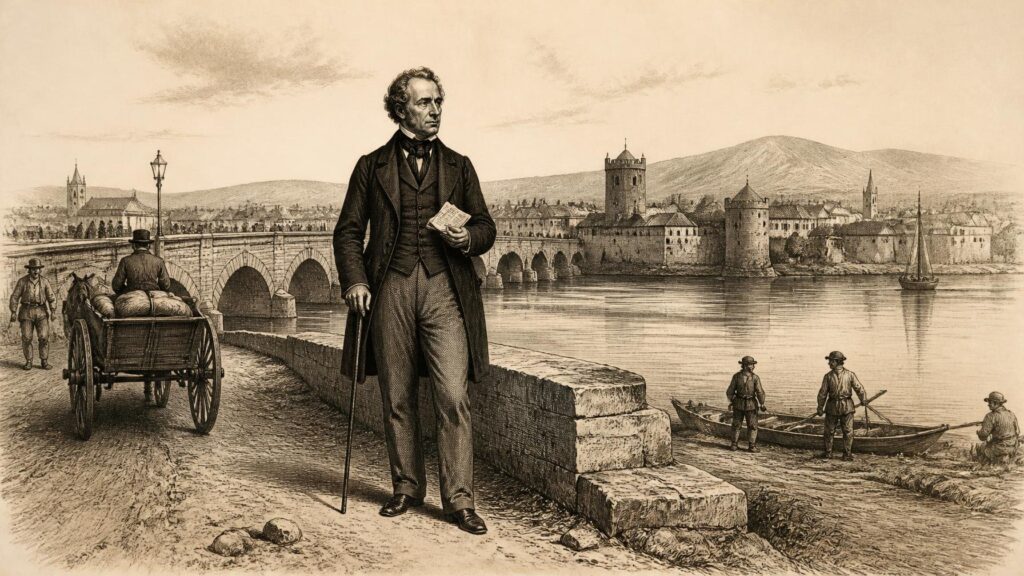
AI generated historical illustration, not a contemporary photograph.
At a Glance
Michael Hogan, the nineteenth century Limerick poet popularly called the Bard of Thomond, was neither a medieval court bard nor a relic of an unbroken hereditary office. He was a working writer of the printed age: a wheelwright’s son, labourer, ballad seller, satirist, local historian, nationalist sympathiser and difficult public personality. His reputation rested on an unusual ability to turn the streets, bridges, taverns, legends, elections and remembered wrongs of Limerick into verse that could be read aloud, sold cheaply and retained in local memory.
Names Settled
The direct answer to the question is Michael Hogan. Contemporary and near contemporary records, later catalogues and the Dictionary of Irish Biography identify him as the poet known as the “Bard of Thomond”. The title appears not merely as a compliment bestowed long after his death but as a public literary identity attached to him during his lifetime. In a letter of 1892 preserved among the D. J. O’Donoghue papers at University College Dublin, Hogan used the designation in correspondence concerning his work. National Library of Ireland archival descriptions likewise refer to “The Bard of Thomond” as Hogan’s alias in the papers of the Inchiquin family.
That clarity matters because “bard of Thomond” can mislead. Thomond, the historic northern division of Munster, had long been associated with learned families, hereditary poets, genealogists and patrons. In early modern Clare, professional Irish poets such as members of the Mac Bruaideadha family worked within systems of aristocratic patronage that historians properly describe as bardic. Nineteenth century writers also sometimes invoked inherited bardic language for local schoolmasters and poets. The phrase was therefore available as a romantic honour long before it became firmly associated with Hogan.
Hogan’s title should consequently be understood in its nineteenth century setting. It announced a poet whose imagined constituency was Thomond: Limerick city, County Clare, the Shannon corridor and the cultural landscape attached to the old O’Brien country. It did not establish that he held an official medieval-style office, nor does it show descent from one of the learned dynasties. It was a popular designation, cultivated through print, performance and local recognition.
The ambiguity is compounded by the survival of conflicting biographical dates. Older accounts, including a biographical sketch published during Hogan’s lifetime, give 31 October 1828 as his birth date. The Dictionary of Irish Biography, drawing on later reference work and archival research, gives 1 November 1832 at Thomond Gate, Limerick. A responsible account cannot silently turn one version into certainty. The documentary record is firmer on Hogan’s mature literary career than on the exact date of his birth. What is beyond reasonable dispute is that he belonged to nineteenth century Limerick and died there on 19 April 1899.
Thomond Meaning
To grasp the force of Hogan’s chosen identity, it is necessary to understand what “Thomond” meant to his readers. The Irish term Tuamhain, usually anglicised as Thomond, referred historically to the northern part of Munster. It was closely linked with the O’Brien lordship and later earldom, and broadly embraced much of present-day County Clare with territories around Limerick and north Tipperary at differing periods. Its boundaries and political meaning altered over centuries; it should not be treated as a modern county with fixed administrative limits.
By Hogan’s day, Thomond was as much a cultural territory as a constitutional one. It evoked the Shannon, Thomond Bridge, Limerick’s northern approaches, Clare’s castles and abbeys, the remembered O’Briens, and a reservoir of Gaelic and Catholic historical sentiment. The word also allowed an urban writer to speak for a region wider than the city where he lived. Hogan could place a humorous Limerick anecdote beside a story of a ruined monastery, an O’Brien legend or a political grievance, and call all of it Thomond.
This was an age in which local history was being eagerly collected, printed and contested. Antiquarian societies, newspapers, schoolbooks, popular lectures and cheap pamphlets circulated stories that moved freely between historical evidence and folklore. Hogan’s readers did not necessarily demand the sharp division between archive and legend expected of modern historians. A place might be important because an annal recorded it, because an old person repeated a story about it, because a graveyard contained a monument, or because it served a political moral in a poem.
Hogan’s title therefore made a claim of local interpretation. He was presenting himself as a voice for a historic country rather than as a detached scholar. His verse frequently made that claim through familiarity: he named streets, bridges, public houses, local officials, well known families and remembered characters. The method gave his work immediacy. It also means that his historical notes must be used with care. They are evidence for nineteenth century Limerick memory and literary culture even where their accounts of earlier centuries cannot be independently confirmed.
Early Circumstances
Michael Hogan was born at or near Thomond Gate, the northern entrance to old Limerick. The location later became central to his public image. Thomond Gate stood near Thomond Bridge, a crossing that connected the city with Clare and carried traffic, trade, migrants and stories. To be a poet of Thomond Gate was to stand at a symbolic threshold between city and region. Hogan’s identity was therefore geographical from the beginning, at least in the way he and later admirers presented it.
His father, Arthur Hogan, was a wheelwright, cabinetmaker and carpenter. The older biographical notice also describes him as a musician who made and played instruments. Such details suit the domestic world from which the poet emerged: craft labour, household music, oral entertainment and practical skill. They should not be inflated into proof that Hogan inherited a formal folk tradition. Yet they help explain why he later wrote for audiences who valued song, recitation and familiar local speech as much as literary polish.
Accounts agree that his formal schooling was limited. One early sketch tells of a disruptive schoolboy who lampooned fellow pupils and teachers, was dismissed, and taught himself to read through painstaking imitation of printed letters. This is memoir-like material, and its comic shape may have been encouraged by Hogan himself. It should be treated as self-fashioning as well as biography. Still, the broad picture accords with his later career: he was not a university-trained man of letters but a self-educated writer who mastered the practical routes through which ordinary readers encountered print.
He trained or worked briefly as a wheelwright but, according to the Dictionary of Irish Biography, abandoned the trade when it no longer offered adequate employment. He subsequently worked as a labourer at a local mill. The distinction is important. Hogan’s reputation as a “people’s poet” did not arise solely from rhetoric. He knew insecure work and the limited resources of an artisan household. His publishing career was never insulated by a salary, inherited property or secure institutional appointment.
He also came of age in the shadow of the Great Famine. The famine was not an abstract national tragedy to a Limerick working family; it reshaped employment, migration, charity, housing and public argument. Hogan later wrote of Irish deprivation and displacement, but he was not primarily a documentary chronicler of famine conditions. His verse converted public suffering into nationalist feeling, moral accusation, satire and lament. It is most useful as evidence of how a popular poet framed the era’s social memory, rather than as a substitute for relief records, census evidence or official correspondence.
Printed Beginnings
Hogan began composing verse early, initially, it seems, as amusement among friends and as a weapon against enemies. Satire was one of the most accessible forms available to a writer without patronage. A pointed local rhyme could be repeated in a workplace, at a fair, in a public house or in a street before it reached a printer. Humour allowed a poet to address authority while retaining the defence that he was merely entertaining an audience.
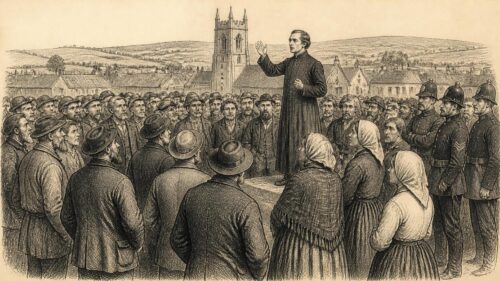
His first separately published work, The Light of Munster, appeared in pamphlet form in 1852. The Dictionary of Irish Biography records his own account that he travelled through the south-west selling copies in market towns. Such itinerant sale was a crucial part of nineteenth century literary life. A pamphlet was not simply a text sent into an impersonal book trade; it was an object carried, displayed, recommended, sung from and paid for directly. The author could meet his readers, explain his subject and turn the performance of authorship into an advertisement.
The available evidence does not permit a complete reconstruction of every edition, printer, print run or route Hogan used. Nor should later admirers’ claims of universal popularity be accepted untested. What can be said is that he worked persistently through inexpensive print and local periodicals. His poems appeared in papers including the Nation, the Irishman and the Celt, and he used the signatures “Thomond” and “M. H. Thomond”. These pseudonyms show that the regional persona was not a title retrospectively fixed upon him; it formed part of his active authorial presentation.
The newspaper world offered both opportunity and danger. Editors could provide a readership beyond Limerick, but payment was uncertain and publication depended on political sympathies, space and personal relations. A poem printed in a nationalist paper might travel widely without making its author secure. Conversely, a local squib could provoke a durable personal quarrel. Hogan’s later career demonstrates both sides: visibility, affection and notoriety did not protect him from financial hardship.
His language was English, though it was an English steeped in Irish place names, idiom and historical reference. This point distinguishes him from an older Gaelic learned tradition while still locating him within Irish cultural continuity. He was not reviving classical Irish metres in the manner of an eighteenth century Irish-language poet. He was writing popular English-language verse for a society in which Irish speech, Hiberno-English, nationalist print culture and antiquarian interest overlapped.
Legendary Lays
Hogan’s best known book was Lays and Legends of Thomond. A first collection appeared in Limerick in 1861, while a substantially enlarged edition was issued in Dublin in 1867; later versions and reprints extended its afterlife. The book gave concrete form to the identity implied by “Bard of Thomond”. Its very title promised songs, narratives, place lore and an inherited regional past.
The work should not be mistaken for a systematic history of Thomond. Hogan arranged poems and accompanying notes in a manner designed to entertain and instruct. He drew on local traditions, received antiquarian lore, published histories, political memory and personal observation. His notes sometimes preserve names or variants of stories that might otherwise have remained obscure. At other times, they reproduce the confident tone of nineteenth century historical romanticism without giving modern readers enough evidence to verify an assertion.
That mixture is not a defect to be concealed. It is the key to the book’s significance. Hogan was operating at the meeting point of folklore and print. Folklore is not necessarily false: it can preserve historical memory, place association, social values and narrative patterns. But it needs to be identified as folklore rather than converted automatically into fact. Likewise, a historical note in a nineteenth century poem may rest on a genuine source but still simplify chronology, exaggerate a local figure’s importance or repeat a long-standing error.
Hogan’s approach made the regional past emotionally available. Ruined abbeys, castles, old families and river crossings were not inert antiquities; they became scenes of courage, loss, comedy and betrayal. In this respect he anticipated the later appetite for heritage writing, though he worked in a far less professionalised historical environment. His readers could purchase a volume that made their district seem full of narrative meaning.
The reception of Lays and Legends of Thomond helped establish his title. Clare Libraries has described the collection as earning him the name Bard of Thomond, while literary catalogues routinely place the phrase beside his name. This is a reasonable summary, provided it is not understood too mechanically. A title is not created by a single book alone. Hogan’s newspaper signatures, public dealings, local performances, satirical reputation and the book’s regional framing all reinforced one another.
Francesca Wilde, mother of Oscar Wilde and a writer deeply involved in Irish folklore and nationalist cultural discussion, reportedly admired Hogan’s work. The fact is revealing even without making extravagant claims about her influence. It shows that a Limerick popular poet could attract notice from figures in the wider Irish literary world. Yet Hogan’s enduring audience remained regional. His strongest legacy was not a place in a narrow metropolitan canon but continued recognition among people for whom Thomond was home, memory and imaginative territory.
Comic Power
Comedy was Hogan’s most dependable strength. His verse could be rough, expansive and occasionally merciless, but it had an ear for the anecdote that readers wanted to repeat. He made local personalities into comic types and turned civic affairs into material for mock epic treatment. The technique depended on recognisability. A reader who knew Limerick streets, offices and reputations could enjoy layers of implication unavailable to an outsider.
Among the works associated with this side of his career was Shawn-a-scoob, a lengthy and continuing satire directed at the lord mayor of Limerick. The Dictionary of Irish Biography dates its run from 1868 to 1876. A sustained lampoon of a civic figure required stamina and a willing audience; it was not a single casual joke. Hogan’s satire made public office vulnerable to public laughter, but it also exposed the poet to resentment. In a close city, the targets of verse were people a writer might encounter in the street.
His comic narrative concerning Drunken Thady and the Bishop’s Lady has also survived in Limerick memory and in later editions. It is often described as a legend of Limerick. The word “legend” here should be read in its literary sense: a story shaped for comic effect, not a verified report of an actual episode. The survival of such work demonstrates the durable local life of Hogan’s storytelling, but historians should resist using its characters or incidents as straightforward evidence for social events.
Hogan’s comic method had a democratic quality. He did not write primarily for readers trained in classical allusion or elite literary taste. He used recognisable speech, exaggeration, nicknames, reversals and local scandal. This could make his work seem parochial to critics seeking refinement. It was precisely what made it portable. The verse could live in a pamphlet, a newspaper clipping, a kitchen, a workshop or a public house.
There is, however, a limit to celebrating satire as harmless popular rebellion. Mockery can deepen personal animosities, preserve unfair caricatures and reduce complicated people to types. Hogan’s unpublished autobiography, written late in life, is said to contain fierce attacks on family members, publishers and prominent Limerick citizens. That manuscript image of the injured, combative author fits the public satirist. It also cautions against treating every quarrel in his poems as a transparent contest between an honest poet and corrupt opponents.
National Feeling
Hogan was openly nationalist. His poems and periodical connections placed him within a nineteenth century Irish public culture in which historical memory, Catholic identity, tenant grievance, constitutional politics and Fenian sympathy often overlapped. The exact political meaning of nationalism varied from reader to reader. Hogan should not be assigned a precise programme merely because he used patriotic language. His verse was shaped by broad national feeling as well as by particular local disputes.
His friendship with John Daly is one of the clearest documented political associations. Daly, a Limerick Fenian, spent periods in prison in England, and the Dictionary of Irish Biography notes their correspondence during his imprisonment in 1884. This evidence establishes a connection between the poet and a prominent republican activist. It does not prove that every Hogan poem was Fenian propaganda, nor that the poet belonged to a particular secret organisation. The distinction matters because later memory often simplifies all nineteenth century nationalist writers into direct political operatives.
Hogan’s nationalism was literary and memorial as much as organisational. He used stories of the old Gaelic past, suffering Ireland, local dignity and English misrule to create a moral community among readers. His work was part of the same general environment that made songs, commemorations, histories and newspapers politically potent. A poem could recruit feeling without instructing a reader how to vote or act.
The political uses of historical memory also explain why Thomond suited him so well. The region’s association with the O’Briens, Clare and Limerick offered a past that could be made honourable, wounded and still present. Historical detail in such writing is rarely neutral. A ruined castle can signify dispossession; an old battle can imply resilience; a local hero can stand for a broader people. Hogan’s poems should therefore be read not only for what they say about the past but for what nineteenth century readers wanted the past to do.
His work also reminds us that Irish nationalism was not solely produced in Dublin. Provincial cities and market towns possessed their own presses, reading rooms, political networks and performance traditions. Limerick’s strategic place on the Shannon, its commercial life and its connections with Clare and Munster made it a fertile setting for a poet who could speak in regional terms. Hogan’s public was local, but local did not mean isolated.
Public Persona
The Bard of Thomond was a persona as well as a person. Hogan’s use of “Thomond” in signatures and titles transformed geography into authorship. It allowed him to appear as the representative voice of an old country while retaining the immediacy of a known Limerick individual. The title could be solemn when he wrote of history and comic when he ridiculed a civic target.
There was a commercial dimension to this identity. A memorable title made a poet easier to advertise, introduce and remember. It could appear on a prospectus, a pamphlet, a newspaper notice or a letterhead. In an age when writers without major publishers needed readers to recognise them quickly, “Bard of Thomond” functioned almost as a brand. This does not make it insincere. Nineteenth century writers commonly joined conviction and self-promotion; the two were often inseparable.
The title also drew prestige from the older Irish idea of the bard. By Hogan’s time, “bard” was a flexible English word. It could mean an accomplished poet, a singer of national memories, a local versifier or an heir in spirit to Gaelic learned culture. Hogan’s readers were unlikely to require a technical distinction between a medieval fili, an early modern court poet and a Victorian balladeer. Modern scholarship must make those distinctions, but it should also acknowledge why the looser word had emotional power.
His career illustrates the difference between popular esteem and material security. A man might be celebrated as a regional bard while continuing to sell his own pamphlets, appeal for patronage and work in other employment. The title itself reveals no settled income. Indeed, Hogan’s later hardships show how precarious authorship could be for a writer whose fame depended upon small sales and local goodwill.
There is evidence that he sought patronage from the Inchiquin family. A National Library description records a letter from “The Bard of Thomond”, identified as Michael Hogan, to Richard Bagwell in October 1877 seeking support for a new poetic work. The episode is revealing. A poet celebrating the old territory of the O’Briens still had to seek assistance from wealthy and influential people connected with its historical elite. Romantic regional identity did not abolish economic dependence.
American Passage
In September 1886 Hogan emigrated to New York. The move belongs to a vast history of Irish migration, but it should not be made typical without qualification. Many Irish emigrants travelled because of necessity, kinship networks or prospects of work. Hogan travelled as a poet already known in Limerick, with eyesight beginning to fail and a reputation that did not translate readily into economic security abroad.
New York was full of Irish people, Irish newspapers, political societies and entertainment venues. That fact might seem to promise an audience for a nationalist poet from Limerick. Yet emigrant communities were not automatically charitable markets for every visiting writer. They contained many competing causes, performers and demands on limited money. The Dictionary of Irish Biography states that Hogan failed to earn a living as a poet and quickly encountered financial difficulty.
His experience complicates the comforting idea that cultural reputation naturally travels with the emigrant. Hogan’s authority had been rooted in a highly particular place. He knew the civic lore, nicknames and micro-geography of Limerick; his title invoked Thomond; his satire relied on local targets. In New York he may have found sympathetic Irish listeners, but the conditions that had made him indispensable at home were weakened.
Friends in Limerick assisted him, and he returned in 1889. The fact of assistance suggests the durability of his personal network and the affection in which he was held by at least some contemporaries. It should not be romanticised as unanimous civic devotion. Hogan’s later writings and recollections indicate that he maintained bitter disputes. Nonetheless, the rescue from financial difficulty confirms that the Bard of Thomond was more than a literary label: it marked a relationship between a poet and a local public that could mobilise aid.
After his return, Limerick Corporation employed him nominally. The arrangement is sometimes described in ways that imply a simple municipal reward for literary merit. The available evidence supports a more restrained reading. It gave a financially vulnerable and increasingly infirm local figure some support. It also indicates that his fame had become a civic concern. The city that had provided material for his poems became, in a limited sense, his benefactor.
Final Years
Hogan’s later years were marked by failing eyesight, limited means and a growing sense of grievance. Such conditions could sharpen the resentments already visible in a satirist’s career. The unpublished autobiography attributed to him reportedly castigated relatives, publishers and prominent citizens. Since the manuscript is not a neutral record, its claims require corroboration before being used against the people it names. Its significance lies partly in what it says about Hogan’s self-understanding: he saw himself as a neglected poet surrounded by inadequate allies and hostile critics.
He had married Anne Lynch of Limerick in June 1858. The Dictionary of Irish Biography says that they appear to have had no children. The cautious wording is appropriate. Absence from a surviving record is not proof of absence in every aspect of family life, but there is no reliable basis for inventing descendants or domestic scenes. The modern temptation to complete a poet’s story with sentimental detail should be resisted.
Hogan died in Limerick on 19 April 1899 and was buried in Mount St Laurence cemetery. His death ended a career that had spanned the growth of popular nationalist journalism, the expansion of cheap print, the rise of civic satire and the continuing reinvention of Ireland’s regional past. Obituaries and later reminiscences preserved the Bard of Thomond identity, though they did not always preserve biographical facts consistently.
His grave and memorial history became part of the story. University of Limerick Special Collections holds records relating to a later Bard of Thomond Memorial Committee, including correspondence concerning the destruction of an earlier monument in St Lawrence’s graveyard, fundraising and the installation of a replacement memorial. Such records show that remembrance was active rather than automatic. Monuments deteriorate or are damaged; committees must raise money; local memory needs institutions as well as affection.
The survival of his books, letters and archival references likewise depended on collectors, librarians, editors and family or civic advocates. A popular writer can disappear quickly if pamphlets are not kept. Hogan’s case is fortunate but incomplete. Much survives to show the scale of his activity, yet gaps remain in print history, correspondence and the exact circumstances of composition. Those gaps are reasons for caution, not invitations to fill them with picturesque invention.
Historical Value
What, then, is Hogan’s place in Irish history? He was not among the most formally celebrated poets of his century, and he cannot be made into one merely by repeating his title. His importance lies elsewhere. He demonstrates how literary culture worked beyond elite institutions: through market-town sale, small pamphlets, local papers, comic verse, personal networks and a readership that valued regional recognition.
He is also valuable as a witness to the uses of local history. In Lays and Legends of Thomond, history and folklore do not sit in separate compartments. They are braided together to create a usable regional inheritance. Modern readers must disentangle them where possible, comparing claims with annals, estate papers, archaeological evidence, parish records and scholarly research. But the blend itself is historically meaningful. It reveals how nineteenth century readers encountered the past: not solely as chronology, but as a living repertoire of places, personalities and morals.
His satirical work opens another window. Municipal politics can be hard to reconstruct from formal records alone because official minutes rarely preserve the tone of public mockery. Hogan’s verses show how civic figures could be judged in street-level language. They are partisan and exaggerated, of course, but that is precisely their value. They tell us that authority was performed before an audience capable of laughing, repeating and remembering.
His nationalist associations further complicate the story. Hogan was not simply a harmless entertainer; his friendship with John Daly and his publication in nationalist journals locate him in political culture. Yet he should not be reduced to a slogan writer. Comedy, legend, personal quarrel, antiquarian curiosity and commercial need shaped his output beside patriotic conviction. His literary identity was broad enough to hold all of these elements.
Finally, Hogan offers a corrective to the idea that Irish cultural memory flows only through canonical books or national institutions. Limerick remembered him through local print, oral recollection, graves, committee work, library catalogues and later editions. His reputation endured because his work attached itself to identifiable places. Thomond Bridge, Thomond Gate, the Shannon and the wider Clare-Limerick world gave readers a map on which to place the Bard.
Lasting Memory
Michael Hogan remains the most secure answer to the question “Who was the Bard of Thomond?” The designation is supported by biographical scholarship, archival catalogues, library records and the history of his own publications. He was a Limerick poet whose regional persona became inseparable from his name.
Yet the title should be handled accurately. Hogan was a nineteenth century English-language popular poet, not a documented holder of an ancient courtly bardic office. He wrote after the old systems of Gaelic aristocratic patronage had been transformed beyond recognition. His relation to earlier Thomond literary culture was imaginative, commemorative and symbolic rather than institutional.
That does not diminish him. On the contrary, it explains his distinct achievement. Hogan took the prestige of the bardic past and adapted it to the practical world of newspapers, pamphlets, street sales and civic controversy. He made himself a bard for a public that did not require a castle patron or a learned academy. His patrons were readers, listeners, subscribers, friends and, at difficult moments, the city that remembered him.
For historians, his legacy is best approached with double attention. The poems deserve enjoyment for their humour, colour and attachment to place. Their historical assertions deserve checking. Their folklore deserves respect without being confused with proof. Their political tone deserves context rather than either dismissal or uncritical celebration. Read in that way, the Bard of Thomond becomes more than a colourful local nickname: he becomes an illuminating figure in the history of Irish popular literature and regional memory.