Constitutional Ireland
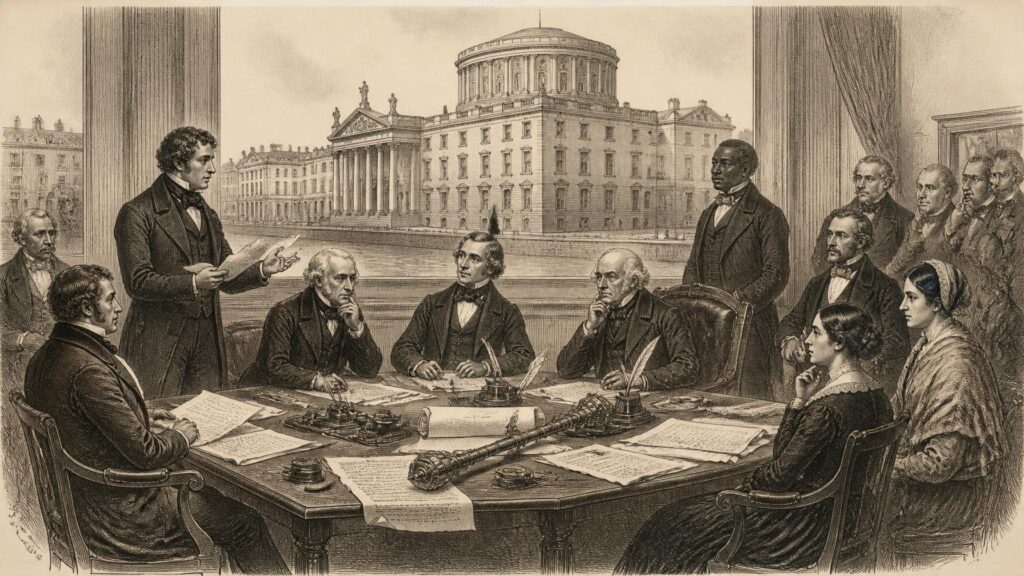
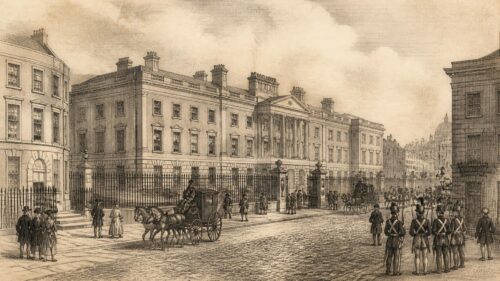
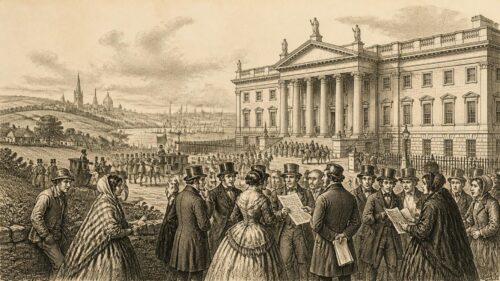
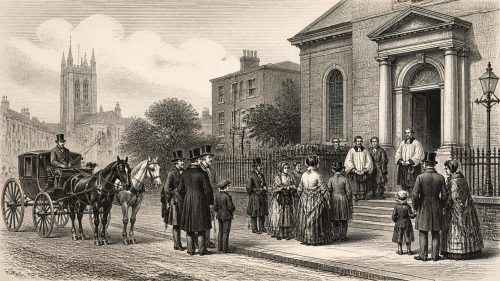
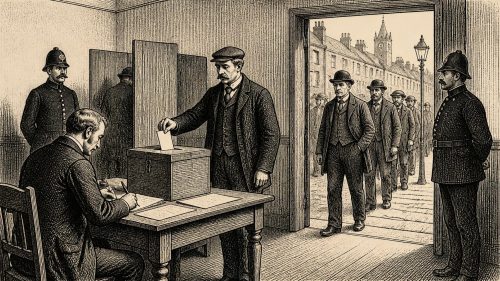
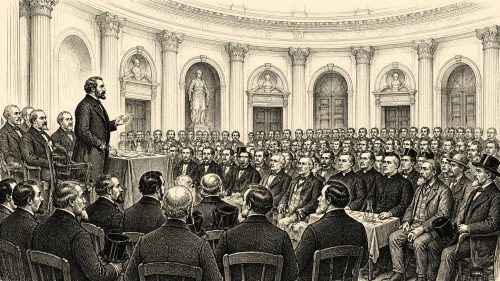
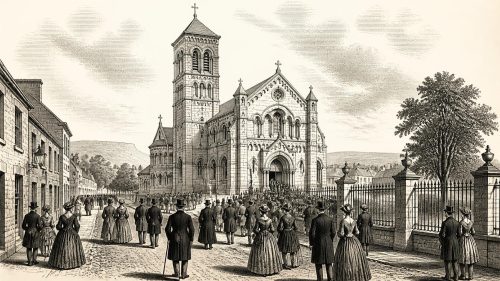
AI generated historical illustration, not a contemporary photograph.
At a Glance
Ireland’s constitutional history is not a single march towards a finished national settlement. It is a record of competing sovereignties, changing ideas of representation and citizenship, and recurrent arguments over the relationship between law, religion, territory and democratic authority. From the eighteenth-century parliament in Dublin to the popular referendum that approved Bunreacht na hÉireann in 1937, constitutional documents were both products of political struggle and instruments through which later struggles were conducted.
Constitutional Meaning
A constitution may be understood in two connected senses. It can mean the broad arrangement of political power: who makes law, who administers it, who judges disputes, and which institutions may restrain the others. It can also mean a particular authoritative text. Ireland has known both kinds of constitution. Before independence, constitutional questions concerned the legal relationship between Ireland and Great Britain, the authority of the Westminster Parliament, the position of the Crown and the rights of local institutions. Since the creation of the Irish Free State, written constitutions have supplied a more visible framework for public life.
Such texts should not be mistaken for neutral descriptions of a society. They select principles, omit others and often preserve deliberate ambiguity. A constitution may declare popular sovereignty while leaving practical power with a limited electorate. It may promise equality while permitting social arrangements that produce unequal results. It may express national aspiration while the State exercising authority under it governs only part of the island. The history of Irish constitutionalism is particularly clear on this point: the written law repeatedly carried hopes which political conditions could not immediately fulfil.
There is also a distinction between what the documentary record can show and what later generations have wished the documents to mean. The surviving statutes, drafts, Cabinet papers, Dáil debates, court decisions and referendum returns establish dates, wording and formal procedures. They do not always reveal private motives with certainty, nor do they settle modern moral judgements. Popular recollections of a constitution as the instant achievement of complete independence, or as the work of one heroic author, simplify a more difficult history. The Constitution of 1937 was certainly associated with Éamon de Valera, but it was prepared through sustained work by officials and lawyers, debated in the Oireachtas and put before the electorate. The Constitution of 1922, similarly, arose from a treaty settlement, internal Irish drafting, British intervention, civil conflict and constituent authority.
Parliamentary Origins
The constitutional history of modern Ireland cannot sensibly begin in 1922. For centuries the island had possessed a parliament, but it was not a sovereign national legislature in the modern democratic sense. The medieval and early modern Irish Parliament operated within the English, and later British, political system. Its membership was confined to a narrow social and religious elite; Catholics were excluded from Parliament for long periods, while the executive remained answerable principally to the Crown and its representatives rather than to an Irish electorate.
Poynings’ Law, passed in the late fifteenth century, became a lasting symbol of constitutional subordination. In simplified form, it required proposed Irish legislation to receive approval through English government channels before being introduced in the Irish Parliament. The exact operation of the measure changed over time, but its political meaning was powerful: Irish legislative action was subject to external control. The eighteenth-century Patriot movement, associated above all with Henry Grattan, attacked this dependence. Its language did not anticipate modern republican democracy; many of its leading advocates were Protestant members of the established political order. Yet it supplied a vocabulary of legislative independence which later nationalists could adapt.
The constitutional concessions of 1782 are often described as the achievement of “Grattan’s Parliament”. That label is useful but incomplete. The Irish Parliament gained an enlarged freedom from British legislative interference, including relief from the most conspicuous effects of Poynings’ Law and recognition that legislation for Ireland should arise in Ireland. The arrangement remained limited. The Crown retained an important executive role; the franchise remained exceptionally narrow; and the political community represented in College Green was overwhelmingly Protestant and propertied. Catholic relief developed unevenly, and the great majority of the population had little direct political voice.
Nevertheless, the constitutional experience of the 1780s mattered. It demonstrated that Irish institutions could become the focus of a claim to self-government, while also exposing the social limitations of that claim. Later nationalist memory sometimes treated the parliament as a lost national legislature extinguished by the Union. Unionist and imperial accounts, by contrast, stressed its restricted franchise and dependency on the British connection. Both observations contain truth. The parliament was neither a modern democratic national assembly nor a constitutional irrelevance. It was an Irish legislature with real, though constrained, importance.
Union Settlement
The rebellion of 1798, the international danger posed by revolutionary France, sectarian violence and British fears for security transformed the constitutional question. The Acts of Union, enacted in 1800 and taking effect on 1 January 1801, abolished the separate Irish Parliament and incorporated Ireland into the United Kingdom of Great Britain and Ireland. Irish representation moved to Westminster. The Union did not end Irish political activity; rather, it changed its constitutional theatre and made reform of the Union a central political issue for more than a century.
The Union was not adopted under conditions that later generations would regard as a full democratic choice. The electorate was narrow, political patronage was extensive and contemporary accusations of pressure and purchase have a substantial place in the historical record. Yet it was enacted by the legal institutions then recognised by the state. That combination explains why constitutional arguments after 1801 were so persistent. Repealers could present the Union as politically illegitimate or nationally damaging, while its defenders could point to its statutory enactment and to the integrated parliamentary order it created.
Daniel O’Connell’s campaign for Catholic Emancipation and later repeal of the Union placed constitutional action at the centre of mass politics. Emancipation in 1829 altered eligibility for parliamentary office, but it did not create democratic equality. Property qualifications and restrictive voting rules remained powerful. O’Connell’s later Repeal movement sought restoration of an Irish legislature while retaining a connection with the Crown. His constitutional programme was therefore neither separatist republicanism nor contentment with the Union. It was an argument for a reconstituted relationship within the monarchy.
The nineteenth century also showed the limits of constitutional agitation under imperial authority. The Great Famine exposed the consequences of administrative power exercised from Westminster and Dublin Castle, while land reform created new forms of political mobilisation. Parliamentary nationalism, Fenian republicanism, tenant activism and unionism all offered different answers to the question of who should govern Ireland. The point was not simply whether there should be an Irish legislature. It was whether constitutional reform could reconcile communities with profoundly different national, religious and economic interests.
Home Rule
Home Rule became the principal constitutional proposal of late nineteenth- and early twentieth-century Irish politics. Under the leadership of Isaac Butt and Charles Stewart Parnell, the demand was generally framed as domestic self-government within the United Kingdom rather than complete separation. The project drew strength from the expansion of the electorate, the growth of disciplined party organisation and the willingness of the Liberal Party at Westminster, at intervals, to contemplate devolution.
Three Home Rule Bills marked the long crisis. The first, introduced by William Gladstone in 1886, was defeated in the House of Commons. The second passed the Commons in 1893 but was rejected by the House of Lords. The third, introduced in 1912, became law as the Government of Ireland Act 1914 after the Parliament Act had reduced the Lords’ absolute veto. Its implementation was postponed by the First World War. These were constitutional measures of considerable significance, but none produced a functioning all-Ireland devolved parliament.
Unionist opposition, particularly in Ulster, made the constitutional difficulty stark. Many unionists feared that Home Rule would place them under a Catholic-majority parliament and threaten their economic interests, civic identity and link with Britain. Nationalists generally insisted that a parliament in Dublin was necessary for Irish self-government and that protections could be devised for minorities. The opposing positions involved genuine apprehensions as well as political calculation. Treating one community’s concerns as mere invention obscures the scale of the constitutional impasse.
The Ulster Covenant of 1912, the formation of the Ulster Volunteer Force, the establishment of the Irish Volunteers and the prospect of armed resistance revealed how rapidly constitutional disagreement was becoming militarised. The phrase “Home Rule crisis” can make this appear a technical dispute. It was not. It concerned territorial integrity, political allegiance, religious fear, military organisation and the future of the United Kingdom. The parliamentary route remained important, but its capacity to command consent was visibly weakening.
Revolutionary Claims
The Easter Rising of 1916 did not immediately create a new constitution, but it transformed the language in which constitutional authority was debated. The Proclamation issued by the insurgent leaders asserted the right of the people of Ireland to ownership of Ireland and to unfettered control of Irish destinies. It was a revolutionary declaration rather than an enacted legal instrument. Its authority was claimed, not acknowledged by the British state. Yet its rhetoric of popular sovereignty became foundational for later republican constitutional thought.
Sinn Féin’s electoral victory in much of Ireland at the general election of December 1918 supplied a different form of mandate. The elected representatives who assembled as Dáil Éireann in January 1919 refused to take their seats at Westminster. They adopted a Declaration of Independence, issued a message to the free nations of the world and adopted a provisional constitution for the Dáil and its ministry. The First Dáil’s constitutional arrangements were necessarily improvised. They did not create control over the whole island, nor did they secure international recognition as a sovereign state. They did, however, provide an institutional claim that republican authority derived from the electorate rather than from the Crown or Westminster.
The Dáil courts, local republican administration and diplomatic efforts gave practical content to that claim during the War of Independence. Their reach varied enormously by locality and circumstance. The Dáil’s institutions existed alongside British administration and were affected by police and military conflict. Historians therefore rightly avoid describing them as a settled alternative state. Still, the documentary record confirms that the revolutionary movement did more than issue declarations. It developed tribunals, departments and procedures that trained political actors in the language and practices of government.
The constitutional history of this period was inseparable from violence. The British Government’s Government of Ireland Act 1920 created two devolved jurisdictions, Northern Ireland and Southern Ireland, within the United Kingdom. The northern parliament began operating in 1921; the southern institutions did not acquire equivalent legitimacy or effective life. Partition was therefore not merely a later consequence of the Treaty. It was embedded in the 1920 legislation, though its permanence and boundaries remained contested.
Treaty Framework
The Anglo-Irish Treaty, signed in London on 6 December 1921, created the framework within which the Irish Free State Constitution was made. It ended the immediate war between the British government and the Irish delegation’s political leadership, but it divided the republican movement. The Treaty provided for an Irish Free State with the constitutional status of a Dominion in the British Commonwealth. It required an oath that linked members of the new legislature to the Constitution and to fidelity to the King. It also allowed Northern Ireland to opt out of the Free State, a choice made by the Northern Parliament in December 1922.
It is important not to compress the Treaty into a simple choice between independence and subjection. The Free State was not the republic proclaimed in 1916 or claimed by the Dáil in 1919. Its Dominion status, oath, Crown representation and treaty obligations were profoundly unacceptable to anti-Treaty republicans. At the same time, it possessed a far wider sphere of self-government than Ireland had enjoyed under the Union. Its supporters presented it as a constitutional advance and, potentially, a means towards greater autonomy. The Civil War was fought in part because those competing interpretations were irreconcilable in the immediate aftermath of revolution.
Drafting a constitution under these conditions was politically hazardous. A committee chaired by Michael Collins began work in early 1922. The papers of the Constitution Committee preserved by the National Archives demonstrate that the text was not simply imported or dictated. Irish drafters considered institutional models, rights provisions and the practical structure of a new state. But British ministers and officials scrutinised the draft for consistency with the Treaty. Where the British government judged provisions incompatible with the settlement, it pressed for alteration.
The result was a document shaped by more than one authority. The Constitution of the Irish Free State was adopted by Dáil Éireann sitting as a constituent assembly on 25 October 1922, and legislation at Westminster also formed part of the constitutional settlement. This dual process gave the document a contested pedigree. Supporters could emphasise constituent enactment by Irish representatives. Opponents could point to the Treaty’s superior legal force and British statutory involvement. Both readings reflected real elements of the arrangement.
Free State
The Constitution of the Irish Free State came into operation in December 1922. Its opening articles carried a notable combination of Dominion language and popular sovereignty. Article 1 described the Free State as a co-equal member of the community of nations forming the British Commonwealth. Article 2 declared that powers of government and authority in Ireland were derived from the people of Ireland and exercised through the institutions established under the Constitution. The juxtaposition was characteristic of the settlement: an Irish state asserted democratic derivation while operating within treaty and Commonwealth constraints.
The Constitution created an Oireachtas consisting of the King, Dáil Éireann and Seanad Éireann. It provided for a Governor-General as the Crown’s representative and an Executive Council responsible to the Dáil. Its institutional design was parliamentary, but not identical to Westminster practice. The President of the Executive Council did not initially enjoy the same power to dismiss individual ministers that a later Taoiseach would possess. The document also contemplated a distinctive relationship between representative government and direct popular action.
Some of the Free State Constitution’s provisions were strikingly liberal by the standards of their time. It recognised voting rights without distinction of sex, included guarantees connected with personal liberty and freedom of conscience, and provided for proportional representation. It contained mechanisms for referendum and initiative. The historical significance of these provisions should be recognised. Women had secured equal voting rights with men in the state’s first constitutional order, and the text made a broad formal commitment to citizenship and political participation.
Formal wording did not remove social or legal inequalities. The existence of constitutional equality did not prevent discriminatory employment practices, unequal access to economic power or conventional assumptions about women’s roles. Nor did guarantees eliminate emergency legislation or the coercive pressures of civil war and its aftermath. A constitution supplies legal standards and institutions; it does not automatically determine how a society distributes power. This distinction is essential when assessing both the achievements and shortcomings of the 1922 document.
The first Seanad was conceived partly as a chamber that might include minority voices and persons of distinction. Its early membership included Protestant unionists and cultural figures. The Senate could delay legislation, but its powers were limited. The new state’s institutions were also tested under severe pressure. The Civil War, the need to establish administration, violence against political opponents and the challenge of policing a divided society left little room for constitutional tranquillity.
Judicial Authority
A constitution becomes more than a political declaration when courts are asked to interpret and enforce it. The Free State established a judicial structure that included a High Court and Supreme Court, while appeals to the Judicial Committee of the Privy Council in London remained possible. The relationship between domestic courts, inherited British legal principles and treaty obligations was complicated. It was one of several reminders that the new state’s constitutional independence was incomplete.
The courts nevertheless became an important arena for defining constitutional limits. Their existence encouraged lawyers and citizens to frame arguments in constitutional terms, particularly around personal liberty, property, criminal procedure and legislative competence. Judicial review did not make judges supreme over politics in any simple manner, but it gave legal form to disputes which might otherwise have remained purely parliamentary.
The Free State Constitution’s amendment procedure proved a major weakness from the perspective of constitutional entrenchment. For an initial period, amendments could be made by ordinary legislation. The Oireachtas used this power repeatedly. By the end of 1936 the Constitution had been amended twenty-seven times. Some changes responded to institutional difficulty or constitutional development; others altered the original settlement more fundamentally. The referendum and initiative provisions were themselves weakened and ultimately removed before they could operate as their designers had envisaged.
Interpretation of this record differs. One view holds that the ease of amendment made the 1922 Constitution fragile and allowed an elected majority to dismantle safeguards too readily. Another observes that the flexibility permitted the Free State to loosen Treaty constraints through domestic legal means rather than through another violent rupture. The evidence supports both observations. Flexibility was a constitutional vulnerability, but it also became part of the peaceful evolution from Dominion status towards a more autonomous state.
Constitutional Change
Fianna Fáil entered office in 1932 committed to removing those elements of the Free State settlement which it regarded as incompatible with national sovereignty. Éamon de Valera’s government used the amendment process to abolish the oath of allegiance, diminish the office of Governor-General and end appeals to the Privy Council. These were not merely symbolic revisions. They altered the visible and legal relationship between the Irish state and the Crown.
The abdication of Edward VIII in December 1936 created an opportunity for particularly rapid change. The Oireachtas passed the Twenty-Seventh Amendment, removing references to the King and Governor-General from the Free State Constitution, while the External Relations Act made provision for the King’s limited role in external relations. This arrangement was deliberately complex. In domestic constitutional terms, the Crown had been removed. In external affairs, the monarch retained a narrowly defined function for a time. The separation between internal and external sovereignty was not always easily understood by the public, and it underlined the unfinished character of the state’s constitutional development.
The abolition of the Free State Seanad in 1936 also changed the institutional landscape. The government had encountered Senate resistance to legislation and chose not to preserve the chamber. A new constitution could therefore be drafted without being bound to reproduce the old bicameral arrangement. Yet de Valera and his advisers ultimately decided that a second chamber should return in a revised, weaker form. This decision reflected both institutional caution and the belief that social and vocational interests should have representation beyond ordinary party politics.
By 1935, work on a new constitution had begun in earnest. John Hearne, a senior civil servant and legal adviser, was central to the drafting process. Other officials, ministers, legal specialists and external commentators contributed. Catholic social teaching, continental constitutional ideas, Commonwealth experience and the Free State’s own institutional record all informed the work to differing degrees. Claims that the 1937 Constitution was simply copied from a single foreign or religious source cannot be sustained. It was a composite document, drafted for particular Irish problems but drawing upon several traditions.
New Charter
The draft Constitution was published and debated in 1937. It was approved in a plebiscite held on 1 July 1937 and came into operation on 29 December 1937. The word “plebiscite” was the contemporary constitutional terminology; in present usage it is commonly called a referendum. The result was a clear majority of valid votes in favour, though the margin and turnout should discourage any claim that the document commanded unanimous national enthusiasm. It was a democratically approved settlement, but one adopted in a politically divided country and within the twenty-six counties governed by the state.
The new text named the state Éire, or in the English language Ireland. It declared Ireland to be a sovereign, independent, democratic state. It created the office of President of Ireland, elected directly by the people, and retained parliamentary government under a Taoiseach dependent upon Dáil support. It re-established Seanad Éireann, although with powers more limited than those of the earlier Senate. It provided a comprehensive institutional map: legislature, executive, President, courts, local government, international relations, public finance and fundamental rights.
The Constitution was bilingual, with Irish and English texts. This was more than an ornamental choice. It expressed the cultural and political importance attached to the Irish language within the state’s national self-understanding. The two texts also raised interpretative questions, since the Constitution provided that the Irish text should prevail in the event of conflict. In practical legal life, however, the English text remained heavily used. The constitutional position of Irish has therefore combined aspiration, legal recognition and continuing debate about implementation.
The Preamble invoked the Most Holy Trinity and acknowledged obligations to Jesus Christ. Several provisions recognised religion and the family in language reflecting the social assumptions of the period. Article 44, before its amendment in 1972, recognised the special position of the Catholic Church while also recognising named Protestant and Jewish communities. Contemporary defenders saw such wording as an acknowledgement of social fact combined with guarantees of religious freedom. Critics regarded it as inconsistent with equal citizenship and as troubling for a state that included religious minorities and wished to represent the whole island.
Historical evaluation requires care. The Constitution did not establish the Catholic Church as the state church, and its text protected free profession and practice of religion subject to public order and morality. Yet it undeniably gave constitutional prominence to Catholicism and framed public life in confessional language. The Fifth Amendment, approved in 1972, removed the special position and the references to particular denominations. That later decision did not erase the earlier wording; it demonstrated that the Constitution could be altered when public and political judgement changed.
Territorial Vision
Articles 2 and 3 of the original 1937 Constitution addressed the national territory and the state’s relationship to the island. Article 2 declared that the national territory consisted of the whole island of Ireland, its islands and territorial seas. Article 3 stated that, pending reintegration of the national territory, the laws enacted by the Oireachtas would have the like area and extent of application as those of the Free State. These articles reflected a nationalist claim to unity while acknowledging, in practical terms, the jurisdictional fact of partition.
For many nationalists, the territorial articles were an assertion that partition lacked moral legitimacy and could not define the nation. For unionists in Northern Ireland, they were often read as a constitutional claim over a territory whose people had not consented to rule from Dublin. The distinction between a claim to national unity and an immediate legal capacity to govern Northern Ireland mattered, but it did not remove the political offence felt by many unionists. Constitutional text had become part of the language of the conflict.
The Good Friday Agreement of 1998 created a new constitutional setting. Following referendums north and south, the Nineteenth Amendment replaced the earlier territorial provisions. The revised Articles 2 and 3 express the entitlement and birthright of every person born on the island to be part of the Irish nation, while recognising that a united Ireland may be brought about only by peaceful means with the consent of a majority in both jurisdictions. This was a major constitutional change, not a merely verbal adjustment. It aligned the Constitution with an agreement based on consent, parity of esteem and the recognition of distinct identities.
The alteration illustrates a wider feature of Irish constitutional history. The Constitution has often been asked to carry national aspiration, but its most durable changes have usually depended upon political agreement and popular endorsement. The revised territorial articles did not resolve every question about identity, sovereignty or the future of the island. They did, however, replace an older claim with a constitutional language more compatible with the peace settlement.
Family Debate
Article 41 on the family has been among the most debated parts of Bunreacht na hÉireann. It recognises the family as a natural primary and fundamental unit group of society and pledges the state to guard it with special care. It also contains the much-discussed provision acknowledging that by her life within the home, woman gives to the state a support without which the common good cannot be achieved, and stating that the state shall endeavour to ensure that mothers shall not be obliged by economic necessity to engage in labour to the neglect of duties in the home.
That wording must be read in its historical setting. Interwar Europe contained many constitutional and political expressions of gendered domestic roles. The provision did not appear in a vacuum, and it corresponded with widespread assumptions about family life. But historical context is explanation, not justification. Irish women’s organisations and individual critics objected during the 1937 debates to language they believed could narrow women’s citizenship and reinforce discriminatory practice. Their objections are part of the documentary history, and they disprove any suggestion that the clause was universally welcomed at the time.
The constitutional text did not itself bar women from paid employment or public office. Nonetheless, it existed alongside legislation, employment rules and social practices that often disadvantaged women. The marriage bar in parts of the public service, for example, was a matter of ordinary law and administration rather than a direct command of Article 41.2. This distinction is important: constitutions influence public culture and legal argument, but particular inequalities often arise through a combination of constitutional ideals, statutes, administrative action and social custom.
Debate about the family has also extended beyond gender. Questions concerning marital status, adoption, children, reproductive autonomy and the recognition of varied family forms have repeatedly required courts, legislators and voters to consider whether a text drafted in 1937 can accommodate changed social conditions. The answer has often been amendment rather than passive interpretation. That pattern is evidence of constitutional durability, but also of the difficulty of relying on broad, morally charged language to settle changing social questions.
Rights Development
Articles 40 to 44 set out fundamental rights, including equality before the law, personal liberty, freedom of expression, assembly and association, rights connected with the dwelling, property, family and religion. Their operation has never been mechanical. Several rights are qualified by public order, morality, the common good or the rights of others. The Constitution therefore gives courts significant interpretative responsibility, while leaving the Oireachtas a substantial field for legislation.
The Irish courts developed the doctrine of unenumerated personal rights in the twentieth century, treating the constitutional reference to personal rights as capable of protecting interests not expressly listed. This jurisprudence became influential in areas concerning privacy, bodily integrity, marital rights and access to justice. It also attracted criticism. Supporters saw it as a necessary recognition that a written constitution cannot list every aspect of human dignity. Critics worried that judges were creating rights without sufficiently clear textual or democratic authority.
The most publicly contentious constitutional amendments have often concerned rights, especially those involving sexuality, marriage and reproduction. The Constitution has been amended to permit divorce, to recognise the rights of children, to remove the crime of blasphemy and to alter provisions concerning abortion. Each episode demonstrates that the Constitution is not frozen in the attitudes of 1937. Equally, each shows that amendment can be slow, emotionally charged and dependent on campaigns that mobilise competing moral visions.
One must avoid a triumphalist account in which later amendments automatically redeem earlier exclusions. Constitutional change may widen recognition, but its effects depend on legislation, public services, court access and social practice. A referendum result marks an important democratic decision; it does not by itself supply housing, healthcare, childcare, legal representation or equal treatment. The history of rights in Ireland is therefore a history of constitutional text, but also of institutions and citizens who insisted that constitutional promises have practical consequences.
European Membership
Ireland’s entry into the European Communities required constitutional amendment in 1972. The Third Amendment authorised membership and accepted that laws, acts and measures required by membership could have legal effect in the state. This represented a significant development in the constitutional understanding of sovereignty. The state remained independent, but it accepted binding obligations and a shared legal order beyond its own institutions.
European membership produced further constitutional referendums as treaties changed the powers and structures of the European Union. These campaigns often involved detailed legal arguments, but they also revived older questions: how far may the people authorise transfer or pooling of powers; what limits should exist; and how should a small state preserve democratic control within wider institutions? The Constitution provided the procedure through which these questions were answered, while European law changed the practical environment in which Irish law operated.
This development offers a useful corrective to a narrow reading of Irish constitutional history as a story only of separation from Britain. The state’s constitutional evolution has also involved voluntary participation in international organisations and legal systems. Independence did not mean isolation. The capacity to enter binding international commitments became, in itself, an exercise of sovereignty, though one that required careful constitutional authorisation.
Living Document
Bunreacht na hÉireann has endured far longer than the Free State Constitution. Its endurance arises partly from a more demanding amendment procedure: a constitutional amendment must be passed by the Oireachtas and approved by the people in a referendum. It also arises from institutional adaptability. Courts have interpreted broad language; governments have operated within parliamentary conventions; and voters have repeatedly revised the text when major questions required explicit settlement.
Longevity should not be confused with perfection. The Constitution has been criticised for conservative social assumptions, insufficiently precise rights language, the structure of the Seanad, the presidential nomination process, emergency powers and the difficulty of reform. Constitutional conventions have considered aspects of these questions, while referendums and legislative proposals have addressed particular matters. Some proposed changes have been approved; others rejected. The defeat of a proposal to abolish the Seanad in 2013, for example, showed that voters could reject a reform supported by the government of the day.
The Constitution’s authority ultimately rests on more than legal enforceability. It depends upon acceptance that political disagreements should be processed through elections, courts, parliamentary debate and, where necessary, referendums rather than violence. That acceptance has not always been secure in Irish history. The transition from Union to revolution, Treaty to Civil War and partition to peace settlement shows the cost when rival constitutional claims cannot coexist. The later constitutional order has not eliminated conflict, but it has provided procedures through which conflict can be argued, judged and revised.
Folklore often presents constitutions as sacred national manuscripts, complete at birth and safeguarded by reverence. The historical evidence suggests a less mystical and more useful conclusion. Ireland’s constitutional texts were drafted by fallible people responding to urgent political circumstances. They contain ideals, compromises, omissions and contradictions. Their importance lies not in perfection but in their capacity to make power answerable to stated rules and to allow later citizens, by lawful collective action, to alter those rules.
Historical Legacy
The constitutional history of Ireland is therefore a history of both continuity and rupture. The eighteenth-century legislature supplied a precedent for Irish parliamentary autonomy, but not a democratic nation-state. The Union centralised authority at Westminster while generating movements for repeal and Home Rule. Home Rule failed to reconcile nationalists and unionists, and revolution produced competing claims of legitimacy. The Treaty created a state whose constitutional status satisfied neither all supporters nor all opponents, yet its institutions became the foundation from which greater autonomy was achieved.
The 1922 Constitution deserves more attention than it sometimes receives. It was not merely a provisional stage before 1937. It created the first constitutional order of the independent state, established democratic institutions, contained ambitious rights and participatory provisions, and gave legal form to the difficult transition from revolutionary politics to government. Its treaty limitations and amendability were real, but so was its constitutional inventiveness.
The 1937 Constitution likewise resists easy classification. It proclaimed sovereignty and created institutions that remain central to Irish public life. It bore the imprint of Catholic and conservative assumptions, while also preserving electoral democracy, judicial authority and a framework of personal rights. It stated an all-island national claim while functioning within a partitioned state. Its subsequent amendments reveal both change in Irish society and the continuing need to negotiate the relation between inherited text and contemporary values.
For historians, the essential task is not to decide whether one constitutional moment was wholly successful and another wholly flawed. It is to understand what each text attempted, which political forces shaped it, whose interests were protected or neglected, and how citizens later contested its meaning. Constitutional Ireland was made through parliamentary debate, electoral choice, legal drafting, administrative practice, public protest and, at decisive moments, conflict. Its history remains relevant because it shows that sovereignty is never only declared. It must be institutionalised, interpreted and renewed.