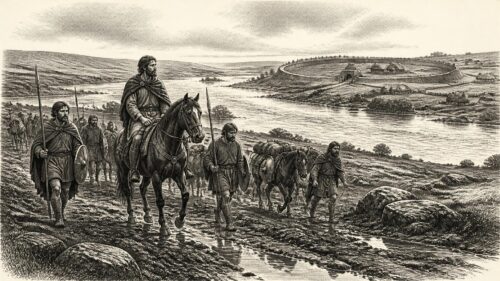
Dublin’s Forsaken Longphort902 CE
In 902, forces led by Cerball of Leinster and Máel Finnia of Brega expelled Dublin’s Scandinavian rulers from Áth Cliath, ending the city’s phase as a fortified naval and commercial base. Annals describe abandoned ships and wounded fugitives, but do not permit reconstruction of battle details or prove every Scandinavian inhabitant left Ireland. Archaeology indicates a diverse settlement of warriors, traders, craftspeople and families, while residual occupation complicates claims of complete abandonment. Elsewhere, Finnguine of Cashel was killed, enabling Cormac’s accession, and ecclesiastical leadership changed at Lathrach Briúin. The expulsion transformed regional power without ending Scandinavian influence or Dublin’s restoration.
Dateline
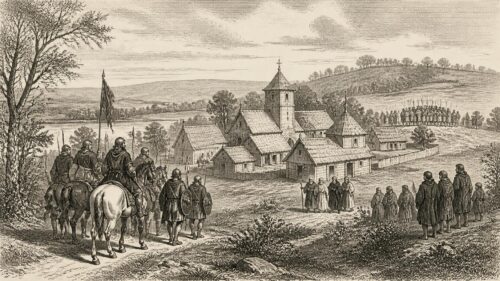
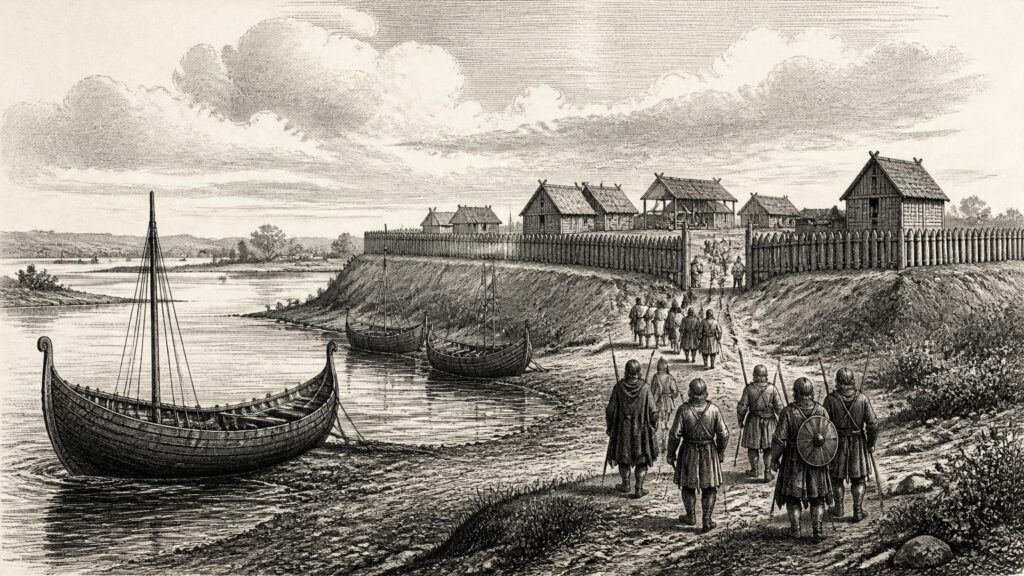
In 902, a coalition from Leinster and Brega forced the Scandinavian rulers of Dublin from their stronghold at Áth Cliath. The entry is brief, but its consequences were considerable. For roughly six decades Dublin had been a principal armed and commercial base in the Irish Sea world: a place from which fleets, raiding parties, merchants and political allies could move along Ireland’s rivers and coasts. Its defeat did not end Scandinavian connections with Ireland, nor did it erase the people, material culture or trading habits created through generations of contact. It did, however, bring the first major phase of Viking political power at Dublin to a sudden close.
A Securely Dated Expulsion
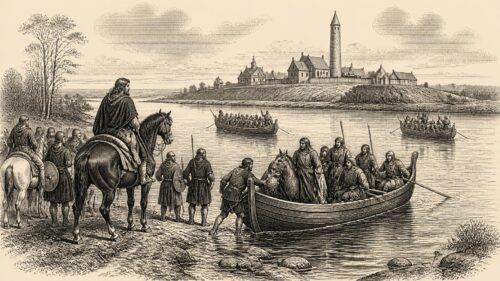
The clearest contemporary-style record is in the Annals of Ulster, under 902. It states that the “heathens” were driven from Ireland, specifically from the longport, or fortified naval base, of Áth Cliath. The victors named were Máel Finnia son of Flannacán, leading the men of Brega, and Cerball son of Muirecán, with the Leinstermen. The annalist adds that the defeated force left many ships behind and escaped overseas “half dead” after being wounded and broken. Chronicon Scotorum independently preserves the same essential account, including the two Irish leaders and the abandoned ships.
The wording deserves care. Medieval annalists often used “heathens” and “foreigners” for Scandinavian forces, and the phrase “driven from Ireland” is followed at once by the more precise identification of Dublin’s fortress. It is therefore safest to understand the entry as the collapse and evacuation of the Dublin-based Scandinavian military regime, rather than as proof that every person of Scandinavian background left the island. Nor does either principal annal supply a day, a named battlefield, a detailed siege narrative or a casualty total. The event belongs securely to 902; its exact sequence cannot responsibly be reconstructed.
Leinster and Brega Act Together
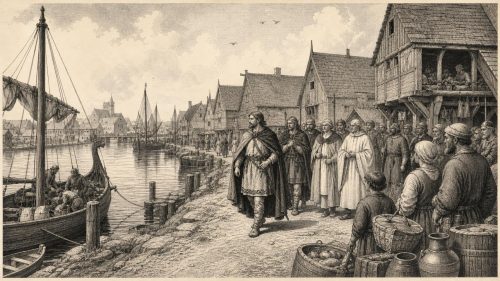
The alliance itself was notable. Dublin stood near the borderlands of Leinster and Brega, beside the Liffey crossing called Áth Cliath and the dark tidal pool from which Dublin took its later name. Its position gave its rulers access to the Irish Sea, but also placed an aggressive maritime power directly beside major Irish kingdoms. Cerball of Leinster approached from the south, while Máel Finnia’s Brega lay to the north. Their joint action put Dublin under pressure from both sides of its regional hinterland.
This was not a simple contest between an undivided “Irish” people and outsiders. Scandinavian rulers had long intervened in Irish rivalries, and Irish kings had fought both against and alongside them. Dublin’s power had rested partly on ships and armed followers, but also on its capacity to make alliances, exact payments and exploit division among neighbouring dynasties. The successful co-operation of Leinster and Brega in 902 shows that such divisions could be overcome when Dublin’s position became intolerable or when its weakness offered an exceptional opportunity.
Flann Sinna, king of Tara and the leading Uí Néill ruler of the period, is not named in the annal’s account of the expulsion. It would be wrong to insert him into the campaign simply because he was the island’s most prominent overking. The named achievement belonged to Cerball, Máel Finnia and their respective forces. Yet the victory plainly mattered within a wider political order in which kings displayed authority through military followings, control of routes and the capacity to protect or dominate neighbouring territories.
Ships Left Behind
The abandoned vessels are among the most striking details in the record. Ships were not merely transport. They enabled rapid raids, troop movements, communication and access to maritime trade, while rivers carried seaborne power into the Irish interior. Losing ships at Dublin represented a severe practical and symbolic setback. The annal’s dramatic claim that the fugitives escaped badly wounded may be conventional victory language, but it leaves no doubt that the writers regarded the defeat as decisive.
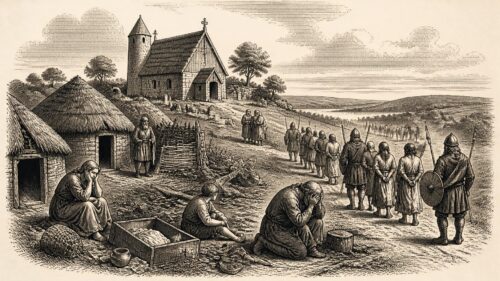
Archaeology helps to explain what was at stake, though it cannot narrate the fighting of 902. Dublin’s ninth- and tenth-century deposits, burials and artefacts reveal a society more varied than a camp of raiders. Finds from the wider Dublin area include weapons, riding equipment, tools, weights and scales, jewellery, combs and domestic objects. Excavated urban evidence points to craftworking in leather, antler, bone and wood, alongside exchange across the Irish Sea and beyond. Women as well as men were present in the Scandinavian settlement world, as furnished graves demonstrate. Such evidence does not tell us which households departed in 902, but it makes clear that the upheaval struck a community with military, commercial and domestic dimensions.
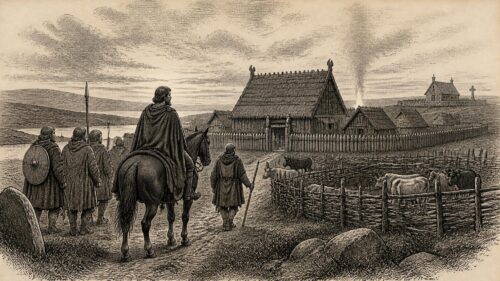
For local farming communities, church estates and smaller settlements, the fall of the longport may have altered the immediate balance of power around the lower Liffey. A fortified maritime centre had demanded food, livestock, labour, tribute and access to markets. Its defeat may have interrupted those demands and redirected regional exchange. But no surviving source permits a confident description of a single year’s harvest, prices or ordinary household experience. The responsible conclusion is narrower: Dublin’s political and naval disruption must have been felt well beyond the fighting force itself.
How Empty Was Dublin?
Older historical accounts often described Dublin as abandoned after 902 until Scandinavian forces returned in 917. The annals certainly support the removal of the ruling military power, and the interval that followed contains far fewer recorded Viking operations in Ireland. Modern archaeological work, however, warns against imagining a perfectly empty site. Some early tenth-century graves and settlement evidence have been interpreted as signs of continuing occupation or residual activity. That possibility fits the practical reality that a harbour, crossing-place and established exchange centre could not simply lose all importance overnight.
The evidence therefore supports a distinction. The longport phase of Scandinavian Dublin ended in 902, and its leaders and many followers fled across the sea. Whether some inhabitants remained, whether Irish people occupied parts of the place, and how far trade continued are questions on which the evidence is incomplete. The return of a Scandinavian fleet in 917 belongs to a later year and should not be allowed to obscure the real break created in 902.
Instability at Cashel
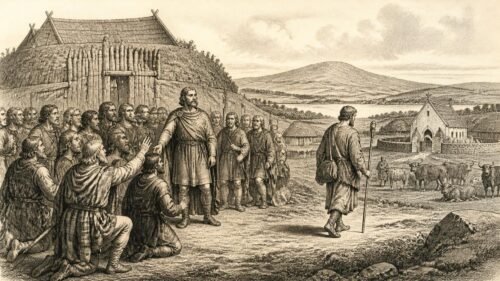
The same annal-year records a second political death, far from Dublin. Finnguine, king of Cashel, was “deceitfully killed by his associates”. Other annalistic traditions call him Cenn Gégaín, and their chronological placement differs: the Annals of Inisfallen puts the killing under 902, while other entries place Cormac son of Cuilennán’s succession around 901–902. The disagreement reflects the well-known dating difficulties of medieval Irish annals, not uncertainty that a change of rule occurred at Cashel around this point.
Cormac was both a religious figure and a member of the Éoganacht dynasty. Later tradition connected him with learned works, especially the glossary known as Sanas Cormaic and the lost Psalter of Cashel, though the precise authorship and compilation history of such texts remain debated. What can be said for 902 is that the violent removal of Finnguine opened the way for Cormac’s kingship. The contrast with Dublin is instructive: while Leinster and Brega combined against an externalised maritime power, Munster’s royal centre was being reshaped by conflict among its own political associates.
Churches, Learning and Lordship
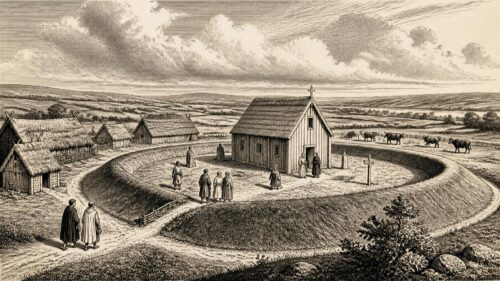
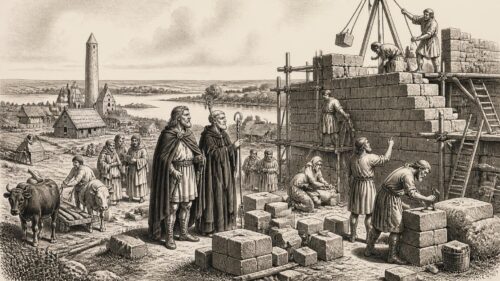
The Annals of Ulster also note the death of Fogartach son of Flann, superior of Lathrach Briúin. Such a terse notice is nevertheless a reminder that ecclesiastical establishments were major landholders, centres of learning and participants in regional politics. The title “superior” indicates leadership of a religious community, not a withdrawal from worldly networks. In early medieval Ireland, kingship, kinship and churches were closely interwoven: elite families supplied clerics and abbots, while churches preserved memory, controlled resources and gave prestige to rulers.
Thus 902 was not only a year of warfare. It was a year in which the relationships between lordship, settlement and religious authority were visibly changing. Dublin’s defeat removed one powerful node from the east-coast political landscape. Cashel’s succession brought Cormac, a king with an unusually learned and ecclesiastical reputation, to prominence. The annals preserve only fragments, yet together they show an island whose political life was being remade through alliances, betrayals, ships, strongholds and institutions of prayer and scholarship.
A Turning Point, Not an Ending
The expulsion from Áth Cliath was a major Irish victory, but it was not the end of the Viking Age in Ireland. Scandinavian and Hiberno-Scandinavian groups remained active around the Irish Sea, while Dublin’s overseas connections helped ensure that its displacement would not be permanent. The Dublin regime’s later restoration should not diminish what happened in 902. For the people who watched ships abandoned or fugitives depart, the fall of the longport represented a profound reversal in the eastern Irish Sea world—and a rare moment when two neighbouring Irish powers successfully dismantled the strongest Scandinavian base in Ireland.
Primary Sources
- The Annals of Ulster, Year U902
- Chronicon Scotorum, Annal CS902
- Annals of the Four Masters, Annal M897
- Annals of Inisfallen, Annal AI902
- Vikings in Irish Chronicles, 794–902: Introduction
- Vikings in Irish Chronicles, 794–902: Data
- Chronicon Scotorum
- Annals of the Four Masters
- Annals of Inisfallen
- Viking
- Guide to the National Museum of Ireland
- Dublin City Urban Archaeology Survey: Preliminary Report
- The Vikings in Ninth-Century Ireland: Sources and Settlements
- The Vikings in Ninth-Century Ireland: Sources and Settlements (full text)
- Dirt, Dwellings and Culture: Living Conditions in Early Medieval Dublin
- Early Medieval Ireland: Archaeological Excavations, 1930–2009
- Vikings in Early Medieval Ireland
- Exile, Return and the Dublin-York Axis: The Context of Church-Raiding, 914–941
- Cormac
- Ireland, 400–800
- Vikings in Ireland and Scotland
- The Vikings in Ireland: longphuirt and legacy