Domnall’s Pilgrim Staff911 CE
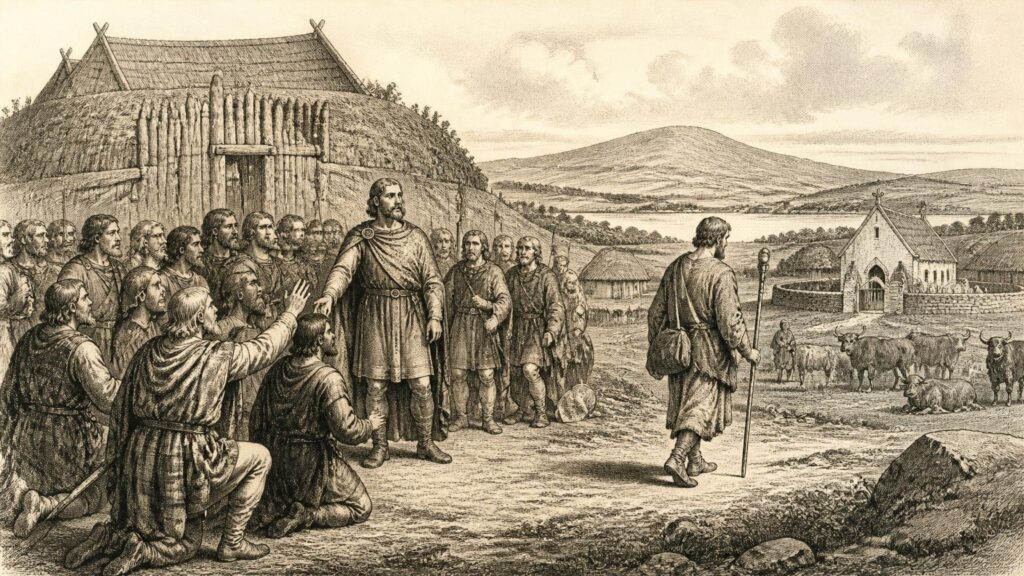
In 911 Domnall, son of Áed Findliath, relinquished the kingship of Ailech by adopting the pilgrim’s staff, a religious renunciation, and his brother Niall succeeded him. Annals of Inisfallen, Chronicon Scotorum and Ulster support the succession, although dating conventions preclude fuller detail. The transfer preserved Cenél nÉogain control of a major northern power, whose authority relied on clientage, tribute, military service and ecclesiastical connections. Domnall died in penitence in 915. Ireland remained politically fragmented under Flann Sinna of Tara; Niall was commander. Records also note a Leinster heir’s death and a phenomenon, while communities sustained networks through agriculture and obligations.
Dateline
In 911, a change of ruler in the northern kingdom of Ailech took place without a recorded battle. Domnall son of Áed Findliath, king of Ailech, “assumed the pilgrim’s staff”: in the language of the annals, he withdrew from secular rule for a religious life. His brother Niall then took the kingship. The notice is brief, but its consequences were considerable. Ailech was the leading kingship of Cenél nÉogain, one of the two great branches of the Uí Néill, and Niall would soon become one of the most forceful figures in Irish politics. For 911 itself, however, the dependable story is one of succession, religious renunciation and the persistent importance of northern royal power.
The event is attested by both the Annals of Inisfallen and Chronicon Scotorum, which place Domnall’s adoption of the pilgrim’s staff in 911; Inisfallen expressly adds that Niall succeeded him. The Annals of Ulster preserve the same notice under an entry labelled “AD 910 alias 911”, a reminder that annalistic year-numbers must be handled carefully. The agreement of the sources is sufficient to connect the succession to 911, but it does not justify inventing a day, a ceremonial location, or a detailed account of Domnall’s retirement.
Ailech Changes Hands
Domnall and Niall were sons of Áed Findliath, the formidable northern Uí Néill king who had held the kingship of Tara until his death in 879. Their inheritance was not automatic in a modern hereditary sense. Early medieval Irish succession was negotiated within powerful kindreds, and the kingship of Ailech had passed through several eligible members of the Cenél nÉogain dynasty before Domnall established himself. Niall had already emerged as an important political and military figure alongside his brother. Their co-operation earlier in the century had helped to assert northern lordship, to pressure neighbouring regions and to challenge the authority of Flann Sinna, king of Tara.
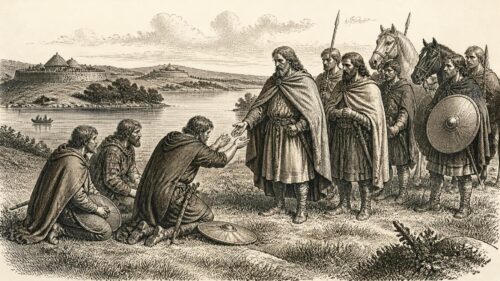
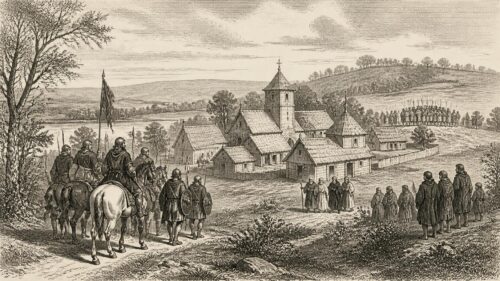
The transfer in 911 therefore represented continuity as much as change. It kept Ailech within the same immediate royal family and put an experienced adult ruler in place. Niall’s later career should not be read backwards as proof that he was destined for supremacy; kingship remained vulnerable to rivals, alliances and military reverses. Yet his accession mattered because it gave him control of the central political resource of the north: the kingship whose name was attached to Ailech and whose authority reached well beyond the hillfort itself.
Ailech was both a kingdom and a statement of dynastic geography. The royal centre is conventionally associated with Grianán of Aileach, the great stone fort on Greenan Mountain in Inishowen. The surviving monument should not be treated as a complete picture of a tenth-century royal residence: its visible fabric and setting have long histories, while kingship also depended on mobile households, client peoples, ecclesiastical allies and control of routes. Even so, the site’s commanding position between Lough Foyle and Lough Swilly expresses why Ailech was such an effective emblem of Cenél nÉogain power. In 911 Niall inherited not merely a title, but a claim to command people, tribute and military service across the north.
Renunciation, Not Retirement
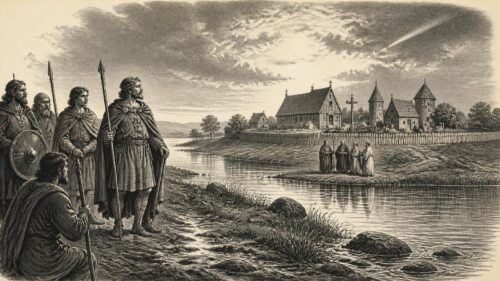
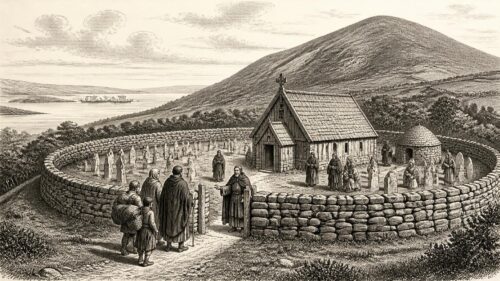
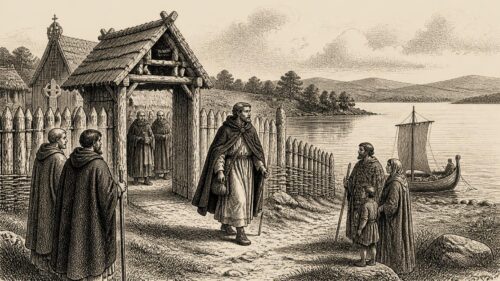
The phrase “assumed the pilgrim’s staff” deserves more attention than it usually receives. A pilgrim’s staff was an outward sign of ailithre or pilgrimage, a religious departure from ordinary worldly life. In Irish Christian culture, pilgrimage could mean travel to a holy place, ascetic wandering, or a more enduring withdrawal from one’s former social position. The sources do not say where Domnall went, whether he entered a named monastery, or what rule he followed. To describe him as becoming a monk at a specific house would go beyond the evidence.
What can responsibly be said is that the act carried political weight. A king who took the staff did not simply disappear from public memory; he made a recognised renunciation that permitted another member of the dynasty to rule. Religious conversion or penitence could provide a language for ending a contested career, settling a succession, seeking spiritual security, or all three at once. Domnall’s choice also reveals the close entanglement of royal and ecclesiastical worlds. Clerics recorded the change, religious status supplied its public meaning, and a king’s departure was worth entering into annalistic history beside deaths, battles and prodigies.
Domnall did not die in 911. The Annals of Ulster later record his death “in penitence” at the spring equinox, 21 March, in 915. That later, precisely dated notice reinforces the interpretation that his withdrawal in 911 was a genuine religious renunciation rather than a euphemism for death. It also shows why the distinction matters: a year-by-year account should preserve the four-year interval between laying down kingship and dying.
The Wider Political Balance
At the time of Niall’s accession, Flann Sinna of Clann Cholmáin remained king of Tara and the foremost claimant to island-wide overkingship. His authority was substantial, but “high kingship” was not a centralised state. Ireland consisted of many kingdoms, lesser lordships, church federations and client relationships. A king of Tara could exact submission, lead hostings, make alliances and cultivate symbolic prestige; he could not rule every region through a permanent administrative machinery. The northern Uí Néill, including the rulers of Ailech, were among the principal powers with which he had to reckon.
This setting makes the peaceful-looking succession at Ailech more significant. The previous decade had seen Domnall and Niall burn Tlachtga, an important royal and assembly landscape in Mide, in 908. Niall also killed Áed son of Máel Pátraic, king of Uí Fhiachrach, in the campaigning recorded for 910. Those events belong before 911, but they show that Niall did not arrive at the kingship as an unknown religious beneficiary. He was already a commander with ambitions in Connacht and Mide, regions essential to the balance between northern and southern Uí Néill power.
Yet 911 should not be made into the opening of a war that occurred later. The major northern expeditions into Dál Araide and Mide, the confrontation at Grellach Eilte, and the arrival of a new Viking fleet at Loch dá Cháech belong to 914 in the chronological framework of the Annals of Ulster. Likewise, Domnall’s death belongs to 915, and Flann Sinna’s death to 916. Later compilations, notably the seventeenth-century Annals of the Four Masters, place some related material under different year-headings. Their testimony is valuable, but parallel annals demonstrate that it cannot be used to relocate those conflicts into calendar year 911.
A Quiet Year in the Record
The surviving annals give 911 a sparse texture. Alongside the change at Ailech, Chronicon Scotorum records the death of Dúnlang son of Coirpre, heir-designate of Leinster. The notice signals a separate succession problem in the east, but it provides no narrative of who succeeded or how political relationships changed. It is a useful warning against treating Ireland as if all affairs flowed from Tara or Ailech alone. Leinster had its own dynastic politics, and the loss of an heir could alter calculations within a province even when the annalist supplies no further detail.
The Ulster annal also associates its “910 alias 911” entry with an extraordinary observation: “two suns ran together” on 6 May. This was almost certainly an atmospheric phenomenon, perhaps a parhelion or sun-dog, interpreted by observers as a remarkable sign. The exact calendrical placement is uncertain because of the annals’ dating conventions, so it should not be advertised as an event firmly dated to 911. It does, however, offer a rare glimpse of what a monastic chronicler thought worth preserving: the heavens, like royal successions and ecclesiastical deaths, could be read as part of history.
Country Life Beneath Kingship
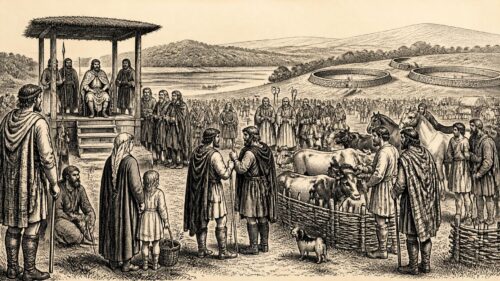
For most people, the change at Ailech was experienced at a distance. Early medieval Ireland remained overwhelmingly rural. Households lived in dispersed farmsteads, often within earthen or stone enclosures now called ringforts or raths. These were homes, working spaces and markers of standing rather than castles in the later medieval sense. Banks, ditches, gates and sometimes underground souterrains helped protect people, animals and stores in a society where raiding was a recurrent danger and livestock was a major form of wealth.
Cattle were central to status, exchange and food supply, but agriculture was not simply pastoral. Archaeological and environmental evidence indicates substantial cereal cultivation, increasing use of grain-processing facilities, and production beyond bare household subsistence in parts of early medieval Ireland. A royal succession could therefore touch ordinary communities through obligations of food-rent, livestock renders, hospitality, labour and military service. Niall’s accession did not create those systems in 911; it placed a new ruler at the head of one northern network within them.
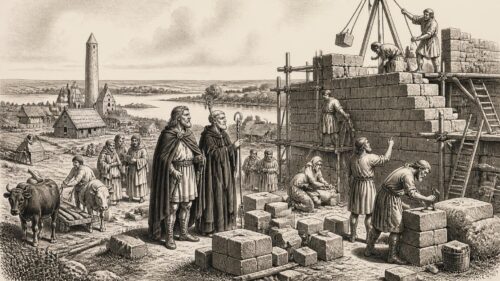
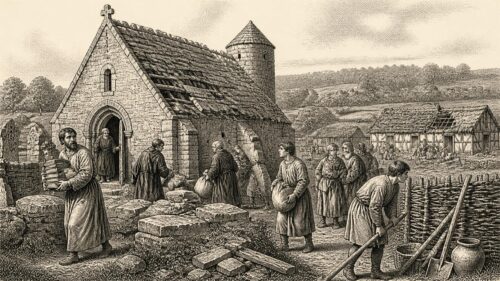
Churches and monasteries were also embedded in this rural world. They were places of worship and burial, but also centres of learning, landholding, craft, food production and political connection. The annals themselves were products of such ecclesiastical milieux, preserving terse reports shaped by the interests of religious communities. Their silence on a particular harvest, household or village should not be mistaken for evidence that nothing happened there. Rather, it reminds us that 911 survives chiefly through the concerns of literate observers: rulers, clerics, unusual sights and events with consequences for powerful institutions.
A Succession With a Long Shadow
There is no securely dated Scandinavian raid in the principal Irish notices for 911. Dublin had been expelled from Viking control in 902, while the renewed large-scale arrival of fleets recorded at Loch dá Cháech was still ahead. That interval did not make Ireland peaceful: rivalry among Irish dynasties, demands on local communities and the possibility of violence remained constant. But it does mean that 911 should not be presented as a year of a Viking offensive merely because such campaigns loom large in the years that followed.
The year’s real importance lies in its restraint. Domnall’s pilgrim staff marked the end of one brother’s rule; Niall’s accession began another. Within eight years Niall would become king of Tara, and his struggle with the revived Scandinavian power at Dublin would end in his death in 919. None of that was inevitable in 911. What the year securely shows is a northern dynasty using a recognised religious withdrawal to manage succession, while the political order of Ireland remained plural, competitive and deeply connected to ecclesiastical life.
Primary Sources
- The Annals of Ulster
- The Annals of Ulster: Bibliographical Details
- Annals of Inisfallen, Annals AI910–AI919
- Annals of Inisfallen
- Chronicon Scotorum, Annals CS910–CS914
- Chronicon Scotorum: Bibliographical Details
- Annals of the Four Masters, Annals M903–M912
- Annals of the Four Masters
- Niall Glúndub
- Flann Sinna
- Grianán of Aileach
- Agriculture, Settlement and Society in Early Medieval Ireland
- Early Medieval Ireland: Archaeological Excavations, 1930–2009
- Early Medieval Dwellings and Settlements in Ireland, AD 400–1100, Volume 1: Text
- Settlement Patterns and Socio-Economic Change in the Diocese of Tuam c.AD 400–1000
- The Concept and Practice of Pilgrimage in Early Medieval Ireland: From the Fifth to the Ninth Century
- The Vikings in Ninth-Century Ireland: Sources and Settlements
- Ringforts / Ráthanna
- Souterrains / Pasáistí Faoin Talamh
- Early Medieval Ireland: Investigating Social, Economic and Settlement Change, AD 400–1100
- List of Published Texts at CELT