Niall’s Connacht Rout913 CE
In the annalistic year conventionally called 913, Niall son of Áed, king of Ailech, campaigned in north Connacht, routing the Uí Amalgada and men of Umall, killing or capturing many. Elsewhere, Donnchad and Máel Mithig defeated forces from southern Brega and Leinster, while Congalach of Conaille Muirthemne was killed by his brother after attacking a church household. Vikings defeated a new Ulaid fleet off England, with Irish losses. Churchman Máel Brigte travelled to Munster to ransom a Welsh pilgrim. Death notices recorded clerics, nobles and a chief poet. Annals called the year dark and rainy, reflecting an interconnected, fractured island.
Dateline
The year conventionally assigned to 913 was marked less by a single island-wide turning point than by hard campaigning, regional bloodshed and the vulnerability of sea routes. Its most substantial recorded Irish action was Niall son of Áed’s expedition into north Connacht, where the king of Ailech defeated the Uí Amalgada and the men of Umall. Yet the surviving annals also preserve an assault on a north-eastern king, a battle involving Brega and Leinster, an Irish naval reverse on the English coast, the ransom of a Welsh pilgrim, and a bleak notice of rain and darkness. Together these terse reports reveal an Ireland of competing kingships connected by roads, lakes and sea-lanes, rather than a politically unified realm.
A Year with Difficult Dates
Medieval Irish chronology requires care. Chronicon Scotorum places Niall’s Connacht victory, the killing of Congalach of Conaille and the Brega–Leinster battle under 913. The Annals of Ulster preserves the same cluster under a heading rendered “AD 912 alias 913”, reflecting a known difficulty in the annalistic year-count. Modern reference works conventionally place Niall’s defeat of the Uí Amalgada and Umall in 913, but an exact day or season cannot be recovered. It is therefore safest to treat these as events of the annalistic year customarily called 913, rather than to claim a precision which the evidence does not possess.
This caution also matters because later compilations sometimes carry comparable notices under shifted years. The famous seventeenth-century Annals of the Four Masters, for example, groups major raids on Munster churches and a crisis within Flann Sinna’s family under its entry for 913, but parallel evidence places that group of events later. They should not be imported into this calendar year merely because of a late annal heading. The securely associated record for 913 is instead concentrated in the north, Connacht, the Irish Sea world and the ecclesiastical networks that linked them.
Niall’s Western Campaign
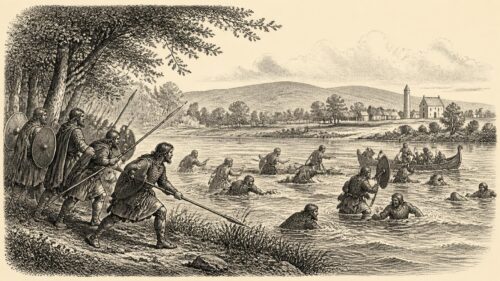
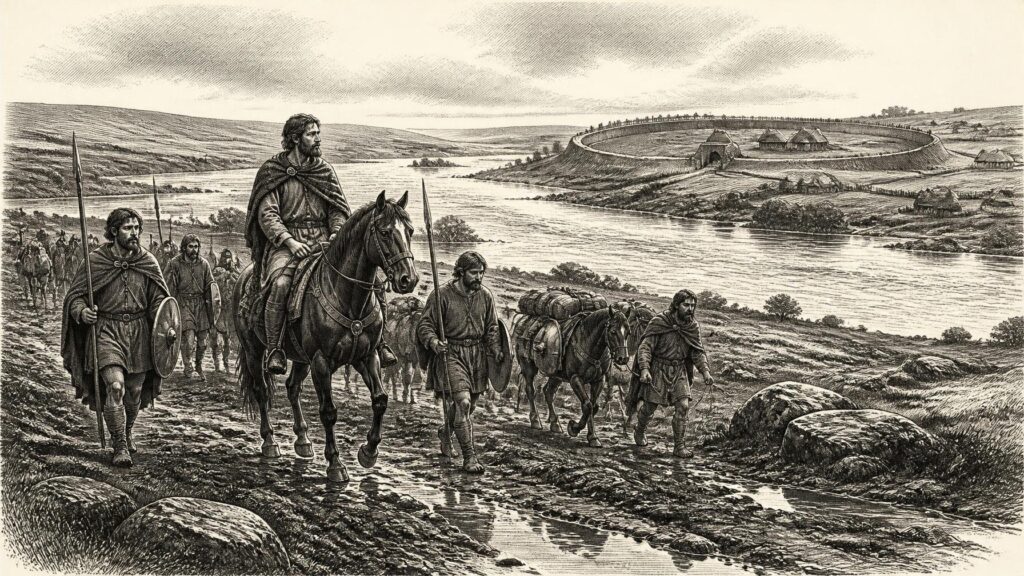
Niall son of Áed, later remembered as Niall Glúndub, was king of Ailech and leader of the northern Cenél nÉogain branch of the Uí Néill. His authority rested in the north-west, but his ambitions reached well beyond it. The annals state that he led an expedition into Connacht and inflicted a rout on the Uí Amalgada and the men of Umall, peoples based broadly in what are now northern and western County Mayo. The defeated force left behind a very large number of dead or captives; Máel Cluiche son of Conchobar is specifically named among those caught up in the disaster.
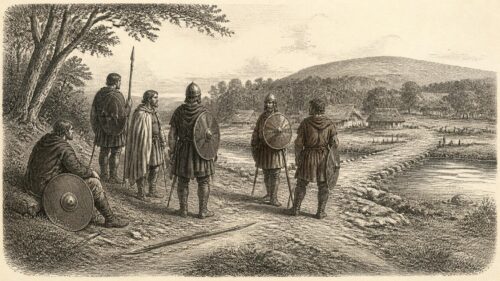
The wording is important. This was not a battle between modern provinces or nations, but an armed intervention among numerous small and middle-ranking kingdoms. Uí Amalgada controlled territory in north Mayo, while Umall lay around the difficult Atlantic-facing country of Clew Bay and its hinterland. A force moving there from Ailech had to demonstrate more than local strength: it had to gather followers, secure routes and sustain them in country where mountains, bogs, river crossings and the coast shaped movement. The annals do not identify the immediate cause of war. It would be unsafe to invent one. But the victory continued Niall’s sustained pressure on Connacht and enhanced the standing of an Ailech ruler seeking influence across the northern half of Ireland.
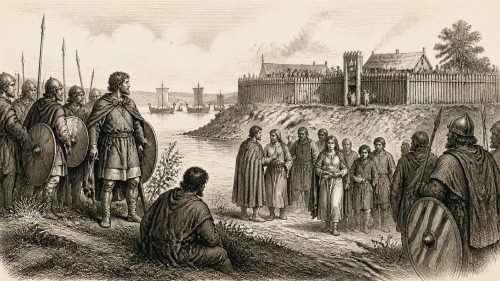
Captives were politically and economically significant. They could be ransomed, exchanged, incorporated into dependent households or used to compel settlements. The record’s pairing of the dead with those taken alive gives a glimpse of warfare whose object was not simply killing an opponent’s army. It was also the seizure of people, movable wealth and political submission. Niall’s later career would bring him into direct competition for the wider kingship of Tara; in 913, the Connacht expedition shows that larger aspiration being built through regional dominance.
Violence in Brega and Conaille
Conflict was not confined to the west. Donnchad, grandson of the overking Flann Sinna, joined Máel Mithig son of Flannacán in defeating Fogartach son of Tolarg, king of southern Brega, and Lorcán son of Donnchad with the Leinstermen. The victors took or killed many of their opponents. Brega, the rich plain north of the Liffey and Boyne, lay close to Tara and was central to southern Uí Néill politics. Its rulers could be allies, rivals or obstacles to Flann’s descendants. The notice does not disclose whether this encounter was a raid, a planned battle or the violent end of a negotiation; it does show that alliances crossed regional boundaries and that Leinster forces were involved in the contest.
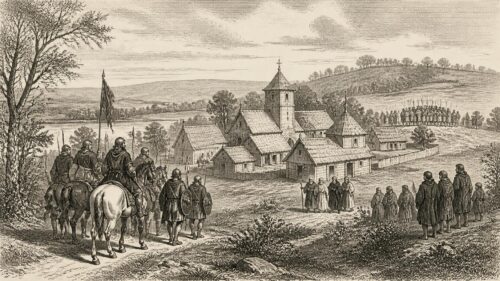
Further north-east, Congalach son of Gairbíth, king of Conaille Muirthemne, was killed by his own brother. The annalist links his death to an earlier outrage: nine months before, Congalach had attacked the abbot’s house at Druim Inasclainn and killed men associated with that church, including its superior Muiredach son of Cormac. Conaille Muirthemne occupied the coastal and inland area around modern Dundalk. The sequence brings together dynastic violence and ecclesiastical protection. A ruler who violated a church household was not necessarily punished by a formal state, but the annal frames his subsequent killing in a moral context of retribution.
Irish Ships and Wider Seas
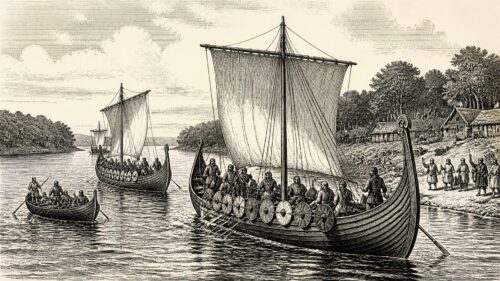
The sea was no boundary. One of the starkest notices of the year reports that “heathens” routed the crew of a new fleet of the Ulaid on the coast of England. Many Irishmen fell, among them Cumuscach son of Máel Mocheirgi, a grandson of the king of Leth Cathail in east Ulster. The annal neither names the English shore nor explains the fleet’s purpose. Its description nevertheless confirms that Ulaid could equip a substantial maritime force and that Irish political conflict and raiding operated across the Irish Sea.
The annalist’s term “heathens” was normally used for Viking enemies, but the passage gives no commander or ethnic detail beyond that label. It should not be turned into a fully reconstructed naval campaign. What can be said is that 913 lay in the uneasy interval after the expulsion of the Viking forces from Dublin in 902 and before the major new Viking arrival at Waterford in 914. The absence of a Scandinavian-dominated Dublin did not make the sea safe. Ships still carried war-bands, merchants, pilgrims and captives between Ireland, Britain and the western seaways.
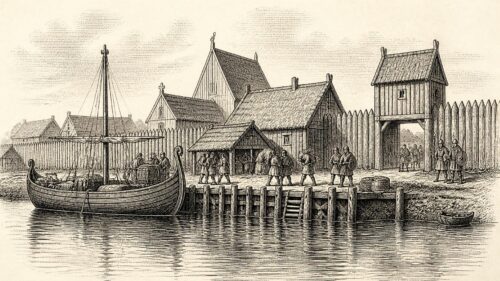
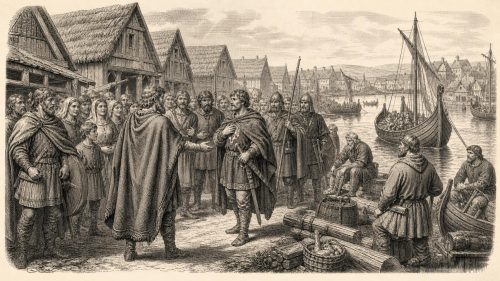
That wider world appears again in the journey of Máel Brigte son of Tornán, a leading churchman associated with Armagh and Iona. The Annals of Ulster records that he travelled to Munster to ransom a Welsh pilgrim. A related, more expansive account in the Fragmentary Annals of Ireland says that he gathered clergy and sought treasure from Munster nobles to redeem Britons who had survived shipwreck and escaped Scandinavian captors. The basic mission is well supported; the dramatic elaboration belongs to a later narrative and should be treated more cautiously. Even so, ransom was plainly a recognised obligation, and churchmen could mobilise aristocratic wealth for people displaced by violence at sea.
Churches, Learning and Loss
Ecclesiastical institutions were woven into this political landscape. The death notices for 913 include Tipraite son of Máel Finn, superior of Imlech Ibuir, the important monastery of Emly in Munster; Máel Muire, daughter of Cináed son of Ailpín; and Cuilennán son of Máel Brigte. The Annals of Inisfallen, compiled in Munster, additionally records the deaths of Torpaid son of Taicthech, styled chief poet of Ireland, and Máel Caisil son of Cináed, abbot of Mungret. These brief entries cannot furnish biographies, but they show the annals’ concern with abbots, aristocratic women and learned poets alongside kings and warriors.
Poetry and learning were not ornamental extras to public life. A chief poet’s standing rested on trained memory, language and patronage; ecclesiastical centres sustained literacy, legal knowledge and contacts extending far beyond their immediate estates. Churches also held land, livestock, food rents, books and precious objects, which made them both centres of refuge and tempting targets. The killing at Druim Inasclainn and Máel Brigte’s ransom journey demonstrate that religious authority could be endangered by violence while also providing a framework for protection, negotiation and redemption.
Rain over a Rural Island
The year closes in the Annals of Ulster with a deceptively short observation: it was “a dark and rainy year”. It is evidence for contemporary perception, not a basis for calculating rainfall or declaring a nationwide famine. Yet weather mattered intensely in an overwhelmingly rural society. Most people lived in farmsteads, ringforts, crannogs or ecclesiastical settlements, working with cattle, pigs, sheep and crops. Archaeology indicates that cattle remained central to wealth and status, while cereal cultivation, milling and grain-drying had become increasingly important. Prolonged wet conditions could complicate travel, harvesting, fodder production and military movement, even if this particular notice does not record its consequences.
Thus 913 offers a sharply textured, if incomplete, view of Ireland: Niall’s western victory, Brega’s shifting alliances, a king slain after violence against a church, an Ulster fleet defeated abroad, and clergy raising ransom for Britons. No single authority controlled all these worlds. Kingship depended on followers and hostages; monasteries were both landed institutions and channels of learning; and the sea joined Ireland to Britain as readily as it exposed travellers to danger. The annals’ rain-darkened final note is an apt reminder that political power and ordinary survival alike depended on the land and weather beneath every campaign.
Primary Sources
- The Annals of Ulster, Year U913
- The Annals of Ulster
- Chronicon Scotorum, Annals CS912–CS918
- Chronicon Scotorum, bibliography and electronic edition details
- Fragmentary Annals of Ireland, Annals FA444–FA449
- Annals of Inisfallen, Annals AI910–AI915
- Annals of the Four Masters, Annal M913
- Annals of the Four Masters
- Niall Glúndub
- Early Medieval Louth: The Kingdom of Conaille Muirtheimne
- Colonisation and Conquest in Medieval Ireland
- Agriculture, Settlement and Society in Early Medieval Ireland
- The Archaeology of Livestock and Cereal Production in Early Medieval Ireland, AD 400–1100
- Early Medieval Dwellings and Settlements in Ireland, AD 400–1100, Volume 1
- Early Medieval Ireland: Investigating Social, Economic and Settlement Change, AD 400–1100
- Early Medieval Ireland, AD 400–1100: The Evidence from Archaeological Excavations
- Early Medieval Ireland: Archaeological Excavations, 1930–2009
- Vikings in Early Medieval Ireland: Church-Raiding, Politics and Kingship
- Vikings in Early Medieval Ireland: Church-Raiding, Politics and Kingship – Review
- The Annals of the Four Masters: National Library of Ireland catalogue record
- Exploring the Irish Annals