Guarded Independence
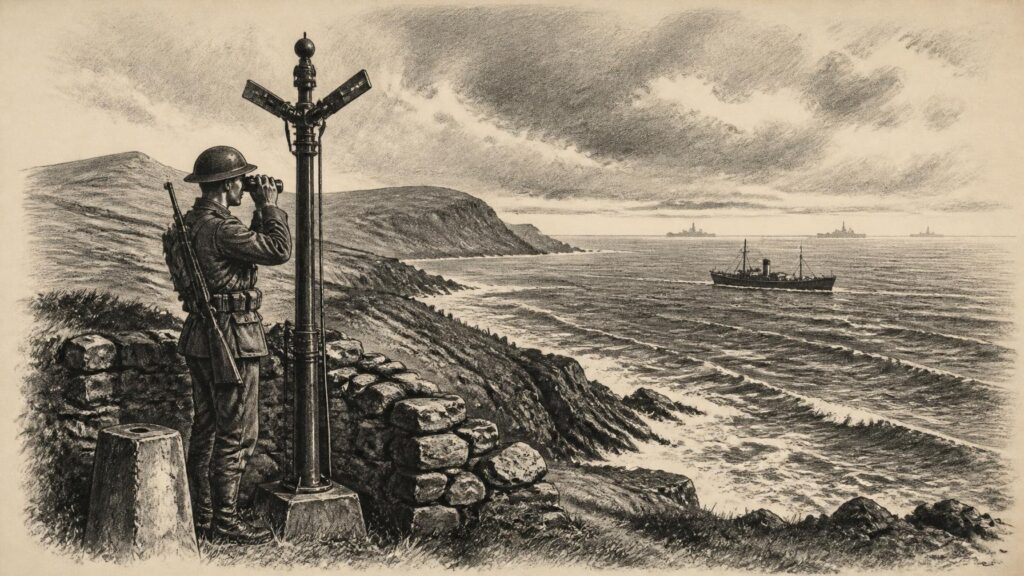
AI generated historical illustration, not a contemporary photograph.
At a Glance
Irish neutrality is often presented as an old and fixed national tradition. The historical record tells a more complicated story. It was fashioned in the twentieth century from the pursuit of independence, the realities of partition and geography, the failure of collective security, and the pressures of war in Europe. It has endured not as a passive withdrawal from the world, but as a contested policy through which successive Irish governments have sought both freedom of action and an international role.
Defining Neutrality
Any history of Irish neutrality must begin by separating ideas that are regularly merged in public debate. In international law, neutrality has a particular meaning during a war between other states. A neutral state must not become a belligerent, must apply rules impartially, and must prevent its territory being used for military purposes by the warring parties. This is not the same thing as a peacetime policy of refusing military alliances. Ireland’s modern position is more accurately described as military neutrality or military non-alignment: it does not belong to NATO and does not undertake an automatic mutual-defence obligation with other states.
That distinction matters because Ireland has never claimed to be neutral towards injustice, colonialism, aggression, apartheid, nuclear proliferation or breaches of international law. Nor has it withdrawn from collective institutions. Its governments joined the League of Nations, later joined the United Nations, sent troops abroad under UN auspices, entered the European Communities, and participated in European foreign-policy structures. A country can therefore be militarily non-aligned while making strong political judgements and contributing materially to international action. The apparent contradiction has been a defining feature of Irish policy rather than an accidental inconsistency.
The constitutional position is equally narrower than popular language sometimes suggests. The Constitution expresses devotion to peace, friendly co-operation, international justice and the peaceful settlement of disputes. It also requires the assent of Dáil Éireann for a declaration of war or participation in war. Yet neutrality as such is not entrenched as an unalterable constitutional rule. Its practical force has rested principally on political choice, legislation, diplomatic practice and public attachment. Constitutional amendments linked to European treaties have added important limits, notably a bar on Ireland adopting an EU decision to establish a common defence where that defence would include the State. Even so, the policy’s boundaries have been argued over repeatedly.
Sovereign Origins
Neutrality did not descend intact from an ancient Irish past. It developed alongside the effort to create a recognisable sovereign state after revolution, partition and civil war. Before independence, Irish political traditions had contained several different attitudes towards European conflict. Constitutional nationalists had supported participation in the British war effort during the First World War, while separatists generally treated British military commitments as evidence of Ireland’s lack of self-government. Republican diplomacy also looked towards the United States and continental Europe in search of recognition. These competing inheritances meant that neutrality could later become a potent symbol of independence, but it was neither universally accepted nor mechanically inevitable.
The Irish Free State entered the international system with limited room for manoeuvre. Created by the Anglo-Irish Treaty of 1921, it remained a Dominion of the British Commonwealth and shared constitutional links with the Crown. Nevertheless, its representatives used international institutions to demonstrate that Ireland possessed interests and judgement distinct from London’s. Admission to the League of Nations in 1923 was consequently significant. It offered a forum in which a small new state could speak, vote and develop a diplomatic service, while the League’s language of collective security and international law appeared compatible with Irish aspirations.
This early diplomacy should not be read as simple isolationism. The Free State participated in League work, supported mechanisms for peaceful settlement and pursued a separate voice on questions that arose within the Commonwealth. The search for legal and diplomatic autonomy was at least as important as any settled doctrine of neutrality. In the inter-war years, Irish leaders were learning how a small state might preserve sovereignty without disappearing from international affairs. The answer they sought was active multilateralism, rather than either permanent detachment or unquestioning alignment with Britain.
League Lessons
The League of Nations shaped Irish thinking profoundly, partly through its promise and partly through its failure. Irish diplomats and politicians took seriously the principle that disputes should be resolved through law and collective action. Éamon de Valera, who became President of the Executive Council in 1932, was especially associated with the League. His standing there helped project Ireland’s separate personality abroad and reinforced the belief that small states had a legitimate claim to influence international order. The ambition was not merely sentimental: a rules-based system seemed one of the few safeguards available to countries with little military power.
Yet the League’s inability to prevent or reverse aggression in Manchuria, Abyssinia and elsewhere exposed its limits. The crisis over Italy’s invasion of Ethiopia was particularly instructive. Economic sanctions were imposed, but they were incomplete, unevenly enforced and ultimately unsuccessful. For Ireland, as for other smaller European states, the episode raised a harsh question: what did collective security mean if powerful states would not accept its costs? The widening gap between legal ideals and strategic reality encouraged caution. It did not erase Irish support for international law, but it made reliance on distant guarantees appear hazardous.
By the later 1930s, European diplomacy was increasingly governed by rearmament, alliances and the expectation of another general war. Ireland’s leaders concluded that the country could not safely be committed in advance to a conflict shaped by the interests of larger powers. The historical interpretation that neutrality arose simply from anti-British feeling is therefore inadequate. Relations with Britain were central, particularly because of partition and the recent memory of conflict, but the policy also grew from a wider European disillusionment with a collective-security system that had proved unable to restrain aggression.
Port Recovery
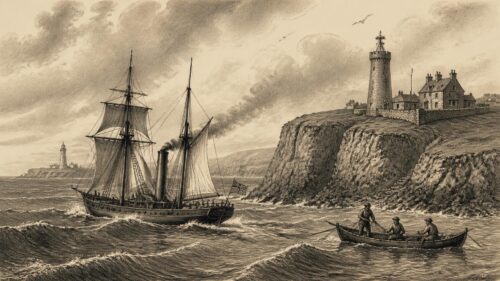
The Anglo-Irish Agreement of 1938 supplied a practical condition for wartime neutrality. Under the 1921 Treaty, Britain had retained control of three naval facilities commonly called the Treaty Ports: Berehaven, Cobh and Lough Swilly. Their existence made full Irish control of territorial waters and coastal defence difficult to claim. Negotiations between the governments of de Valera and Neville Chamberlain resolved the economic dispute known as the Economic War and transferred the ports to Irish control. The agreement did not remove Ireland from Britain’s strategic orbit, but it gave Dublin an authority it had lacked during the previous decade.
The return was consequential rather than ceremonial. As international tension mounted, the ports lay on Atlantic approaches of immense naval importance. Had Britain retained them in 1939, Ireland’s assertion of neutrality would have been severely compromised, and perhaps impossible to administer credibly. Irish governments later treated the recovery as proof that constitutional diplomacy could secure vital elements of sovereignty. British officials, meanwhile, would come to regard the loss of direct access as a serious wartime inconvenience. The same event thus acquired sharply different meanings on either side of the Irish Sea.
It would be misleading, however, to imagine that the 1938 settlement made Ireland militarily secure. The state had a small population, limited resources, modest armed forces and a coastline difficult to defend. Northern Ireland remained within the United Kingdom, and Britain’s security planning necessarily treated the island and surrounding waters as strategically connected. The return of the ports enabled a policy of neutrality; it did not solve the geographical predicament that made that policy so difficult once war began.
Wartime Test
Germany’s invasion of Poland in September 1939 brought the decisive test. Ireland declared neutrality and introduced emergency powers. The period became known in the State as the Emergency, a term reflecting both the legal framework adopted and the sense that independence itself might be endangered. De Valera’s government maintained that participation in Britain’s war would divide the country, weaken the authority of the still-young state and jeopardise the prospect of eventual unity. In a society marked by the recent Civil War and by partition, neutrality could be represented as a national policy around which many otherwise opposed citizens might gather.
Neutrality demanded administration as well as rhetoric. The government regulated trade, shipping, censorship, broadcasting, travel and the movement of foreign military personnel. The Defence Forces were expanded, while local defence organisations were raised to prepare against invasion or sabotage. The official record assembled in the Documents on Irish Foreign Policy shows civil servants and diplomats confronting daily problems that could not be resolved by a single declaration: belligerent ships, aircraft, intelligence activity, shortages, maritime danger, propaganda, refugees and relations with both German and British representatives.
European war also demonstrated that a neutral policy did not place Ireland outside danger. German aircraft bombed Irish territory, including the North Strand in Dublin in May 1941, though the circumstances and intention of particular raids remained contested at the time. Merchant shipping faced grave risks in the Atlantic. Shortages of fuel, fertiliser, machinery and foodstuffs affected ordinary life. The state’s dependence on trade with Britain gave London considerable leverage, while German victory in Europe would have posed an even more existential threat. Neutrality was not a sheltered condition. It was an attempt to manage vulnerability amid competing perils.
Uneven Practice
The wartime record resists both heroic legend and denunciation. Ireland was formally neutral, retained diplomatic relations with Germany and did not grant Britain the Treaty Ports. It also applied rules which could irritate the Allies and created deep resentment in Britain and the United States, especially when the war’s outcome seemed uncertain. The decision by de Valera to offer condolences at the German legation after Adolf Hitler’s death in 1945 remains the most cited and most controversial symbolic act. It was consistent with a strict diplomatic reading of neutrality, but it was insensitive to the moral and political realities revealed by the war in Europe.
At the same time, Irish neutrality was not symmetrical in every practical consequence. Economic links with Britain continued. Information useful against German submarine activity was shared, and co-operation occurred in matters of security and defence, particularly when fears of invasion were acute. Allied personnel who crossed into the State were generally permitted to return, while German personnel were interned. Thousands of people from the State also enlisted in British forces or worked in Britain’s war economy, acting as individuals rather than agents of the Irish government. These facts do not turn Ireland into a covert belligerent, but they show that neutrality operated within a profoundly unequal relationship.
Historians have consequently described Irish conduct in differing terms: principled neutrality, pragmatic neutrality, benevolent neutrality towards the Allies, or neutrality shaped by Britain’s overwhelming local power. Each captures something, but none is sufficient alone. The government’s foremost object was preservation of state authority and territorial independence. It refused formal entry into the war while recognising that the defeat of Nazi Germany was in Ireland’s interest. The policy was constrained by moral compromise, limited military capacity and economic necessity. It was neither an uncomplicated triumph nor an empty pretence.
Atlantic Limits
The end of the war did not settle Ireland’s relationship with European security. The emerging Cold War divided the continent into rival blocs. NATO was established in 1949, and Ireland did not join. Partition was a principal reason. Irish governments held that entering a military alliance alongside Britain, while Northern Ireland remained under British sovereignty, would undermine the national position on unity. The State’s experience during the Emergency also strengthened the political appeal of avoiding formal military commitments. Membership was not treated as a merely technical defence choice; it was bound to sovereignty, history and domestic legitimacy.
Non-membership nevertheless had costs and ambiguities. Ireland was geographically close to the North Atlantic sea lanes and economically tied to western Europe and North America. In a major conflict, its security could not have been separated neatly from Britain’s or from the wider western alliance. Nor did neutrality signify equal distance between liberal democracies and Soviet communism. Irish governments were culturally, economically and politically located in the western world, even when they rejected membership of its military alliance. The distinction between non-alignment and ideological neutrality was therefore important.
For much of the Cold War, the apparent stability of the European balance reduced pressure for a dramatic change. Ireland could remain outside NATO while participating in western economic and political life. This was possible partly because other states supplied the strategic security of the region, a point critics have frequently stressed. Supporters answered that a small state with modest forces should concentrate on diplomacy, development, peacekeeping and the institutions of international law. The debate was already present: whether neutrality represented an independent contribution to peace or dependence upon protection supplied by others.
United Nations
Ireland’s admission to the United Nations in 1955 offered a new setting for the internationalism that had been frustrated by the League’s collapse. Membership allowed the State to combine a non-aligned military posture with active engagement in global affairs. Irish representatives became associated with decolonisation, human rights, disarmament and nuclear non-proliferation. The image of Ireland as a small country seeking to mediate rather than dominate was useful diplomatically, though it should be understood as a political construction as well as a description of conduct.
Peacekeeping became the most visible expression of this role. Irish military observers first served with a UN mission in Lebanon in 1958. Later deployments, most notably in the Congo, Cyprus and Lebanon, made overseas service a major element in the public identity of the Defence Forces. These missions were not without danger or controversy. Irish soldiers were killed in the Congo in the early 1960s, and peacekeeping could require the use of force, difficult decisions and operation amid civil wars rather than between clearly separated armies. The experience contradicts the assumption that neutrality means military inactivity.
The UN connection also gave Irish governments a framework for explaining how armed deployments could be reconciled with military neutrality. The State was not joining a permanent alliance or accepting an automatic obligation to fight for another country. It was contributing, subject to domestic decision, to international missions authorised through a collective organisation. Over time, the familiar requirement of UN authorisation, government approval and Dáil approval became known as the triple lock. Its exact legal and political operation has evolved, but its underlying purpose has been to ensure that overseas military action retains multilateral and democratic legitimacy.
European Entry
Ireland’s turn towards European economic integration complicated but did not extinguish neutrality. In the late 1950s and early 1960s, economic policy moved away from protectionism towards export-led development. The European Economic Community offered access to a growing market and a route beyond overwhelming dependence on Britain. Ireland first applied to join in 1961, alongside Britain, Denmark and Norway. The application revealed a tension that would persist for decades: could a state with a policy of military neutrality take part fully in an enterprise that many hoped would eventually achieve political as well as economic union?
Seán Lemass and his ministers did not present Ireland as permanently detached from European political development. Their language often emphasised the aspiration to participate in Europe’s future. Yet the EEC of the period was not a military alliance, and accession negotiations did not require Ireland to join NATO. France’s veto of Britain’s application halted the first effort, while Ireland’s economic dependence upon the British market made separate entry difficult. When the route opened again, Ireland chose membership. The referendum of May 1972 approved accession, and Ireland entered the Communities on 1 January 1973 with Britain and Denmark.
This decision is essential to understanding Irish neutrality. European membership was not a betrayal of the policy, nor was it an assertion that security questions no longer mattered. It was a deliberate judgement that economic and political integration served independence by widening Ireland’s options. Membership helped transform the economy, diversified diplomatic relationships and situated Irish decision-making within continental institutions. Yet it also ensured that each later European treaty touching foreign, security or defence policy would be examined at home through the lens of neutrality.
Security Debates
European Political Co-operation, developed from the 1970s, encouraged member states to consult on foreign-policy issues. The Single European Act of 1986 gave that co-operation a treaty basis and generated an Irish debate over whether references to European security might narrow freedom of action. Government supporters argued that the Act did not impose military obligations and that co-operation gave Ireland a stronger platform for advancing views on human rights, development and disarmament. Opponents warned that apparently political language could create momentum towards a defence identity dominated by NATO states.
Neither side was wholly irrational. European integration has often advanced through incremental institutional change, and the boundary between foreign policy, security policy, arms production, sanctions, civil protection and military capability is not always sharp. At the same time, an assumption that any co-operation necessarily amounted to alliance membership ignored the safeguards built into the treaties and the retained authority of member states. Irish policy developed through this tension. Dublin increasingly worked through European institutions while insisting that it would not be drawn into a mutual-defence pact.
The end of the Cold War intensified the issue. European states reconsidered security structures after the collapse of the Soviet bloc and the wars in the former Yugoslavia. The European Union began to develop capacities for crisis management and security policy. Ireland’s participation in the EU’s evolving arrangements was generally framed as a contribution to peace support, humanitarian action and UN-compatible crisis management. Critics saw a gradual erosion of the older policy; governments saw a necessary adaptation that maintained the core refusal of binding military alliance. The disagreement was not simply factual. It involved rival understandings of what neutrality ought to protect.
Treaty Politics
Referendums made neutrality a recurring element of democratic debate on Europe. The Maastricht Treaty, approved by Irish voters in 1992, created the European Union and established a Common Foreign and Security Policy. The treaty did not oblige Ireland to join an alliance, but it made defence questions more visible. The Amsterdam Treaty and the prospect of EU links with the Western European Union renewed concern during the 1990s. Government assurances and constitutional procedures became increasingly important because public confidence depended not only on legal text but on whether voters believed Ireland retained control over military commitments.
The Nice Treaty referendum was especially consequential. Voters rejected the treaty in 2001 before approving it in a second referendum in 2002. The result had several causes, including concerns about institutional change, enlargement, information and trust, but neutrality was prominent. At the European Council in Seville in June 2002, Ireland made a national declaration stating that participation by Irish Defence Forces contingents in overseas operations required UN authorisation, government agreement and Dáil approval. The other member states took note of the declaration. It was a political reassurance, not the invention of neutrality, yet it made the triple lock central to public language about overseas deployment.
The Lisbon Treaty produced a similar cycle. It was rejected in 2008 and approved after a second referendum in 2009. In response to concerns raised in Ireland, the European Council agreed legal guarantees addressing, among other matters, Ireland’s traditional policy of military neutrality. Ireland’s national declaration reiterated that it was not party to any mutual-defence commitment and that deployments remained subject to the established domestic conditions. The constitutional amendment associated with Lisbon also included the prohibition on joining an EU common defence that would include the State. These measures did not end argument, but they show how neutrality was repeatedly translated into treaty language and electoral reassurance.
Public Memory
Neutrality has acquired a cultural life larger than its legal definition. For many citizens, it represents the achievement of an independent voice after centuries in which Irish people were affected by British wars and imperial decisions beyond their control. The memory of the First World War, the 1918 anti-conscription crisis, revolutionary struggle, partition and the Emergency all contributes to that understanding. In this account, military non-alignment protects the right of Ireland to decide for itself whether war is justified.
That memory is meaningful, but historians must distinguish it from a seamless ancestral tradition. The Irish state has not always spoken with one voice about war, and Irish people have served in many armed forces, including the British armed forces, across several centuries. Nor has the State been detached from international power. Geography, trade, communications and intelligence relationships have connected Ireland closely to Britain, Europe and the Atlantic world. The popular phrase that Ireland is neutral can obscure how much depends on the period, the issue and the meaning assigned to the word.
Folklore and political myth have sometimes simplified the Emergency into either a tale of flawless resistance or a story of cynical collaboration. Neither withstands close examination of official records. The state did face a genuine threat to its sovereignty; it also made decisions that remain morally troubling. It preserved its formal non-belligerence; it did so in conditions where complete even-handedness was impossible. Historical judgement should retain those tensions rather than using the past as a stock of comforting symbols for present arguments.
European Context
Ireland has never been Europe’s only non-aligned state, but its situation differs from that of other countries often placed in the same category. Switzerland’s neutrality has a particular international legal history. Austria’s neutrality was bound to the settlement that restored its sovereignty after the Second World War. Finland’s Cold War posture developed under direct pressure from the Soviet Union. Sweden long combined non-alignment with substantial national defence capacity. Ireland’s position was instead shaped by the island’s relationship with Britain, the unresolved constitutional question of Northern Ireland, a comparatively small defence establishment and a strong association between sovereignty and non-participation in British-led wars.
Comparison makes clear that neutrality is not one uniform doctrine. European neutral or non-aligned states have adapted differently to changing threats and institutions. Some altered their positions after the Cold War; some sought closer co-operation while preserving formal non-alliance; some joined NATO. Ireland’s own policy has similarly changed in practical expression while retaining a core official description: non-membership of military alliances and non-participation in common or mutual defence arrangements. The persistence of that formula reflects political choice, not an exemption from European security pressures.
The European Union adds another layer. It is not itself a conventional military alliance, yet it possesses common foreign, security and defence instruments and includes member states with NATO commitments. Ireland has taken part in selected EU missions and co-operation, while maintaining national control over participation and stressing UN compatibility. The historical question is therefore not whether Ireland is simply inside or outside European security. It is how far a non-aligned member can influence, assist or join common action without crossing the line it has set against collective defence obligations.
Future Questions
Russia’s full-scale invasion of Ukraine in February 2022 revived arguments that had seemed less urgent in earlier decades. It exposed the limits of treating European security as a distant concern and prompted renewed discussion in Ireland about defence capability, cyber security, maritime infrastructure, airspace surveillance, intelligence and the meaning of solidarity with European partners. The resulting controversy should not be mistaken for proof that neutrality has disappeared. Rather, it demonstrates that the policy must continually be interpreted in circumstances very different from those of 1939, 1949 or 1973.
One question concerns capacity. A decision not to join a military alliance does not remove the obligation to protect territory, citizens, communications and critical infrastructure. Another concerns collective action. Ireland has imposed sanctions through the European Union, supported humanitarian and political responses to aggression, and participated in international peace-support structures. Such action is compatible with the official understanding of military neutrality, but it challenges a wider popular notion that neutrality means standing apart from disputes. A third question concerns democratic consent: changes in deployment rules or defence co-operation inevitably raise the issue of whether existing safeguards remain adequate.
History offers no automatic answer. It does show that Irish neutrality has survived because it has been elastic enough to accommodate UN membership, peacekeeping and European integration, while retaining a powerful public association with independence. Its future will depend on whether governments can explain clearly what practical commitments Ireland undertakes, what it refuses, and how the State will meet dangers that do not fit older categories of war and alliance. Ambiguity can sometimes assist diplomacy; it is less useful when public trust requires precise choices.
Historical Balance
Irish neutrality should therefore be understood as a historical achievement of statecraft, but not as an uncomplicated inheritance. It emerged from a drive for sovereignty after independence, was sharpened by the collapse of the League of Nations and made operational by the return of the Treaty Ports. The Second World War endowed it with emotional and symbolic force, while also revealing its moral and practical limits. Post-war governments transformed it by coupling military non-alignment with United Nations service, peacekeeping, disarmament and European membership.
There has been real continuity. Ireland has stayed outside NATO and avoided automatic military commitments. There has also been substantial change. The State has become far more integrated economically and politically with Europe, has served on international missions, has participated in EU security structures, and has placed treaty-specific safeguards around decisions on common defence and overseas deployment. To describe this entire history as either steadfast neutrality or steady abandonment is to mistake a changing policy for a static object.
The most defensible conclusion is that neutrality has functioned in three ways at once: as a strategic response to limited power and difficult geography; as a diplomatic instrument for independent international engagement; and as a national symbol connected to the experience of colonial rule, revolution and partition. These purposes do not always align. Their friction explains the persistence of the argument. It also explains why Irish neutrality and Europe cannot be separated: the policy has always been made in response to Europe’s wars, institutions, markets and changing ideas of security.
Operational Boundaries
Ireland’s participation in European security arrangements has therefore been governed less by a simple choice between engagement and withdrawal than by efforts to set operational boundaries. The State has joined neither NATO nor a collective-defence system, but it has accepted that modern peacekeeping, humanitarian relief and crisis management require co-operation with other armed forces. This has produced a policy in which the Defence Forces may train, plan and serve alongside partners while the Government insists that such activity does not create an automatic commitment to war. The distinction is central to the modern meaning of military neutrality, but it is also the source of continuing disagreement about where preparation ends and alignment begins.
The decision to join NATO’s Partnership for Peace in 1999 illustrated the problem. The partnership was established after the Cold War as a framework for security co-operation and, for some participating states, a route towards NATO membership. Ireland’s decision was controversial precisely because those two purposes could not easily be separated in public argument. The Government presented participation as a practical means of improving the capacity of Irish personnel to take part in multinational peace-support and humanitarian operations. Its defenders also pointed out that military forces drawn from different countries needed shared procedures, communications and training if they were to operate safely together. Critics replied that interoperability with NATO forces could have political consequences even without formal accession to the alliance.
Participation in the Partnership’s Planning and Review Process from 2001 made the argument sharper. The process was intended to develop capabilities for multinational operations, and it encouraged the Defence Forces to work to common standards. In practice, this suited an organisation whose international role had become increasingly important to its identity and professional development. Yet it also exposed the limits of reassuring language. A state can preserve the legal right to refuse a mission while still acquiring habits, equipment and expectations shaped by co-operation with military partners. The dispute was not resolved merely by observing that Ireland remained outside NATO. It turned on whether neutrality should be defined narrowly as non-membership of an alliance or more broadly as distance from alliance-centred security structures.
The EU’s developing security policy created a comparable tension. The Common Security and Defence Policy, established under the Lisbon Treaty in 2009, provided a framework for peacekeeping and crisis-management operations. Irish governments have emphasised the primacy of the United Nations within this framework and have sought close EU–UN co-operation. That preference reflects both principle and institutional need: EU operations with UN backing are easier to reconcile with the State’s established approach to overseas deployment. Ireland has nevertheless taken an active operational role. An Irish general commanded the EU mission in Chad and the Central African Republic in 2007, and Ireland contributed more than 440 personnel to the mission as part of a joint Irish-Dutch battalion. Such involvement demonstrates that non-alignment has not meant military passivity.
The triple lock is the principal domestic mechanism intended to keep this engagement under political control. Deployment on overseas military operations requires a government decision, Dáil approval and UN authorisation. The arrangement gives elected institutions a visible role and aims to ensure that Irish participation rests on multilateral legitimacy rather than on the decision of an alliance or a larger power. It has also generated practical difficulties. A mission may command broad support but lack a Security Council mandate because of a veto unrelated to conditions on the ground. The 2003 EU operation in Macedonia became a prominent example: Ireland did not contribute when Security Council authorisation was blocked, a result connected to China’s position on Macedonia’s recognition of Taiwan. The later 2006 amendment to the Defence Acts broadened the forms of UN sanction that could satisfy the requirement, without abandoning the principle.
These arrangements reveal why Irish neutrality remains guarded rather than absolute. They preserve national discretion, parliamentary authority and a preference for international law, while allowing the State to contribute personnel and expertise where governments judge participation appropriate. They cannot eliminate every ambiguity. Treaty declarations, constitutional safeguards and domestic procedures may establish limits, but the meaning of those limits is repeatedly tested by new forms of co-operation and new international crises. The enduring question is not whether Ireland is involved in the world beyond its shores; it plainly is. It is whether that involvement can continue to strengthen collective peace and security without surrendering the independent judgement that neutrality was designed to protect.