Harcourt Street and Manhattan1955 CE
In 1955, Ireland faced emigration, unemployment and rural decline under John A. Costello’s coalition government, despite claims of economic improvement. Farmers established the National Farmers’ Association in Dublin, seeking stronger influence over agricultural policy. Ireland joined the United Nations on 14 December, gaining an independent diplomatic platform while retaining neutrality and confronting partition. The BBC’s Divis transmitter introduced television broadcasting to Northern Ireland, extending media connections across the island. Radio Éireann launched its first soap opera, theatre provoked controversy and presented Beckett, and fire destroyed Cork Opera House. The year balanced domestic insecurity, institutional development, cultural change and international assertion.
Dateline
In 1955 Ireland was a small, politically stable but economically anxious republic whose horizons were being pulled in opposite directions. At home, emigration, weak employment and the continuing decline of many rural districts dominated public argument. Abroad, the State finally secured a place in the United Nations on 14 December. The year therefore combined a stark recognition of domestic limits with a durable assertion of international sovereignty. It also brought new forms of organisation, entertainment and communication: farmers founded a national pressure group in Dublin, a permanent television transmitter began serving Northern Ireland, and Irish theatre and radio registered both popular appetite and sharp cultural conflict.
A Government Under Pressure
John A. Costello’s second inter-party government, in office since June 1954, governed the twenty-six counties with Fine Gael, Labour, Clann na Talmhan and Clann na Poblachta represented in the coalition. Seán T. O’Kelly was President, William Norton was Tánaiste, and Gerard Sweetman held the difficult Finance portfolio. The administration inherited neither a constitutional crisis nor an immediate security emergency. Its central political problem was more persistent: how to make independence deliver livelihoods sufficient to retain the population.
That problem was not merely rhetorical. In February, the Dáil debated a motion calling for immediate action on excessive emigration, movement from the countryside and endemic unemployment. Deputies argued fiercely over responsibility and remedies, but the terms of the debate reveal a shared recognition that departure for Britain and elsewhere had become a normal response to limited prospects. Later official census analysis would show the severity of the wider 1951–56 period: the population of the State fell from 2.96 million to 2.89 million, while estimated net emigration averaged 13.4 people per thousand annually. Those figures were not available in their completed form during 1955, but they illuminate the conditions contemporaries were confronting.
The regional consequences mattered. The subsequent census commentary identified especially heavy net losses in many northern and western counties, including Leitrim, Donegal, Monaghan, Mayo, Cavan, Sligo, Longford, Roscommon and Clare. The national question, therefore, was also a local one: whether a family farm, a village business or a young worker could sustain a future at home. In an October Dáil debate, ministers pointed to a reduction in registered unemployment since 1953; opponents emphasised the adverse trade balance and the continuing exodus. Neither side could plausibly treat the situation as solved.
Farmers Find a National Voice
On 6 January, a mass meeting at the Four Provinces Ballroom on Harcourt Street, Dublin, formally established the National Farmers’ Association. Juan Greene made the proposal to found the body. The attendance reported by the organisation itself—2,000 farmers—conveyed the scale of the demand for a stronger and more unified voice. The NFA, later renamed the Irish Farmers’ Association, emerged from a rural world of small and medium-sized holdings, creameries, cattle and tillage, where farm income and the unequal bargaining power of producers were pressing concerns.
Its creation should not be mistaken for an instant solution to the difficulties of the countryside. Rather, it was an institutional response to them. The association sought organised representation in discussions on prices, marketing, legislation and agricultural policy. In a State where agriculture remained the largest indigenous economic activity, its arrival signalled that farmers intended to intervene more directly in national policy rather than rely on scattered local protest or the goodwill of governments and commercial middlemen.
The Oireachtas legislation of 1955 also shows how much daily government remained tied to farming, work and infrastructure. Acts passed that year dealt with agriculture, fertilisers and feeding stuffs, seed production, sea fisheries, arterial drainage, electricity, transport, factories, social welfare and workmen’s compensation. Such measures did not amount to a single dramatic economic turn. They did, however, show the State attempting to regulate the practical foundations of production, employment and rural life. A Greyhound Industry Bill was introduced during the year, proposing a new regulatory board for racing and breeding. Its progress was delayed by the change of government in 1957, and Bord na gCon was not in fact established until the Greyhound Industry Act of 1958.
Admission to the United Nations
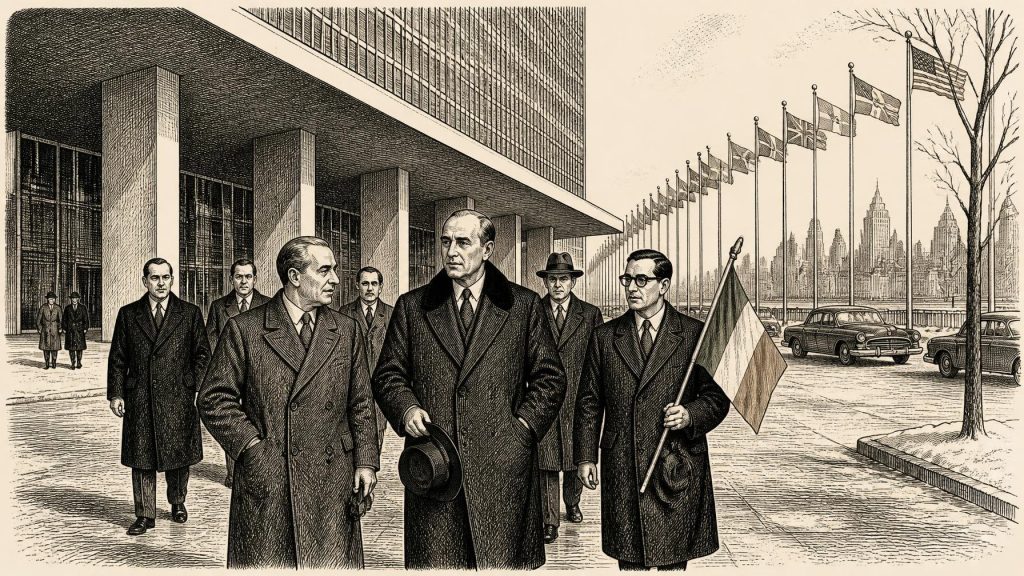
The most clearly dated diplomatic event came on 14 December. On that day the United Nations Security Council recommended Ireland and fifteen other applicant states for membership, and the General Assembly admitted all sixteen through Resolution 995 (X). Ireland had applied much earlier, but Cold War deadlock had held up a group of applications from states on different sides of Europe’s political divide. Admission came not through a special concession to Dublin but as part of a negotiated enlargement that also included Austria, Finland, Italy, Portugal, Spain and several states in eastern Europe, Asia, the Middle East and north Africa.
For Ireland, the vote had importance beyond ceremony. The State had participated in the League of Nations before the Second World War, but United Nations membership gave its diplomats a standing platform in the principal multilateral institution of the post-war world. It created a setting in which the Republic could articulate its interests independently of Britain, while also working with states far beyond its familiar Atlantic connections. Frederick Boland, then secretary of the Department of External Affairs, became Ireland’s first permanent representative to the UN. His appointment marked the beginning of a sustained Irish diplomatic presence in New York.
Membership did not mean abandonment of military neutrality or immediate entry into every international commitment. Nor did it change partition. Northern Ireland remained within the United Kingdom under the unionist government of Lord Brookeborough, while the Republic’s constitutional claim to the whole island remained a central feature of political life in the south. Yet the admission altered the scale on which Irish officials could operate. It placed a State preoccupied with emigration and agricultural income in an assembly of sovereign governments, and it would help provide the institutional setting for Ireland’s later reputation in peacekeeping and international development.
Signals Across the Island
Communications offered another, quieter sign that Ireland could not be understood solely within the borders of the Republic. On 21 July the BBC’s permanent television transmitter at Divis, west of Belfast, took over from the temporary Glencairn service. Technical surveys undertaken soon afterwards found that the transmitter served most of Northern Ireland, though not every peripheral district. It was the first permanent television transmitter on the island.
Television sets were still costly and far from universal. The Republic would not begin its own television service until 1961. Nevertheless, Divis brought BBC pictures into more homes in Northern Ireland and, where reception permitted, across the border. It supplied viewers with programmes made within a British broadcasting system at a time when Radio Éireann remained the Republic’s national broadcasting medium. The new transmitter thus foreshadowed a more visually connected, and less easily compartmentalised, island.
Radio Éireann itself entered new territory on 14 April when The Kennedys of Castleross began. Sponsored by Fry-Cadbury, it was the station’s first soap opera. Its fictional rural setting, recurring characters and lunchtime scheduling made it an example of commercial sponsorship working within public broadcasting. The serial’s long later run suggests that it spoke to a large audience, but in 1955 its significance lay in the experiment itself: familiar domestic storytelling was being adapted to the rhythms of modern mass media.
Stage, Church and Civic Loss
Cultural life also exposed disagreement about the boundaries of public expression. Seán O’Casey’s The Bishop’s Bonfire opened at the Gaiety Theatre on 28 February, produced by Cyril Cusack and directed by Tyrone Guthrie. Demonstrations accompanied the production, with opponents objecting to what they regarded as irreverence towards Catholicism. The controversy should not be reduced to a simple contest between a homogeneous Church and a homogeneous public: there were also organised supporters of the play. But it demonstrated the authority religious sensibilities could exercise over theatre-going, press debate and public order in mid-century Dublin.
Later in the year, on 28 October, the Pike Theatre gave Samuel Beckett’s Waiting for Godot its Irish première, directed by Alan Simpson. Beckett’s spare, unsettling drama was far removed from the domestic realism of radio serials and the public quarrels surrounding O’Casey. Its appearance in Dublin nonetheless placed an Irish-born writer at the centre of a theatrical modernism already attracting international notice. Earlier that year, the English translation of Beckett’s Molloy, prepared with Patrick Bowles, had appeared in Paris and New York. These were firmly dated cultural events, not evidence that every Irish reader or theatre-goer had embraced experimental art; their importance lies in the fact that Dublin stages and Irish literary connections participated in the wider circulation of modernist work.
On the night of 12 December, disaster struck Cork Opera House after a rehearsal for that year’s pantomime, Sleeping Beauty. Fire destroyed the old building on Emmet Place, a venue with a century of associations with concerts, drama, opera and civic gathering. The immediate loss was both material and emotional: Cork lost a major stage and a familiar landmark. The fundraising and rebuilding effort that followed belonged chiefly to later years, but the fire itself was an abrupt reminder that cultural institutions depended not only on artists and audiences, but on vulnerable physical spaces.
By year’s end, 1955 had not resolved Ireland’s defining domestic hardship. Rural insecurity, emigration and economic dependence remained. Yet the year left permanent marks: the NFA supplied farmers with a national organisation; Divis changed the media landscape; radio and theatre tested popular and artistic forms; and UN membership gave the Republic an international seat it had long sought. The contrast between Harcourt Street and Manhattan captures the year’s character. Ireland was trying simultaneously to hold communities together at home and to make itself heard abroad.
Primary Sources
- Admission of New Members to the United Nations: Resolution 995 (X)
- Member States: Ireland
- Resolution 109 (1955)
- 1955 Yearbook of the United Nations
- Timeline of Events, 1919–69
- Private Members' Business: Emigration and Unemployment—Motion (Resumed), 23 February 1955
- Dáil Éireann Debate, 26 October 1955
- Census 1956 Volume 1: Population
- Census of Population 1956: Commentary
- Census Through History
- Our History
- Remarks by President McAleese at a Gala Function in the RDS to Mark the 50th Anniversary of the Irish Farmers’ Association
- Chronological Table of the Statutes: 1955
- Bord na gCon: Appendix II, Historical Background
- The Kennedys of Castleross Episode 1
- Scripts for the Radio Éireann Serial The Kennedys of Castleross, 1955–1967
- The Service Area of the Divis Transmitter
- Broadcasting House, Belfast: A Story Still in the Making
- Waiting for Godot / En Attendant Godot
- Samuel Beckett in Context: Chronology
- Autograph Letter from Seán O’Casey to Mai McCarthy, February 1955
- O’Casey, Seán
- Cork Opera House
- Cork Opera House, Emmett Place, Cork City