The Gaeltacht Department Opens1956 CE
In 1956, Ireland confronted population decline, unemployment and record emigration despite democratic stability and international involvement. The April census confirmed losses, while rural electrification expanded unevenly. Government created the Department of the Gaeltacht, defining language areas and linking Irish preservation with economic and social development. New citizenship legislation reflected continuing constitutional claims regarding Northern Ireland. The IRA’s Border Campaign began in December; Costello’s administration opposed violence while disputing British sovereignty claims. Ireland engaged with UN responses to Suez and Hungary, accepting Hungarian refugee families. T. K. Whitaker became Finance Secretary, and Olympic medals, led by Ronnie Delany, provided national celebration.
Dateline
In 1956, Ireland faced a contradiction visible in almost every part of the country. The State possessed durable democratic institutions, a newly established place at the United Nations and ambitious cultural policies. Yet its population was falling, unemployment and outward migration were subjects of urgent political dispute, and many rural households still lacked services that city dwellers increasingly took for granted. The year was governed in Dublin by John A. Costello’s second inter-party administration, a coalition of Fine Gael, Labour, Clann na Talmhúain and Clann na Poblachta. Its work ranged from the creation of a Department of the Gaeltacht to difficult responses to crisis at the Border and in Europe.
A Census of Departure
The census taken on Sunday, 8 April provided the starkest contemporaneous measure of the Republic’s demographic condition. It recorded a population of 2,898,264, a fall of more than 62,000 since the previous census in 1951. The eventual statistical analysis showed that average annual net emigration during 1951–56 was 39,353, the highest rate for an intercensal period since the beginning of the twentieth century. These figures did not describe an abstract economic difficulty: they reflected young people, often from small farms and towns, leaving for work and wider opportunities in Britain, the United States, Australia and elsewhere.
The decline was especially troubling because it occurred despite natural increase. In practical terms, households lost sons, daughters and potential successors; villages lost customers and voluntary workers; and farms faced a narrowing labour force. The census was a carefully scheduled snapshot rather than an explanation in itself. But it confirmed what public representatives already heard in constituency correspondence and in Dáil debates: employment, low incomes, weak local prospects and migration were tightly linked. In October, Costello acknowledged the political seriousness of unemployment and emigration while arguing that expanded agricultural and industrial output, export surpluses and better living conditions were the necessary remedies. Opposition deputies found that answer too distant from the immediate experience of departure.
This was consequently a year of pressure on the inherited economic model. Protection of domestic industry remained central to policy, agriculture remained a major source of work and export earnings, and the State continued to support infrastructure and local development. But the limits of those arrangements were becoming difficult to overlook. On 30 May, the 39-year-old T. K. Whitaker became Secretary of the Department of Finance. His later influence on economic policy should not be projected backwards as though a new programme began at once: the landmark report Economic Development belonged to 1958. Still, his appointment in 1956 placed an able and unusually young senior official at the centre of government just as the need for a different approach to growth was becoming unmistakable.
Electric Wires and Irish Speech
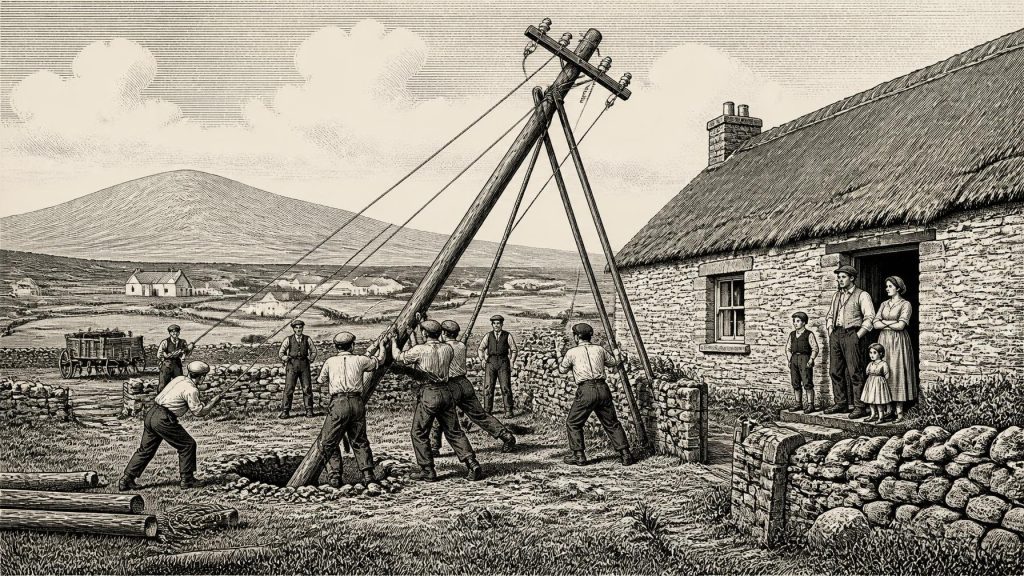
Change reached rural life unevenly. The Electricity Supply Board’s Rural Electrification Scheme was continuing to alter domestic routines and productive possibilities. In the year ended 31 March 1956, 34,257 consumers were connected and 99 rural areas completed; cumulative connections under the scheme reached 162,891. Electric light reduced dependence on lamps and candles, while power could support pumps, machinery and household appliances. Yet connection did not abolish the disadvantages of remoteness, small holdings or scarce employment. Financial pressures also mattered: the withdrawal of the Exchequer subsidy in 1956 slowed the wider programme, and its costs increasingly fell upon the ESB and consumers.
Government policy also addressed rural decline through language and regional administration. The Ministers and Secretaries (Amendment) Act received assent on 5 June and enabled the creation of a separate Department of the Gaeltacht. The department formally began work on 2 July, initially under Richard Mulcahy, who was Minister for Education as well as Minister for the Gaeltacht; Patrick J. Lindsay succeeded him in the Gaeltacht portfolio in October. This was more than a symbolic rearrangement. The new department was charged with promoting the Gaeltacht’s cultural, social and economic welfare, preserving and extending Irish as a vernacular language, and advising other departments on services affecting those areas.
The Act also provided a statutory framework for defining Gaeltacht areas. The Gaeltacht Areas Order of 1956 identified specified district electoral divisions and townlands in Donegal, Galway, Mayo, Kerry, Cork and Waterford. It replaced a looser inherited understanding with mapped administrative boundaries. The decision recognised that language survival could not sensibly be separated from roads, housing, employment, fishing, farming and access to public services. A special Irish-language inquiry was included in the April census for designated areas. The evidence gathered in 1956 therefore served both cultural policy and a more practical question: whether communities in which Irish remained part of daily speech could retain their population.
Citizenship and an Unsettled Island
On 17 July the Irish Nationality and Citizenship Act, 1956, updated the law on citizenship, naturalisation and loss of citizenship. Its provisions covered citizenship by birth and descent, citizenship of adopted children, registration of births abroad, naturalisation, and the possibility of honorary citizenship granted by the President. It also contained a striking Partition-era qualification. Pending the “re-integration of the national territory”, a person born in Northern Ireland after 6 December 1922 did not automatically gain citizenship under one provision unless a declaration was made. The law thus combined practical rules for families, migration and administration with the Republic’s constitutional and political refusal to regard Partition as settled.
That unresolved issue acquired a violent new form late in the year. On the night of 11–12 December, the Irish Republican Army launched Operation Harvest, generally known as the Border Campaign. Attacks were directed at targets in Northern Ireland, including British military facilities and other security or communications sites. At Gough Barracks in Armagh, armed men fired on the barracks and threw incendiary devices; an unfinished Territorial Army centre at Enniskillen was seriously damaged. The campaign’s proclaimed objective was to end Partition through armed action, but its opening did not represent policy of the Irish Government.
Dublin publicly rejected the use of force on 14 December. Costello’s government stated that it would take steps, with the Gardaí and Defence Forces, to prevent activities likely to cause loss of life. Its position was politically complex but clear: it continued to seek Irish unity, while insisting that unlawful military activity challenged the democratic institutions of the State. London nevertheless delivered an aide-mémoire expressing concern. On 19 December, Prime Minister Anthony Eden restated at Westminster the United Kingdom’s responsibility for Northern Ireland and referred to its status under the Ireland Act 1949. Costello’s reply of 24 December protested that formulation while reaffirming opposition to violence. In other words, the governments disagreed fundamentally over sovereignty but the Republic did not endorse the IRA’s campaign.
For people living near the Border, these exchanges had immediate consequences. The Northern Ireland authorities responded with security measures, including road blocks authorised on 21 December, and used powers of detention against republican suspects. The escalation at year’s end sharpened boundaries that had already shaped trade, travel, policing and political identity. It also foreshadowed a campaign that would continue into the early 1960s; that later course, however, should not obscure how abruptly the armed phase began in December 1956.
A New International Responsibility
Ireland was in its first full calendar year as a member of the United Nations, having joined in December 1955. The crises of 1956 gave that membership immediate meaning. The Suez conflict and the Soviet suppression of the Hungarian uprising dominated international discussion. Irish officials engaged with the United Nations response and considered participation in the new United Nations Emergency Force for the Middle East, although Irish military observers would not be sent abroad until 1958. The year marked the beginning of a more active Irish engagement with multilateral diplomacy rather than an instant transformation of defence policy.
Hungary brought a more tangible humanitarian decision. On 23 November, the Cabinet agreed in principle to admit up to 500 refugees consisting of children and family groups, with provision to accept more if necessary. It asked officials and the Irish Red Cross to organise selection and transport from Austria. The decision was compassionate, but its limits are revealing: able-bodied adults outside family groups were generally excluded from the initial plan. Ireland, itself marked by mass emigration and limited employment, was beginning participation in international refugee relief while calculating its capacity with caution. By the end of the year, Hungarian families were arriving and being accommodated through Red Cross arrangements, including the former military site at Knockalisheen in County Clare.
Melbourne’s Shared Celebration
Against this background of anxiety, Irish sport produced a memorable public success. At the Melbourne Olympic Games, on 1 December, Dublin runner Ronnie Delany won the 1,500 metres in an Olympic-record 3 minutes 41.2 seconds after a decisive late surge. Ireland also won silver through boxer Fred Tiedt and bronze medals through boxers Freddie Gilroy, John Caldwell and Tony Byrne. The team’s five medals made these the country’s most successful Olympics to that point.
Delany’s victory was especially resonant. A 21-year-old Irish athlete, educated in Dublin and competing while studying at Villanova University, offered a rare international triumph at a time when much public discussion concerned young citizens leaving the country. His success could not resolve the economic and political pressures disclosed during 1956. It did, however, furnish a powerful shared moment of achievement. The year ended with wires extending across rural districts, a new department charged with protecting Irish-speaking communities, refugees seeking a future in Ireland, and renewed danger along the Border: signs of a society at once modernising, anxious and outward-looking.
Primary Sources
- Fifteenth Dáil
- Census 1956 Volume 1 – Population
- Census through History
- Statistics (Census of Population) Order, 1956
- Ceisteanna—Questions. Oral Answers. – Unemployment and Emigration
- Ministers and Secretaries (Amendment) Act, 1956
- Gaeltacht Areas Order, 1956
- Report – Appropriation Accounts 1956 – 1957
- Irish Nationality and Citizenship Act, 1956
- Former Secretaries General
- Twenty-Ninth Annual Report and Accounts, 1955-56
- Rural Electrification
- Electricity Supply in Ireland
- Volume 10 – Documents on Irish Foreign Policy
- Extract from the Minutes of a Meeting of the Cabinet: ‘Refugees from Hungary: Admission’
- Memorandum by Moynihan: Irish Aid to Hungarian Refugees
- Aide-Mémoire from John A. Costello to Sir Alexander Clutterbuck
- Military Barracks, Northern Ireland (Attacks)
- Northern Ireland (Situation)
- The Northern Ireland Border
- The Border Campaign
- History of the Army
- What Was the Irish Response to Hungarian Refugees in the 1950s?
- Melbourne 1956
- Ronnie Delany
- Ronnie Delany