

Blockade Politics
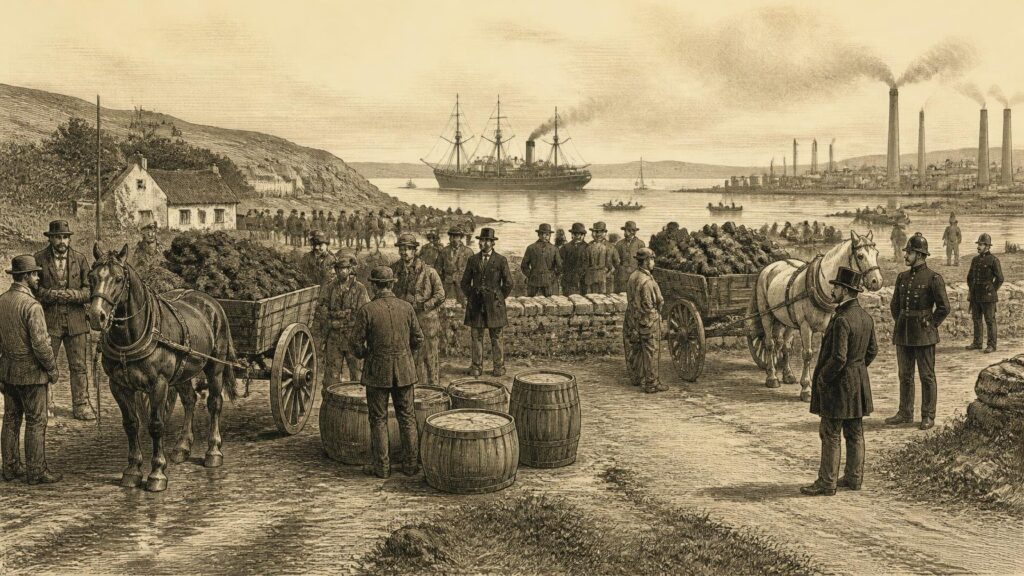
AI generated historical illustration, not a contemporary photograph.
At a Glance
In April 2026, rising fuel prices became the immediate cause of a national confrontation in Ireland, but the dispute quickly grew into something wider: an argument about economic vulnerability, the limits of protest, representative authority and the confidence owed to a Government in a parliamentary democracy. Convoys, blocked depots and crowded streets made the crisis highly visible. Yet its deeper significance lay in the way a price shock at the pump exposed the interdependence of households, farms, transport firms, health services, ports and political institutions.
Immediate Spark
The fuel protests of April 2026 emerged during an abrupt international energy shock associated, in Government statements and parliamentary debate, with conflict in the Middle East and the Gulf alongside the continuing effects of the war in Ukraine. Irish consumers and businesses did not experience that shock as an abstract matter of geopolitics. They encountered it in the daily price of petrol, diesel, home-heating oil and the fuels required to move goods, collect milk, operate machinery, reach appointments or travel to work. The apparent simplicity of the complaint—fuel had become too expensive—gave it a broad emotional force.
That simplicity should not obscure differences among those affected. A private motorist may respond to a price rise by cutting journeys, postponing purchases or accepting a smaller household budget. A haulier, farmer, agricultural contractor, fisher or home-care worker has fewer such choices when fuel is a direct business input. For transport operators, fuel costs are bound up with margins, contracts and competition. For agricultural producers, they are incorporated into the cost of feeding animals, operating equipment, transporting produce and maintaining supply chains. In rural areas, where public transport can be sparse and distances long, fuel is often closer to a basic necessity than a discretionary consumer good.
It was therefore unsurprising that organised and unorganised participants alike found a language of survival rather than merely inconvenience. They spoke of work becoming uneconomic, of rural life being misunderstood, and of a political system too slow to recognise pressures before they reached a breaking point. Such claims were political arguments, not measurements in themselves. They nevertheless rested upon a real material problem: a rapid change in energy costs could redistribute hardship quickly between households, businesses and regions.
The protests began with road action and slow-moving convoys, but their character changed when participants targeted fuel infrastructure. By 8 April, reporting from Whitegate in County Cork described blockades at the country’s only oil refinery as well as disruption at other distribution points. The force of the action came not from the number of protesters alone but from the location chosen. Fuel infrastructure is designed to keep products moving continuously from import, refining or storage through terminals and tankers to filling stations and end users. Interrupting that movement can produce consequences out of proportion to the size of a blockade.
This was the central contradiction of the protest. Its participants sought to demonstrate that fuel was indispensable to ordinary life and productive work. Their most effective tactic was to stop fuel moving. The tactic made the complaint impossible to ignore, but it also placed pressure on people whose circumstances might be no better than those of the protesters: patients travelling to hospital, care workers, small businesses, bus passengers, dairy farmers and families trying to obtain enough fuel for essential journeys.
The phrase “fuel protests” can therefore mislead if it implies a single, unified campaign with one social base, one leadership and a settled programme. Evidence available during the episode indicates a more fluid coalition. Farmers, hauliers, contractors and other motorists appeared in overlapping local actions. Established representative organisations engaged separately with ministers. People at blockades did not necessarily speak for every worker in the sector with which they were associated. This distinction became increasingly important as the Government decided whom it would negotiate with and whom it would treat as organisers of an unlawful disruption.
Fuel Geography
Ireland’s fuel system gave the protests unusual leverage. The State is an island economy dependent on maritime connections, road distribution and a relatively small number of strategically important facilities. Fuel may be purchased in thousands of ordinary transactions, but it reaches forecourts through a concentrated logistical network. That network is usually inconspicuous. In April 2026 it became visible in queues, empty pumps, traffic diversions and reports of tankers unable to reach or leave terminals.
Whitegate, in east Cork, became the most symbolically charged site because it is Ireland’s sole oil refinery. The blockade there was not simply a local dispute. It highlighted the importance of infrastructure that most citizens rarely consider until it fails. Reporting during the protest also identified disruption at Foynes in County Limerick and at Galway, while road action affected Dublin and other routes. Taken together, those locations linked refinery, port, storage, road transport and urban consumption.
The geography mattered politically as much as commercially. A march outside a government building communicates anger directly to office-holders. A blockade at a refinery or depot communicates a capacity to interrupt the whole economy. It is a form of leverage built on circulation. The protesters’ argument was that circulation had already become unaffordable for those expected to keep the country supplied. The Government’s response was that preventing circulation imposed an intolerable burden on everyone else.
Both propositions could be true at once. It is entirely possible for transport and agricultural businesses to face acute financial pressure, and also for an obstruction to aggravate the conditions of people who have no practical part in the dispute. Historical interpretation should resist the temptation to turn such a conflict into a simple contest between virtue and wrongdoing. The defining feature of infrastructural protest is precisely that it connects a legitimate grievance to a tactic with extensive collateral effects.
The case of Galway illustrated this sharply. RTÉ reported that a tanker carrying six million litres of fuel was unable to unload while access to the depot was restricted and storage capacity could not be freed. This was not a shortage in the usual sense of an empty national stock. Fuel existed, but it could not reach the places where it was needed. The distinction is important. It showed that modern energy security depends not only upon having supplies in the country, but upon the continuous, orderly operation of transport, storage, staffing, policing and access routes.
In that sense, the protests created a civic lesson in logistics. A filling station forecourt appears to be an independent commercial site, but its ability to sell fuel depends on drivers, depots, ports, roads, information systems and predictable access. The same is true, at another scale, of hospitals, farms and food distribution. The most durable historical significance of the episode may be that it brought this hidden architecture of everyday life briefly into public view.
Rural Burdens
Fuel prices have a particular political resonance in Ireland because arguments about transport and energy often overlap with arguments about rural disadvantage. The country’s population is not confined to a single metropolitan region, and public services, employment opportunities and commercial activity are distributed unevenly. For many rural households, the car remains essential. For farming and fishing communities, the issue reaches beyond commuting: diesel, heating fuel and transport are integral to production.
Those circumstances help explain why the protests acquired a language of neglected work. Protesters and sympathetic commentators presented fuel as a cost imposed on people who already performed essential but under-recognised labour. Haulage keeps shops supplied; agricultural transport connects farms and processors; contractors undertake seasonal work; fishers depend upon fuel-intensive vessels; carers travel between clients. The argument was not merely that fuel cost too much. It was that the cost was passed into livelihoods that urban political discussion could too easily overlook.
There is evidence that disruption itself rapidly affected agriculture. On 8 April, the Minister for Agriculture referred to reports that milk was not being collected from some dairy farms and warned of potential consequences for animal welfare where feed ingredients could not move through ports and supply chains. Such warnings did not disprove the underlying grievances of many protesters. Rather, they demonstrated the fragility of the systems on which rural production relies. Farmers could share the anger over fuel costs while also suffering from blocked movement of milk, feed and supplies.
This complication matters because “the rural interest” was not a single interest. A dairy farmer awaiting a milk tanker, a contractor operating a tractor in a convoy, a livestock producer requiring feed, and a village shop proprietor facing empty forecourts could all experience the same protest differently. Political slogans tend to smooth away those differences. Historical analysis should restore them.
The Government sought to distinguish between listening to recognised bodies and yielding to blockades. In practice, representatives of the Irish Road Haulage Association, farming organisations and other sectoral groups met ministers during the crisis. The language of representation was central. Ministers argued that they would engage with national organisations and democratically elected representatives, rather than with what they described as self-appointed spokespeople. Protesters, by contrast, often claimed that established bodies had failed to convey the urgency experienced by people on the ground.
This was an old dispute in a new setting. Representative organisations offer continuity, procedures and a recognisable mandate, but they can be criticised as cautious or remote. Spontaneous protest offers immediacy and can reveal discontent that formal structures have not absorbed, but it may lack accountability and agreed authority. The April protests exposed the gap between those two forms of political expression. That gap was not created by fuel prices, though the price shock made it impossible to ignore.
Protest Anatomy
Public memory often condenses a fast-moving protest into a few dramatic images: tractors outside a refinery, heavy vehicles in city streets, a line of parked lorries, Garda officers at a barricade. Those images are important, but they cannot tell the whole story. The April 2026 protests were composed of varied actions across several days and places. Their methods included convoys, road disruption, gatherings, depot blockades and the occupation or restriction of routes close to key facilities.
Convoys have a special place in fuel protests because they are both expressive and practical. A line of tractors or trucks signals the identity of participants through the vehicles of their work. It demonstrates numbers without requiring a conventional march. It also creates congestion, which may be the very point. Slow-moving or stationary vehicles turn ordinary roads into arenas of negotiation between protest rights, traffic management and public inconvenience.
The move from convoy to blockade was more consequential. A convoy can inconvenience; an infrastructure blockade can ration access to a vital good. At Whitegate and other sites, the action was no longer confined to making a demand visible. It threatened the movement of fuel at a time when prices were already the source of public anxiety. Government figures and industry representatives repeatedly emphasised that the problem was access, not an absence of fuel stocks. The protesters had therefore found a tactic that could create a shortage-like experience without resolving the underlying price crisis.
There were also differences between the declared aims of the action and the meanings others attached to it. Participants said they sought lower prices, tax relief and recognition of mounting pressures. Critics viewed the depot blockades as coercive and self-defeating. Opposition politicians attempted to separate sympathy for people struggling with costs from endorsement of a tactic that endangered supplies. These distinctions were politically necessary, because the public could support the demand for relief without supporting the restriction of fuel to the wider public.
Social media amplified this ambiguity. It helped assemble people rapidly, circulate footage and sustain local momentum, but it also made it difficult to establish a stable chain of responsibility. In decentralised protest, a person may attend because of a broad grievance without accepting every message, symbol or tactic associated with others present. Conversely, a small group can acquire outsized influence by controlling a strategic site. Contemporary records will need careful reading before historians can state with confidence how decisions were made, who directed particular actions, or how representative individual organisers were.
Folklore emerged quickly, as it often does during periods of disruption. Accounts of empty stations, alleged shortages, impending national shutdowns and supposed hidden negotiations circulated faster than verified information. Some were based on visible experience: a closed forecourt or a cancelled journey. Others were harder to substantiate. The distinction between a real local shortage and a national exhaustion of supply became especially important. Contemporary reporting and official statements consistently described a distribution crisis, though individual motorists could understandably experience an empty pump as a shortage in the fullest sense.
For historians, the episode is a reminder that a protest’s public meaning is made by more than organisers. It is made by participants, onlookers, political parties, broadcasters, police, businesses and those inconvenienced by it. The power of April’s blockades lay partly in this contest over interpretation. Was the protest a necessary act of working people pushed beyond endurance, an unlawful threat to public welfare, or an unstable mixture of both? The answer depended not only on facts but on political values.
State Response
The State’s response moved through several phases: acknowledgement of economic pressure, appeals for blockades to end, engagement with sectoral representatives, emergency planning, enforcement and the announcement of financial supports. That sequence reflected a difficult balance. A Government that refused to recognise hardship risked appearing aloof. A Government that made policy under the immediate pressure of blockades risked suggesting that control of infrastructure was an acceptable route to political influence.
By 9 April, the Minister for Justice, Jim O’Callaghan, stated that the blocking of critical national infrastructure would not be permitted to continue and that assistance from the Defence Forces had been requested in aid to the civil power. The statement was deliberately firm. It warned owners of large vehicles that they should remove them and declared interference with access to fuel and clean water unacceptable. The reference to military assistance did not mean that the Defence Forces had replaced civilian policing. It referred to the longstanding principle that they may assist An Garda Síochána when lawfully requested.
The language of critical infrastructure was central to the Government’s case. It placed refineries, depots, ports and routes within a category more serious than an ordinary traffic protest. This was not merely a question of property or commercial loss. Ministers and officials argued that fuel access affected emergency services, healthcare, food distribution and water. Once framed in those terms, the State could present enforcement as an obligation to protect the rights and safety of people beyond the immediate dispute.
Yet enforcement alone could not settle the political crisis. The Government also held discussions with representative bodies and developed an enhanced support package. On 12 April, it announced measures worth more than €500 million to assist people affected by energy costs. The package included temporary reductions intended to lower petrol and diesel prices, subject to the relevant parliamentary processes, alongside other supports. The detail of individual measures mattered, but the announcement also had a communicative purpose: it demonstrated that the State was responding to the underlying cost pressures while refusing to treat blockades as the legitimate decision-making mechanism.
That distinction was repeatedly emphasised. The Government portrayed talks with recognised sectoral organisations as constructive engagement and blockades as an unacceptable attempt to dictate terms. This was a constitutional argument as much as an administrative one. Ministers did not deny that protest could be legitimate. They claimed, rather, that public policy could not be settled by those able to interrupt vital supply systems.
Whether the response was timely is a political judgement on which contemporaries disagreed. Critics said ministers had reacted only after disruption became severe and that delayed assistance helped create the conditions for escalation. Supporters said the international price shock could not be eliminated by domestic policy and that the Government acted to cushion its effects while protecting essential services. A historical account can record both arguments without pretending that either automatically resolves the other.
The most important documented point is that the response combined concession and coercion. This combination is characteristic of democratic government in disputes involving essential infrastructure. The State may acknowledge a grievance, negotiate with recognised interests and spend public money, while also insisting that roads, ports, refineries and emergency services cannot be subject to indefinite obstruction. The April crisis revealed how controversial that balance can become when many citizens accept the grievance but question the method.
Public Services
The strongest case against the blockades was made not by abstract claims about order but by their visible consequences for public services. By 10 April, the Department of Health said that fuel disruption was affecting ambulance operations, home care, meals-on-wheels services and respite provision. Health officials and ministers warned of risks to patient safety and of regional variations in the effect of restricted fuel supplies, with the west, mid-west and south-west particularly affected at that stage.
These effects transformed the moral and political terrain of the protest. A fuel price dispute might be understood as a contest between taxpayers and Government, workers and employers, or rural communities and decision-makers. Once ambulances, dialysis appointments, cancer treatment, home care and hospital staffing entered the picture, the dispute became a question of vulnerability. It brought into view people who could neither absorb rising costs easily nor join a convoy or wait through a disruption.
The health system’s predicament also showed that essential services do not operate in isolation. An ambulance fleet may have priority access to fuel, but its functioning depends on staff getting to work, pharmacies receiving deliveries, home-care workers travelling between homes and patients reaching scheduled appointments. A disruption in one part of the fuel network can therefore multiply through many other services. The historical record of the crisis should not reduce this to a dramatic claim that the entire system stopped; it did not. Rather, the evidence points to mounting contingency planning, altered priorities and serious concern about what might follow if blockades continued.
The Government and Gardaí also faced a practical dilemma. Rapid intervention might reopen a route but could provoke confrontation or shift the action elsewhere. Delay might lower immediate tension but encourage further obstruction and leave vital services exposed. The clearing of blockades at Whitegate and Galway required a substantial police operation, and contemporary reports referred to arrests. Such events should be read with care. The mere fact of arrest does not settle questions of proportionality, just as the existence of a grievance does not settle the legality of a blockade.
Transport disruption extended beyond emergency services. Dublin city-centre road closures and the presence of protest vehicles affected bus routes and ordinary journeys. At Rosslare, services were affected by restrictions near the Europort. Businesses faced uncertainty over deliveries and staff travel. The cost of that uncertainty is difficult to calculate immediately, because it includes lost time, missed appointments, cancelled work and the precautionary behaviour of people who avoid travel or fill tanks early. This is why fuel blockades can have a psychological effect beyond their physical reach.
Public reaction was not uniform. Many people could sympathise with high fuel bills while resenting the inability to obtain fuel or reach a destination. Others saw the disruption as regrettable but necessary because quieter protests had failed to produce action. The division was not simply between city and countryside, or between left and right, or between workers and Government. It ran through households, workplaces and communities. That complexity helps explain why political parties found it easier to condemn disruption than to dismiss the anger from which it emerged.
Parliamentary Confidence
The crisis entered its most explicitly constitutional phase when Sinn Féin tabled a motion of no confidence in the Government. A fuel protest had become a test of executive authority. The parliamentary debate did not concern fuel prices alone. It concerned whether the Government had understood the cost-of-living pressures, whether it had responded quickly enough, whether it had mishandled the protests, and whether its actions had protected or endangered public confidence.
The wording of the Dáil motion is revealing. It linked high energy and fuel prices to a pre-existing cost-of-living crisis and argued that Government had a duty to shield people from severe energy shocks. It criticised delays, alleged insufficient engagement and called for maximum action to make fuel affordable. The Government’s amendment acknowledged the pressure caused by international conflict and emphasised its support measures, engagement with representative bodies and opposition to unlawful blockades.
This was a classic parliamentary reframing. Protesters had made claims through roads, depots and public squares. Opposition parties translated those claims into a constitutional critique of the Government. The Government, in turn, translated its response into a defence of institutional order and responsible administration. The result was not a direct referendum on the protesters. It was a contest over which political interpretation of the crisis should command a majority in Dáil Éireann.
The Government survived the confidence vote on 14 April by 92 votes to 78. The arithmetic preserved the coalition, but it did not erase the political damage or the underlying disagreement. A Government can win a division and still be forced to recognise that a public grievance has altered the political climate. Equally, an opposition can lose a vote while establishing a narrative it hopes will matter at later elections. Confidence motions are decisive in the narrow constitutional sense, but their longer meaning is often unsettled.
There is a temptation to interpret every confidence vote as a simple measure of public opinion. It is not. TDs vote within party structures, coalition arrangements and institutional rules. Their decision may reflect views on the motion’s wording, the prospect of an election, the conduct of protesters, the adequacy of announced supports, or the wider record of the Government. A vote of confidence says that the Government retained the support required to remain in office at that moment. It does not prove universal approval of its policies or universal rejection of the protest.
The episode nevertheless revealed an important relationship between street politics and parliamentary politics. Protest can accelerate issues already present in public life, forcing parties to declare positions more sharply. It can also complicate opposition strategy. Parties may wish to champion people facing hardship without endorsing actions that obstruct ambulances or fuel supplies. Government parties may wish to defend public order without sounding indifferent to hardship. The April debate obliged each side to draw those lines in public.
The term “confidence” had a second meaning beyond the formal motion. It referred to confidence in the reliability of supply chains, in the capacity of emergency services, in the fairness of institutions and in the willingness of Government to listen before frustration hardens into confrontation. The vote resolved the first of those questions temporarily. The others could not be decided by a division bell.
Historical Echoes
The April 2026 protests did not arise from nowhere. Ireland had experienced an earlier wave of fuel-price agitation in September 2000, when hauliers, farmers and fishers protested rising costs in a European context shaped by high oil prices and fuel-tax controversy. Contemporary reports recorded truck protests in Irish cities and towns, concern about blockades, and the formation of a Government task force. Fishers also staged a 24-hour tie-up, citing the heavy burden of fuel on vessel operating costs.
The comparison is useful but should not be pushed too far. The Ireland of 2000 was economically, technologically and politically different. It was in the period commonly associated with the Celtic Tiger, with a different communications environment, different patterns of employment and a different relationship between domestic politics and global energy markets. Yet the earlier episode reveals enduring features of fuel protest. First, fuel taxes and prices are uniquely visible. Second, sectors that consume fuel as an input can mobilise vehicles and machinery as both tools of work and instruments of demonstration. Third, protest in one European country can encourage or shape action in another when a shared oil-price shock is involved.
There is also continuity in the tension between the protester’s economic claim and the public consequences of disruption. Hauliers in 2000 could point to costs that threatened their businesses. Government and the public could point to the effects of road blockages and supply disruption. The underlying question was similar: how should a democratic state respond when a group’s economic vulnerability gives it the capacity to inconvenience or constrain the wider population?
Ireland’s broader history offers still older parallels, though none is identical. Rural protest has repeatedly used the visibility of land, roads, livestock, markets and local knowledge to contest decisions made elsewhere. Nineteenth-century agrarian agitation often involved boycotts, mass meetings and efforts to regulate local economic life through collective pressure. Labour disputes in the twentieth century demonstrated the power of workers positioned at key points in transport and distribution. Campaigns over road building, environmental risk and resource extraction have similarly shown that infrastructure can become a focus for arguments about consent, development and local rights.
These are analogies, not direct lines of descent. It would be misleading to describe the 2026 protesters as heirs to any one historical movement, or to imagine a continuous tradition with unchanged aims. The context was different: a global energy shock, a digital communications environment, modern policing, a parliamentary coalition and a highly integrated supply economy. Still, historical comparison helps explain why blockades command attention. They exploit the fact that collective life depends upon movement: of people, goods, fuel, information and authority.
The 2026 protests also echoed the fuel demonstrations that affected Britain and continental Europe in 2000. In those episodes, blockades of refineries and distribution points demonstrated how rapidly a logistics dispute could become a national political emergency. The lesson was not that every country would follow the same pattern. Ireland’s geography, fuel infrastructure and political institutions gave the April crisis its particular shape. But the wider European precedent made the tactics intelligible to contemporaries.
Another historical echo lies in the relationship between physical protest and mediated public opinion. In 2000, television, radio and newspapers were the principal national forums through which people encountered a blockade beyond their locality. By 2026, video clips, message groups and social platforms enabled almost instant circulation of images and claims. This accelerated mobilisation but also increased uncertainty. A short recording could create an impression of national unanimity or catastrophe without providing scale, location or context. Official statements and public-service reporting consequently became part of the struggle over trustworthy information.
Historians should be particularly alert to retrospective simplification. Later narratives may portray the protesters as a united popular rising, or the Government as a monolithic defender of order, or the support package as either a victory won by direct action or an independent response already in preparation. The available evidence does not support such neat conclusions. The protest involved diverse people and motives. The State used both negotiation and enforcement. The measures announced by Government were real, but their relationship to the pressure created by blockades will remain a matter of interpretation.
Political Meanings
The most significant question raised by April 2026 was not whether fuel prices mattered. Plainly they did. The harder question was what kind of political response high prices should produce. There were at least four competing answers. One held that the crisis demanded immediate tax reductions and targeted support. Another argued for longer-term insulation from fossil-fuel volatility through energy transition and transport alternatives. A third stressed the right of citizens to protest when ordinary political channels seem ineffective. A fourth insisted that no grievance could justify controlling access to essential infrastructure.
These positions overlapped more than public rhetoric sometimes allowed. A person could favour temporary relief while supporting climate measures over time. A person could sympathise with protesters while rejecting depot blockades. A person could defend policing while believing the Government had been late to act. The political challenge was that public debate rewarded sharper binaries: listening versus indifference, protest versus sabotage, rural Ireland versus Dublin, people versus establishment.
The energy transition complicated matters further. Efforts to reduce reliance on fossil fuels are often presented as environmental necessities, and there is strong evidence internationally that dependence on imported oil exposes countries to price and geopolitical shocks. Yet transition policies can lose legitimacy if people whose work depends on vehicles believe they are being asked to bear costs without workable alternatives. For many rural or transport-dependent workers, a promise of future change does not answer an invoice due today.
This does not mean that every fuel-price intervention is either socially just or environmentally sound. Broad reductions can benefit those who consume most fuel as well as those who are most burdened. Targeted supports may be fairer but more administratively complex. Taxes fund public services even as they raise pump prices. Temporary relief may cushion a shock while leaving the underlying exposure untouched. These are policy trade-offs rather than questions that can be settled by slogans.
The protests also raised questions about political trust. When people say that no one listens, they may mean several things: that they have not received the outcome they want; that consultation feels remote; that their representative body is not forceful enough; that their local circumstances are misunderstood; or that they distrust the information supplied by Government and media. Each problem requires a different response. Treating all dissatisfaction as misinformation is as unhelpful as treating all institutional restraint as proof of bad faith.
Confidence in democratic institutions depends partly on visible competence. During a fuel disruption, competence includes maintaining emergency services, communicating accurately, protecting lawful protest, preventing intimidation and explaining what measures Government can realistically take. It also depends on procedural fairness: whether those affected can make their case through channels that appear meaningful before they conclude that disruption is their only leverage.
The April episode showed that economic protest can become a referendum on representation. Protesters questioned whether elected institutions and established associations reflected their circumstances. Ministers answered that decisions must be taken by accountable institutions rather than by whoever could block a road or depot. Neither claim can simply be dismissed. Democracies require mechanisms for urgent dissent, but they also require safeguards against the power of strategically placed groups to impose costs on everyone else.
There is a further question about narrative ownership. The Government emphasised the international roots of the energy shock and the danger posed by blockades. Protesters emphasised domestic tax choices and the cost of living. Opposition parties emphasised governmental delay and lack of empathy. Each narrative selected genuine elements of the crisis. The historical task is not to choose one slogan as the whole truth, but to understand how these elements interacted: external price pressure, domestic policy, rural dependence, transport costs, infrastructural vulnerability and political mistrust.
Future Questions
By the end of the immediate crisis, the blockades had been cleared or stood down, fuel movement had begun to recover, and the Government had survived a confidence vote. Those facts mark an end to the acute phase, not an end to the issues revealed. Ireland remained exposed to international energy prices. Households and businesses still faced uneven transport needs. The relationship between rural livelihoods, climate policy and fuel taxation remained politically sensitive.
Future historical research will need more evidence than was available in the first weeks after the protests. It will need records of cabinet decisions, Garda operational material where eventually released, correspondence between departments and industry, the accounts of participants, and data on retail supply, prices and service disruption. Oral testimony will be valuable, but it will also require careful comparison with contemporary documentation. Memory tends to give coherence to events that were confused while they were happening.
Several questions deserve particular attention. Did the emergency measures materially change the position of the people most affected by higher fuel costs? Did the protests alter the negotiating power of representative organisations? How did social media shape turnout, rumour and leadership? Were there lasting consequences for policing of critical infrastructure? Did the episode change public support for fuel-tax policy or for the broader energy transition? These are research questions, not conclusions already established by the evidence.
The lasting lesson may be less about fuel itself than about dependency. Modern Ireland depends on systems that are efficient precisely because they operate continuously and largely unnoticed. When one link is disrupted, the consequences travel quickly. Protesters demonstrated the political power contained in those systems. The Government demonstrated the limits it believed democratic order must place upon that power. Between those two positions lay the unresolved problem of how a State should respond when rising prices turn private hardship into collective anger.
April 2026 was, therefore, more than a week of blocked roads and empty pumps. It was a compressed episode in which economic grievance, logistical fragility and parliamentary authority collided. Its history should be written neither as a romantic tale of popular defiance nor as a simple story of disorder overcome. It was a conflict over who bore the cost of an international crisis, who could speak for those affected, and what forms of pressure a democratic society could accept when confidence in ordinary channels had weakened.

The article reveals a striking paradox: blockades made the burden of fuel costs visible, yet disrupted deliveries could intensify hardship for dairy farmers, care workers, patients and small businesses. Its emphasis on Whitegate and other nodes suggests that energy security depends not only on fuel stocks, but also on uninterrupted access, transport and distribution. The protests likewise exposed tension between spontaneous action and established representative bodies, each claiming to express urgent concerns. This raises an important policy question about whether governments can address rural and haulage dependence on fuel without rewarding disruptive tactics. How should Ireland balance these competing needs?