Leth Cam and Lusca827 CE
In 827, Irish annals recorded conflict, church politics, Viking raids and royal diplomacy across a divided island. Niall Caille of Cenél nÉogain defeated forces of Ulaid and Airgialla at Leth Cam near Armagh, strengthening his influence and supporting Éogan Mainistrech’s ecclesiastical position. Church leaders also died at Tallaght, Fir Rois and Cell Achaid. Viking raiders burned Lusk, ravaged eastern districts and defeated a Leinster encampment, killing Conall of the Fortuatha. Violence disrupted fairs at Tailtiu and Colmán. Finally, Munster’s Feidlimid and Tara’s Conchobor held a royal conference at Birr, acknowledging competing powers amid instability within Ireland’s political and religious life.
Dateline
The year 827 survives in the Irish annals as a concentrated record of violence, contested authority and external attack. No source supplies a month or day for its principal events, and the annalistic year itself should not be mistaken for a modern calendar diary. Yet the entries conventionally assigned to 827 are unusually revealing. They show northern kings fighting over influence at Armagh, royal power asserted – and blood spilled – at major assembly fairs, Viking raiders striking the east-coast heartland, and the leading rulers of Munster and Tara meeting at Birr. Ireland was not a single kingdom, but a landscape of competing dynasties, church communities and regional peoples. In this year, their rival claims collided particularly visibly.
A Northern Battle for Armagh
The year’s most consequential Irish conflict was the battle of Leth Cam. The Annals of Ulster records a victory by Niall son of Áed over the Uí Chremthainn and Muiredach son of Eochaid, king of Ulaid. Cumuscach and Congalach, sons of Cathal, fell with many other kings of the Airgialla. Niall was Niall Caille, ruler of Cenél nÉogain and king of Ailech; he would not become king of Tara until 833. In 827, therefore, his victory was an expansion of northern regional power, not an act undertaken by a universally acknowledged high king.
The battle cannot be separated from a dispute at Armagh. The annals first report the “dishonouring” of Éogan at Ard Macha by Cumuscach son of Cathal and Artrí son of Conchobor. That compressed phrase points to an assault on Éogan Mainistrech’s claim to Armagh’s headship, the prestigious succession of Patrick. Armagh was a major ecclesiastical community, but its religious offices carried political consequence: control of its personnel, revenues, clients and sacred authority mattered to kings. Éogan enjoyed Niall’s support, while his opponents were bound into rival political networks.
A later and fuller account in Chronicon Scotorum makes the connection explicit. It presents Artrí as Éogan’s rival for Patrick’s succession and says that Niall intervened after Éogan appealed to him. It locates Leth Cam in Mag Enir, near Armagh, and declares that the ensuing victory secured Éogan’s tenure. This should be used with care: the fuller narrative was written down later than the terse Annals of Ulster, and it adds details absent from that annal. It nevertheless accords with the broader pattern. Niall’s military success sharply increased Cenél nÉogain influence over Airgialla and at Armagh.
There is one important difference between the records. Chronicon Scotorum says that Muiredach, king of Ulaid, was killed at Leth Cam, whereas the Annals of Ulster names Cumuscach, Congalach and other Airgialla kings among the dead but does not explicitly include Muiredach. The discrepancy cautions against presenting every later detail as certain. What is firm is that forces of Ulaid and Airgialla confronted Niall, that leading men were killed, and that the battle decisively favoured the northern Uí Néill interest around Armagh.
Church Office and Community
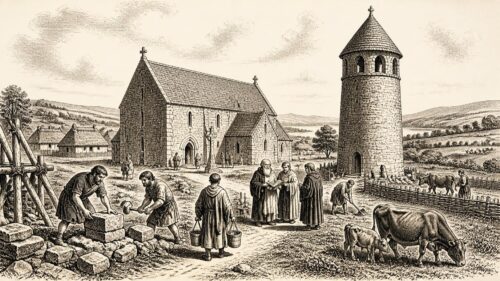
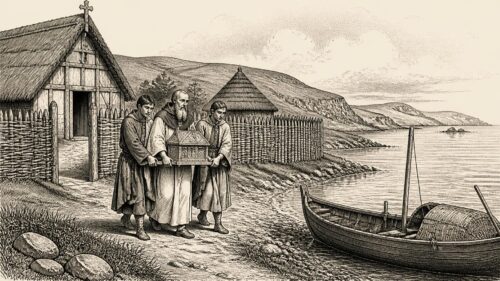
Armagh was not the only ecclesiastical centre visible in 827. Échtgus, superior of Tamlacht – Tallaght, near modern Dublin – died; so did Maenach son of Crunnmael, prior of Fir Rois, and Abniér, abbot of Cell Achaid. These notices are brief but meaningful. They reflect a society in which churches and monasteries were not isolated retreats. Their superiors administered landed communities, received food-renders and other dues, maintained learned and liturgical life, and dealt with kings and local elites. An abbot, prior or superior could be a figure of regional importance even when the annalist offers no biography.
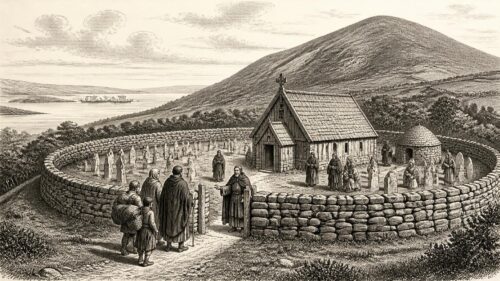
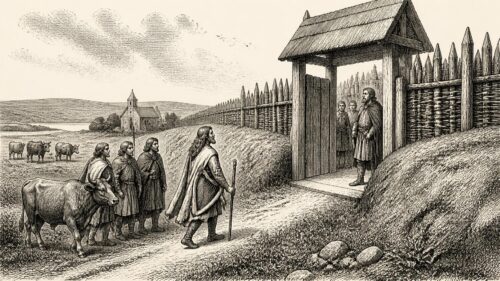
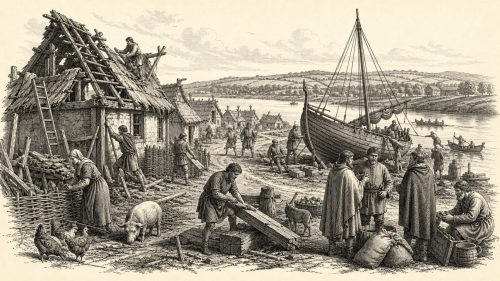
For ordinary people, life remained rooted in dispersed rural settlements. Archaeology shows that many prosperous households lived in enclosed farmsteads, now commonly called ringforts or raths, containing houses, work spaces and storage. Cattle were a central measure of wealth, but farming also involved crops, dairying, craft production and seasonal labour. Ecclesiastical enclosures likewise housed more than churches: they could include dwellings, workshops, cultivation and burial grounds. The deaths entered under 827 therefore belonged to institutions woven into the practical economy and social hierarchy of the island, rather than to a separate religious sphere.
The conflict over Armagh also illuminates learning. Éogan Mainistrech was associated with Monasterboice and held scholarly office before becoming abbot. The authority of a leading church rested partly on its saintly inheritance and property, but also on books, teachers, scribes, liturgy and the ability to preserve claims in writing and memory. The annals themselves are evidence of that culture: terse records of kings, churchmen, raids and assemblies were maintained and later copied because communities regarded such events as significant to their own past and rights.
Raiders on the Eastern Shore
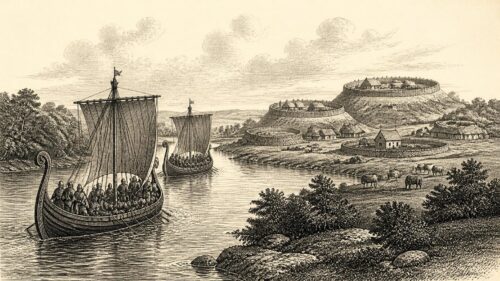
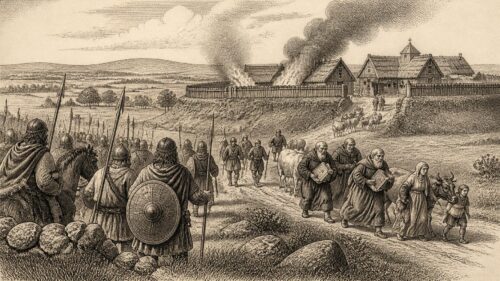
Two entries record attacks by genti, “heathens” or foreigners – the annalists’ usual term for Viking raiders at this date. Lusca, modern Lusk in north County Dublin, was plundered and burned. The attackers also invaded Cianacht as far as Uachtar Ugán. The latter place is not securely identified, so the annal should not be made to yield an exact route. Its geography nevertheless indicates destructive movement through the eastern coastal and lowland zone, where religious sites, productive farmland and political centres were accessible from the Irish Sea.
The same entry adds a difficult phrase, translated as a plundering involving “the foreigners of the East”. The wording is too compressed to establish precisely who attacked whom; it may preserve a further raid or a counter-action against raiders. Certainty ends there. What can responsibly be said is that eastern Ireland experienced a sequence of connected depredations in 827, of which the burning of Lusk is the clearest event.
A second Viking entry is still more severe in tone. An encampment of the Laigin, the people of Leinster, was overwhelmed by foreigners. Conall son of Cú Chongalt, king of the Fortuatha, died, with “countless others” according to the Annals of Ulster. The later Annals of the Four Masters, entered under a different annal-year, calls the victim Conaing and places the disaster at Druim. Those variations underline the limits of the evidence, but both traditions preserve a major Leinster defeat and the death of a regional king.
These were early Viking-age raids, not evidence that Dublin was already a Viking town. Permanent riverine fortified camps, or longphuirt, become prominent in the annals only in the following decade. In 827 raiders could be devastating without holding an established urban base in Ireland. Their mobility exposed monasteries and secular gatherings alike, but Irish rulers were neither passive nor united: earlier and later annals record local victories as well as defeats. The events at Lusk and in Leinster show an unstable coastal frontier, not a simple story of conquest.
Fairs Turned Violent
Internal violence also ruptured two great public gatherings. At the Fair of Tailtiu, Conchobor son of Donnchad attacked the Gailenga, and many people died. Conchobor was the Clann Cholmáin ruler who held the kingship of Tara. Tailtiu, in modern County Meath, was a major assembly-place associated with the exercise of Uí Néill authority. Such fairs brought together political ceremony, legal business, exchange, sporting and cultural activity, and seasonal social contact. An attack there was therefore more than a local skirmish: it disrupted an occasion at which lordship was displayed and relationships between peoples could be negotiated.
The Fair of Colmán was likewise thrown into disorder when Muiredach attacked the Laigin Desgabair, the southern Leinstermen; the annalist again says that very many fell. The source supplies neither a precise site nor an explanation of the quarrel. It does, however, show that fairs were not protected spaces beyond politics. Their gatherings concentrated people, goods, dependants and rival armed followings. They offered opportunities for proclamation and trade, but also for coercion. The deaths at Tailtiu and Colmán would have touched traders, households and ecclesiastical interests as well as warriors, though the sources do not allow the victims to be counted or socially identified.
Birr and the Balance of Power
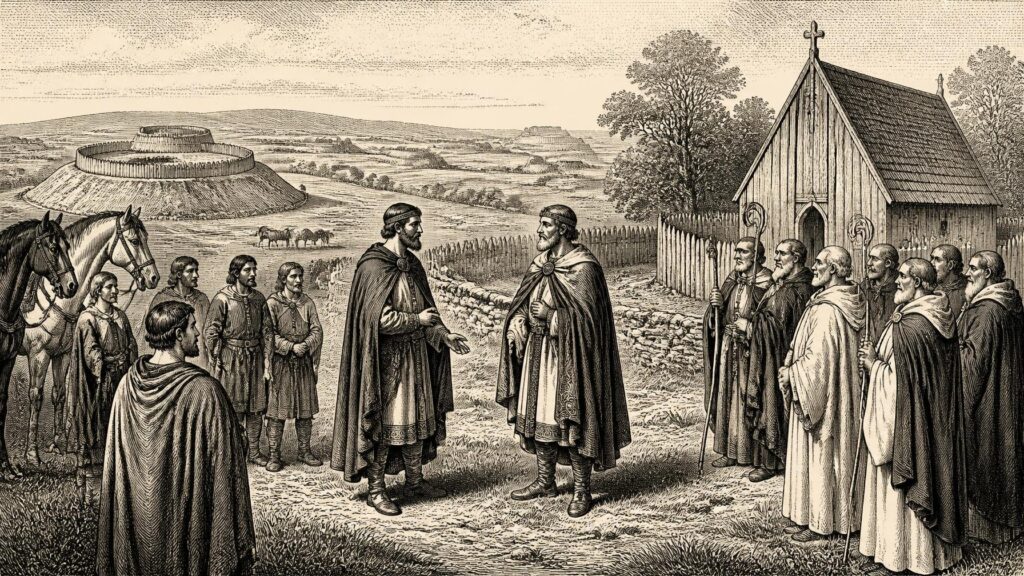
The final major entry for 827 records a rígdál, a royal conference, at Birr between Feidlimid son of Crimthann and Conchobor. Feidlimid was the powerful overking of Munster; Conchobor was king of Tara. Birr lay in a strategically resonant borderland between the political worlds often styled Leth Moga and Leth Cuinn, the southern and northern halves of Ireland. The annal does not record the terms, whether hostages were exchanged, or whether an agreement endured. It is wrong to invent a treaty where the evidence records only a meeting.
Even so, the conference matters. Feidlimid’s ability to meet the king of Tara as a principal demonstrates the reach of Munster’s kingship at this moment. The year had already exposed strain around Armagh, in Airgialla, Leinster and the eastern coast. Birr offered a diplomatic response to a political order in which no ruler could simply command the whole island. The meeting did not end competition: both Feidlimid and Niall Caille would remain central figures in the struggles of the 830s and 840s. But in 827, amid raids, battles and broken fairs, it marks the recognition that negotiation between the greatest powers was necessary.
Thus 827 was not merely a Viking-raiding year, nor merely a dynastic year. Its entries show how external attacks intersected with Ireland’s own contested landscape of kingship, church patronage and regional identity. Leth Cam altered the northern balance around Armagh; Lusk’s burning revealed the vulnerability of the east; violence at fairs pierced institutions of assembly and exchange; and Birr brought rival overkings face to face. The record is fragmentary, but its fragments disclose an island whose political and religious networks were deeply connected – and under exceptional pressure.
Primary Sources
- The Annals of Ulster: Year U827
- The Annals of Ulster (Irish text), U827
- Chronicon Scotorum: CS827
- Chronicon Scotorum
- Vikings in Irish Chronicles, 794–902: Data
- Annals of the Four Masters
- Annals of the Four Masters (Irish text)
- The Annals of Tigernach
- Éogan Mainistrech
- Niall Caille
- Fedelmid (Feidlimid)
- Feidlimid mac Crimthainn: (d. 847), king of Munster
- The Fair of Tailtiu and the Feast of Tara
- The Metrical Dindshenchas: Tailtiu
- Early Medieval Ireland: Archaeological Excavations, 1930–2009
- Ringforts / Ráthanna
- Churches and Ecclesiastical Enclosures / Shéipéil agus Ráthanna
- Clonmacnoise, County Offaly
- Viking Special Volume 3: Narrating and Negotiating Difference in the Insular Viking Age
- The Annals of Inisfallen to Go on Public Display in University College Cork