Cormac’s Tomgraney Cloigtheach965 CE
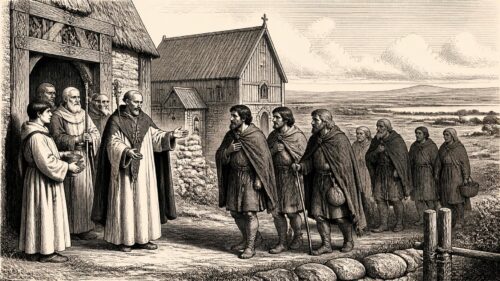
In 965 Ireland suffered a great famine, recorded by the Annals of Ulster as so severe that families reportedly sold children for food. Its causes and regional effects remain unknown, but scarcity threatened households, churches and political communities dependent on crops, cattle and stored resources. Domnall ua Néill, king of Tara, raided Connacht and took hostages from Ua Ruairc, while the Uí Channannáin won a battle killing Domnall. Ecclesiastical successions and deaths occurred at Tír dá Glas, Lismore and Armagh. Chronicon Scotorum associates bishop Cormac Ua Cillín with Tomgraney’s church and bell-house, though its construction date and form remain uncertain.
Dateline
For Ireland, 965 is remembered above all for hunger. The Annals of Ulster, our most nearly contemporary surviving annalistic witness for the year, opens with an unusually stark notice: a “great and intolerable famine” afflicted Ireland, and desperation was said to have driven fathers to sell sons and daughters for food. The sentence is brief, but it brings the human stakes of the year into sharper view than the usual record of kings, raids and clerical deaths. It also places the politics of 965 in a landscape where food, dependants and cattle were inseparable from power.
The year’s evidence is not simple. Irish annals were compiled through overlapping traditions, and their year-numbers can differ by one or more years. Later compilations preserve additional material but occasionally arrange events differently. The firmest account below therefore follows the entries securely associated with 965, while treating the famous building notice from Tomgraney with appropriate chronological caution. What emerges is not a united kingdom enduring one shared experience, but an island of regional lordships, church communities and Scandinavian towns, all vulnerable to a severe subsistence crisis.
Famine and Its Human Cost
The annalists did not explain what caused the famine. They did not specify whether harvest failure followed weather extremes, animal disease, warfare, disrupted movement, or several pressures acting together. Nor do they supply mortality totals, prices, or a calendar of the crisis. It would be wrong, therefore, to turn their terrible phrase into a precise demographic calculation or to assume that every district suffered identically. Yet the fact that the Annals of Ulster recorded scarcity at all is significant: annals normally reserved space for events considered exceptional.
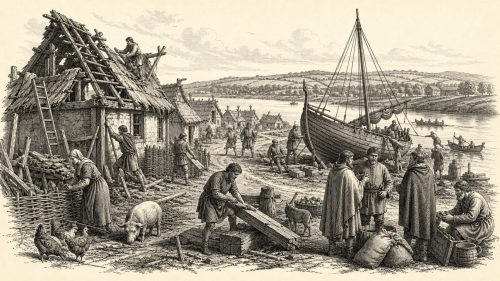
For most people, food security depended on a mixed rural economy. Cattle supplied milk, butter, meat, hides and a principal measure of wealth; crops, especially oats and barley, mattered for bread, gruel and ale. Households processed dairy produce, ground grain and maintained stores for winter, but reserves were unevenly held and could be exhausted by repeated poor seasons. A famine could compel the sale of livestock, tools, land-rights or dependants, damaging a family’s capacity to recover even after food became more available. The annal’s image of children sold for food should be read as testimony to social collapse and to the extremity of distress, not as a statistic.
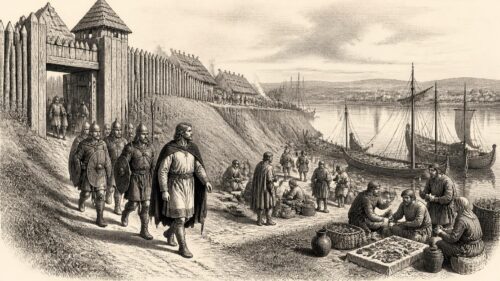
Monastic centres may have offered religious authority, hospitality and stored resources, but they too relied on tenants, dues and surrounding production. Hunger would have reached beyond isolated farms into ecclesiastical settlements, royal households and trading places. It also made raiding and the seizure of hostages more consequential: a lord who controlled cattle, labour and routes of movement possessed means of survival as well as political leverage.
Hostages in Connacht
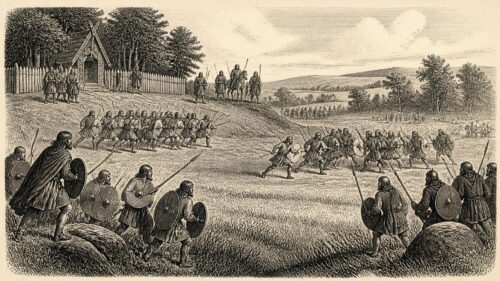
Despite the famine, high politics continued. Domnall ua Néill, described by the Annals of Ulster as king of Tara, led an expedition into Connacht, plundered there and took hostages from Ua Ruairc. The entry does not identify the route, scale of forces, terms imposed, or the precise identity of the Ua Ruairc concerned. Its essentials nevertheless matter. Domnall’s authority was expressed not through a permanent national administration but through campaigning, negotiation and the extraction of hostages from rival rulers.
Hostage-taking was a recognised instrument of early medieval Irish kingship. Hostages could guarantee submission, an agreement, tribute or military obedience; their removal made a relationship of superiority visible and enforceable. Domnall’s expedition should not be mistaken for the conquest of Connacht. It was a forceful assertion of predominance over a regional opponent, one which depended on personal alliances and could be challenged again soon afterwards. In a hungry year, the removal of people and the plundering of resources would have had consequences far beyond the immediate political display.
The same annal records a victory by the Uí Channannáin in which a man named Domnall was killed. It gives no location or fuller identification, and responsible interpretation must stop there. The notice does, however, underline the volatility of northern and north-western politics. Powerful dynasties were not fixed territorial states: they were kin-groups whose standing could be transformed by one defeat, one killing or one successful raid.
Churches, Offices and Succession
Ecclesiastical change was another defining feature of 965. The Annals of Ulster note the deaths of Ioseph and Dúnchad, abbots of Tír dá Glas, and of Cinaed, abbot of Lismore. Such notices are more than obituary details. Major churches held land, livestock, dependent communities, learned traditions and prestige associated with their founders. Their leaders could be political actors as well as clerics, while control of an office could bring both spiritual status and material resources.
At Armagh, Dub dá Leithe replaced Muiredach of Slieve Gullion as abbot. The change of abbot at Ireland’s foremost Patrician church was consequential, even though the annal gives no narrative of dispute or ceremony. Armagh’s claims upon the inheritance of St Patrick gave its leadership exceptional authority. A succession there involved the management of property, personnel and relationships with kings across a wide ecclesiastical network.
These entries also show how closely learning, worship and lordship were intertwined. An abbot’s community was not simply a secluded body of monks. It was commonly a settlement with churches, workshops, cultivated ground, livestock, tenants, visiting clerics and lay protection. The loss of senior figures in a famine year therefore brought institutional uncertainty as well as bereavement.
Tomgraney’s Remembered Belfry
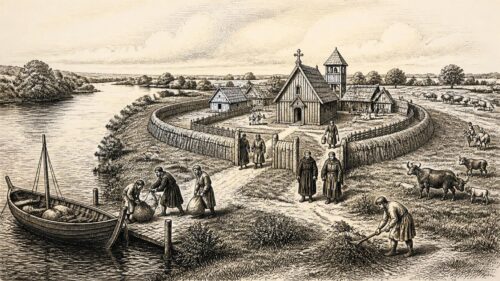
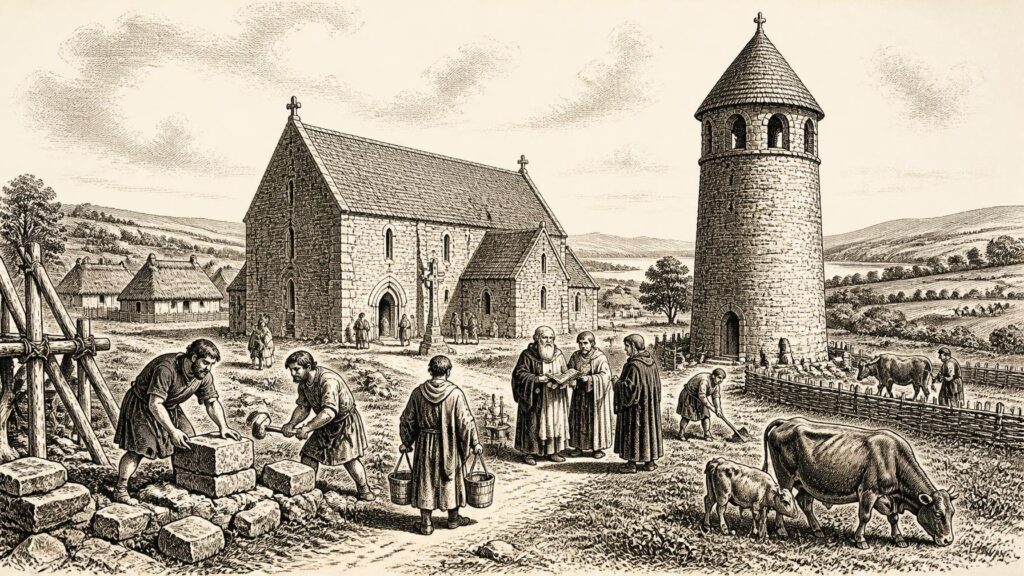
A notice in Chronicon Scotorum connects 965 with an enduringly important architectural memory. Its chronology runs one year behind the modern alignment for this period, but the editor explicitly associates the relevant entry with 964/965. It records the death of Cormac Ua Cillín of Uí Fhiachrach Aidhne, called successor of Ciarán and Comán and successor of Tuaim Gréine, now Tomgraney in eastern County Clare. Cormac is described as wise, old and a bishop; the notice adds that the great church of Tuaim Gréine and its cloigtheach were made under him.
This does not prove that construction began or ended in the calendar year 965. The wording associates the works with Cormac’s career, and records his death in the annalistic sequence. Nor should the term cloigtheach, literally a bell-house, be treated too casually as proof of the precise shape of a lost building. It has long been linked with a round tower at Tomgraney, and the notice is celebrated as the earliest surviving annalistic reference to the erection of such a structure. But the physical form of Cormac’s bell-house is not securely recoverable from the text alone.
Even with those limits, the entry is revealing. Building a large stone church and bell-house demanded organisation: access to skilled labour, materials, food for workers and authority over land and people. It shows that ecclesiastical investment could proceed, or at least be commemorated, in an age marked by political competition and acute scarcity. Tomgraney’s church settlement stood within the Shannon region, where waterways connected communities, estates and churches. Cormac’s overlapping titles point to the wide ecclesiastical affiliations that could bind places across provincial boundaries.
A Year of Strain, Not Silence
It is tempting to let warfare dominate the picture of tenth-century Ireland, or to treat the Scandinavian settlements as the sole engines of change. The evidence for 965 suggests a broader and harsher reality. The great famine placed ordinary households under intolerable pressure; Domnall ua Néill’s Connacht expedition demonstrated that rulers still pursued hostages and plunder; and church successions continued at Tír dá Glas, Lismore and Armagh. Alongside them stands the remembered achievement of Cormac Ua Cillín at Tomgraney.
The year cannot be reduced to a single event. Its most secure record is a conjunction of scarcity, coercive politics and institutional continuity. Irish society survived through local production, kinship, lordship, church networks and exchange, but each of those arrangements could become more fragile when food failed. In 965, the annals preserve both the extremity of that fragility and the structures of authority through which communities sought to endure it.
Primary Sources
- The Annals of Ulster: Year U965
- The Annals of Ulster
- Chronicon Scotorum
- Chronicon Scotorum: Introduction and Chronological Notes
- Annals of the Four Masters: Annal M965
- Annals of Inisfallen: Annal AI965
- Annals of Inisfallen
- The Annals of Inisfallen MS. Rawlinson B. 503
- The Annals of Tigernach
- Tomgraney Parish; Church and Round Tower
- Recorded Monuments Protected under Section 12 of the National Monuments Act: County Clare
- Monuments in State Care
- The Archaeology of Livestock and Cereal Production in Early Medieval Ireland, AD 400–1100
- The Economy of Early Medieval Ireland
- Early Medieval Dwellings and Settlements in Ireland, AD 400–1100: Vol. 1 Text
- Famine in Ireland, 1300–1900
- Eating People is Wrong: Famine’s Darkest Secret?
- Early Christian Monasteries
- Churches and Ecclesiastical Enclosures
- Ordinary People in Early Christian Ireland
- Patrician and Early Christian Architecture
- Early Irish Monasticism