
Connacht in Crisis1082 CE
In 1082, Connacht’s Ua Conchobair dynasty suffered a violent succession struggle: Cathal son of Áed treacherously killed heir-designate Domnall son of Tadc, before Ruaidrí, Cathal’s half-brother, defeated and killed him with a large force. Ruaidrí’s victory strengthened his claim but did not secure all Connacht, whose subordinate rulers remained autonomous. Annals also record several regional lords slain, illustrating political insecurity. Cinaed Ua Ruadáin, senior officer at Clonmacnoise, died, while Cenn Faelad Ua hÓcáin assumed Brendan’s coarbship. Later, less secure accounts describe fighting on Lough Ree and a fire at Clonmacnoise. Tairdelbach Ua Briain’s wider overlordship framed political conflict across Ireland.
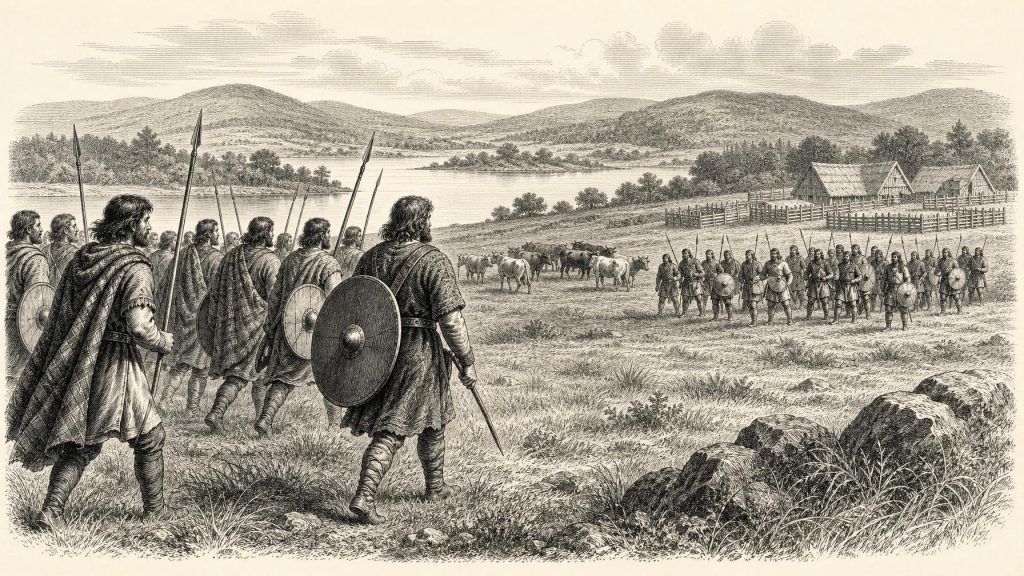
Dateline
The surviving record of 1082 is brief, uneven and dominated by violent deaths. Its clearest narrative concerns a struggle within the Ua Conchobair dynasty of Connacht, where the killing of one prospective ruler was followed by the defeat and death of another. Elsewhere, annalists listed fallen regional lords, the death of a senior churchman at Clonmacnoise and a new holder of the coarbship associated with St Brendan. Later compilations add a destructive clash on Lough Ree and a fire at Clonmacnoise. These additions are plausible and may derive from lost medieval records, but they cannot be treated as securely as events preserved across earlier annalistic traditions.
A Dynasty Turns Inward
The best-attested political event was the treacherous killing of Domnall, son of Tadc Ua Conchobair, described as an heir-designate of Connacht. The Annals of Tigernach, Chronicon Scotorum and a passage preserved in the Annals of Ulster agree that Cathal, son of Áed Ua Conchobair, was responsible. The much later Annals of the Four Masters identifies Cathal as Domnall’s paternal uncle and attributes the murder to envy and malice. That moral explanation should be treated cautiously, but the relationship reveals the intensely familial nature of the contest.
Connacht was not governed through automatic succession from father to eldest son. Eligibility extended across the wider royal kindred, while a man styled rígdamna, or king-material, possessed a recognised claim rather than a guaranteed inheritance. Brothers, uncles, nephews and cousins therefore competed for support among subordinate rulers, leading churches and military followings. Domnall’s designation made him dangerous to other eligible Ua Conchobair men, whether or not he was immediately expected to become provincial king.
Cathal’s success was short-lived. The same annalistic group reports that he fell with a large company before Ruaidrí Ua Conchobair. The wording indicates a substantial armed encounter rather than a private assassination, although no battlefield is named. The Annals of Inisfallen compresses the story still further, recording only that Cathal, a royal heir of Connacht, was slain by Ruaidrí. Taken together, the sources support a sequence in which Cathal eliminated Domnall but was then himself destroyed by Ruaidrí and his supporters.
Ruaidrí, later known as Ruaidrí na Saide Buide, was Cathal’s half-brother and a son of the former Connacht overking Áed in Gaí Bernaig. His victory in 1082 removed two rivals in a single year: Domnall died at Cathal’s hand, and Cathal then fell before Ruaidrí. It strengthened Ruaidrí’s position within Síl Muiredaig, the branch of the Uí Briúin Aí from which the Ua Conchobair kings emerged. It did not, however, create stable control over every part of Connacht. Bréifne, Uí Maine, west Connacht and numerous smaller territories retained rulers whose obedience depended on negotiation, kinship, hostages and force.
Deaths Across the Provinces
The Annals of Ulster places Cathal among six notable men killed in 1082. The others were Gilla Críst Ua Maelfabhaill, king of Carraig Brachaidhe; Finnchad son of Amalgaid, chief of Clann Bresail; Domnall son of Conchobar Ua Briain; Flaithbertach Ua Maeladúin, king of Lurg; and Uidrín son of Mael Muire, chief of Cenél Feradaig. The chronicle supplies no causes, locations or connection between their deaths. They should not be turned into a single imagined campaign.
The list nevertheless conveys the persistent insecurity of regional lordship. Several of the named territories lay in the north or north-west, while Domnall Ua Briain belonged to the powerful Munster dynasty. A king or chief was expected to defend land, clients, cattle and political standing personally. Leadership brought access to tribute and military service, but it also exposed a ruler to ambush, battle and betrayal. The language of the annals distinguishes peaceful death from killing, making the concentration of slain nobles in this entry especially striking.
A separate episode appears in the Annals of the Four Masters. It states that Domnall son of Flann Ua Máelshechlainn killed many people of western Mide, Delbna and Cuircne on Lough Ree in an engagement remembered as the “Breach of the Boats”. No earlier surviving chronicle consulted here provides the same account, so its details require qualification. If correctly assigned to 1082, it shows that the Shannon lakes were theatres of warfare as well as routes of communication. Boats could carry raiders, provisions and fighting men between territories whose political boundaries met along the water.
Churches and Communities
Clonmacnoise remained one of Ireland’s foremost religious, intellectual and political centres. Chronicon Scotorum records the death there of Cinaed Ua Ruadáin, vice-abbot or tanist-abbot of the community. The Four Masters calls him a senior and “head of counsel”, language suggesting that his importance extended beyond liturgical duties. Major monasteries contained churches, workshops, schools, guest houses, farms and substantial lay populations. Their senior officers administered property, preserved relationships with royal patrons and helped mediate disputes.
The Four Masters also records that the cemetery of the nuns at Clonmacnoise, its stone church and the eastern third of the settlement were burned. Because this report is absent from the shorter contemporary-looking entries, it is best presented as a later annalistic notice rather than an independently confirmed event. Fire was a recurring danger in densely occupied ecclesiastical settlements, where stone churches stood among timber houses, workshops, fences and stores. Whatever its cause, such destruction would have affected clergy, craftspeople, tenants, pilgrims and families attached to the monastery.
In Munster-connected church affairs, the Annals of Inisfallen says that Cenn Faelad Ua hÓcáin of Dál Cais took the coarbship of Brendan after Ua Flainn. This is conventionally associated with the great foundation of St Brendan at Clonfert. A coarb was the recognised successor to a founding saint, controlling the saint’s church, lands, dependants and relic-centred authority. Cenn Faelad’s Dál Cais identity is noteworthy in an age when ecclesiastical office and dynastic influence often overlapped, although the annal does not say that King Tairdelbach Ua Briain arranged the appointment.
The Shadow of Tairdelbach
No major expedition by Tairdelbach Ua Briain is securely recorded for 1082, yet his supremacy formed the year’s wider political setting. Since the death of Diarmait mac Máel na mBó in 1072, Tairdelbach had built an extensive southern overlordship based on Munster, influence in Leinster and control over Dublin. He had already intervened in Connacht and compelled Ruaidrí to submit in 1076. Ruaidrí’s victory over Cathal therefore occurred within a province exposed to pressure from a powerful Munster king.
Tairdelbach’s authority was real but not equivalent to central government. Ireland consisted of layered kingdoms held together by tribute, fosterage, marriage, hostages and repeated military demonstrations. A provincial claimant could acknowledge an overking while continuing to fight local rivals. Tairdelbach’s son Muirchertach governed Dublin and was gaining the political and naval experience that would later make him a major ruler. In 1082, however, Tairdelbach remained alive, active and dominant; the succession crisis that followed his illness and death still lay ahead.
Work, Trade and Learning
For most people, the year was measured less by royal killings than by the agricultural cycle. Cattle remained central to wealth, status, food production and compensation, while sheep, pigs, grain-growing, dairying, fishing and woodland resources supported households. Most communities were rural, living in dispersed farmsteads, ringforts, raised settlements or around ecclesiastical centres. Political conflict mattered because raiding commonly targeted herds, stores and captives: the resources that sustained ordinary life also financed kingship.
Dublin, Waterford, Cork and Limerick connected this predominantly rural economy to Irish Sea and wider European trade. Archaeology from eleventh-century Dublin reveals compact post-and-wattle houses, fenced plots, lanes and workshops. Craftspeople worked wood, iron, bone, antler, leather, amber and textiles. Imported pottery, soapstone and silver testify to maritime exchange. Dublin had issued silver pennies since around the end of the tenth century, although cattle and weighed precious metal remained more significant than coin in much of Gaelic Ireland.
Learning continued in monasteries despite political violence and accidental destruction. The very entry for 1082 in the Annals of Inisfallen was copied by a late eleventh-century hand whose work continued to 1092, bringing the surviving manuscript unusually close to the events described. Annalists recorded lunar information and the weekday of New Year’s Day alongside deaths and accessions. Their concise notices were not complete histories, but selections shaped by local knowledge, institutional memory and political interest.
A Year of Contested Claims
The lasting significance of 1082 lies in Connacht. Domnall’s murder and Cathal’s subsequent defeat cleared Ruaidrí’s path towards provincial predominance, while exposing the lethal instability of royal succession. Around that central drama, the annals preserve a landscape of vulnerable chiefs, influential monasteries, armed lake routes and competing regional powers. They also leave large silences. The year can be reconstructed responsibly only by respecting those silences and separating contemporary context from events explicitly assigned to it.
Primary Sources
- The Annals of Ulster
- Annals of Ulster, Irish Text
- The Annals of Tigernach, Part 19
- Chronicon Scotorum, Part 131
- Annals of Inisfallen, English Translation, Part 64
- Annals of Inisfallen, Irish Text, Part 7
- Annals of the Four Masters, English Translation, Part 18
- Annals of the Four Masters, Irish Text, Part 18
- Ua Conchobair, Ruaidrí na Saide Buide
- Ua Briain, Tairdelbach
- Ua Briain, Muirchertach
- Ua Lochlainn (Mac Lochlainn), Domnall
- Brendan (Brénainn)
- Viking
- 950–1450: Vikings, Normans and Medieval Mints
- Irish School of Illumination, c. 650–1100
- Clonmacnoise Visitor Guide
- Medieval Ireland: Territorial, Political and Economic Divisions
- The Chronology and Sources of the Early Irish Annals
- Chronological Synchronisation of the Irish Annals
- The Irish Annals: Their Genesis, Evolution and History — Review
- Kingship, Society, and Sacrality: Rank, Power, and Ideology in Early Medieval Ireland
- Changing Human-Cattle Relationships in Ireland: A 6000-Year Isotopic Perspective
- Excavations at Fishamble Street, Dublin, 1977–79
- Excavations at Dublin City, 1971
- Animals and the Economy of Medieval Ireland
- Inland Waterways and Lakes in Early Medieval Ireland: Archaeological Evidence