

Patronage Reformed
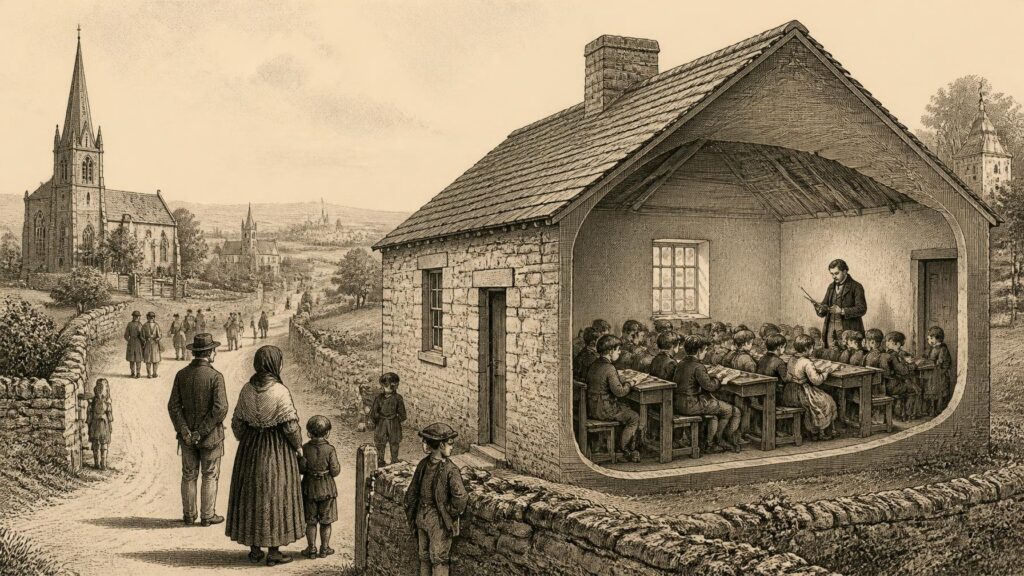
AI generated historical illustration, not a contemporary photograph.
At a Glance
Irish school patronage reform is the story of a public education system whose buildings, funding and curriculum came to be closely intertwined with religious institutions, and of later efforts to adapt that inheritance to a more religiously diverse and more secular republic. It cannot be reduced to a contest between Church and State. It concerns parental rights, local loyalties, minority protections, school property, the meaning of public provision and the difficult practical business of changing institutions which generations of families have regarded as their own.
Inherited Framework
In Irish educational language, a school patron is not simply an honorary supporter. The patron is the person or body associated with the establishment of a recognised school and holds substantial responsibilities in its governance. Those responsibilities have commonly included appointing members of the board of management, safeguarding the school’s characteristic spirit or ethos, and exercising functions conveyed by statute or by the deeds and arrangements under which a particular school was founded. The word can sound archaic, as though it belonged to a world of landed benefactors and subscription lists. Yet it remains central to the organisation of many publicly funded schools in the Republic of Ireland.
That peculiarity is historical. Irish primary education was not built chiefly through a single network of schools owned and operated directly by central or local government. Instead, it developed through arrangements in which public funds supported schools established, owned, managed or influenced by voluntary and religious interests. The result was a system in which the State paid teachers, regulated standards and supplied grants, while churches and other patron bodies retained a formative role. It was an accommodation born in the nineteenth century, made durable by the social conditions of the new State, and later questioned as the population, its religious practice and its expectations of public institutions changed.
For much of the twentieth century, this settlement seemed ordinary to many families. A local national school might be known by the parish name, associated with a priest, religious congregation or bishop, and treated as a familiar element of village or suburb. Patronage was frequently less visible in everyday conversation than the school’s teachers, principal, board and parents’ association. Yet invisible structures can be powerful. Patronage connected a school’s formal identity to a wider authority, and it shaped the place of religion within school life, the constitution of boards, the use of buildings and, in some circumstances, admission arrangements.
Reform therefore raised questions that could not be answered merely by counting churches or schools. If a Catholic patron transferred a school, who would own or use the premises? Would the existing staff remain? Would religious education be altered immediately or over time? Could a community retain its local school while changing its ethos? Would a new multi-denominational school expand meaningful choice, or would it create fresh lines of social separation? These were practical as well as philosophical questions. They explain why reform proceeded in stages rather than through a single national decree.
Colonial Origins
The modern history begins with the national school system established in 1831 under British administration. The system was associated with the letter issued by Edward Stanley, Chief Secretary for Ireland, to the Duke of Leinster, president of the new Board of National Education. Its stated ambition was striking for its time: children of different religious denominations were to receive ordinary secular instruction together, while religious instruction would be separately arranged. In a country marked by deep confessional suspicion, this was intended to make state-assisted elementary schooling available without requiring one church’s doctrine to govern every part of the school day.
That original design should not be romanticised. It arose within a colonial administration and amid wider British governmental concerns about poverty, order, language and social improvement. Nor did it create a fully neutral public school system in the later civic sense of the word. Local managers and patrons remained crucial because the central Board required local cooperation, sites, buildings and organisational support. The national system was to be national in funding, inspection and curriculum, but it depended on local agencies for its existence.
The arrangement soon encountered resistance from several directions. Catholic leaders feared that undenominational schooling could weaken religious formation or permit Protestant influence. Protestant interests feared, from the opposite direction, that their own religious position might be compromised. The intended distinction between common secular lessons and separate religious teaching was harder to sustain in real communities than it appeared in administrative theory. Schools had to open and close at particular times, children had to be grouped, teachers had their own beliefs, and clerical authorities wanted confidence that the education of their communities would not be detached from faith.
Over the nineteenth century, the national system became increasingly denominational in practice. By the century’s end, much of primary education was owned or managed under the influence of the principal churches: Roman Catholic, Church of Ireland and Presbyterian. This development was not the consequence of one clean legislative transfer. It emerged through local decisions, clerical organisation, property arrangements, public grants and the gradual acceptance that denominational managers would supply schools more readily than an administration capable of building and running a wholly state-owned network.
Patronage, in this context, was a mechanism of compromise. It enabled the State to extend mass education without assuming complete ownership and direct control. It enabled religious communities to participate in publicly supported schooling while preserving an institutional role. The compromise had advantages. It helped create schools in communities that might otherwise have lacked them, and it acknowledged that religion was a major source of voluntary organisation. But it also embedded a pattern in which access to publicly funded local education was linked to denominational structures.
Denominational Settlement
The development of denominational management did not mean that every school experience was identical. Ireland contained urban model schools, small rural schools, schools connected with religious orders, Protestant schools serving dispersed minorities, and a variety of voluntary initiatives. Nor should the historical role of minority churches be treated as incidental. Church of Ireland, Presbyterian, Methodist, Quaker, Jewish and later Muslim educational provision reflected genuine communities with constitutional and social claims to maintain schools in accordance with their traditions. School patronage was never solely a Catholic question, even though Catholic patronage became numerically dominant at primary level.
Nevertheless, the scale of that dominance became the central fact of later debate. Catholicism was the faith of most of the population, and Catholic institutions had a dense local presence. Parish-based schooling was an intelligible arrangement to parents and clergy alike. In many places there was only one practicable primary school. The distinction between a parish community and a school catchment could therefore become blurred. A school funded by the State might be understood locally as a Catholic school because it stood beside a church, drew from a parish and was tied to diocesan governance.
Property was especially important. The historical system often distinguished between the patron, trustees and board of management, but the exact arrangements varied. A school building might stand on land held by trustees, a parish or a religious body; a board could manage day-to-day affairs; the State could finance teachers and capital works. This layered structure made later reform more complicated than a simple administrative reclassification. Transferring patronage may involve legal interests in land and buildings, obligations towards staff, negotiations between patrons and the Department, and the confidence of families whose children are already enrolled.
The word ethos also requires care. In general usage, it refers to the values, atmosphere and distinctive character of a school. In Irish law and policy, it has had a more formal significance. A school’s characteristic spirit may influence how it approaches religious education, ceremonies, pastoral care, school policies and communal life. Critics of the inherited system argued that a publicly financed school should not make any child feel peripheral because of faith or non-faith. Defenders replied that pluralism includes the right of religious parents to choose an education shaped by their beliefs. Both arguments draw on important principles, and the history of reform has been an effort to hold them together rather than erase either one.
Folklore has sometimes portrayed nineteenth-century national schools as either wholly secular institutions later seized by churches, or as church schools from the outset merely funded by government. Neither description adequately captures the documentary record. The 1831 scheme envisaged common schooling alongside separate religious instruction; the actual system developed through negotiation and denominational influence. Its later form was not preordained in every detail, but neither was it an accidental departure from an otherwise fully secular state system. Historical interpretation is strongest when it recognises both the original undenominational aspiration and the local institutional conditions that transformed it.
Independent State
Independence did not dismantle the denominational framework. The Irish Free State inherited a school system whose primary sector was already deeply shaped by church management and property. In the decades after independence, governments concentrated on nation-building, language policy, school attendance, teacher training and the extension of educational opportunity. The churches remained major partners in primary education. Religious instruction acquired a more settled position within the school day, while the Catholic ethos of many schools was reinforced by the wider moral culture of the State.
This continuity should not be interpreted as proof that the State lacked power or interest. Governments regulated schools, paid salaries, prescribed curricula, inspected teaching and determined recognition. Rather, the State exercised these powers through a partnership model. It funded a system that was public in purpose and finance but not uniformly public in ownership or patronage. That distinction became a recurring source of confusion in later debate. Families rightly saw national schools as public institutions because education was free and teachers were state-paid. Patrons rightly pointed to their legal and historical responsibilities. The system contained both realities.
The 1937 Constitution gave powerful expression to parental rights in education. Article 42 acknowledges the family as the primary and natural educator of the child and protects parents’ freedom to provide education at home, in private schools or in schools recognised or established by the State. It also says that the State shall not oblige parents, contrary to conscience and lawful preference, to send children to schools established by the State or to a particular type of school designated by the State. The State must provide free primary education and support private and corporate educational initiative with due regard to parental rights, especially religious and moral formation.
These provisions have mattered profoundly in debates about patronage. They do not prescribe one denominational model, and they do not require that every school be religious. But they make it difficult to portray Irish education as a field in which the State may simply impose one uniform institutional type. Constitutional language has encouraged a framework in which different patrons can exist. At the same time, the Constitution’s protection of conscience and its prohibition on compelling attendance at religious instruction have supplied arguments for those who seek more inclusive arrangements within schools where alternatives are scarce.
For decades, demographic patterns reduced the urgency of the contradiction. Ireland remained relatively homogeneous by European standards, religious affiliation was high, and in many rural areas the prospect of operating parallel schools was impractical. Catholic patronage was not merely an administrative fact; it corresponded, often imperfectly, to the preferences of many parents. Church of Ireland schools likewise served communities that valued continuity and minority protection. A reform history that ignores those attachments risks treating ordinary families as passive recipients of institutional control. They were also participants in, and frequently supporters of, the schools available to them.
Legal Architecture
The Education Act 1998 supplied a modern statutory definition of the patron’s position. It recognised existing patrons of primary schools and treated trustees or governing bodies of post-primary schools as patrons for the purposes of the Act. In the case of a newly recognised school, the patron is ordinarily the person who sought recognition, or that person’s nominee. The Act also provides for registration and amendment of the register of patrons. This did not invent patronage, which had existed in practice since the beginnings of national education, but it placed the concept explicitly within the principal education legislation of the modern State.
The Act matters because it demonstrates that patronage is more than custom. A patron’s powers and functions may arise from legislation, deeds, charters, articles of management and other instruments relating to a school’s establishment or operation. Accordingly, changing patronage may require more than a ministerial announcement. It may involve a registered change, agreement on assets, revised governance arrangements, consultation with staff and parents, and an incoming patron able to take responsibility for the school’s future.
At primary level, boards of management became the principal structures of local governance, usually bringing together nominees of the patron, parents, teachers and community interests. Yet boards operate within the patron’s characteristic spirit and within statutory rules. The balance between patron and board is one reason why reform sometimes appeared abstract in national debate but immediate in local communities. A parent may be chiefly concerned with the quality of teaching, a safe journey to school and the friendship networks of a child. A proposed patronage change can nevertheless affect the board’s composition, the pattern of celebrations, the timing and character of religious education, and the sense of institutional belonging.
Post-primary education followed a different historical path. Voluntary secondary schools often developed under religious congregations or diocesan trustees, while vocational schools were connected with local vocational education committees and later Education and Training Boards. Community and comprehensive schools added further models. Patronage reform attracted greatest attention in the primary sector because the concentration of denominational patronage was most pronounced there and because a single primary school often served an entire local district. It would be misleading, however, to assume that questions of ethos, trusteeship and public accountability ended at the primary gate.
The growth of Education and Training Boards also offered a significant state-linked form of patronage. Their educational predecessors had long run vocational schools. Later legislation and policy allowed them to become patrons of Community National Schools and other institutions. This did not create a pure government department model: ETBs are statutory bodies with their own governance and regional role. But their expansion provided an alternative organisational vehicle for communities seeking a multi-denominational primary school without relying on a voluntary religious patron.
Pluralist Pressure
From the later twentieth century, several developments made the inherited pattern more contested. Religious practice changed, even where census affiliation remained substantial. New migration brought families from many Christian traditions, other world religions and no religious tradition. Parents became more accustomed to speaking of individual rights, equality and choice. Scandals concerning institutional abuse and the wider authority of the Catholic Church altered public trust, though it would be inaccurate to treat school patronage reform as caused by any one event. The issue gathered force because social change exposed a widening gap between the pattern of provision and the diversity of families using it.
Educate Together became an important part of this history. Emerging from parent-led initiatives, it developed a multi-denominational model intended to be equality-based, co-educational and child-centred. Its growth demonstrated that there was demand for a school ethos not aligned with a single religion. Gaelscoileanna and Irish-medium patron bodies also complicated any crude equation of diversity with secularisation. For some families, linguistic and cultural preference was as central as religious ethos. The expanding landscape included Catholic schools, minority-faith schools, Church of Ireland schools, multi-denominational schools, Irish-medium schools and later Community National Schools.
Community National Schools were established in 2008 as a new model of primary patronage. The first schools were designed to serve children of all faiths and none under an inclusive, multi-denominational ethos. They developed initially under ministerial patronage, with Education and Training Boards intended to become the long-term patrons. Their emergence was historically important because it showed the State moving beyond the older assumption that a new primary school would normally require a denominational patron. It also supplied a potential receiving structure for schools changing from another patronage model.
The language used in these discussions mattered. “Multi-denominational” generally described schools intended to include children of all religions and none, rather than schools belonging jointly to a set of churches. “Inter-denominational” could refer more specifically to arrangements bringing together different Christian traditions. “Non-denominational” was sometimes used more broadly in public debate, but it could obscure differences in how schools approached religion, ethical education and belief. Reform was therefore not a simple choice between religion and its absence. It involved competing institutional accounts of inclusion.
Evidence of demand was also more complicated than rhetoric often allowed. Many parents who wanted a local school did not necessarily make their decision on patronage. Proximity, siblings already enrolled, transport, reputation, special educational provision and the quality of staff could all be decisive. Research discussed in policy debates found that parents did not always use the vocabulary of patronage even where they recognised a school’s religious character. This helps explain why surveys on school preference could attract criticism. A response to a question about ethos may not reveal how a family would behave if changing patronage involved a different location, a phased transition or the possibility of a new school alongside an existing one.
Forum Findings
In 2011, the Government established the Forum on Patronage and Pluralism in the Primary Sector. It was chaired by Professor John Coolahan and was asked to consider how a sufficiently diverse range of primary schools could be provided, how the transfer or divestment of patronage might operate, and how diversity could be accommodated in areas where only one or two schools served the community. The Forum brought together a difficult subject that had previously been addressed in fragments: new school recognition, parental preference, religious instruction, governance, school property and the rights of children in stand-alone schools.
The Forum’s report, presented in 2012, did not recommend a sudden national abolition of denominational patronage. Its central approach was more cautious. In areas of stable population, where there was evidence of parental demand for a different type of provision and where several schools existed, it proposed that existing patronage could be divested or transferred. This was intended to create choice without the expense and educational inefficiency of opening an additional school where one was not needed. In effect, the report acknowledged both demographic reality and the constraint of public resources.
The emphasis on stable population was important. In a rapidly growing suburb, the State might establish a new school and determine its patron through a competition or consultation process. In a town with little population growth and several existing schools, a new building might not be justified. The route to diversity in the latter case was likely to be reconfiguration: one existing school changing patronage or ethos, perhaps gradually. In a rural locality with only one school, however, neither a new institution nor a simple transfer might provide an easy answer. Such schools posed the deepest challenge because parental rights to an alternative ethos could collide with the practical impossibility of maintaining separate local provision.
The Forum also distinguished between patronage reform and the broader question of inclusion within schools that would remain denominational. It considered a common programme about religions, beliefs and ethics, and it drew attention to the need for clearer arrangements around religious instruction and withdrawal. These proposals reflected a central historical insight: diversification of patrons alone would not solve every difficulty. If a child attended the only local school, the everyday experience of inclusion depended on classroom practice, timetable arrangements, respect for conscience and the culture of the whole school.
Its report was an intervention in a changing Ireland, but it also revealed continuity. The basic problem was still the old one: how could the State support education shaped by parental convictions while avoiding the exclusion of those who did not share the local majority’s faith? In 1831, the proposed answer had been common secular instruction with separately organised religious teaching. In the twenty-first century, the terms had changed, but the tension between common provision and particular conviction remained recognisable.
Measured Divestment
The policy that followed was generally described as divestment, though “transfer of patronage” is often more precise. Divestment does not mean that a school is closed or that its pupils are displaced. It means that the responsibilities associated with patronage move from one recognised body to another. The incoming patron may be Educate Together, an Education and Training Board operating a Community National School, An Foras Pátrúnachta in an Irish-medium context, or another approved body. Because the ethos of the school may change, a transfer must be handled with particular care.
Early departmental surveys sought to establish parental preference in selected areas. In 43 areas surveyed in 2012 and 2013, the Department identified sufficient demand for wider patronage choice in 28. Yet translating survey results into changed schools proved slow. The difficulty did not necessarily demonstrate public hostility to diversity. It reflected the realities of buildings, local school rolls, property ownership, governance, staffing and competing preferences. A numerical preference for more choice did not automatically identify which school should change, where children would enrol, or whether the existing patron was willing and able to release a building.
Some transfers took place, and the system gradually acquired practical experience of reconfiguration. In certain cases, a new multi-denominational ethos was introduced on a phased basis, beginning with junior infant classes and extending upward year by year. This arrangement sought to respect families who had enrolled in a school with a particular denominational ethos while making a changed form of provision available to incoming families. It also illustrates why the word reform can mislead if it implies an instant transformation. A school community has pupils across several age groups, staff with contractual rights, religious preparation already under way, and traditions that cannot simply be removed by administrative language.
There were criticisms from several perspectives. Advocates of more rapid secularisation argued that divestment had delivered too few changes and relied too heavily on existing patrons’ cooperation. Some religious authorities and parents worried that surveys or policy targets undervalued the continued demand for faith-based education. Others warned that multiplying school types could deepen social sorting by class, ethnicity, religion or parental confidence. The Oireachtas Library and Research Service drew attention to the possibility that school choice and admission practices could contribute to segregation. This warning did not amount to an argument against diversity; rather, it showed that choice must be designed alongside inclusion.
The debate over pace is therefore partly a debate about what counts as success. If the objective is to end religious patronage as quickly as possible, incremental local transfers will appear inadequate. If the objective is to broaden choice without closing viable schools, violating property rights or overriding local communities, gradual change may appear necessary. Historical judgement should distinguish those normative positions from the documentary fact that reform was deliberately framed as an incremental process. The Forum itself had anticipated that its recommendations would be difficult to implement and would not rapidly remake the entire system.
Admissions Debate
Patronage reform became closely connected with admissions policy, although the two are not identical. Patronage concerns the body responsible for a school and its ethos. Admissions concern how places are allocated when applications exceed capacity. A family may experience the two together when a local school’s published admissions policy gives priority to children connected with a particular religious community. But a denominational school can be inclusive in many respects, and a multi-denominational school can face capacity pressures. Reformers therefore had to address both the supply of different school types and the rules governing entry.
In the past, the absence of an alternative local school made the question especially acute. The constitutional protection against compulsory attendance at a particular type of state school did not automatically provide a nearby non-denominational place. Nor did a right to withdraw from religious instruction necessarily resolve every issue arising from a school day structured around a particular ethos. Families could feel that a formal option existed while a practical choice did not. Conversely, communities that had sustained a minority-faith school could reasonably fear that broad reforms might weaken their capacity to preserve a distinctive tradition.
The Education Admission to Schools Act 2018 changed significant aspects of enrolment law. Its purpose included making admissions arrangements more transparent and reducing practices that could operate unfairly. The Act restricted the use of religion as a selection criterion in many circumstances, while preserving particular provisions for minority religions. Its importance lies not in ending denominational education but in recognising that public access to schools requires a clearer balance between school ethos, parental preference and equality.
Admissions policy also exposed the limits of framing patronage only as a religious issue. Housing patterns, transport, school reputation, special classes, fee-charging activities, uniform costs and informal local knowledge can all shape who attends a school. Research cited in Irish policy discussions has warned that parental choice can reinforce socioeconomic and ethnic clustering if left unchecked. It follows that a more diverse patronage landscape is not automatically a more integrated educational landscape. A school system can have many ethos labels and still reproduce inequality.
This is one reason why the phrase “parental choice” needs historical scrutiny. It is an important constitutional and political principle, but the choices available to families are uneven. A parent with a car, flexible work, familiarity with enrolment procedures and several schools nearby possesses options not available to a parent in a small rural community or under financial pressure. The most demanding test of reform is not whether a menu of patrons exists nationally. It is whether a child can attend a genuinely welcoming local school without a family having to make unreasonable sacrifices of travel, time, identity or conscience.
Contested Meanings
Public argument about patronage often uses the vocabulary of control. It is understandable: patronage can confer real authority, and the historic prominence of churches in a state-funded system raises legitimate questions about democratic accountability. Yet “control” can flatten distinctions between ownership, governance, curriculum, staffing, inspection and religious formation. The State retains decisive authority over recognition, funding, curricular requirements, teacher allocation and much educational regulation. Patrons retain important functions, but they do not operate outside public law. A historically accurate account must keep both sides in view.
It is similarly misleading to say that reform seeks simply to remove religion from schools. Some advocates do favour fully secular state schools, but official policy has generally pursued greater diversity of provision, including faith-based schools. The aim is not necessarily to deny religious parents the right to choose a school shaped by their beliefs. Rather, it is to ensure that families of other beliefs or none have realistic options, especially in places where the inherited pattern leaves them with little practical choice. Multi-denominational education is therefore not identical with hostility to religion; it is an institutional attempt to make common schooling hospitable to difference.
Religious patronage itself is not a single phenomenon. A Catholic diocesan patron, a religious congregation, a Church of Ireland patron, a Muslim foundation and a joint interdenominational arrangement arise from different histories and serve communities of very different sizes. Minority religious schools have often been defended not as remnants of privilege but as protections for communities whose traditions might otherwise be submerged. A reform programme that treated all faith-based patrons as equivalent would miss this asymmetry. The moral and practical case for changing the patronage of a school where one tradition enjoys overwhelming dominance is not identical to the case for altering a school that sustains a small minority.
There is also a distinction between documented evidence and retrospective judgement. It is documented that the 1831 national system envisaged mixed secular instruction and separate religious teaching; it is documented that denominational management became predominant; it is documented that the 1998 Act formalised patronage in legislation; and it is documented that the Forum proposed divestment where demand and local circumstances warranted it. Whether the nineteenth-century settlement was a wise accommodation, a failure of state responsibility or both is an interpretation. The evidence supports differing evaluations, but it does not support simplistic claims that Ireland once had either a wholly secular national school system or a uniformly church-owned one.
Nor should the debate be explained through folklore about an uncomplicated past. Memories of a school can be affectionate, painful or both. Former pupils may remember teachers’ dedication, local solidarity and strong educational opportunity. Others may remember exclusion, compulsory conformity or being visibly different. Personal testimony is valuable historical evidence of experience, but it cannot by itself settle the institutional history of a school system. The task is to listen to such memories while examining the statutes, records, policies and demographic changes that structured them.
Current Direction
Recent policy has retained the language of reconfiguration for diversity. The Department of Education has described this process as a means of helping school communities determine whether there is demand for a change in patronage. Its current framework presents the objective as wider parental access to both multi- or non-denominational and faith-based education. This formulation is significant. It signals a pluralist reform strategy rather than a programme of compulsory secularisation.
Government policy has also set an ambition to expand multi-denominational primary provision, including a target of 400 such schools by 2030. Targets should be read carefully: they express a policy aim rather than a guarantee that every transfer will occur on a fixed timetable. The Department’s reconfiguration material stated that 172 schools had a multi-denominational or inter-denominational ethos when the framework was published in late 2025. Such figures are useful markers of direction, but they do not disclose the whole lived geography of choice. A national total can rise while an individual town or rural district still has only one nearby option.
The modern process seeks more structured engagement than the earlier survey exercises. Parents and guardians can be asked about preferences regarding religious or multi-denominational patronage, language of instruction and co-educational or single-sex provision. In principle, this treats patronage as one component of wider school planning. In practice, consultation must be designed carefully. The questions must be comprehensible, the choices must be real, and communities must know whether a response concerns a new school, a transferred school, a phased transition or a hypothetical preference without immediate consequence.
Community National Schools remain an important institutional expression of the reform era. They are state, co-educational, multi-denominational primary schools under the patronage of Education and Training Boards. Their history began with two pilot schools in 2008 and continued with the transfer of patronage to ETBs in 2016. As new and reconfigured schools, they offer a model in which religion and belief are approached through a common educational framework rather than through the ethos of one denomination. Their development is not proof that one model suits every locality; it is proof that the Irish system now has an established alternative capable of receiving and managing schools.
Unfinished Settlement
School patronage reform has not produced a final settlement because the underlying questions remain alive. What does equality require where a publicly funded school has a religious ethos? How should a small minority community preserve its educational tradition? What weight should be given to the views of current parents, future parents, local residents and children? Can an inherited building serve a new ethos without severing its local history? How can policy promote choice without generating social division? None of these questions has a purely technical answer.
The reform process is best understood as a long adjustment of an inherited institutional map. The nineteenth-century national system was designed in a different political world, then reshaped by denominational organisation and absorbed into the independent State. The twenty-first-century republic has not simply repudiated that past. It has tried, unevenly and sometimes slowly, to add forms of provision that better reflect changed convictions and demographics while continuing to support faith-based education. That approach produces frustration for those who seek a more decisive break, but it reflects the legal, social and material complexity of the schools concerned.
Its deepest historical lesson may be that education cannot be made inclusive merely by changing labels. A transfer of patronage can be meaningful, particularly where it creates an option previously unavailable. But inclusion also depends on admissions, transport, staff support, curriculum, respect for conscience, dialogue with parents and the ordinary habits of school life. Equally, a denominational school is not adequately assessed by its title alone; its practices towards children of other beliefs matter greatly. Reform must therefore be judged not only by the number of schools transferred, but by whether children and families experience the system as fair, welcoming and genuinely open.
Irish school patronage reform remains a historical process rather than a completed event. Its roots run back to the unresolved promise of 1831: common education in a society of strong and differing convictions. The form of that promise has changed. The question has not. Ireland’s continuing challenge is to sustain schools in which religious freedom and non-religious freedom are both respected, where local attachment does not become exclusion, and where the public character of education is felt by every child who enters the classroom.
One issue is the article’s portrayal of patronage reform as institutional adaptation rather than removal of religion from public education. Because patronage reaches property, governance, ethos and belonging, transferring a school may widen choice while unsettling communities attached to an arrangement. The comparison between the 1831 ambition for secular instruction and today’s reconfiguration suggests Ireland has repeatedly balanced common provision against denominational confidence. Community National Schools and divestment therefore appear less like final solutions than evolving compromises. How should policymakers and communities judge fairly whether a proposed patronage change improves inclusion for all without diminishing parental choice or minority rights?