

Shelter Rights
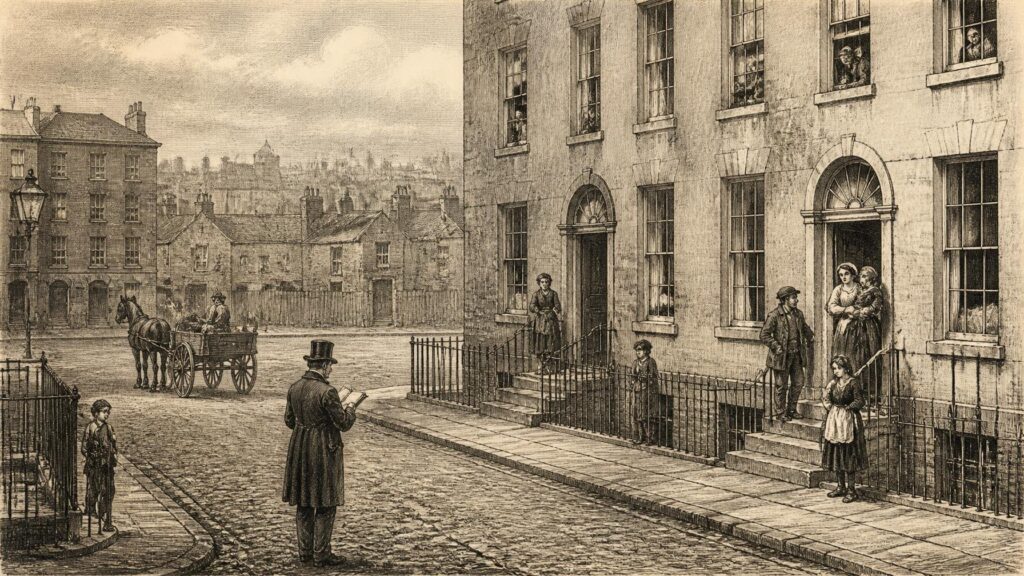
AI generated historical illustration, not a contemporary photograph.
At a Glance
Irish housing and rent reform has never been a single, uninterrupted campaign towards better homes. It has been a succession of arguments about ownership, public health, municipal responsibility, affordability and the limits of state intervention. From the nineteenth-century struggle of tenant farmers against landlord power to the regulation of private rents in the twenty-first century, housing has repeatedly revealed how questions of shelter are also questions of citizenship and power.
Land Foundations
The long history of housing reform in Ireland begins, in an important sense, with land rather than buildings. For much of the nineteenth century, the defining relationship for a great many Irish households was not that of an urban tenant and landlord but that of an agricultural tenant occupying land owned by another person. A cottage, its small yard and the holding on which it stood could not readily be separated in either law or daily life. Rent was paid for the productive ground that sustained a household, but the insecurity of tenure reached into the home itself. Eviction meant loss of livelihood and shelter together.
This was not the whole Irish experience. Towns and cities contained lodgings, artisan dwellings, commercial premises with rooms above, charitable institutions and increasingly crowded subdivided houses. Nevertheless, the land question supplied the political language through which security, rent and property were debated. It accustomed people to asking whether a landlord’s legal title should be qualified by the tenant’s labour, improvements and settled occupation. That question later reappeared in urban contexts, although with different institutions and different social consequences.
The Land Law Ireland Act of 1881 belongs to this background. Its provisions addressed the occupation and ownership of land, strengthened the legal framework around tenancy and enabled forms of tenant purchase through the Land Commission. The statute cannot be treated as a housing act in the modern sense: it did not establish a broad right to a decent dwelling, regulate urban standards or create a national building programme. Yet it mattered to the history of shelter because it helped shift public expectations. A tenant’s occupation was no longer discussed solely as a private bargain between unequal parties. It was increasingly seen as a social relationship in which government and courts might intervene.
The rural reform tradition also helped create the powerful Irish ideal of small-scale ownership. Over time, land purchase measures transferred many holdings from landlord to occupier. The outcome was neither universal prosperity nor a simple ending of rural hardship. Small farms could remain economically precarious, agricultural labourers often possessed little land, and emigration remained an enduring feature of Irish life. Still, the political success of tenant purchase left a deep mark. It encouraged the belief that security was best achieved through ownership, an assumption that has shaped Irish housing policy long after the great estates ceased to dominate public affairs.
That inheritance had a double effect. On one hand, it gave wide popular force to the proposition that homes should not be vulnerable to arbitrary rent demands or removal. On the other, it made long-term renting appear, to many families and politicians, less desirable than eventual ownership. Later governments therefore often supported owner occupation, while public rental housing was expected to serve those excluded from the market. The distinction was never absolute, but it helps explain why Ireland developed a large owner-occupied sector alongside a tradition of municipal housing and a private rented sector whose legal protections have repeatedly been contested.
Popular memory sometimes compresses this story into a simple tale in which land reform solved the housing problem. Documentary evidence points to a more complicated reality. Agrarian reform transformed rural property relations, but it did not remove poor housing, overcrowding or poverty. It also did little by itself to address the distinctive crisis of the larger cities, where old houses had been divided into multiple tenancies and where rent was paid room by room or week by week. There the material condition of the dwelling, not merely the terms of occupation, demanded attention.
Urban Crisis
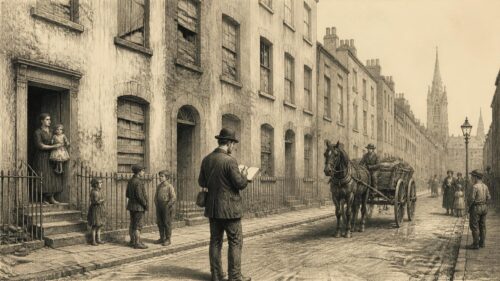
Dublin’s tenements became the starkest symbol of that urban crisis. The word tenement could describe a rented dwelling generally, but in Irish historical usage it is closely associated with the subdivision of older urban houses into separate rooms and small apartments. These dwellings were not all identical. Some were better maintained than others; some tenants had regular employment; some households lodged with relatives or took in boarders to make rent. Yet the evidence collected by investigators in the late nineteenth and early twentieth centuries makes clear that severe overcrowding, structural neglect and inadequate sanitation were widespread and deadly features of the city’s poorest districts.
Charles Eason’s 1899 study of Dublin tenement homes drew upon earlier official inquiries, census material and public-health discussion. It recorded the findings of the 1879 sewerage and drainage commission, which had identified thousands of houses let in tenements and found a substantial number unfit for habitation. The commission associated the condition of such houses with exceptionally high mortality and urged registration, inspection and regulation. Its language reflects the assumptions of its period, including moral judgements about poverty and behaviour that modern readers should approach critically. Yet the underlying evidence of dilapidation, inadequate ventilation, overcrowding and deficient sanitary provision remains indispensable.
The housing problem was not merely that old buildings existed. It was that the return from renting rooms could encourage subdivision without corresponding investment in repair. A single former townhouse might contain several families, each with limited control over common stairs, yards, taps, drains and privies. Landlords might live elsewhere; middlemen and caretakers could stand between owner and occupier; tenants themselves sometimes sublet space as a means of survival. Reformers therefore faced a difficult question: who could be required to make a building safe, and how could the law be enforced when the poorest residents had little capacity to move?
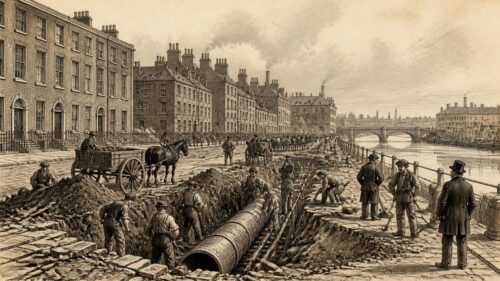
Sanitary regulation was one response. Dublin adopted tenement house by-laws in 1880, and public bodies gained powers to inspect, register and, in some cases, close unhealthy accommodation. But regulation alone could not resolve a shortage of affordable homes. Closing a ruinous building might reduce danger within it, yet it could also displace its tenants into another overcrowded house unless replacement dwellings were available. This tension between improvement and displacement is one of the most persistent themes in Irish housing history.
The catastrophe at Church Street in September 1913 brought the issue before a wider public. The collapse of two tenement houses killed seven people, including children. It was not the sole source of concern, nor did it create the city’s housing problem, but it gave dramatic force to warnings already made by doctors, sanitary officials, charitable bodies and local campaigners. The disaster contributed to an atmosphere in which the inadequacy of existing arrangements became harder for public authorities to ignore.
The Dublin housing inquiry of 1913 and 1914 was a landmark in the documentary record. The Statistical and Social Inquiry Society of Ireland’s committee on the control and improvement of tenement houses urged a twofold approach: improve and regulate buildings capable of repair, while closing and, where necessary, demolishing dwellings unfit for human habitation. Crucially, it recognised that clearance required new accommodation for those displaced. This was a practical acknowledgement that public health policy and housing supply could not sensibly be separated.
The inquiry’s figures are frequently repeated in popular accounts of ‘Darkest Dublin’. Some are soundly rooted in official returns; others have been simplified in retelling. The safest conclusion is not a single dramatic statistic but a documented pattern: a very large share of working-class Dublin households occupied one room or small rented spaces, and many had insufficient access to sanitation. The city’s housing conditions were conspicuously poor by the standards of contemporary urban reform. They were not a colourful backdrop to political history. They shaped childhood, illness, family life, work, mortality and the capacity of people to participate in civic life.
It would be misleading, however, to portray residents only as passive victims. Tenement households made decisions within harsh constraints: they moved when they could, pooled earnings, relied on kin, organised through trade unions and neighbourhood networks, and sometimes resisted rent demands or evictions. Their agency did not remove the imbalance of power between poor tenants and property owners. It does remind us that housing history is not only the story of laws enacted above them. It is also the story of how people used, negotiated and contested those laws.
Municipal Response
The late nineteenth-century Housing of the Working Classes legislation gave local authorities a more substantial part in dealing with unhealthy urban housing. The legislation made possible clearance schemes and the construction of replacement dwellings, although what individual councils achieved depended on finance, land, political will and administrative capacity. Dublin Corporation built some municipal housing before independence, but the pace of improvement did not match the scale of need. The First World War then constrained borrowing and building materials, while rent pressures intensified.
Municipal housing carried an inherent contradiction. It was designed to improve the conditions of people who could not obtain adequate homes in the private market, yet a council had to meet loan charges, manage estates and collect rents. If rents were set at a level intended to cover the full cost of provision, the very families most in need could be excluded. If rents were set below cost, the difference had to be met by rates, grants or other public funds. The issue was financial, but it was also political: should a decent home be treated as a commodity that must pay for itself, or as a public service supported according to need?
After independence, the new state inherited local-government structures, an acute shortage of suitable urban housing and the legacy of nineteenth-century public-health law. The Department of Local Government and Public Health, established in 1924, supervised a growing housing programme. Government activity during the 1920s and 1930s included expansion of local-authority housing, town planning and infrastructure. Yet the early Free State did not possess unlimited resources, and the needs of rural labourers, smaller towns and the major cities competed for attention.
Housing policy was also shaped by population movement. The construction of cottages for agricultural labourers, a programme whose roots lay in the Labourers Acts of the late nineteenth century, continued to influence rural settlement. In towns, local authorities faced the legacy of older central districts while also developing suburban estates. New estates could offer gardens, indoor facilities and more space than tenements, but relocation could separate families from workplaces, schools, extended kin and established local support. The reformer’s map of a healthier city did not always match the resident’s map of daily survival.
The 1938 to 1943 Commission of Inquiry into the Housing of the Working Classes of the City of Dublin demonstrated that the tenement problem had not disappeared. Evidence later cited in scholarly work shows that large numbers of urban families still lived in unsuitable or hazardous conditions. By 1950, thousands of tenement houses remained in Dublin, housing a substantial proportion of the Corporation’s population. The broad fact of continuing crisis is beyond dispute, even though individual figures should be read in their administrative context and not treated as interchangeable measures of every form of housing need.
The most important lesson of this period was that demolition was not a policy in itself. Replacement building had to be sufficient in quantity, suitable in location and affordable to those leaving condemned houses. The records of public administration show officials grappling with whether families displaced by clearance would accept new tenancies and whether local authorities could sustain the associated costs. A family’s refusal of a new dwelling was not necessarily evidence of irresponsibility. Rent, distance, work, household size and the disruption of community ties all mattered.
Municipal housing therefore changed the terms of debate. It established that public authorities could be landlords and builders, not merely inspectors of private landlords. It made the quality and cost of a dwelling matters for local and central government. At the same time, it exposed the burdens of managing a public stock: arrears, repairs, allocation, estate services and the tension between universal standards and limited budgets. Those issues have endured in changed form into the present.
War Controls
Rent control entered Irish housing history through wartime emergency. The British government introduced restrictions on rent increases and mortgage interest in 1915, when Ireland remained within the United Kingdom. The immediate rationale was the disruption caused by the First World War: shortages, inflation and the danger that landlords might exploit constrained supply. Controls were presented as exceptional measures, not as a permanent redesign of the rental market.
After the establishment of the Irish Free State, rent restrictions continued in adapted form. The 1923 legislation and associated rules dealt with procedures under the new jurisdiction. In the interwar period there were attempts to reduce or end control progressively, but the system did not simply vanish. As the explanatory memorandum prepared for the 1960 rent restrictions measure later recalled, decontrol was arrested in 1928. By then, restrictions broadly covered older dwellings below specified valuation limits. The history matters because it shows that rent regulation survived not as a single frozen scheme but through repeated political decisions to continue, amend and redefine it.
The Second World War, known in Ireland as the Emergency, brought a renewed and expanded intervention. An Emergency Powers order of 1944 brought further premises under control, including some houses built after the earlier historical cut-off. The practical principle was familiar: a lawful rent was anchored to a past rent, with limited permitted additions. This approach sought to protect sitting tenants from sudden increases, but it also created administrative complexity. The status of a dwelling could depend on age, valuation, furnishing, use and previous rent history.
There were good reasons for tenant protection in a period of scarcity. A household unable to absorb a sharp rent rise could face homelessness, overcrowding with relatives or a return to substandard lodgings. Rent controls could offer a measure of predictability where bargaining power was radically unequal. They were particularly significant in older urban property, where tenants might have lived for many years and where the rental market did not operate as a neutral meeting of equally placed parties.
But control also produced difficulties that would recur in later debates. Where controlled rents were low, landlords had less income for repairs, especially if the property was already old and expensive to maintain. Some owners may have lacked the resources to improve buildings; others may have chosen not to invest because regulation reduced the return. It would be too simple to claim that rent control alone caused disrepair. The older housing stock, the original condition of buildings, weak enforcement, poverty and limited alternative accommodation all mattered. Still, the relationship between regulated rents and maintenance became a central argument in policy discussion.
The state attempted to manage this problem through legal provisions allowing certain rent additions for improvements and through duties relating to repair. Such measures reveal the ambition and limitation of the system. Legislators wanted to protect tenants from exploitation without making repair financially irrational. Yet a schedule of authorised additions could not by itself produce competent management, capital investment or effective inspection. The social purpose of the law remained dependent on institutions capable of enforcing it.
Rent restriction also encouraged a distinction between protected and unprotected tenants. A household in an older controlled dwelling might have a level of security and affordability unavailable to a newcomer seeking a home. That division could generate inequalities between generations of renters. It is a recurring feature of rent regulation internationally, and Irish experience illustrates it clearly: measures created to prevent hardship for existing tenants can make access more difficult for those outside the protected group if supply remains constrained.
Legal Settlement
The Rent Restrictions Act 1960 consolidated a series of temporary and amending measures into a more comprehensive statute. It defined controlled dwellings, set out methods for determining basic and lawful rents, provided for information to be given to tenants and courts, and contained rules concerning repairs, deposits, possession and recovery of overpayments. The structure of the Act shows that rent reform was not simply a matter of fixing a number. It involved evidence, procedure, enforcement and the relationship between rent, condition and possession.
Its scope was nevertheless selective. It did not cover every dwelling. The Act excluded, among other categories, certain newer properties, owner-occupied homes and premises above specified rateable valuations. In broad terms, it concentrated protection on older, lower-valued, privately owned and unfurnished dwellings. That concentration reflected the social geography of the rental sector but also meant that legal rights varied sharply according to the history and classification of a particular property.
Part of the Act sought to connect rent with the landlord’s duty to repair. Where a landlord was in default of repair obligations, a tenant could seek a reduction in rent. The law also contemplated payments to a tenant where disrepair resulted from a landlord’s default. Such provisions are historically important because they rejected the idea that rent and condition were separate. A tenant’s obligation to pay was linked, at least in principle, to the landlord’s obligation to provide and maintain a habitable dwelling.
Another part restricted the recovery of possession. In practice, security of tenure is as important as rent level. A low rent offers little protection if a landlord can rapidly remove the occupier, while a tenant with some security may be better able to insist on repairs or challenge an unlawful increase. The Act’s possession provisions attempted to give controlled tenants greater protection, though they also required courts to interpret detailed statutory terms and exceptions.
The statutory system became increasingly difficult to defend as a lasting settlement. It protected a shrinking and historically defined class of tenants, while much newer rented accommodation lay outside its reach. The valuation thresholds and building-date rules made sense only in relation to the emergency measures from which the regime had grown. What began as a temporary response to war had become a complex legal inheritance, preserving old rent relationships in a changing housing market.
The decisive rupture came in 1982, when the Supreme Court in Blake v Attorney General found key parts of the 1960 Act invalid in light of constitutional property protections. The case did not mean that every form of tenancy regulation was unconstitutional, nor did it settle all future policy choices. Its importance lay in demonstrating that reform had to be framed within constitutional limits and could not rely indefinitely on a system that imposed a severe and open-ended burden on one category of property owner.
After the judgment, the old system of controls could no longer be maintained in its existing form. The Housing Private Rented Dwellings legislation of 1982 and 1983 provided transitional protection for certain tenants of formerly controlled dwellings, including a mechanism by which a Rent Tribunal could determine a just and fair rent in specified cases. This was an attempt to avoid an abrupt loss of protection for long-standing tenants while accepting that the previous legal structure had failed.
The episode is often invoked in contemporary argument as proof either that rent controls are impossible in Ireland or that constitutional rights invariably defeat tenant rights. Neither conclusion follows automatically. The documented lesson is narrower and more useful: the design of regulation matters. A measure must have a legitimate public purpose, operate proportionately and take account of the constitutional framework. It must also be supported by a realistic approach to supply, maintenance and the distribution of costs.
Public Rents
While private rent control followed one path, local-authority rents followed another. In the early decades of public housing, councils commonly faced pressure to charge rents below the full economic cost of construction and management. The problem was visible in the difference between the rent needed to service loans and maintain houses, and the rent that low-paid households could actually afford. If public housing was to reach households escaping overcrowding and poor-quality accommodation, affordability could not be treated as an afterthought.
Cork Corporation was especially significant in the development of income-related rents. In the 1930s, under the influence of its long-serving housing administrator Philip Monahan and pressure from tenants’ representatives, the city moved away from cost rents and linked charges more closely to household income. The idea later became known as differential rent. It expressed a distinctive principle: households in similar dwellings need not pay identical rents if their capacities to pay differed substantially.
This was not charity in the narrow sense. It was a way of defining public housing as a social service. A household with a low income would pay less, while rent could rise as income rose, usually subject to scheme rules and maximums. The arrangement aimed to prevent municipal housing from excluding those most in need. It also recognised that the cost of a home could not be understood without reference to wages, family size and other household circumstances.
Tenant mobilisation mattered. Historical accounts of differential rents note campaigning by tenants’ organisations and, in some places, rent strikes. These actions should not be romanticised. Rent strikes could involve hardship and conflict; they were responses to specific local circumstances rather than a uniform national movement. Yet they demonstrate that tenants helped shape policy. Income-related rents did not descend untouched from administrative expertise. They were pressed upon authorities by residents who challenged rents they regarded as unaffordable.
The Housing Act 1966 required local authorities to operate differential rent schemes, embedding the principle nationally. The law did not produce a perfectly uniform system: authorities retained significant discretion, and rent schemes could differ in details. But the principle that social-housing rent should be related to means became one of the most enduring features of Irish housing policy. It remains a significant contrast with market rent, where the price is determined primarily by location, supply and demand rather than the particular income of the tenant.
There was, however, a financial cost. Income-related rents weakened the revenue stream that had been expected to service the debt incurred in building public housing. Over time, particularly amid the fiscal pressures of the 1980s, the borrowing-based model of financing social housing became increasingly difficult to sustain. This does not mean that differential rents were a mistake. It means that affordable rents require a source of subsidy, whether through rates, central taxation, capital grants or cross-subsidy. Affordability does not eliminate cost; it changes who pays and when.
The public-rent system also challenged a recurrent political assumption that ownership is the only secure or respectable tenure. A well-managed public tenancy, with an affordable income-related rent and meaningful security, could offer stability that many private renters lacked. Conversely, poorly maintained public housing or insufficient supply could undermine that promise. The historical record supports no simple contrast between good public housing and bad private housing. It does show that the state, when it became a landlord, accepted responsibilities that private-market policy alone could not meet.
Market Turn
The later twentieth century saw a marked change in the balance of Irish housing policy. Home ownership remained politically influential, while local-authority construction declined from the levels associated with earlier building programmes. Private renting, which had contracted in relative importance during parts of the post-war period, later regained significance. The private rented sector included students, younger workers, migrants, lone-parent households, families awaiting social housing, older long-term tenants and people renting by preference. It was too diverse to be described accurately as a temporary tenure for a single social group.
In 1978, Rent Supplement was introduced as part of wider social-security reform. Initially directed at benefit-dependent private tenants, it represented a different mode of state intervention. Rather than providing a dwelling directly or fixing rents generally, the state assisted eligible households to meet the rent charged in the private market. This could prevent immediate hardship, but it also made the state a participant in a market it did not control comprehensively.
Over subsequent decades, policy increasingly combined income support, tax measures, local-authority allocation and private provision. This approach offered flexibility but could fragment responsibility. A tenant might deal with a landlord for repairs, a welfare office for rent support, a local authority for housing need and a court or tribunal for disputes. The distinction between housing policy and social policy became less clear in lived experience.
Security of tenure emerged as a central concern. A renter might afford the current rent yet remain vulnerable to termination, sale of the property or a landlord’s decision to use the dwelling differently. The Landlord and Tenant Amendment Act 1980 included an occupation-equity provision that could, after long occupation, give some tenants an entitlement to a new tenancy. Research and policy review later noted a practical difficulty: landlords might end arrangements before the qualifying period was reached. The episode illustrates a broader problem. Rights that arise only after a very long period may fail to protect people whose tenancy can lawfully be ended earlier.
By the end of the twentieth century, pressure grew for a clearer and more comprehensive framework for residential tenancies. The Commission on the Private Rented Residential Sector, established in 2000, examined a sector in which older rent-control arrangements had largely receded but where tenants still faced insecurity, weak standards and uneven dispute mechanisms. Its work formed part of the background to the Residential Tenancies Act 2004.
That Act was a major institutional reform. It provided for the registration of many private residential tenancies, created the Residential Tenancies Board’s predecessor institution, established a dispute-resolution system and introduced statutory rights and obligations for landlords and tenants. Its Part 4 tenancy provisions gave qualifying tenants security after six months’ occupation, subject to specified grounds for termination. The legislation did not freeze rents generally. Instead, it sought to regularise the private rented relationship and make rights enforceable without requiring every dispute to become a conventional court case.
The importance of the 2004 Act lies partly in its change of legal culture. Renting was no longer treated simply as a private contract supplemented by fragments of older landlord and tenant law. It became a regulated field with registration, standardised notices, administrative decision-making and defined routes for resolving disputes. This did not eliminate imbalance between landlords and tenants, nor did it supply homes where too few existed. But it made the rules more visible and gave the state better information about the sector.
Renewed Controls
The financial crisis of the late 2000s and the subsequent housing shortage returned rent to the centre of public controversy. As demand recovered and supply lagged, rents rose sharply in many places. The political question was once again familiar: should the state restrain rent increases directly, assist tenants with payments, increase housing supply, or do all three? Irish policy after 2016 combined these approaches, though not without argument over their effectiveness.
The Planning and Development Housing and Residential Tenancies Act 2016 introduced the framework for Rent Pressure Zones. The first designations took effect on 24 December 2016 in Dublin’s local-authority areas and Cork City. The scheme was later extended to additional areas. Unlike the historic controls associated with a building’s age and valuation, the newer system was geographically targeted and based on indicators of rent pressure. It aimed to make rent increases more predictable in areas where rents had risen quickly and housing demand was acute.
Rent Pressure Zones did not simply recreate the 1960 regime. They formed part of the amended Residential Tenancies Act and operated through modern registration data, prescribed notices and an administrative regulator. Their rules changed over time. That instability is itself historically significant: governments repeatedly adjusted the system as market conditions, constitutional concerns and evidence of unintended effects developed.
Supporters argued that limits on increases gave existing tenants breathing space, reduced sudden displacement and moderated rent inflation. Critics argued that restrictions could discourage landlords from remaining in the market, reduce investment in rental homes or make it harder for new tenants to find accommodation. Both arguments identify genuine policy risks. The historical question is not whether regulation has effects; it plainly does. It is how those effects are distributed between sitting tenants, prospective tenants, landlords, public finances and the supply of homes.
In 2025, Rent Pressure Zone rules were extended across the country for a limited period. A more substantial national rental system then took effect on 1 March 2026, replacing the Rent Pressure Zone framework for private and student-specific accommodation. The Residential Tenancies Board explains that the new rules include national restrictions on rent setting, while allowing market rent in defined circumstances, including some new tenancies and at the end of a tenancy cycle, subject to significant limits after a no-fault termination. Because this is recent law, its long-term social and economic consequences cannot yet be stated as historical fact.
That caution is important. It is tempting to describe every new measure as either the final answer or a repetition of past failure. History does not support either certainty. The 1915 controls, the 1960 consolidation, the constitutional crisis of 1982, the 2004 tenancy framework and the twenty-first-century rent restrictions arose from different housing markets and legal settings. They share a recurring concern with security and affordability, but they cannot be treated as interchangeable experiments.
Nor can rent reform be assessed independently of supply. A regulated increase may protect an existing tenant, but it cannot by itself construct a home for someone excluded from the market. Conversely, additional construction may improve availability over time, but it may not protect a household facing an immediate increase or termination. Irish housing history repeatedly demonstrates that effective reform has required several instruments at once: standards, security, public building, subsidies, planning, regulation and mechanisms for dispute resolution.
Historical Balance
The most enduring lesson of Irish housing history is that shelter cannot be reduced to one legal category. A cottage on a tenant farm, a room in a Dublin tenement, a Corporation house, a private flat and a student tenancy are materially and legally different forms of home. Yet each raises the same underlying questions. Who bears the risk of scarcity? Who pays for repair? How much security should occupation bring? When should the state intervene in an agreement between owner and occupier? And how should public policy respond when market price exceeds what ordinary households can pay?
Documentary evidence establishes that reform has often followed visible crisis: agrarian conflict, epidemic disease, structural collapse, wartime shortage, constitutional litigation and rapid rent inflation. Interpretation enters when explaining why particular responses prevailed. One plausible interpretation is that Irish governments have repeatedly preferred solutions that preserve the social value of ownership while mitigating the harshest effects of rental insecurity. Another is that public intervention has expanded when private provision visibly failed, then been constrained when its fiscal, legal or market consequences became politically difficult. These interpretations are compatible, but neither should be mistaken for a single proven law of history.
Folklore and family memory also deserve a place, but a careful one. Stories of tenement endurance, harsh landlords, generous Corporation officials, impossible queues and decisive rent strikes preserve emotional truths about insecurity and solidarity. They can illuminate what official records omit. They should not, however, be used to manufacture dates, uniform experiences or unverified claims. The historical record is strongest when personal memory is read alongside legislation, inquiry reports, tenancy records, administrative correspondence and contemporary evidence.
Irish rent reform has repeatedly confronted a dilemma that no statute can entirely dissolve. Tenants need homes that are secure, healthy and affordable. Landlords and public authorities need revenue sufficient to maintain and provide dwellings. The state must decide how much of that cost should be borne privately and how much collectively. Each generation has answered differently, but the argument has remained recognisable from the age of the Land Commission to the tenancy reforms of 2026.
The history is therefore not a march from neglect to completion. It is a record of partial achievements: tenant purchase that altered rural power, sanitary inquiry that exposed urban danger, municipal building that rehoused many families, differential rents that linked public charges to means, and tenancy law that made private rental rights more explicit. It is also a record of unfinished work. Reform succeeds most durably when it acknowledges that a home is both a place to live and an economic asset, while refusing to treat the security of those who live there as a secondary concern.

The article shows that Irish housing reform repeatedly confronted a dilemma: measures intended to protect residents, whether tenement clearance, municipal building or rent controls, could create pressures through displacement, unaffordable rents or reduced maintenance. This suggests that success cannot be judged solely by safer buildings or lower immediate rents, but by whether households could remain securely connected to work, family and community. The comparison between emergency-era controls and contemporary national rental rules is intriguing, since both address unequal bargaining power amid scarcity. How should policymakers balance tenant security, landlords’ capacity to maintain homes, and the need for replacement housing today?