

Famine Remembrance
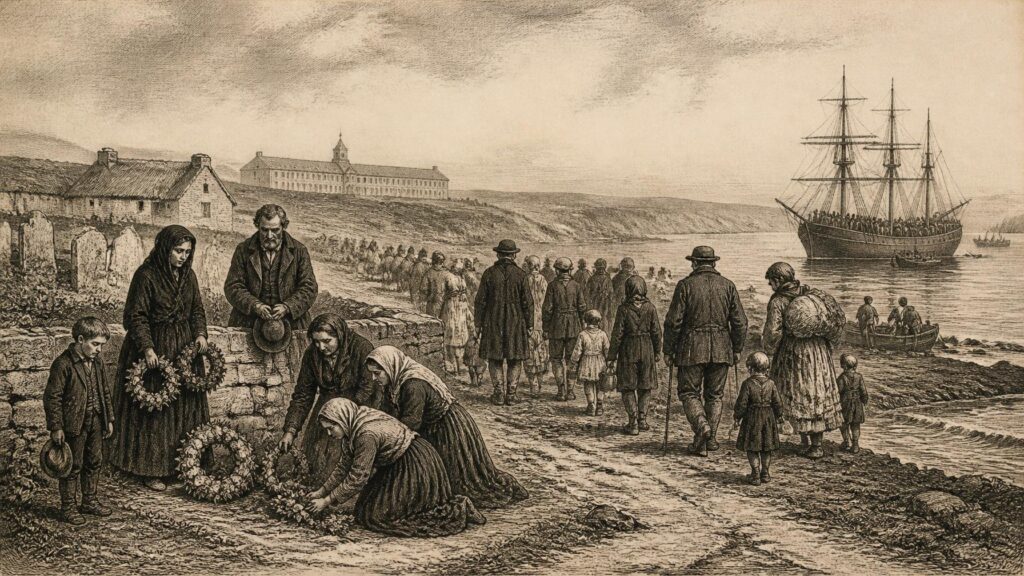
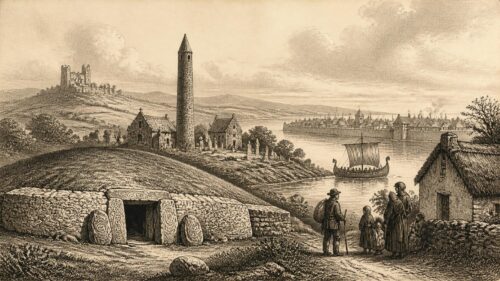
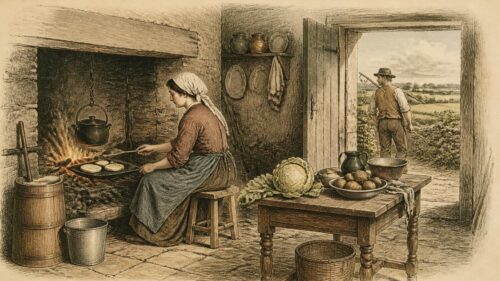
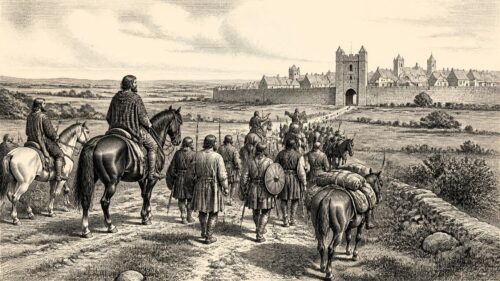
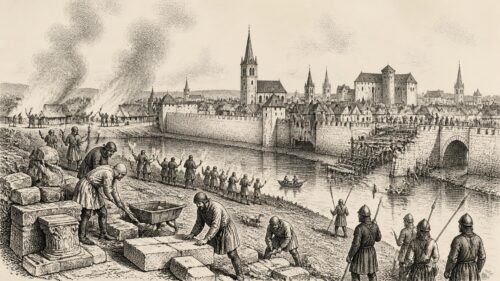
AI generated historical illustration, not a contemporary photograph.
At a Glance
National Famine Commemoration is Ireland’s annual public act of remembrance for the Great Famine, known in Irish as An Gorta Mór. It honours people who died, those driven from their homes, and those who emigrated during and after the catastrophe of the 1840s. Yet it is more than a ceremonial anniversary. Its changing locations, local research, military honours, artistic performances and international connections reveal how Ireland has gradually sought to make a national memory from an event whose experiences were profoundly unequal, locally varied and often difficult to speak about.
Public Memory
The National Famine Commemoration belongs to the history of memory as much as to the history of the Famine itself. The Famine was not a single day, battle or proclamation which could readily be marked at one fixed monument. It was a prolonged social disaster, conventionally dated from 1845 to 1852, although the intensity and chronology of hunger, disease, eviction and migration varied greatly between places. Potato blight was the immediate environmental trigger, but its consequences were shaped by landholding, poverty, political power, public policy, relief systems and unequal access to food. The people most exposed were overwhelmingly poor, particularly labourers, cottiers and smallholders dependent on the potato. A national ceremony therefore confronts an absence: most victims have no known grave, no surviving portrait and no individual monument.
That absence helps explain the form the commemoration has taken. It does not claim to recreate the Famine or to identify one universally representative victim. Instead, it gathers descendants, local communities, public representatives, diplomats, historians, clergy, artists and schoolchildren around the memory of a society altered beyond recognition. Official descriptions emphasise death and emigration together. This is significant. Irish family histories often preserve migration stories more readily than the names of those who died in workhouses, fever sheds, roadside cabins or anonymous burial grounds. Emigration could leave letters, remittances and descendants overseas; death frequently left a silence.
The annual observance was established after a Government decision in 2008 to commemorate the Great Famine with a memorial day. The first event took place at Dublin’s Custom House in that year. In 2009, Skibbereen in County Cork hosted the first ceremony combining substantial local participation with the formal State occasion. Since then, the commemoration has been associated with the weekend of the third Sunday in May, while practical arrangements have occasionally led to variation. It is distinctive among Irish State commemorations because its venue changes, allowing communities in different parts of the island to present the particular history of their own locality.
This mobility is not merely logistical. It makes an argument about the Famine: no one landscape can contain it. The quays of a port, the ruins of a workhouse, a graveyard, a former estate, a mountain road, a parish church, a museum or a civic square may each offer a different historical entry point. A host place can show the material traces of hunger and departure in its own geography. It can also make visible regional differences which broad national figures obscure. Connacht, Munster and parts of Ulster suffered in different ways; towns, estates and parishes experienced the crisis according to their own economies, relief arrangements and patterns of landholding.
Commemoration is consequently an act of selection. It selects a date, a place, speakers, music, symbols and words. Such selection is unavoidable, but it demands care. A dignified ceremony may create solidarity, yet it can also smooth over divisions of class, religion, gender, region and power. Historical work complicates the collective image of an undifferentiated people enduring a common ordeal. The Famine did not affect all Irish people equally, and its burdens were not evenly shared even within a single parish. To remember responsibly is not to abandon national mourning; it is to recognise that mourning must leave room for evidence, disagreement and the recovered lives of individuals.
Hungry Past
The commemoration cannot be understood without the catastrophe it marks. In 1841, the population of Ireland exceeded eight million. By the census of 1851, it had fallen by about one and a half million through death and emigration. Estimates of mortality vary because records were incomplete and because famine deaths were often caused by diseases that preyed upon weakened bodies rather than by starvation alone. Historians therefore rightly avoid turning a vast human loss into a simple arithmetic formula. Nonetheless, the demographic shock was unmistakable, and it set Ireland on a long course of population decline. The official famine commemoration site describes the disaster as Ireland’s greatest social calamity and notes the enduring consequences for migration, social relations and the Irish language.
The potato was central to this vulnerability. For many poor rural households, it offered a remarkable yield from small plots and sustained a dense population where paid work was irregular and land was subdivided. Dependence on one principal crop, however, produced grave exposure when potato blight arrived. The failure was neither wholly unprecedented nor instantly fatal: Ireland had experienced hunger and partial crop failures before. What made the 1840s catastrophic was the repeated destruction of the crop, beginning in 1845 and returning with particular severity, alongside a social system in which many families had little savings, little secure tenure and few alternatives.
The phrase ‘potato famine’ can consequently mislead if it implies that a plant disease alone explains the catastrophe. The blight was a necessary part of the immediate story, but food continued to be produced in Ireland; the question of entitlement, purchasing power, relief and governmental action was crucial. The Poor Law system, public works, soup kitchens, workhouses and outdoor relief all formed part of the response, but their effects varied and their limits were often brutal. Families already weakened by want encountered typhus, relapsing fever, dysentery and cholera. The workhouse, imagined by policy-makers as a deterrent system of last resort, became in many districts an overcrowded refuge and a place of death.
The surviving documentary record is extensive but uneven. Parliamentary papers, Poor Law returns, estate records, relief committee papers, newspapers, letters, workhouse registers, graveyard evidence and later testimony all preserve fragments. The National Library of Ireland points researchers towards prints, drawings, ephemera and documentary material, while warning indirectly against the modern expectation that the Famine should be visually well recorded: photography was new, expensive and largely inaccessible to those suffering most. The images through which many people now imagine famine Ireland are therefore frequently illustrations made for newspapers, later artworks or commemorative monuments, rather than photographs of victims.
The distinction matters. Visual images can generate powerful sympathy, but they may also turn hunger into a generic spectacle. A national commemoration has a different responsibility: to move from a vague picture of misery towards historically grounded understanding. Names on a memorial wall, entries in a workhouse register, a family letter from an emigrant ship, the account books of a relief committee or a local burial tradition can restore texture without pretending that every silence can be filled. The work of remembrance begins not with certainty, but with an honest recognition of what survives and what has been lost.
Long Silence
It is tempting to say that Ireland simply forgot the Famine until recent decades. That interpretation has force, but it needs qualification. The Famine was never absent from family memory, emigrant traditions, local stories, political rhetoric, literature, folk belief or the physical landscape. Ruined cabins, former workhouses and unmarked burial grounds could be persistent reminders. Nor did nineteenth- and twentieth-century writers cease to invoke famine suffering. What changed was the extent to which it was formally commemorated in public national culture, and the manner in which scholars, museums and State institutions approached it.
For a long period, the Famine was an uneasy subject. Its scale was painful; its victims were disproportionately the poor; its history involved shame as well as grief. Families might remember eviction, begging, a workhouse death or a relative who departed, yet avoid speaking of these experiences in detail. The apparent silence could arise from trauma, but also from social aspiration. In communities attempting to establish respectability, ownership or security after generations of poverty, the memory of destitution might be difficult to display. Silence should not therefore be treated as proof that experience was erased. It may instead signal the conditions under which certain memories could be transmitted privately but not publicly.
Historians have also warned against the comforting idea of a perfectly shared national memory. Cormac Ó Gráda, writing on famine, trauma and memory, observed that the rhetoric of the 1990s commemorations often assumed a collective memory binding Irish people everywhere. He set this against a historical record in which the disaster was unequal and divisive, striking poor people far more severely than wealthy ones and sometimes setting neighbours against one another. His warning remains valuable. It does not deny fellow feeling or communal endurance. Rather, it asks whether modern commemorators risk converting a complex history into an uncomplicated narrative of united suffering.
There were political reasons for reticence too. The Famine was inseparable from the history of British rule in Ireland, debates about colonial governance, landlordism, relief policy and national self-government. Nationalist memory could present it as a defining indictment of British misrule; unionist or imperial accounts often framed it differently, stressing blight, charitable effort, administrative difficulty or wider European conditions. Neither political argument nor historical scholarship stood still. By the later twentieth century, a richer body of demographic, economic, regional and cultural research had made it harder to sustain simplistic explanations.
Popular memory also developed its own vocabulary. ‘Taking the soup’ became a term of accusation associated with famine-era proselytism: the belief that hungry Catholics were induced to change religion in exchange for food. The phrase has powerful emotional life, but historical evidence varies from place to place. Maynooth University historian Ciarán Reilly notes that the strongest social memory of such incidents in some areas was recorded later by the Irish Folklore Commission, while also emphasising that soup kitchens and relief efforts could be humane, ecumenical and life-saving. The lesson for commemoration is clear: folklore is historically important evidence of later memory, but it is not identical to contemporary proof of every alleged event.
National Famine Commemoration has emerged after this long and complicated afterlife. It is not the first Irish act of remembrance, and it should not be mistaken for the beginning of memory. It is better seen as a public framework that gathers older local commemorations, scholarship, family research, museums and diaspora connections into an annual State-recognised occasion. Its value lies partly in making space for the difficult history that earlier public culture did not always know how to hold.
Renewed Attention
The modern revival of famine remembrance gathered strength before the annual commemoration began. The sesquicentenary of the Famine in the 1990s prompted exhibitions, publications, academic conferences, memorials, heritage initiatives and ceremonies in Ireland and overseas. This occurred during a period when Irish historical scholarship was expanding rapidly and when Ireland’s relationship with its diaspora was being reconsidered. The 150th anniversary did not produce one agreed interpretation, but it encouraged public engagement with evidence and helped make the Famine a more visible subject of national conversation.
President Mary Robinson played an important part in giving that remembrance a moral and international language. In addresses in Ireland and at diaspora sites, she linked Famine memory with emigration, global Irish communities and concern for contemporary hunger. Ó Gráda identified this as a central theme of the 1990s commemorations: remembrance could be presented as a moral act, strengthening bonds between Ireland and emigrant communities while encouraging concern for people facing famine elsewhere. The appeal was powerful because the Irish Famine had created diasporic communities on a vast scale. It also raised a difficult question: can a past catastrophe be used to generate international solidarity without reducing other people’s suffering to an Irish analogy?
The answer must be cautious. Historical comparison can be illuminating when it is precise and respectful. Ireland’s nineteenth-century experience can sharpen awareness that famine is never merely natural, that hunger is intertwined with political choices and that migration is often a consequence of dispossession. Yet no modern crisis is simply another Great Famine. Conditions of war, climate, international law, state capacity, media and humanitarian action differ. A mature commemoration does not claim ownership over global hunger. It uses Irish history to resist indifference and to recognise the dignity of people facing different emergencies.
Memorials gave this renewed attention a physical form. In Dublin, Rowan Gillespie’s figures on Custom House Quay have become a familiar public image of famine emigration and deprivation. At Murrisk beneath Croagh Patrick, John Behan’s National Famine Monument evokes a coffin ship. At Strokestown, the former estate landscape and the Irish National Famine Museum connect visitors with the complex history of landlordism, assisted emigration and archival survival. Such sites cannot contain the Famine, but they establish places where it can be encountered deliberately rather than merely invoked.
The rise of genealogy also changed the terms of remembrance. Digital catalogues, parish records, census material, shipping research and estate archives have enabled many people to seek named ancestors. This can be immensely meaningful, though it carries risks. An ancestor story may be fragmentary, and a desire for a dramatic connection can sometimes exceed the evidence. The best local projects make careful distinctions between documented fact, reasonable inference and family tradition. In doing so, they model the historical discipline that national commemoration requires.
The 2008 decision to institute an annual memorial day should be seen in this wider context. It was not a sudden discovery of a forgotten past, but a decision to give permanent public form to a memory that had been researched, debated and commemorated in many ways. The National Famine Commemoration Committee became the mechanism for organising the annual programme, consulting with host communities and coordinating national and international dimensions. The ceremony thus joined the State to work already being done by local historians, museums, archivists, voluntary groups and descendants.
State Ceremony
The annual ceremony has a recognisable structure. A host community and local authority organise a local programme with departmental support. This commonly includes lectures, exhibitions, walks, music, school participation, genealogical work, museum activity or acts of remembrance at places connected with local famine history. The formal State ceremony follows, normally with military honours and wreath laying, and is presided over by the President of Ireland or the Taoiseach. It is open to the public, though it also includes invited guests, diplomats and representatives of civic institutions.
Military ceremony may seem at first an unusual language for a commemoration of civilians who died from hunger and disease. It has, however, a specific civic function. State honours recognise that the victims belong within the public history of Ireland and are not merely objects of private grief. The danger is that ceremonial formality can become too polished for the disorder and suffering it recalls. This is why local testimony, music, readings and historical interpretation are important counterweights. They return the ceremony from abstraction to particular people and places.
The alternating presence of President or Taoiseach matters symbolically. The President can speak in a deliberately broad ethical register, representing the people of Ireland across political difference. The Taoiseach represents the government of an independent State. Their participation acknowledges that the Famine was not simply an episode of misfortune but a formative event in the political history from which modern Ireland emerged. At the same time, responsible addresses should avoid treating the victims as instruments in a straightforward national story. They were not waiting to become symbols. They were people making constrained choices under conditions many could not survive.
Speeches at the commemorations often relate the Famine to emigration, cultural loss, Irish language decline, social inequality and humanitarian responsibility. These are legitimate themes, provided that rhetoric does not outrun evidence. The claim that the Famine changed Ireland permanently is beyond dispute; the exact mechanisms and regional patterns remain subjects for historical investigation. Population decline, altered settlement, changes in farm size, enduring migration and the loss of communities in Irish-speaking districts were real, but they did not occur everywhere in identical fashion. The strength of an annual ceremony lies not in supplying a final interpretation, but in keeping such questions public.
The coronavirus pandemic demonstrated both the flexibility and vulnerability of commemorative practice. In 2020, restrictions prevented a normal large gathering. A reduced ceremony took place in Dublin’s St Stephen’s Green, was livestreamed, and included the unveiling of a plaque marking the 2008 inaugural annual commemoration at the Custom House. The event linked the past with a present public-health emergency, while also showing that remembrance could be transmitted through broadcast media when physical assembly was impossible.
There is a useful restraint in the ordinary ritual of wreath laying. It neither claims to resolve historical argument nor pretends to know every victim’s story. It gives public recognition to loss. But ritual alone is insufficient. The most successful programmes surround it with learning: archives displayed, local names read, workhouse sites interpreted, historians heard and young people invited to investigate rather than merely inherit a prepared emotion. In this sense, the formal State event is the culmination of commemoration, not its whole substance.
Local Landscapes
The changing venue is the commemoration’s most distinctive feature. Rotation among provinces and host communities prevents Dublin from becoming the sole stage for a national tragedy. It also resists the assumption that famine Ireland can be represented by one celebrated location. Skibbereen, Strokestown, Murrisk, Kilrush, Drogheda, Clones, Newry, Ballingarry, Glasnevin, University College Cork, Milford and Portumna each bring different histories into view. Some are associated with workhouses, some with emigration, some with estate records, some with famine graves, rebellion, urban relief or local cultural memory.
Skibbereen acquired particular symbolic force because contemporary reports from west Cork helped make suffering there internationally visible. Yet its prominence should not make other places appear secondary. The Famine was not a regional event imposed upon a few western districts. Its incidence was widespread, although mortality and destitution were uneven. A rotating ceremony is a reminder that national history is made from local histories, and that local histories require investigation rather than assumption.
Strokestown provides an especially vivid example of how place and records can transform commemoration. The estate archive preserved evidence of the assisted emigration of 1,490 people from 275 families and thirty-two townlands in 1847. A memorial wall, developed from those records, gives names to people who might otherwise remain an anonymous mass. Naming is not a sentimental substitute for history. It is a historical achievement, dependent on surviving documents and painstaking work. It also illustrates an ethical distinction: where names are known, they should be used; where they are not, silence should not be filled with invented certainty.
Workhouses are similarly difficult sites. Their buildings are powerful survivals, but they can encourage a misleadingly simple story in which the workhouse itself becomes the whole Famine. In reality, the Poor Law system operated through many institutions and decisions: boards of guardians, ratepayers, medical officers, relieving officers, local elites, central authorities and families forced to decide whether entry was preferable to hunger outside. Workhouse records can be extraordinarily revealing, but they are administrative records produced within a coercive system. They must be read for what they say and for what they omit.
Routes and landscapes matter too. A road associated with a relief march, a harbour from which emigrants sailed, a field containing a mass grave or the site of a demolished cabin can hold local meaning. Such locations are often surrounded by stories passed down over generations. Some may be corroborated by contemporary sources; others cannot. Their value should not be dismissed simply because they are not all verifiable, for they show how communities have made sense of loss. But public interpretation should label them carefully as oral tradition, later testimony or documented event. Confusing these categories weakens rather than honours the past.
Local commemoration can also recover acts of care. The Famine was a history of failure, neglect and suffering, but not only that. Neighbours, clergy, doctors, nurses, relief committees, charities and people overseas tried to help in conditions often beyond their control. Their actions do not erase the inadequacy of relief or the structural causes of the disaster. They do, however, complicate a narrative in which every person is cast only as victim, villain or spectator. A historically serious ceremony can acknowledge courage without allowing benevolence to become an alibi for policies that failed to prevent mass death.
Global Diaspora
Emigration gives National Famine Commemoration an international reach. The official programme includes an International Famine Commemoration, held in different locations so that diaspora communities can remember the catastrophe and the subsequent dispersal of Irish people. This is not an optional decorative addition. Migration was one of the Famine’s central outcomes, and Irish communities abroad preserved experiences, family stories and institutions that became part of the memory of the event.
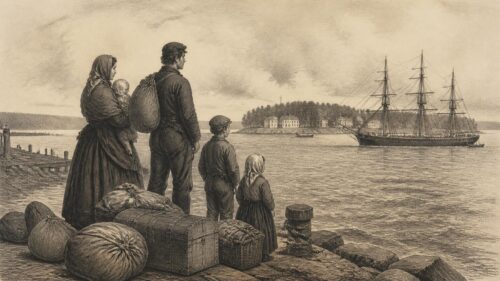
People departed for Britain, North America, Australia and elsewhere. Their journeys were not uniform. Some left under assisted-emigration schemes; some travelled through family networks; some went from ports such as Liverpool before continuing overseas; some died in transit or shortly after arrival. The phrase ‘coffin ship’ is now deeply embedded in popular language. It captures real danger, particularly in 1847, but it should not imply that every emigrant vessel was identical or that every journey had the same mortality. Historical precision is not a cold correction. It enables commemoration to understand the specific conditions people faced.
Canada has particular importance in famine remembrance because of the number of Irish emigrants who arrived in 1847 and the suffering endured at quarantine stations, especially Grosse Île. The Irish Famine Archive at the University of Galway notes the flight of an estimated 100,000 Irish people to Canada in this bleak period and preserves material relating to the care of widows and orphans. The story naturally includes the generosity of the Grey Nuns and others who assisted the destitute, but it also includes the unequal vulnerability of migrants, the loss of parents and children, and the ways in which Irish newcomers entered an already complex colonial society.
International events can make descendants active participants rather than distant spectators. They create occasions for family reunions, archival exchanges, music, scholarship and civic recognition. They can also reveal the diversity of the diaspora. Irish famine migrants did not become one homogeneous community abroad. They entered cities, farms, factories, religious institutions, political movements and households in different countries; they encountered welcome, prejudice, employment, poverty and opportunity in varying measure. The diaspora is best understood not as a single outcome but as many intertwined migrations.
There is an additional ethical dimension. Irish commemoration has often recalled the donation made by the Choctaw people for famine relief in 1847. The gift is moving, particularly because it came from a people who had themselves suffered forced removal and deprivation. It should be remembered with gratitude, but not reduced to a consoling legend in which all historical differences disappear. Proper remembrance acknowledges the distinct history of the Choctaw Nation and avoids appropriating its suffering into an Irish narrative. The connection is strongest when it encourages reciprocal learning and respect.
Modern Irish public culture sometimes uses Famine memory to interpret contemporary migration. This can foster empathy, especially when it reminds audiences that Irish people once fled hunger, eviction and insecurity. Yet comparison must not flatten the experiences of present migrants, refugees or asylum seekers. Their histories belong to them. The moral use of Famine memory is not to announce that every journey is the same; it is to challenge the complacency that treats desperate movement as alien to Irish history.
Historical Evidence
A commemoration of the Famine must be founded on evidence, while recognising the evidence’s limits. Contemporary records were generated unevenly. Landlords and officials left papers in greater quantity than labourers and paupers. Workhouse registers preserve names, ages and admissions, but seldom the full inner lives of those entered. Newspapers may report vivid scenes, but their political orientation, readership and appetite for sensation need consideration. Estate correspondence can reveal decisions about rents, eviction, relief and migration, but it represents the viewpoint of power. Letters from emigrants are precious, though only some families could write, preserve and transmit them.
For this reason, no single archive can tell the whole story. A historian may compare a Poor Law return with parish records, census data, local newspapers, maps, folklore, archaeological evidence and family testimony. Contradictions are not failures of research; they are often clues to different perspectives. A landlord’s claim that relief was adequate may be set against a doctor’s report of fever, a guardian’s minutes, or the record of an overflowing burial ground. The task is neither to trust every document nor to dismiss documents because they are partial. It is to ask who produced them, for what purpose and in what circumstances.
National institutions make much of this work possible. The National Library of Ireland preserves printed and visual material, including newspaper illustrations and famine-related ephemera. Its guidance for researchers highlights the usefulness of collections beyond familiar textbook images and reminds users to search with relevant terms and dates. The university-based Irish Famine Archive preserves a distinct transatlantic dimension, while local archives and museums retain estate papers, workhouse material and community research. These resources mean that commemoration need not rely solely on inherited story or political speech.
Statistics require particular care. It is reasonable to say that around one million people died and more than a million emigrated, because these rounded figures convey the scale recognised in historical scholarship and public memory. It is less responsible to treat them as exact totals. Mortality estimates depend on methods and assumptions, while emigration figures must distinguish years, destinations and routes. Similarly, a population decline between censuses cannot simply be assigned to deaths without allowing for migration. Good public history uses figures to establish magnitude but does not conceal uncertainty behind false precision.
Language requires care as well. ‘Great Famine’, ‘Great Hunger’, An Gorta Mór and An Drochshaol each carry meanings and histories. None is wholly neutral. ‘Famine’ is familiar in English and connects Ireland to comparative history; ‘Great Hunger’ can stress human suffering; Irish-language terms preserve vernacular and cultural associations. The choice of term may reflect region, family tradition, scholarship or political emphasis. A respectful ceremony need not enforce one vocabulary, provided it does not obscure the event itself.
Folklore deserves a secure but disciplined place. Recollections collected decades later may preserve names, locations, emotions and interpretations otherwise absent from official records. They can also incorporate later assumptions, local rivalries, nationalist language or the ordinary transformations of oral transmission. The question is not whether folklore is true or false in a crude sense. It is what kind of truth it offers: sometimes evidence of an event, sometimes evidence of how a community remembered an event, and often both in uncertain proportion. National commemoration is strongest when it can say plainly which is which.
Contested Meaning
Famine commemoration has never been politically empty, nor should it pretend to be. The Great Famine raises unavoidable questions about responsibility. How far did British government policy worsen a crisis created by blight? How did laissez-faire ideas, Treasury priorities, the design of the Poor Law and decisions about food relief affect survival? What responsibility lay with landlords, local authorities, churches, merchants or relief bodies? Historical scholarship has debated these questions vigorously, and public language has ranged from descriptions of neglect to accusations of genocide.
Genocide is particularly contentious. Some people use the term to express the conviction that the catastrophe was preventable and that official policy showed lethal disregard for Irish lives. Others argue that the legal and historical meaning of genocide requires proof of intent to destroy a protected group, which the available evidence does not establish. The disagreement should not be hidden, but a State commemoration should not settle it through slogan. Its proper role is to acknowledge preventability, policy failure, human agency and the intensity of historical debate, while allowing scholarship to test arguments against evidence.
Official speeches have often made a strong case that the Famine was not an unavoidable natural disaster. In Portumna in May 2026, the Taoiseach described the combination of neglect, colonial attitudes and harsh ideology that allowed disaster to deepen, while also stressing the generosity of people around the world who sent relief. Such speeches represent a governmental interpretation rather than a substitute for archival research. Their importance lies in refusing an older evasion: blight does not explain why a crop disease became mass death on this scale.
There are other tensions. A commemoration framed chiefly through national independence can imply that the principal historical lesson is the eventual achievement of the Irish State. That interpretation has meaning, but it can narrow the experience of people who lived in places with different political loyalties, those who migrated to Britain, or those whose descendants identify in diverse ways. Conversely, a commemoration stripped of political context can turn the Famine into a natural disaster detached from institutions and power. The challenge is to hold both truths: the Famine shaped political consciousness, and the people who suffered cannot be reduced to later political outcomes.
Religion is similarly complex. Clergy and religious communities were involved in relief, advocacy, pastoral care, proselytism controversies and the administration of institutions. The Famine occurred in a society marked by denominational difference and unequal power. To remember only conflict would obscure much practical charity; to remember only charity would obscure coercion and fear. The best local programmes use their own evidence rather than repeating inherited generalisations.
Contestation need not diminish commemoration. Indeed, a ceremony that admits difficult questions may be more durable than one that offers a finished national myth. Public remembrance becomes hollow when it asks people merely to feel what they are expected to feel. It becomes historically productive when it invites them to consider how a society becomes vulnerable to hunger, who is heard in the archives, why some deaths are named and others anonymous, and how later generations have used the past.
Living Legacy
The Famine’s legacy is visible not only in memorial days but in Ireland’s demographic and cultural landscape. Population loss, emigration, changes in settlement, family separation and the decline of Irish-speaking communities shaped generations. It would be mistaken to attribute every later feature of Ireland to the Famine, yet it would be equally mistaken to treat it as a closed nineteenth-century episode. Family patterns, property arrangements, local memory and relationships with the wider world bear marks of the period, sometimes directly and sometimes through accumulated consequence.
National Famine Commemoration has developed a language of obligation from this legacy. It asks present-day Ireland to remember people whose lives were devalued by systems of poverty and governance. It also asks what practical solidarity means in a world where hunger persists. The official programme’s international dimension and many presidential or governmental addresses connect historical remembrance with humanitarian concern. Such connections are morally compelling when they encourage attention to present suffering, not when they convert that suffering into a mirror for Irish self-regard.
Education is central. Younger generations are increasingly distant from family members who heard Famine stories directly. School and community projects can bridge that distance, but only if they encourage inquiry. A child who maps a local workhouse, reads an emigrant letter, compares census figures or interviews relatives about a family tradition learns more than a set of dates. They learn how history is assembled. They also learn that compassion is not the same as credulity: empathy grows stronger when it is rooted in careful evidence.
Digital access offers new possibilities. Online archives allow descendants overseas to encounter documents that would once have required a journey to Dublin, Galway, Roscommon or a local repository. Livestreamed ceremonies can extend participation beyond the host town. Digitisation, however, does not solve every problem. What is digitised is shaped by funding, copyright, survival and institutional priorities; records remain unevenly preserved. The prominence of searchable names may favour people who left a documentary trace over those who did not. Commemoration must therefore remember the unnamed as actively as it celebrates recovered identities.
The annual event’s greatest achievement may be its refusal to locate Famine memory in one institution alone. The State provides recognition and ceremonial weight. Local communities provide place, knowledge and participation. Archives provide evidence. Museums interpret material remains. Scholars test claims. Descendants bring family connection. Artists find forms for grief that statistics cannot convey. None can replace the others. Together they create a civic practice capable of being both solemn and questioning.
That practice remains unfinished. Every host community discovers new records, revises local assumptions and encounters gaps that cannot be repaired. Every generation brings different questions: earlier commemorators might have stressed national survival; later ones may focus more on migration, social inequality, language, global hunger or the ethics of historical representation. Change is not a betrayal of remembrance. It is evidence that the commemoration is alive.
Enduring Duty
National Famine Commemoration does not and cannot compensate for the suffering of the 1840s. No ceremony can restore the dead, undo evictions, reunite separated families or recover every lost name. Its purpose is more limited and more necessary. It gives public recognition to a catastrophe that transformed Ireland, insists that those who suffered belong in the national story, and offers communities a disciplined way to connect local evidence with shared mourning.
Its most responsible form avoids two temptations. The first is simplification: turning a complex disaster into an easy lesson about nature, nation or blame. The second is sentimentality: allowing music, symbols and inherited phrases to stand in place of knowledge. The commemoration is at its best when formal dignity is matched by historical candour; when it remembers death alongside migration, victimhood alongside agency, local difference alongside national consequence, and the documented record alongside the silences which no record can remove.
For that reason, the changing annual venue matters so much. It asserts that the Famine happened not in an abstract Ireland but in particular townlands, houses, workhouses, roads, ports and graveyards. It asks each host place to recover what it can, to distinguish evidence from folklore and to present its history to the wider country. In return, the wider country acknowledges that a local wound is part of a national inheritance.
The annual gathering thus performs a modest but profound civic act. It names a past injustice without claiming easy mastery over it. It mourns people who were too often recorded only as numbers. It recognises that historical memory can be contested without becoming meaningless. Above all, it keeps before Ireland a question that belongs to every generation: when hunger, poverty and displacement confront a society, what does it choose to see, and what does it choose to do?

National Famine Commemoration’s rotating locations seem especially significant because they resist reducing a varied catastrophe to one national image. By linking local archives, burial grounds, workhouses and emigrant memories to a State ceremony, the observance can acknowledge both shared loss and unequal experiences shaped by class, region and power. The article also suggests that public remembrance must not substitute for historical inquiry, particularly where records are fragmentary and family traditions uncertain. How might future commemorations balance national solidarity with the need to present contested local evidence, unnamed victims and the differing experiences of those who died, migrated or survived it?