

Catholic Ireland
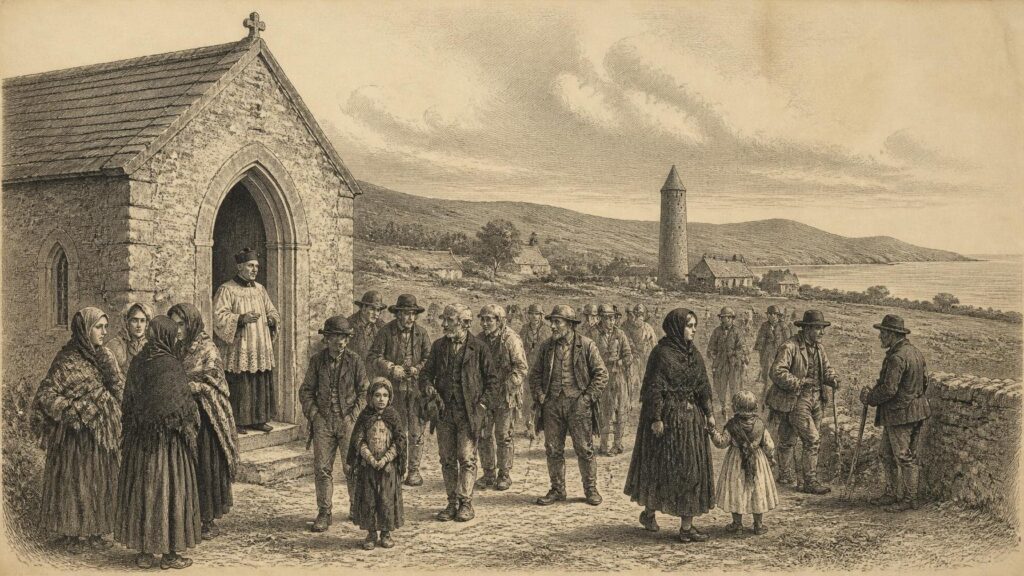
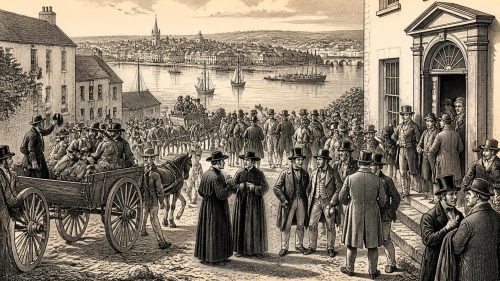
AI generated historical illustration, not a contemporary photograph.
At a Glance
Catholicism has been one of the most enduring forces in Irish history, but it has never been a simple synonym for Ireland, nor a single unchanging institution. It has been a creed, a sacramental culture, an international allegiance, a language of resistance, a source of education and care, and, at times, a structure of authority capable of grave injustice. Its history on the island is therefore not a tale of uninterrupted national devotion. It is a history of adaptation, conflict, reform, popular practice and contested memory.
Early Beginnings
Christianity reached Ireland during the later Roman world, although the manner, pace and geography of its arrival remain subjects of historical reconstruction rather than complete certainty. The traditional popular story places Saint Patrick at the beginning of Irish Christianity and presents him as the solitary converter of a wholly pagan island. That story has immense cultural power, but it is an inadequate historical explanation. Patrick’s own surviving writings show a Christian missionary operating among Irish communities in the fifth century, while the evidence for Palladius, sent as bishop to Irish Christians in 431, indicates that there were already believers worth serving before Patrick’s mission became established.
Neither the calendar of conversion nor the scale of pre-Christian religion can be reduced to a single date or event. Archaeology, inscriptions, later hagiography and the texts associated with Patrick all contribute different forms of evidence. They do not allow historians to describe a clean replacement of one religious order by another. Rather, Christianity gained footholds among local rulers, kin-groups and settlements, then developed institutions that were shaped by the political world of early Ireland. Christian ideas, clerical learning and new forms of burial spread unevenly. Older customs did not simply vanish; some were transformed, accommodated or condemned.
The early Irish church was part of Latin Christendom, not an isolated national invention. Its clergy used Latin, drew on scriptural and patristic learning, and maintained connections with Britain and continental Europe. Yet its organisation was strongly influenced by the island’s dispersed kingships and powerful kindreds. Bishops were important, but monasteries and monastic federations acquired exceptional influence. Great ecclesiastical centres, associated in tradition and documentary record with places such as Armagh, Clonmacnoise, Kildare and Bangor, became nodes of worship, learning, patronage and political negotiation.
This was not a uniform ecclesiastical landscape. Churches and monasteries were embedded in local society; leading families often supplied abbots and protected religious communities. That relationship brought resources and stability, but also competition. Saints’ lives, written long after the saints themselves, frequently portray holy founders confronting kings, druids or rival churchmen. Such texts are valuable evidence for the ideals and claims of their authors, but they are not straightforward reports of fifth- or sixth-century events. Folklore and hagiography should not be mistaken for modern biography.
Monastic Networks
From the sixth century onward, Irish monasteries became famous as centres of manuscript production and scholarship. The survival of illuminated books and learned texts has encouraged a romantic picture of an island uniquely preserving European civilisation after Rome. That phrase, often associated with popular narratives, overstates both Irish isolation and Irish singularity. Learning continued in many regions of post-Roman Europe, and Ireland’s intellectual life depended upon wider Christian networks. Yet the surviving evidence leaves no doubt that Irish ecclesiastical communities produced important works of biblical interpretation, grammar, law, liturgy and art.
The Book of Kells, probably made around the turn of the ninth century, is the best-known surviving example. It is a Gospel book of extraordinary artistic complexity, associated with the Columban world of Iona and Kells. Its beauty can obscure its practical identity: it was a Christian liturgical book, created within a learned religious culture. Other manuscripts, metalwork and carved crosses reveal the material resources of churches and monasteries. They also show that Christian art was not merely imported. Local artists adapted Mediterranean, Insular and northern European visual languages into forms now strongly associated with early medieval Ireland.
Irish clerics travelled widely. Columbanus and other missionaries founded or influenced monasteries in what are now France, Switzerland and Italy. Irish students and scholars appear in continental sources across the early Middle Ages. These movements were not a simple export of an especially pure ‘Celtic Church’. The phrase is often used loosely, sometimes to suggest a church fundamentally separate from Rome. Historians are more cautious. Irish Christianity possessed distinctive practices and institutional arrangements, but it remained within the broad Latin Christian tradition, even where disagreement existed over matters such as the calculation of Easter or styles of monastic discipline.
The reforming synods of the eleventh and twelfth centuries altered the church’s structures. Dioceses, territorial bishoprics and cathedral chapters became more defined, and ecclesiastical reformers sought greater conformity with continental canon law. The Synod of Rath Breasail and the Synod of Kells are conventionally treated as landmarks in this reorganisation, though the process was neither instant nor complete. The arrival of Anglo-Norman power after 1169 became entwined with church reform, papal authority and competing claims of kingship. Church history cannot be separated from conquest, but neither can conquest be explained solely through religion.
Medieval Devotion
Medieval Irish Catholic life extended far beyond monasteries and bishops. Parish churches, pilgrimage places, saints’ wells, shrines, confraternities and seasonal observances carried religion into everyday life. The evidence is partial: many buildings have vanished, written records are uneven, and later custom has sometimes been projected backwards without proof. Still, the physical landscape preserves traces of a deeply Christian society. Church ruins, graveyards, high crosses, holy wells and place-names record long traditions of devotion and local memory.
Saints occupied a central place in this religious world. Patrick, Brigid, Columba and many regional holy figures were honoured as intercessors and protectors. Their cults were expressed in liturgy, pilgrimage, relics and storytelling. Some surviving customs at holy wells may contain elements older than Christianity, but historians must resist easy claims of direct pagan survival. Continuity is possible in particular places and practices; it must be demonstrated rather than assumed. A well visited for prayer in the nineteenth century cannot by itself prove an unchanged rite from pre-Christian antiquity.
Religion also structured social power. Churches held land, received gifts, offered sanctuary and participated in legal culture. Clerics could act as advisers, scribes and diplomats. Yet ecclesiastical ideals repeatedly collided with violence, dynastic conflict and worldly patronage. Medieval Christianity in Ireland was not a tranquil spiritual refuge outside politics. It was woven into the politics of Gaelic lordships, Hiberno-Norman settlements and royal administration. The distinction between ‘religious’ and ‘secular’ authority, familiar in modern discussion, was far less sharply drawn.
By the later Middle Ages, mendicant orders such as the Franciscans and Dominicans had established houses in Irish towns. Their preaching, pastoral work and learning broadened religious life beyond older monastic models. Parish organisation developed differently in different regions, reflecting the varied reach of lordship and administration. The resulting Catholic culture was locally rooted but connected to Europe through religious orders, papal provisions, pilgrimage and trade. On the eve of the Reformation, Ireland was not outside western Christendom; it was one of its varied and politically divided regions.
Reformation Upheaval
The sixteenth-century Reformation introduced the most consequential religious rupture in Irish history. Henry VIII’s rejection of papal jurisdiction, followed by the establishment of royal supremacy, brought a constitutional break with Rome. In Ireland, however, the new ecclesiastical settlement was unevenly implemented and unevenly received. The Tudor state’s authority was limited in many areas, while the religious changes associated with the English crown could be understood as inseparable from military expansion, legal transformation and the advance of English political power.
It is misleading to imagine a population making a single, clear confessional choice at a particular moment. Many communities experienced the Reformation through altered appointments, changing church property, official injunctions and political pressure. The availability of clergy, the strength of local rulers, language, geography and the reach of government all mattered. The Church of Ireland retained the legal establishment and much ecclesiastical property, but large parts of the population continued to adhere, in varying degrees, to Catholic worship and allegiance.
Counter-Reformation renewal gave Irish Catholicism new energy and sharper institutional definition. Continental seminaries trained clergy, religious orders returned or reorganised, and bishops sought to implement the decrees of the Council of Trent. This was not merely a defensive revival. It reshaped religious culture through catechesis, sacramental discipline, clerical education and new devotional emphases. The process unfolded amid war and confiscation, making Catholic loyalty both a spiritual and a political matter in the eyes of rulers and subjects alike.
Confessional identity became entangled with land, sovereignty and ancestry. Catholic did not always mean Gaelic, nor Protestant always mean newcomer: the older English Catholic population, Gaelic elites, settlers, converts and dissenters complicate every broad division. Still, the political order increasingly favoured Protestant interests, particularly after conquest and plantation. Catholicism became associated, often powerfully but not exclusively, with those dispossessed or excluded by that order.
Confederate Moment
The rebellion of 1641 and the wars that followed produced a brief but important experiment in organised Catholic politics. In 1642, Catholic representatives established the Confederate Catholic Association at Kilkenny. The Confederacy brought together many Gaelic Irish and Old English Catholics, maintained armies, raised revenue, issued proclamations and negotiated with royalists and foreign powers. It was not a modern nation-state, and its members were divided by regional interests, military priorities and views on the proper relationship with King Charles I and the papacy.
Its existence nevertheless demonstrates that Catholicism could serve as a political language capable of crossing older ethnic and social boundaries. Confederates sought religious toleration and the restoration of Catholic rights, but they also pursued property, security and political influence. Clerical figures were influential, though they did not speak with one voice. The papal nuncio Giovanni Battista Rinuccini supported a more uncompromising Catholic settlement than many lay magnates were willing to accept. The divisions between military necessity, religious principle and constitutional calculation proved fatal.
Cromwellian conquest after 1649 brought defeat, land confiscation, transportation and a new Protestant ascendancy. The scale and human consequences of the conquest remain central to Irish historical memory. Popular accounts often compress a prolonged and varied process into memorable slogans, but the broad outcome is clear: Catholic landholding and political power suffered devastating reduction. Catholic worship survived, yet it did so under conditions of insecurity and legal constraint.
The Williamite war at the end of the seventeenth century confirmed the political predominance of Protestant rule. The Treaty of Limerick in 1691 is remembered for promises concerning Catholic subjects that later generations believed had been dishonoured or narrowed. Its precise legal and political consequences have long been debated, but it became an enduring symbol of broken confidence. The subsequent penal code fixed Catholic exclusion into a series of statutes rather than leaving it merely to administrative custom.
Penal Survival
The Penal Laws were not one single enactment, nor were they enforced in the same way at all times or places. They were a body of legislation and legal disabilities introduced or strengthened from the late seventeenth century. Catholics faced restrictions affecting property, education, public office, political participation, arms, religious orders and the clergy. The laws aimed to secure a Protestant political order by weakening Catholic wealth, leadership and institutional capacity.
It would be wrong, however, to describe eighteenth-century Catholic life only as clandestine misery. The restrictions were real and could be severe, but Catholics retained family networks, economic activity, devotional practice and forms of local influence. Priests ministered despite registration requirements and other restraints. Mass was sometimes celebrated in discreet settings, but the image of every service taking place secretly at a remote ‘Mass rock’ has been romanticised. Such sites existed and are important memorial places, particularly in regions exposed to harassment; they were not necessarily the universal or permanent norm of Catholic worship.
The Catholic population was internally diverse. Wealthy merchants, gentry families, tenant farmers, labourers and urban artisans did not experience the code alike. Some Catholics used legal devices to protect property; others suffered acute exclusion. Continental Irish Colleges remained vital for clerical education, while a domestic clerical structure continued to function. By the later eighteenth century, practical relaxation, geopolitical pressures and changing political ideas created opportunities for relief.
Catholic relief came gradually. Measures in the 1770s and 1780s eased important restrictions relating to property, worship, education and clergy. The process was shaped both by imperial anxieties and by Irish political argument. Britain’s wars and the fear of foreign invasion made Catholic loyalty a strategic concern, while reformers increasingly challenged the old assumptions underlying exclusion. Relief did not mean equality, and it did not resolve the question of parliamentary access. Yet it marked the beginning of the penal system’s dismantling.
Emancipation Campaign
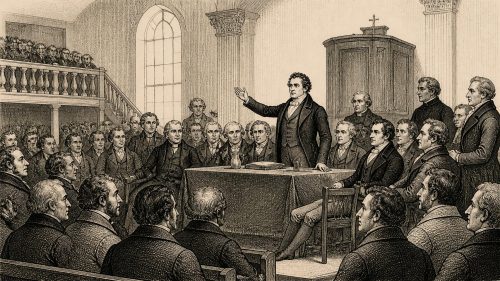
The campaign for Catholic emancipation transformed Irish politics. The central demand was admission of Catholics to Parliament and the removal of remaining civil disabilities. Daniel O’Connell, a Kerry barrister of remarkable political ability, became its foremost leader. Through the Catholic Association, founded in 1823, he helped build a mass movement financed in part by the small regular subscription known as Catholic Rent. Parish clergy, local organisers and ordinary supporters gave the movement a reach unprecedented in Irish electoral politics.
O’Connell’s achievement was not simply that he won legislative change. He helped establish a form of constitutional mobilisation that made Catholic voters and their priests visible as a national political force. His election for County Clare in 1828, though he could not legally take the parliamentary seat as a Catholic, created a crisis that the British government could not ignore. The Roman Catholic Relief Act of 1829 followed, permitting Catholics to sit in Parliament after taking a revised oath.
Emancipation was a watershed, but not a complete social revolution. The accompanying raising of the property qualification for the Irish county franchise excluded many poorer voters who had participated under the previous system. Nor did admission to Parliament undo the economic inequalities, landlord power or sectarian suspicions embedded in Irish society. Its symbolic importance was immense nevertheless. Catholic citizenship was now recognised more fully within the United Kingdom, even while the union itself remained bitterly contested.
O’Connell’s relationship with the Catholic hierarchy was consequential and uneasy. He enlisted priests in electoral organisation, but he insisted that Irish politics should not be governed from Rome. His famous distinction between religion and politics reflected a real tension: Catholic nationalism could draw strength from faith without being reducible to clerical direction. Later nationalist traditions would repeatedly negotiate that same tension, sometimes by cooperating with bishops and sometimes by resisting them.
Famine Transformation
The Great Famine of the 1840s was a catastrophe of hunger, disease, eviction, migration and death. Its effects altered almost every institution in Ireland, including the Catholic Church. Priests and religious sisters ministered to people facing destitution, fever and bereavement; some died after contracting disease in pastoral or charitable work. Churches could provide networks of relief, consolation and communication, but they did not possess the resources to meet the scale of the disaster. Responsibility for relief lay fundamentally within the structures of government, landlords, workhouses and local administration, not with a church that was itself often poor.
The Famine accelerated emigration and population decline, changing the religious geography of the island and expanding the Irish Catholic diaspora. Irish-born priests, sisters and lay migrants carried devotional practices and institutional ambitions to Britain, North America, Australia and beyond. In many cities, Irish Catholic parishes, schools, hospitals and charitable societies became central to immigrant community life. This global expansion was not simply an extension of an Irish nation abroad. Migrants adapted to new racial, class and political worlds, while Irish Catholic institutions themselves became more international.
Within Ireland, historians have described the decades after the Famine as a period of intensified devotional practice and ecclesiastical consolidation. The phrase ‘devotional revolution’, associated especially with the work of Emmet Larkin, captures visible changes: more regular sacramental observance, missions, confraternities, processions, rosaries, pilgrimages and church building. The interpretation remains debated. Some scholars emphasise gradual development, regional variation and practices already present before 1850. The evidence supports substantial change, but not a magical overnight conversion of an undisciplined people into uniform Roman Catholics.
Cardinal Paul Cullen, Archbishop of Dublin from 1852 and later Ireland’s first cardinal, was crucial to the Romanising tendency. Educated and experienced in Rome, he promoted clerical discipline, episcopal authority and closer conformity with Roman norms. His influence was formidable, though not absolute. Priests, religious orders and laypeople did not merely receive a programme from above; they made Catholic culture through their own choices, expectations and participation. The post-Famine church grew powerful because institutional leadership and popular devotion reinforced one another.
Roman Discipline
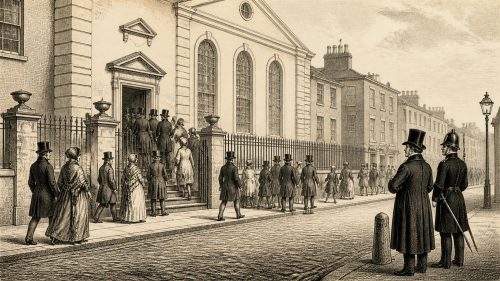
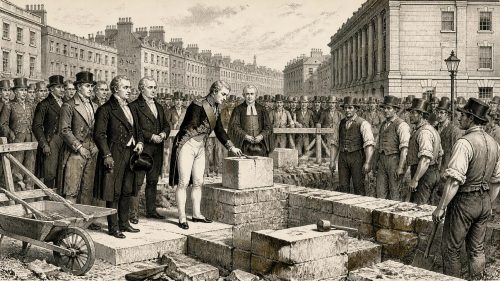
Nineteenth-century Catholicism produced a more visible ecclesiastical landscape. Large churches rose in towns and cities; convents and monasteries expanded; schools and hospitals multiplied. The construction of grand buildings is sometimes treated as proof of clerical domination, but it also indicates fundraising by laity, the growth of urban Catholic communities and a new confidence after emancipation. Architecture expressed both devotion and social aspiration. A cathedral or convent could be a place of worship, education, employment, philanthropy and civic presence.
Religious women were especially important. Congregations including the Sisters of Mercy, Presentation Sisters and many others worked in education, nursing, orphanages and poor relief. Their labour filled gaps in public provision and created opportunities for women within religious life that were otherwise limited. This does not make all religious institutions benign. The same institutional world could offer care and discipline, compassion and control. Its history must be judged through evidence about particular places, practices and periods, rather than either devotional gratitude or blanket condemnation.
Maynooth College, established in 1795 for the education of Irish Catholic clergy, became a central institution in the formation of a domestic priesthood. Its existence reduced dependence on continental seminaries and helped standardise clerical training. The college’s place in British politics was contentious; opponents treated state support for it as an affront to Protestant ascendancy, while supporters saw trained clergy as a means of social order and pastoral provision. These disputes reveal that Catholic institutional growth was always connected to wider arguments about the state.
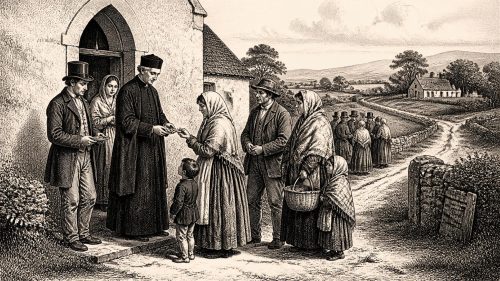
Popular religion during this period was disciplined but not passive. Lay Catholics attended missions, joined sodalities, visited shrines and contributed to parish life, yet they also brought local expectations to priests and bishops. Some devotions flourished in particular regions more than others. Pilgrimage sites, including Croagh Patrick and Lough Derg, had long histories but acquired changing meanings in modern conditions. Accounts of simple priestly control underestimate the negotiation involved in sustaining a mass religious culture.
National Questions
The relationship between Catholicism and Irish nationalism was close, but never identical. O’Connell’s campaigns linked Catholic equality to national political demands, and later Home Rule movements drew support from a predominantly Catholic electorate. Yet Irish nationalism also included Protestants, dissenters, secular radicals and people whose religious beliefs differed sharply. The United Irishmen of the 1790s had imagined a civic unity of Catholic, Protestant and Dissenter; their project was not a Catholic political programme.
Most bishops opposed revolutionary republican movements in 1798, 1848 and 1867. Their objections arose from theology, fear of disorder, constitutional loyalty and concern for clerical authority. The hierarchy could support national claims while condemning secret societies and armed insurrection. This distinction frustrated republican activists, who sometimes believed that national independence logically required ecclesiastical support. It did not. Church leaders judged political movements according to their own priorities, which included social order and the protection of Catholic institutions.
During the struggle for independence in the early twentieth century, Catholic identity provided cultural confidence to many nationalists but did not determine every political choice. Priests could bless republican commemorations, mediate local disputes or condemn violence. Individual clergy took divergent positions. The Catholic Church did not create Irish nationalism, and nationalism did not simply create the Church’s influence. Their histories met repeatedly because colonial government, demography, language, land and religious allegiance had made them difficult to disentangle.
Partition in 1921 made this complexity still sharper. In Northern Ireland, Catholics became a substantial minority within a state whose political culture was strongly unionist and Protestant. In the Irish Free State, Catholics formed an overwhelming majority, while Protestant minorities received constitutional protections but could reasonably fear cultural marginalisation. The two jurisdictions produced different church-state relationships, different experiences of discrimination and different political uses of religious identity.
Free State
The Irish Free State did not become a theocracy, but Catholic moral teaching and Catholic institutions had considerable public influence. The new state inherited weak resources, a rural economy and a network of schools, hospitals and charitable institutions in which religious congregations already played major roles. Governments depended on these bodies for services they could not easily provide directly. This practical dependence helped embed clerical and religious influence in education, healthcare and social welfare.
The language of Catholic social order also influenced public policy. Censorship, sexual morality, marriage, contraception and family life became prominent fields of debate. The 1937 Constitution reflected the religious atmosphere of its time while also guaranteeing freedom of conscience and the free profession and practice of religion. Its current Article 44 expressly states that the State shall not endow any religion and shall not discriminate on grounds of religious profession, belief or status. The Constitution’s history shows both Catholic influence and constitutional limits upon confessional privilege.
It is important not to portray this period as one in which bishops simply issued commands and governments obeyed. Politicians made choices; civil servants administered laws; voters supported, resisted or ignored particular measures; and Catholic laypeople held varied views. Still, deference to clerical authority was often considerable, especially in matters presented as touching faith and morals. Public criticism could be constrained by social pressure as much as by formal law.
For many families, Catholic institutions supplied valued education, medical care and mutual aid. Generations remembered schools, parishes and religious communities with affection. Historical assessment must acknowledge this lived experience. It must also consider whose voices were less easily heard: unmarried mothers, institutionalised children, people with disabilities, survivors of abuse, religious minorities, women whose ambitions conflicted with prescribed roles, and those who ceased to believe. A national history that retains only either gratitude or injury will be incomplete.
Institutional Power
The twentieth-century authority of Catholic institutions was most consequential where religious provision intersected with state funding, professional power and social stigma. Industrial schools, Magdalene laundries, county homes, mother and baby homes and certain residential institutions cannot be treated as a single system with identical administration or experience. They involved different congregations, local authorities, state departments, laws and periods. Yet they shared a wider culture in which poverty, illegitimacy, sexuality, gender and family respectability could be regulated through institutional confinement.
The final report of the Commission of Investigation into Mother and Baby Homes makes clear that the relevant institutions must be understood in context, including inherited British and Irish poor-law arrangements, social attitudes and state structures. It also records the severe vulnerability of women and children placed within them. The historical responsibility cannot fairly be assigned to one actor alone. Church and State, families, medical professionals, charitable bodies and wider communities all formed parts of the system. That shared responsibility does not dilute the accountability of particular institutions or individuals where evidence establishes failure, neglect or abuse.
Clerical sexual abuse and the mishandling of allegations fundamentally altered public trust in the Catholic Church from the late twentieth century onwards. Official inquiries, survivor testimony, court proceedings, journalism and archival research exposed patterns of abuse and institutional failure. The moral authority once claimed by church leaders was gravely damaged by the contrast between public teaching and documented conduct. For survivors, these are not merely topics in a narrative of secularisation; they concern lifelong harm, justice, acknowledgement and access to records.
Historians should avoid a consoling story in which abuse was solely an aberration hidden from an otherwise healthy society. Equally, it is inaccurate to assign every failure of Irish welfare or every harsh social attitude to Catholic doctrine alone. Institutional power operated through partnerships with the state and through wider social consent. The most responsible historical account identifies structures without dissolving individual responsibility, and listens to testimony without treating survivors as illustrations for an abstract argument.
Northern Experience
In Northern Ireland, Catholic life developed under conditions distinct from those in the Republic. Catholics were a minority in a devolved polity established in 1921, and their religious identity frequently overlapped with national identity and political grievance. Catholic parishes, schools and voluntary associations offered cohesion and support, but they also existed within a society marked by residential segregation, contested symbols and unequal political power.
The civil-rights movement of the late 1960s included Catholics, Protestants and people of no strong religious commitment. Its demands concerned housing, voting, employment and policing. Nevertheless, its emergence was quickly caught within a conflict commonly described in sectarian terms. Religion in Northern Ireland was not simply theology or worship; it could serve as a marker of community inheritance, constitutional aspiration and perceived security. To call the conflict ‘religious’ without qualification is misleading, but to disregard religious identity is equally inadequate.
Catholic clergy sometimes acted as intermediaries, public critics and pastoral carers during the Troubles. Their positions varied. Some sought dialogue and condemned violence consistently; others were accused of insufficient distance from particular political causes. The hierarchy’s public interventions cannot stand for the views of all Catholic people. The experience of a Catholic family in Belfast, Derry, rural Tyrone or a mixed workplace could differ profoundly according to class, neighbourhood, age and political allegiance.
The peace process encouraged new forms of inter-church dialogue and civic cooperation, though religious division has not disappeared. Contemporary Catholicism in Northern Ireland is shaped by migration, demographic change, secularisation and the continuing legacy of conflict. Its history cautions against treating Catholic identity as an uncomplicated badge of nationalism, or Protestant identity as an uncomplicated badge of unionism.
Changing Authority
From the later twentieth century, the social position of Catholicism changed markedly. Urbanisation, higher education, migration, changing roles for women, access to international media and shifts in personal morality all contributed. So did the credibility crisis arising from institutional abuse and its concealment. Declining deference did not mean that religion instantly vanished. Many Irish people continued to baptise children, attend funerals, marry in churches, undertake pilgrimages or retain forms of belief while becoming more selective about institutional authority.
Changes in law and constitutional practice demonstrated that Catholic teaching no longer determined public outcomes as it once could appear to do. Debates about contraception, divorce, reproductive rights, marriage and education exposed substantial differences among Catholics themselves. Referendums made those differences electorally visible. They should not be read as a simple contest between a religious past and a secular present, since believers participated on every side and many arguments drew upon ideas of dignity, conscience and social justice that had religious as well as secular genealogies.
The Church’s material role also changed as the state expanded public services and religious vocations declined. Schools and hospitals with religious patronage remained significant, but administration, professional standards and public accountability evolved. The transition has been uneven and often contentious. Questions concerning patronage, ethos, historical records, redress and memorialisation continue to show that the legacy of Catholic institutions cannot be confined to the past.
Recent Irish Catholicism is also more diverse than older national images suggest. Immigration has brought Catholics from Poland, Nigeria, India, the Philippines, Latin America and elsewhere, alongside members of many other Christian traditions and religions. This diversity complicates the old equation of Catholicism with ancestral Irishness. The church on the island is now both older and newer than that equation allows.
Historical Balance
The history of Catholicism in Ireland cannot responsibly be told as either triumph or tragedy. It includes scholarship, art, charity, resilient community life and spiritual meaning. It includes the preservation and transformation of culture across centuries of conquest and exclusion. It also includes coercive moral authority, sectarian division, institutional cruelty and failures of leadership that had devastating human consequences.
Documented evidence is strongest where records survive: legislation, episcopal correspondence, parish registers, state files, institutional accounts, court records, government commissions and contemporary newspapers. Such evidence permits historians to trace changing structures and decisions, though archives themselves reflect unequal power. They preserve the words of officials more readily than those of poor people, women, children or migrants. Oral testimony and family memory are therefore indispensable, but they require sensitive handling and contextual comparison.
Interpretation begins where historians connect these sources into explanations. Was post-Famine piety primarily imposed from above, embraced from below, or formed through both? Did Catholic influence after independence arise from theology, demography, state weakness or popular desire for moral order? The best answers are usually plural. Folklore, meanwhile, preserves meanings that may not be literally verifiable: Mass rocks, saints’ miracles, penal-era hiding places and local holy places can express communal memory even where the chronology is uncertain. Their cultural truth should be respected without converting it automatically into documentary fact.
Catholic Ireland is thus not a finished historical object. It is a continuing argument about identity, belief, power and memory. Its past is visible in manuscripts and monuments, in parish life and emigrant communities, in constitutional debate and survivor testimony. To understand it is not to excuse it, condemn it wholesale or detach it from the wider history of the island. It is to recognise how a worldwide church became, for many centuries, one of the principal institutions through which Irish people understood both themselves and their place in the world.


The article’s refusal to equate Catholicism simply with Irish identity is illuminating, especially in its treatment of how faith operated simultaneously as communal support, political language and institutional authority. Its emphasis on uneven change—from early conversion to penal restrictions, emancipation, nationalism and later survivor testimony—suggests that Catholic influence cannot be measured only through doctrine or state policy. The distinction between documentary evidence, hagiography and folklore also complicates popular memory of saints, Mass rocks and continuity with pre-Christian practice. How might historians best assess the relationship between ordinary devotional experience and the Church’s changing political and social power across Irish communities?