Capel Street’s Circular1811 CE
In 1811, Irish politics centred on Catholic emancipation and the legality of organised petitioning. Edward Hay’s plan for county-appointed petition managers prompted Chief Secretary Wellesley-Pole’s circular, invoking the Convention Act to restrain the Dublin Catholic Committee. The ensuing controversy exposed tensions between constitutional petitioning, representative organisation and Dublin Castle’s authority after the Union. Henry Grattan presented a Catholic petition at Westminster, but emancipation failed; nevertheless, Catholic activists developed safer organisational methods, influencing Daniel O’Connell’s later strategy. The year also saw the foundation of the Kildare Place Society, cultural works by Owenson and Knowles, and HMS Saldanha’s wreck at Lough Swilly.
Dateline
In 1811, the most revealing struggle in Irish public life concerned not an election or a battle, but the right to organise a petition. The immediate issue was Catholic emancipation: the still-unfulfilled demand that Roman Catholics should be admitted fully to political and civil life within the United Kingdom created by the Union of 1801. The dispute centred on a Catholic committee in Dublin, the law used to restrain it, and the uneasy boundary between lawful petitioning and a representative national movement. It unfolded as Ireland adjusted to the new Regency, remained bound to Britain’s long war against Napoleonic France, and experienced the unequal opportunities and insecurities of a predominantly rural society.
A New Regent, an Old Administration
On 5 February, parliamentary machinery placed George, Prince of Wales, in the office of Regent because George III was unable to exercise royal authority. This applied to the United Kingdom of Great Britain and Ireland, but it did not produce a new Irish constitutional settlement. Ireland had lost its own parliament at the Union a decade earlier. Government still operated from Dublin Castle through the lord lieutenant, Charles Lennox, fourth Duke of Richmond, and the chief secretary, William Wellesley-Pole, while Irish questions were decided ultimately at Westminster.
The change of regnal authority nevertheless gave political argument a new setting. Catholics constituted the great majority of Ireland’s population, yet important disabilities survived the relief measures of the late eighteenth century. They could vote if they met the property qualification, but could not sit in parliament and remained excluded from many offices and forms of public authority. Their claim was therefore not simply for toleration in private worship. It was for equal participation in the state whose wars they helped to finance and fight.
Edward Hay’s January Appeal
Early in the year, the General Committee of the Catholics of Ireland attempted to give its campaign a more national form. Its secretary, Edward Hay, circulated a letter dated 1 January inviting Catholics in the counties to appoint persons who could assist in managing a petition to parliament. The language of representation was the danger. Since the 1790s, Irish governments had been alert to conventions and delegated assemblies: bodies which could seem to claim authority beyond an ordinary meeting, and which ministers associated with the volatile politics of the French Revolutionary era.
The relevant law was the Convention Act of 1793. Its purpose and reach were sharply contested in 1811. Ministers treated the proposed county appointments as an unlawful representative assembly. Catholic advocates maintained that those chosen would manage petitions, not usurp parliament or establish a rival legislature. The distinction mattered greatly. Petitioning the crown and parliament was a recognised constitutional practice; organising a permanent body of delegates could be represented as something much more threatening.
On 12 February Wellesley-Pole, acting for the Irish administration, sent a circular to sheriffs and chief magistrates. It instructed them to act against people involved in appointing representatives, delegates or managers to an assembly styling itself the Catholic Committee. The letter invoked the 1793 statute and contemplated arrest and commitment unless bail were given. Its breadth alarmed opponents. In Westminster debate, critics said that an instruction framed in such general terms endangered the political rights of a vast Catholic population; defenders insisted that the administration was preventing an illegal convention rather than forbidding Catholics to seek redress.
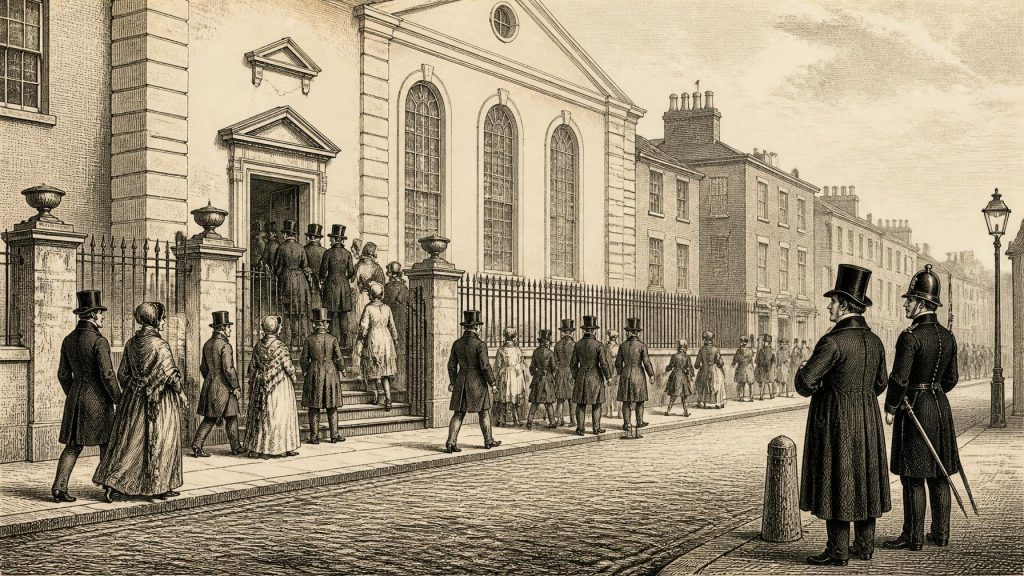
Capel Street Under Watch
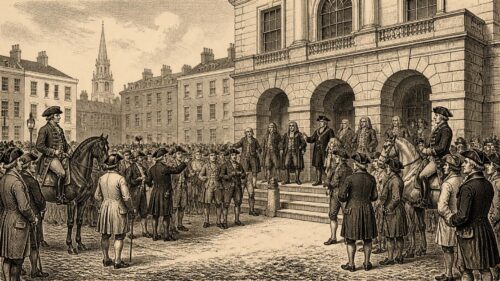
The controversy became visible in Dublin. At a meeting held at 4 Capel Street on 26 February, the General Committee protested that it had been appointed to prepare and procure petitions for the removal of Catholic disabilities. It published its correspondence with government and pledged continued constitutional effort. The wording was deliberate. Catholic leaders needed to assert their right to combine while avoiding the accusation that they were an elected national convention.
Daniel O’Connell, then a young barrister rather than the later mass leader of the 1820s, was already important to this legal and political strategy. He favoured a nationwide organisation able to demonstrate that Catholic claims were not merely the request of a few Dublin gentlemen. Yet 1811 also showed the constraints under which such a movement worked. Lawyers could argue over forms of requisition, the exact language of resolutions and the limited objects of a meeting; Dublin Castle could use a coercive reading of an existing law to halt the experiment. Public politics in Ireland had to be assembled cautiously, through signatures, petitions, notices and carefully chosen terms.
The circular quickly became a British parliamentary issue. The House of Lords debated it on 22 February and again in April; the Commons examined it at length on 7 March. Critics questioned whether Wellesley-Pole had exceeded the statute and whether he had acted without proper prior authority from ministers in London. His conduct caused real embarrassment: later accounts confirm that the cabinet had not authorised the initial move. But the wider administration did not abandon its underlying position that a delegated Catholic body could be restrained under the Convention Act. The episode exposed both divisions within British political society and the limited autonomy of the Dublin executive after the Union.
The Petition Reaches Westminster
Suppression of the representative scheme did not end the emancipation campaign. On 20 May Henry Grattan presented a petition from Irish Catholics to the House of Commons. Its language joined grievance to loyalty. The petitioners recalled past legal persecution, stressed their contributions to British military power and revenue, and asked parliament to restore them to full participation in the constitution. They did not receive the relief they sought. A further Commons debate on 31 May ranged over Catholic doctrine, loyalty, military service and the possible consequences of removing the remaining restrictions, but produced no emancipation measure.
This failure is essential to understanding the year. The petition was a firmly dated event; it was not a victory. Nor did the controversy mean that all Irish Catholics shared a single political voice. The campaign brought together Catholic peers, gentry, clergy, lawyers, merchants and county activists with different views on tactics and on safeguards proposed by Protestant supporters. Yet it demonstrated a developing political infrastructure. County opinion could be solicited, delegates or managers proposed, a Dublin committee could draft a national petition, and parliamentary allies could carry it to London. Government intervention made those methods more conspicuous, not less.
By the end of 1811, the representative committee had been checked, but Catholic organisation did not disappear. Meetings and the search for legally safer structures continued, and a non-representative Catholic Board emerged at the year’s close. It would be misleading to treat this as the creation of the later Catholic Association, which belonged to 1823. Still, the crisis of 1811 was an important rehearsal: it clarified the legal obstacles to mass constitutional politics and helped establish O’Connell’s lasting insistence that popular mobilisation must be both national and defensibly lawful.
Schooling the Poor
Another Dublin initiative of 1811 addressed a quieter but equally fundamental question: who would educate poor children, and on what religious terms? During the year, philanthropists founded the Society for Promoting the Education of the Poor in Ireland, soon widely called the Kildare Place Society. Its declared ambition was to encourage schooling without interfering with the particular religious opinions of Christian pupils. At its foundation this was an experiment in voluntary association, not yet a national state school system.
The society’s later prominence should not be projected too far back into its first year. Its network, teacher training, textbooks and government support were developments of subsequent decades. But the foundation itself was significant. It arose from a growing conviction among reformers that literacy, orderly instruction and trained teachers might improve the prospects of the poor and lessen social division. It also carried a problem that would become more acute: even an arrangement described as non-denominational could be distrusted if Bible reading, control of texts or local management seemed to favour one confession. In 1811, education already lay at the meeting point of charity, social discipline and religious power.
Print, Stage and Empire
Irish cultural life in 1811 was not confined to the constitutional dispute. Sydney Owenson, known later as Lady Morgan, published The Missionary: An Indian Tale. Set in India and issued in three volumes, the novel carried an Irish writer’s work into the wider imperial world. Its appearance is a reminder that Dublin and Irish readers participated in British publishing networks while Irish authors could use distant settings to explore religion, authority and cultural encounter.
In Belfast, James Sheridan Knowles’s Brian Boroihme; or, The Maid of Erin was associated with the theatre in 1811 and proved popular. Its invocation of Brian Boru turned medieval Irish memory into contemporary entertainment. Such a work should not be mistaken for a programme of modern nationalism, but its success shows that Irish historical subjects could draw urban audiences in a town whose commercial and intellectual connections reached across the Irish Sea and beyond.
War at Lough Swilly
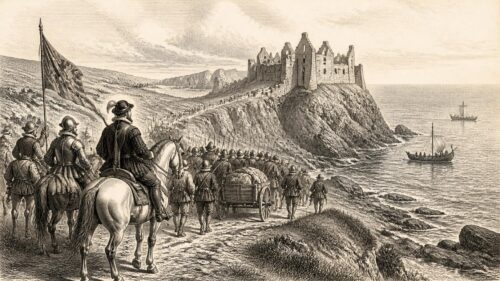
The Napoleonic War also entered the Irish year with terrible directness. On 4 December the Royal Navy frigate HMS Saldanha was wrecked in a gale at Lough Swilly, County Donegal, with the loss of all aboard. The loss was recorded in naval lists and quickly entered local memory around Rathmullan and the Swilly shore. Later recollections vary in their details and numbers, so the safest conclusion is the stark contemporary one: the wreck was a major maritime disaster and there were no survivors.
Lough Swilly’s deep waters and position on the north-western approaches made it part of the wartime maritime landscape. The Saldanha disaster did not alter the course of the war, but it made the sea’s dangers immediate for coastal communities. A single winter gale could bring wreckage, bodies, news and mourning ashore. It also underlined Ireland’s place in a state at war: troops, grain, naval patrols, taxation and political argument all connected local Irish life to conflicts far beyond the island.
Thus 1811 was not a year of constitutional transformation, but it was a year in which institutions and methods took clearer shape. Wellesley-Pole’s circular revealed the state’s fear of organised Catholic representation; the petition campaign revealed the persistence and adaptability of the emancipation cause. The Kildare Place Society opened a new chapter in the contested provision of popular education. Books, theatre and a Donegal shipwreck connected Irish experience to empire, memory and war. At Capel Street, above all, Ireland’s future political question was rehearsed in a contest over who had the right to speak for the country.
Primary Sources
- The Office of the Chief Secretary of Ireland: Chronology
- The Regency Bill as Passed, 5 February 1811
- Catholics of Ireland—Mr Wellesley Pole’s Circular Letter, 22 February 1811
- Catholics of Ireland, 7 March 1811
- Catholics of Ireland—Mr Wellesley Pole’s Circular Letter, 4 April 1811
- Commons Chamber, 20 May 1811: Catholic Petition Presented
- Roman Catholic Petitions, 31 May 1811
- Pole, William Wellesley-
- Public Meetings, Respectable Requisitions, and Popular Politics in Great Britain and Ireland, c.1769–1850
- Wellesley’s Ireland and the Catholic Question, 1807–1827
- Society for Promoting the Education of the Poor of Ireland: Statement
- Historical Commentaries for 1818: Education of the Poor of Ireland
- Inspecting a Doomed Non-Denominational School System: The Inspectorate of the Kildare Place Society in Ireland, 1811–1831
- The Missionary: An Indian Tale. By Miss Owenson
- Dictionary of National Biography: Knowles, James Sheridan
- Royal Navy Loss List
- Annual Reports and Proceedings of the Belfast Naturalists’ Field Club
- Sea Disaster, St Garvan’s, Rathmullan, The Schools’ Collection
- History of the Commercial and Financial Relations between England and Ireland from the Period of the Restoration
- Declaration of the Roman Catholics of Ireland, Adopted at a Meeting of the Catholic Board
- Official Papers of George IV as Regent and King
- The Proceedings of the General Committee of the Catholics of Ireland, Compared with the Proceedings of the Catholic Committee in 1810 and 1811